



Quick answer: Online notarization requires a current, unexpired, government-issued photo ID that passes credential analysis, typically a U.S. driver’s license, state ID, passport, military ID, or foreign passport. The ID must show your name, photo, signature, and expiration date. Expired IDs, photocopies, and digital-wallet IDs are not accepted.
What ID do you need for online notarization?
For online notarization you need a current, unexpired, government-issued photo ID, and it has to pass an automated authenticity check. Most states require the ID to show four things: your full name, a photograph, your signature, and an expiration date.
One rule trips people up: it must be a physical card. A photo of your ID, a photocopy, a scan saved on your phone, or a digital wallet ID won’t work, because the verification software needs to read the card’s real security features. You’ll hold the actual card up to the camera (and usually photograph it) so the system can analyze it.
This is stricter than a quick in-person glance because the notary isn’t in the room, the technology has to do the verifying. For the full picture of a session, see how remote online notarization works.
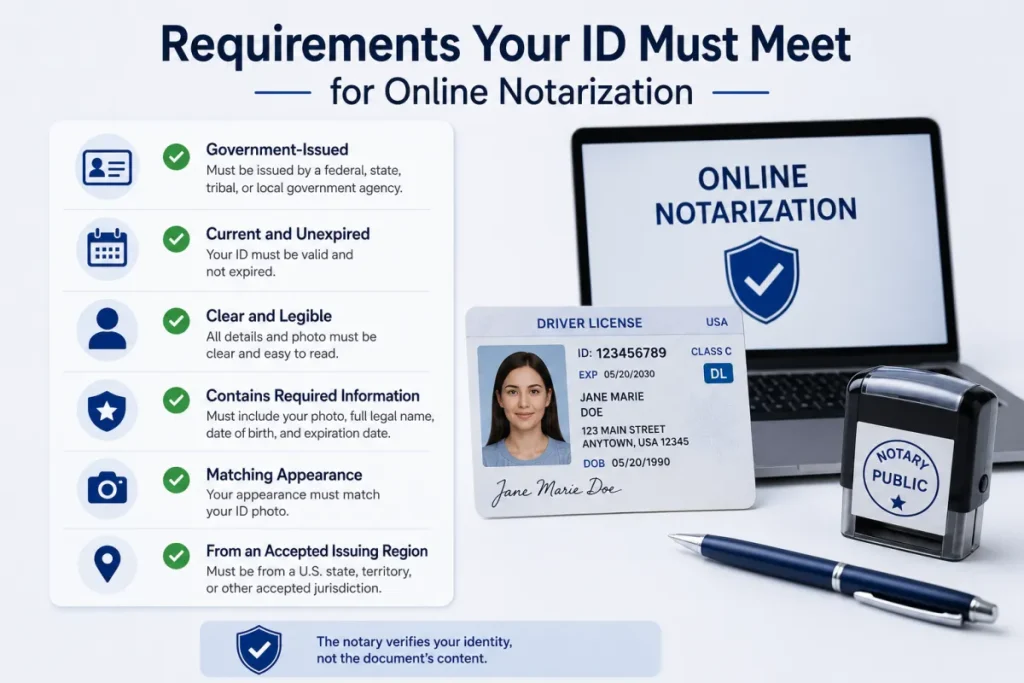
Accepted forms of ID for online notarization
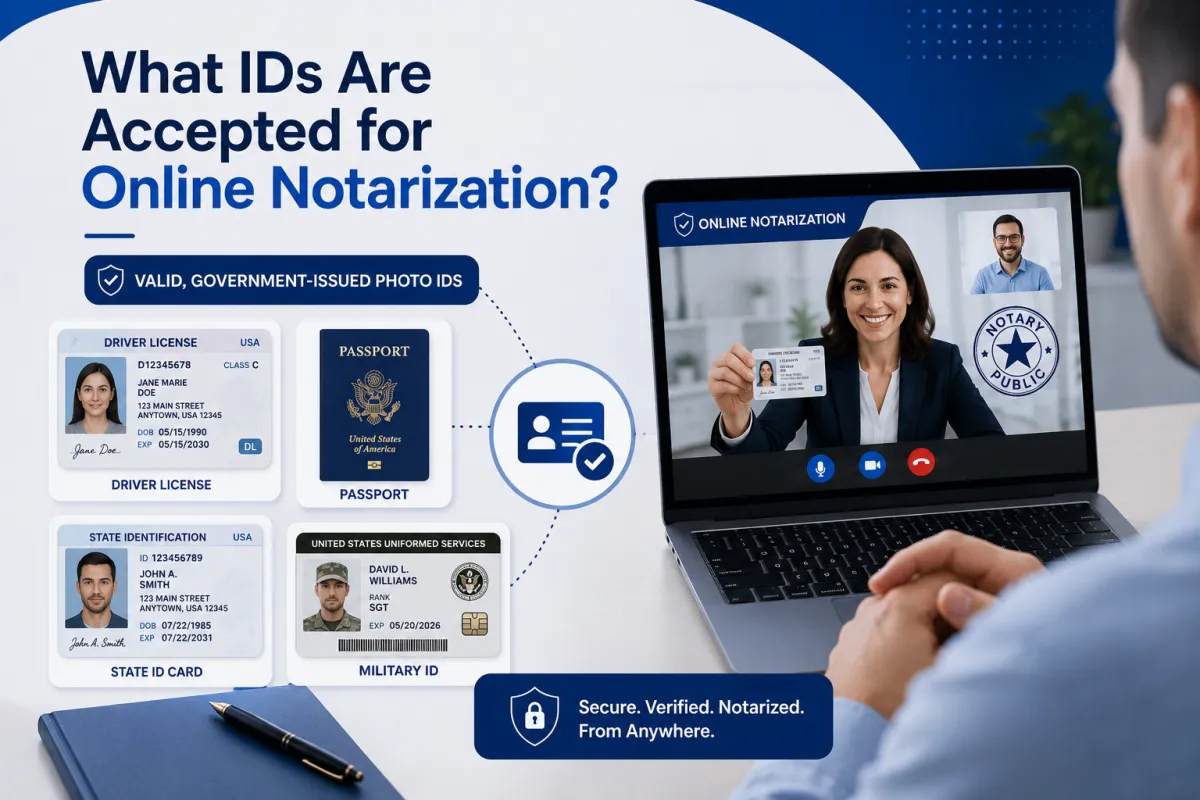
These government-issued photo IDs are the “gold standard” and are accepted in most states, as long as they’re current and unexpired:
- U.S. driver’s license
- U.S. state-issued ID card
- U.S. passport or passport card
- U.S. military ID
- Foreign passport (some states want a U.S. visa or immigration stamp)
- Permanent resident card (green card)
The common thread: each is issued by a government, carries a photo and signature, and has security features the system can validate. For the broader list of everything you bring to a session, the what-do-you-need-to-notarize checklist is the companion guide.
IDs that are NOT accepted
Plenty of “official-looking” documents don’t qualify. These are not acceptable for online notarization:
| ❌ Not accepted | Why |
|---|---|
| Expired IDs | A notary can’t accept an ID past its expiration — even by a day (unless a state explicitly allows a grace period) |
| Photocopies, scans, or photos of an ID | The card’s real security features can’t be verified |
| Digital-wallet / mobile IDs | Most RON platforms require a physical card |
| Social Security card | No photo |
| Birth or marriage certificate | No photo; it’s a record, not an ID |
| Credit, library, or school ID | Not government-issued photo ID |
| Temporary/paper driver’s license | Lacks the needed security features |
If your only ID is expired, renew it before booking, it’s the single most common reason a session fails.
How online notarization verifies your ID
This is where online notarization is actually more rigorous than a quick in-person check. Identity is confirmed in layers:
- Credential analysis. You photograph your ID, and software scans its security features, holograms, and microprint to confirm it’s genuine and unaltered. Only IDs that pass can be used.
- Knowledge-based authentication (KBA). You answer about five personal questions drawn from public records (past addresses, vehicles, etc.) within a time limit. You must pass to continue.
- Biometric / facial match. Many platforms compare a live selfie to your ID photo to confirm the person on camera matches the card.
Together these create a recorded, tamper-evident identity trail, often stronger evidence than a paper notary journal. The National Notary Association’s guidance on acceptable IDs explains the underlying standards, and your state’s notary rules set the exact requirements.
No SSN or a foreign signer? Here’s what happens
KBA pulls from U.S. public records, so signers without a Social Security number, or many foreign signers, can’t always answer the questions. That doesn’t necessarily lock you out:
- Some platforms offer biometric verification (ID + facial match) for U.S.-based matters even without an SSN, in place of KBA.
- A valid foreign passport can satisfy credential analysis where the state allows it.
- A few states permit a credible identifying witness who personally knows you and can vouch for your identity.
Because these alternatives are state- and platform-specific, confirm availability before your session, especially for international signers handling U.S. documents.
Common ID problems (and how to avoid them)
- Expired ID → renew it first; expired won’t pass.
- Name mismatch → the name on your ID should reasonably match the document; large discrepancies need an explanation or a name-affidavit.
- Glare or blurry scan → use good lighting and a steady hand so credential analysis can read the card.
- Failed KBA → ask whether the platform offers a biometric path, especially if you’ve recently moved or have a thin credit file.
- Digital ID only → get the physical card; screenshots don’t work.
Conclusion
Online notarization comes down to one thing on your end, a current, unexpired, government-issued photo ID with your name, photo, signature, and expiration date, a driver’s license, state ID, passport, military ID, or foreign passport. Skip the expired card, the photocopy, and the phone-wallet version, they won’t pass the credential-analysis and KBA checks that make online notarization secure. If you don’t have an SSN or you’re signing from abroad, ask about biometric verification before you book, since it can replace KBA for U.S. matters.
Have a valid ID ready? Start your session and connect with a commissioned online notary on BlueNotary in about 15 minutes, 24/7, ID check included. Want the full pre-session list? Run through what you need to notarize first so nothing slows you down.
Frequently asked questions
What ID do you need for online notarization?
A current, unexpired, government-issued photo ID showing your name, photo, signature, and expiration date, such as a driver’s license, state ID, passport, military ID, or foreign passport.
Can you use a passport for online notarization?
Yes. A valid U.S. passport or passport card is widely accepted, and a foreign passport is accepted in many states, sometimes with a U.S. visa or immigration stamp.
Is an expired ID accepted for notarization?
Generally no. A notary cannot accept an expired ID, even by one day, unless the state explicitly allows a limited grace period. Renew it before your session.
Can you get a document notarized online without an SSN?
Sometimes. KBA relies on U.S. records, but some platforms offer biometric verification for U.S.-based matters without an SSN. Availability depends on your state and platform.
Does a digital ID or a photo of my ID work for online notarization?
No. Most platforms require a physical card so the software can verify real security features. Photocopies, scans, and digital-wallet IDs aren’t accepted.
What are credential analysis and KBA?
Credential analysis scans your ID’s security features to confirm it’s genuine. KBA asks about five personal questions from public records to confirm you are who you claim to be.