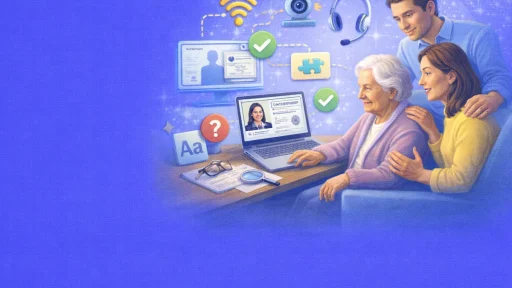



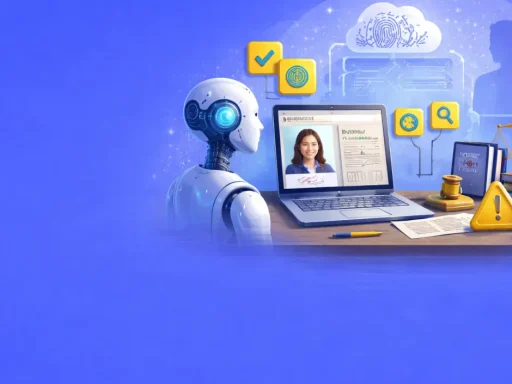
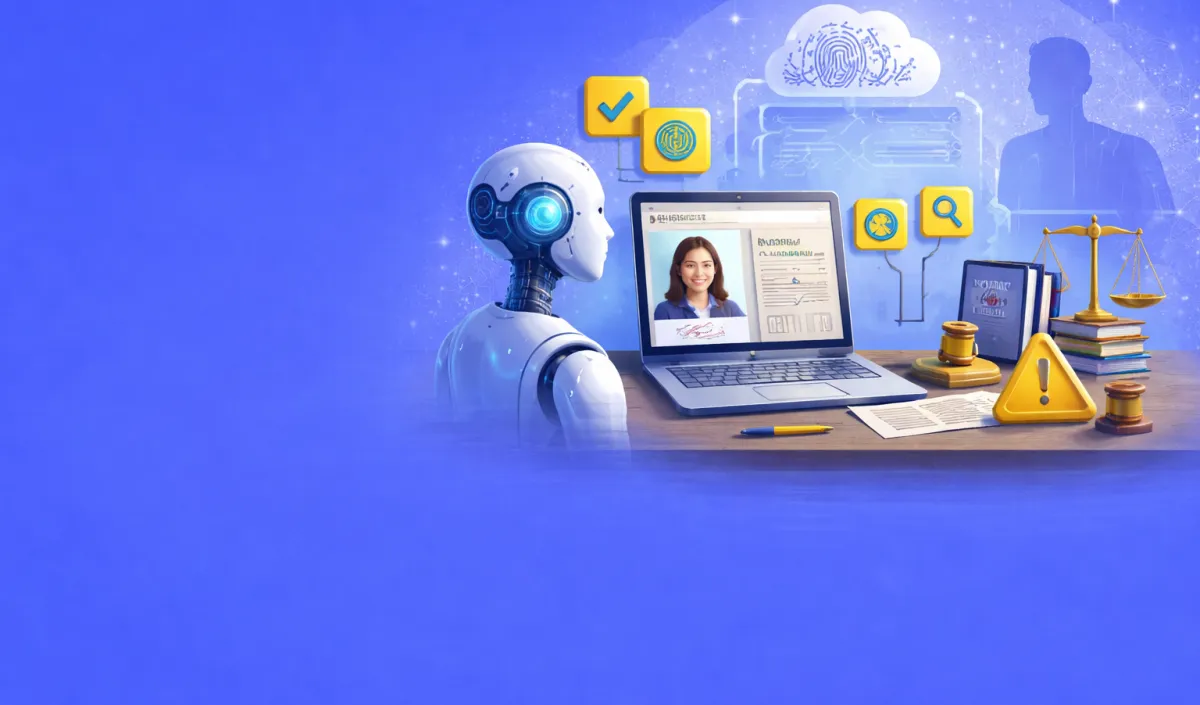

A notary opens a remote online notarization session. Before the signer even says hello, the platform has already scanned the uploaded ID, compared the photo against the live video feed, run a liveness check to confirm a real person is present, and flagged a subtle inconsistency in the document’s formatting. The notary gets a green light on identity verification and a yellow flag on the document — all within seconds.
That is AI at work in notarization today. Not replacing the notary. Not making legal decisions. Just running checks faster and more consistently than any human could on their own.
Artificial intelligence now touches nearly every step of the remote online notarization process. It powers identity verification, catches document errors, spots potential fraud, and helps platforms stay compliant across dozens of state jurisdictions. More than 45 states have enacted RON laws, and as transaction volumes climb, AI helps platforms handle scale without sacrificing security.
But AI in notarization also carries real limits and real risks and cannot assess whether a signer acts under duress. It cannot tell if someone truly understands a power of attorney. It cannot replace the legal authority of a commissioned notary public. And when AI tools handle sensitive personal data, privacy and ethical questions follow close behind.
This guide takes a balanced look at where AI genuinely helps in notarization, where it falls short, why human notaries remain essential, and what ethical lines the industry needs to watch.
Where AI Adds Real Value Today
AI is not a future promise for notarization platforms. It already operates in production across several key areas. Understanding what AI does well helps separate genuine capability from marketing hype.
Identity Verification and Credential Analysis
Identity verification is the single biggest area where AI impacts notarization right now. When a signer uploads a government-issued ID during a RON session, AI-powered systems analyze the document in multiple ways.
Optical Character Recognition (OCR) reads the text on the ID and extracts data like the name, address, date of birth, and expiration date. Image analysis checks the document’s visual features — holograms, microprinting, color patterns, and layout — against known templates for that document type. The system compares the photo on the ID to the live video feed of the signer using facial recognition algorithms.
This all happens in seconds. A human reviewer doing the same checks manually would take significantly longer and miss subtle details that pattern-matching algorithms catch reliably.
On top of document analysis, many RON platforms run knowledge-based authentication (KBA). The system pulls questions from public and private databases — credit history, address history, transaction records — and asks the signer to answer them in real time. AI helps generate and evaluate these questions dynamically, making each session unique.
Liveness Detection Against Deepfakes
Deepfakes now rank among the top five fraud types globally, according to the Sumsub 2025 Identity Fraud Report. Veriff’s 2025 report found that deepfake attacks drive 1 in every 20 identity verification failures. For RON platforms, this means a criminal could potentially use a deepfake video to impersonate a signer during a live session.
AI-powered liveness detection fights this threat. These systems analyze the video feed for signs that a real, physically present person is on the other end. They look for natural eye movement, skin texture, light reflection, micro-expressions, and response to prompts like head turns. Advanced systems also check for artifacts that deepfake generators leave behind — subtle inconsistencies in facial edges, unnatural blending around the hairline, or compression patterns that differ from a live camera feed.
No liveness system catches every attack. Deepfake technology keeps advancing. But AI-based liveness detection raises the bar significantly compared to a simple visual check by a human alone.
Document Classification and Error Detection
Before a notarization session begins, someone needs to confirm that the right documents are present and properly prepared. AI handles much of this pre-session work on modern platforms.
Document classification algorithms identify what type of document the signer uploaded — a deed of trust, power of attorney, affidavit, or something else. The system reads the document structure, key terms, and formatting to categorize it automatically.
Error detection takes this further. AI scans for missing signatures, unsigned pages, incomplete fields, outdated forms, and formatting inconsistencies. If a 30-page loan package has an unsigned page on page 22, the system flags it before the session starts rather than letting the notary discover it mid-signing.
This kind of pre-screening saves time for everyone. The notary starts the session with a clean document set. The signer does not have to reschedule because of a preventable error. The business gets a complete, compliant package on the first pass.
Compliance Monitoring Across Jurisdictions
RON laws vary from state to state. Commission requirements, acceptable ID types, journal-keeping rules, certificate wording, and recording retention periods all differ. For platforms operating nationwide, tracking compliance across 45+ jurisdictions creates a massive operational challenge.
AI assists by monitoring transaction data against state-specific rule sets. The system can flag when a notarial certificate uses wording that does not match a particular state’s requirements, when an ID type might not meet that state’s standards, or when a session recording falls short of mandated retention periods.
This monitoring does not replace legal counsel or human compliance officers. But it catches rule mismatches at volume in ways that manual review cannot scale to match.
Fraud Pattern Detection
Beyond individual identity checks, AI analyzes patterns across transactions to spot fraud that no single session review would reveal. If the same device, IP address, or behavioral pattern appears across multiple sessions tied to different identities, the system flags it. If a signer’s typing speed, mouse movement, or interaction patterns differ sharply from their profile, that triggers a review.
This kind of behavioral analytics works best at scale. The more data the system processes, the better it gets at distinguishing normal variation from genuinely suspicious activity. For high-volume platforms processing thousands of notarizations per day, this layer of fraud detection adds security that manual oversight alone cannot provide.
Where AI Falls Short
For all its capabilities, AI hits hard limits in notarization. These limits are not temporary gaps that better algorithms will close. They reflect fundamental qualities of the notarial act that require human judgment, legal authority, and interpersonal assessment.
Assessing Willingness and Voluntariness
Every notarization requires the notary to confirm that the signer acts voluntarily. Nobody should sign a document under threat, coercion, or undue pressure. Detecting these situations requires reading body language, tone of voice, facial expressions, hesitation patterns, and the overall context of the interaction.
AI cannot do this reliably. As the California League of Independent Notaries (CLIN) states in its special report on AI ethics, determining a signer’s willingness and understanding “is no substitute for human intuition and observation. An algorithm cannot truly gauge if a signer seems confused, afraid, or under duress — only a human notary can.”
A signer might glance nervously at someone off-camera. They might pause too long before answering a question. Their voice might waver when confirming they understand a document. These signals carry meaning that a trained notary picks up instinctively. No current AI system reads these cues with the reliability needed for a legal proceeding.
Confirming Understanding and Awareness
A notary must also satisfy themselves that the signer understands what they are signing. This goes beyond checking that a person can read. It means assessing whether the signer grasps the implications of a power of attorney, the terms of a deed of trust, or the consequences of an affidavit.
AI can verify that a document contains the right language. It cannot verify that the human being in front of the camera truly comprehends that language and its real-world impact. Contextual understanding, common sense, and the ability to gauge mental clarity remain beyond current AI capabilities — and this limitation matters enormously for sensitive documents like wills, healthcare directives, and financial instruments.
Exercising Legal Authority
A notary public holds a state-issued commission. That commission grants them specific legal authority to administer oaths, take acknowledgments, and certify documents. This authority carries legal weight in courts and government filings because a real, identifiable, accountable human being exercised it.
AI holds no legal authority. No state has granted a software system the power to perform a notarial act. No court accepts an AI-generated notarial certificate as legally binding. The notary’s commission, their personal liability, and their professional accountability form the legal backbone of notarization. AI can support the process, but it cannot serve as the notary.
Handling Edge Cases and Ambiguity
Notarizations sometimes involve unusual circumstances. A signer might present a valid foreign passport that the platform’s AI has never seen before. An elderly signer might need extra time and patience. A document might contain unusual language that does not fit standard templates.
AI systems struggle with edge cases. They perform best on well-defined, repeatable patterns. When something falls outside the training data, the system either rejects it (causing unnecessary delays) or misclassifies it (creating risk). A human notary can apply judgment, ask questions, consult references, and make a reasoned decision. That flexibility remains a uniquely human strength.
Why Human Notaries Remain Essential
The conversation about AI in notarization sometimes drifts toward a replacement narrative — the idea that technology will eventually make human notaries unnecessary. The evidence points firmly in the opposite direction. As AI gets more sophisticated, the human notary becomes more important, not less.
The Three Assurances Only Humans Provide
The National Notary Association and industry experts consistently point to three assurances that only a human notary can provide with legal weight.
First, identity verification goes beyond scanning an ID. It involves comparing the person to their credentials and assessing inconsistencies that machines might miss. A notary can notice that the person on camera looks 20 years older than the photo on the ID, or that the signature style does not match, or that the signer cannot answer basic questions about the information on their own identification.
Second, willingness assessment confirms the signer acts voluntarily. As covered above, this requires human empathy and observation skills that AI cannot replicate.
Third, awareness confirmation verifies the signer truly understands what they are signing and its implications. This subjective assessment remains beyond current AI capabilities, especially in contested legal situations.
Accountability and Trust
People trust notarization because a real person stakes their reputation and legal standing on every act. If a notary commits misconduct, they face commission revocation, fines, civil liability, and potentially criminal charges. This accountability structure gives notarized documents their legal weight.
AI systems face no such consequences. If an algorithm makes a wrong call, nobody goes to court. Nobody loses a professional license. The accountability gap is not just a philosophical problem — it is a practical one. Courts and regulators rely on the ability to hold a specific person responsible for a notarial act. Without that, the entire system of trust weakens.
The Layered Trust Model
The strongest approach to notarization security combines technology and human judgment in layers. Each layer covers vulnerabilities the other misses.
AI handles pattern recognition, data comparison, and speed. It catches machine-readable fraud signals that humans might overlook in a fast-paced session. The human notary handles judgment, context, and legal authority. They catch interpersonal signals that machines cannot read, exercise discretion in ambiguous situations, and provide the legal accountability that makes the notarization enforceable.
Remove either layer and gaps appear. A notary without AI support might miss a sophisticated fake ID. An AI system without a notary cannot assess willingness, exercise legal authority, or adapt to unusual circumstances. The combination is stronger than either alone.
Ethical Considerations for AI in Notarization
AI brings genuine benefits to notarization, but it also introduces ethical questions that the industry cannot afford to ignore. Getting these right protects signers, notaries, and the integrity of the process.
Data Privacy and Confidentiality
Notaries handle deeply sensitive information. Government IDs, Social Security numbers, financial records, health directives, and property documents all pass through the notarization process. When AI systems process this data — especially cloud-based services — questions about storage, access, and data retention become critical.
Many AI services process data on remote servers. Some learn from the data they receive, potentially incorporating sensitive information into training models. CLIN’s AI ethics guidance warns notaries to be cautious about uploading client documents to AI platforms for processing, summarizing, or analysis.
RON platforms must demonstrate clear data handling policies. Signers deserve to know where their data goes, who can access it, and how long it stays in the system. Encryption, access controls, and compliance with data protection standards are minimum requirements, not optional extras.
Algorithmic Bias and Fairness
AI systems learn from data. If that data contains biases — and most real-world data does — the AI can reproduce those biases in its decisions. In identity verification, this can mean higher false rejection rates for certain demographic groups, people with darker skin tones, older individuals, or people whose IDs come from less common jurisdictions.
A false rejection in notarization is not just an inconvenience. It can delay a real estate closing, prevent someone from executing a power of attorney for a sick family member, or block access to legal services. The stakes are too high for biased systems to go unchecked.
Platforms should audit their AI tools regularly for fairness across demographics. They should track rejection rates by group and investigate disparities. And they should always provide a human escalation path so that a person unfairly flagged by an algorithm can still complete their notarization.
Overreliance and Complacency
One of the most practical ethical risks is complacency. When an AI system gives a “pass” result on identity verification, a notary might unconsciously lower their guard. They might skip their own visual inspection of the ID. They might not ask the follow-up questions they would normally ask.
CLIN’s guidance draws a parallel to ABA Model Rule 1.1 on competence, which requires lawyers to understand the technology they use. The same principle applies to notaries. Understanding how the AI works — and where it can fail — prevents the false sense of security that leads to mistakes.
AI should raise the floor of security, not lower the ceiling of human diligence. The notary who treats an AI verification result as one input among many, rather than a final answer, provides the strongest protection for signers and businesses.
Transparency and Explainability
When AI flags a document as suspicious or rejects an ID, the notary should understand why. Black-box systems that provide a yes/no result without explanation create problems. The notary cannot make an informed decision without knowing what the system detected. The signer cannot understand why they were flagged. And if the decision is challenged later, nobody can explain what happened.
Platforms that use AI in notarization should strive for explainability. Show the notary what the system found. Let the notary make the final call based on all available information. Document the AI’s role in the process so that the audit trail reflects both the automated checks and the human judgment applied.
What the Regulatory Landscape Looks Like
No state has passed laws specifically governing AI in notarization. However, the regulatory environment is tightening around AI in identity verification and fraud prevention more broadly, and those rules affect notarization platforms directly.
FTC Action on AI Impersonation
The Federal Trade Commission has taken notice of AI-driven impersonation. The FTC proposed rules to ban the use of AI for deceptive impersonation of people in images, video, or text. While these rules target fraud broadly, they carry direct implications for any platform where AI-generated deepfakes could be used to fool identity verification during a notarization session.
State-Level Notary Requirements
Several states have updated their notary laws in 2025 to address technology and fraud concerns. Florida now mandates that county recorders receive training on authenticating documents notarized online. California, Florida, Nevada, and Washington require notaries to report missing stamps quickly. Kansas proposed legislation requiring biometric identity confirmation for real estate notarizations, though the bill did not advance to a vote.
These laws reflect a growing awareness that technology changes the threat landscape. As more states update their RON laws, specific requirements around AI-assisted verification may follow.
Industry Standards and Best Practices
MISMO (Mortgage Industry Standards Maintenance Organization) certifies RON platforms against a set of standards for remote online notarization. The National Association of Secretaries of State (NASS) maintains standards for electronic notarization that include requirements for identity verification and tamper-evident technology.
While neither organization has published AI-specific standards yet, their existing frameworks create a foundation. Platforms that use AI for identity verification, document processing, or fraud detection should ensure their AI tools meet or exceed the security, accuracy, and audit requirements already in place.
What No Other Guide Covers: The Trust Inversion Problem
Most discussions about AI in notarization focus on how AI helps notaries do their job better. Very few address a subtler problem: what happens when AI creates a false sense of security that actually makes the system less safe.
How the Inversion Works
Every layer of technology added to a process carries an implicit promise: this makes things more secure. When a RON platform adds AI-powered identity verification, businesses and signers naturally assume the process is now harder to fool. In most cases, they are right.
But the assumption of security can itself become a vulnerability. A title company that trusts the platform’s AI verification might skip its own independent checks. A signer who knows the platform uses facial recognition might assume a forged document would never get through. A notary who sees a green checkmark from the AI might relax their own scrutiny.
The result is a trust inversion. The technology that was supposed to add a security layer instead replaces existing layers. Net security does not improve — it just shifts from distributed human vigilance to centralized algorithmic checking. And if the algorithm has a blind spot, nobody is watching for it.
How to Prevent It
The fix is cultural, not technical. Organizations that use AI-enhanced notarization platforms should treat AI verification as additive, never substitutive. Train notaries to perform their own ID checks regardless of what the AI reports. Train staff to run independent verification steps even when the platform shows all green. Build workflows where the AI result is one input among several, not the final word.
The platforms that get this right will be the ones that present AI results as information for the notary to consider, not decisions for the notary to accept. The distinction sounds small. In practice, it determines whether AI makes the system genuinely stronger or just creates a different kind of weakness.
Frequently Asked Questions
Can AI perform a notarization on its own?
No. Every U.S. state requires a commissioned notary public — a real person — to perform notarial acts. AI holds no legal authority and cannot administer oaths, take acknowledgments, or certify documents. No state has proposed legislation to change this. AI assists the notary but cannot replace them.
How does AI help detect fake IDs during remote notarization?
AI systems analyze the uploaded ID for visual features like holograms, microprinting, and layout patterns. They compare the ID photo against the live video feed using facial recognition. Liveness detection checks confirm a real person is present. These layers catch many fakes, but advanced AI-generated documents can still slip through, which is why human review remains essential.
What are the biggest ethical risks of AI in notarization?
The top concerns include data privacy (sensitive documents processed by cloud-based AI), algorithmic bias (unfair rejection rates for certain demographics), overreliance (notaries trusting AI results without independent verification), and transparency (black-box systems that do not explain their decisions). Each of these can undermine the integrity of the notarization process if left unaddressed.
Will AI replace human notaries in the future?
Experts across the industry say no. AI cannot assess willingness, detect duress, confirm understanding, or exercise legal authority. These human judgments sit at the core of what makes notarization legally meaningful. The likely future involves AI handling more of the technical and administrative work while human notaries focus on judgment, accountability, and the legal act itself.
How does AI handle compliance across different state RON laws?
AI systems monitor transactions against state-specific rule sets. They flag mismatches in certificate wording, ID requirements, recording retention periods, and other jurisdiction-specific rules. This helps platforms maintain compliance at scale, but human compliance officers still review edge cases and make final determinations.
What happens if the AI verification system makes a mistake?
If an AI system incorrectly approves a fraudulent ID or wrongly rejects a legitimate signer, the consequences fall on the parties involved in the transaction — not on the AI system. This accountability gap is one reason human notaries remain essential. The notary bears personal and legal responsibility for the notarization, regardless of what the AI reported.
How should notaries approach AI tools in their practice?
CLIN recommends treating AI as a supplemental aide, not a substitute. Notaries should educate themselves on how the AI tools on their platform work, understand their limitations, perform their own identity checks regardless of AI results, and always exercise independent judgment. If something feels wrong, the notary has the authority and duty to pause or refuse the notarization.
Are there specific AI regulations for notarization platforms?
No state has passed laws specifically governing AI use in notarization. However, the FTC has proposed rules banning AI-powered impersonation. Several states updated notary fraud prevention laws in 2025. And existing RON standards from MISMO and NASS create baseline requirements for identity verification and security that apply to AI-assisted processes.
Conclusion:
Artificial intelligence brings genuine, measurable value to notarization. It speeds up identity checks, catches document errors, detects fraud patterns, and helps platforms manage compliance across a patchwork of state laws. These capabilities make the notarization process faster and more secure for everyone involved.
But AI does not notarize documents. People do. The human notary provides the legal authority, the personal accountability, the willingness assessment, and the contextual judgment that no algorithm can deliver. Removing that human element would not modernize notarization — it would gut the trust that makes notarized documents legally meaningful.
The best path forward treats AI as a powerful tool in the hands of a skilled professional. It raises the floor of what every notarization session can catch. It frees the notary to focus on the judgments that matter most. And it leaves the final decision — the one that carries legal weight — exactly where it belongs: with a real, accountable human being.
For a RON platform that combines AI-powered identity verification and document security with the judgment of commissioned notaries, BlueNotary provides remote online notarization tools built for both efficiency and trust.