



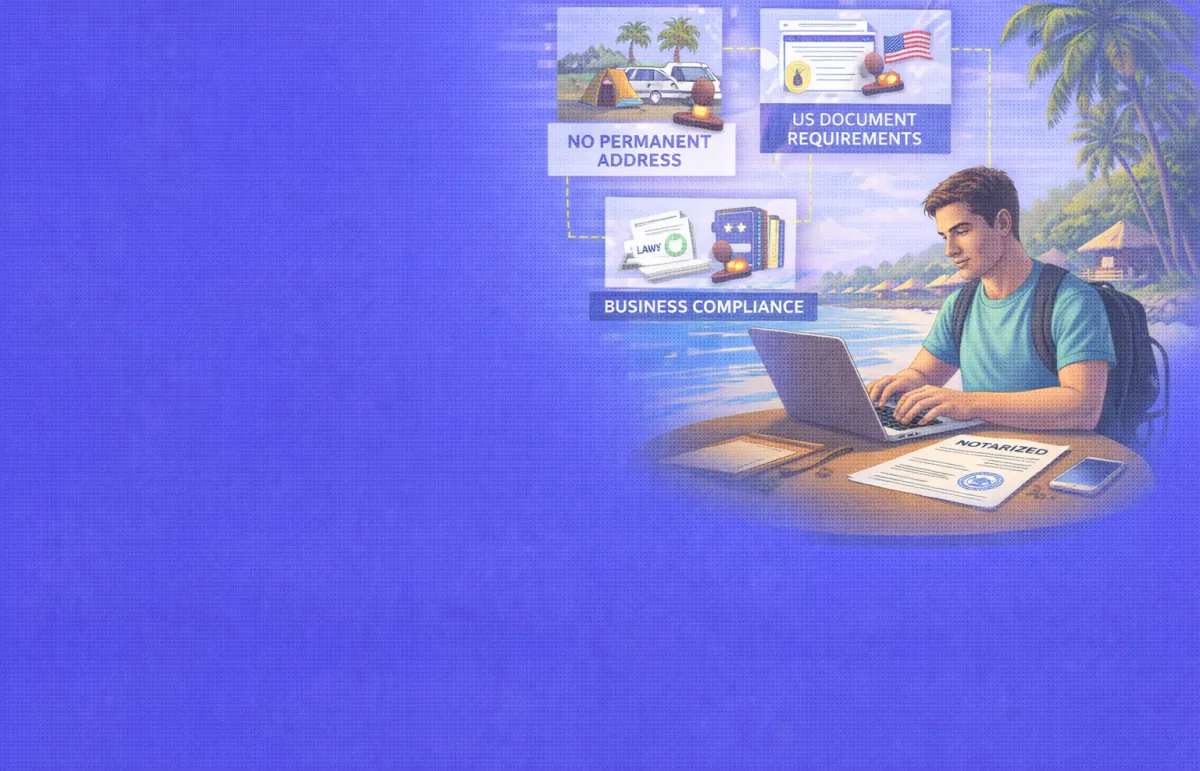

You close your laptop in a Lisbon coworking space and check your email. Your LLC’s annual report is due in Wyoming next week. Your bank needs a notarized affidavit to update your account. A new client contract requires a notarized operating agreement. And the IRS wants to know about the Portuguese bank account you opened last month.
Welcome to the paperwork side of location independence.
An estimated 18.5 million Americans now describe themselves as digital nomads, according to MBO Partners’ 2025 research. That number has grown 147% since 2019. More than 50 countries offer dedicated digital nomad visas. The infrastructure for working from anywhere has never been stronger.
But the compliance infrastructure has not caught up. Tax filings, business registrations, notarized documents, and bank verifications all assume you have a fixed address, a nearby notary, and easy access to a government office. When you are bouncing between Bali and Barcelona every few months, those assumptions break down fast.
This guide covers the document compliance challenges that digital nomads and remote workers actually face — and the practical systems for handling them without flying home every time a form needs a signature.
The Address Problem: Why It Matters More Than You Think
Every compliance obligation starts with the same question: where do you live? For digital nomads, that question has no simple answer. But the legal system needs one.
Why You Need a U.S. Domicile
Even if you spend 300 days a year outside the United States, you still need a legal domicile in a U.S. state. Your domicile determines where you vote, where you pay state taxes (if applicable), where your driver’s license is issued, and which state’s laws govern your personal legal matters.
Your domicile also anchors your identity in the U.S. public records system. This matters for notarization because remote online notarization (RON) platforms verify your identity partly through knowledge-based authentication (KBA). KBA questions pull from U.S. public records — credit history, address history, vehicle registrations. If you have no stable U.S. address tied to your name, the KBA system may not generate enough questions to verify you. The result: you cannot complete the notarization.
Choosing a Domicile State
Many digital nomads establish domicile in a state with no income tax to minimize their tax burden. Popular choices include Wyoming, Texas, Florida, South Dakota, and Nevada. Each offers different advantages beyond tax treatment.
Wyoming charges some of the lowest LLC formation and annual report fees in the country. Texas has a large network of virtual mailbox services that cater to nomads. Florida allows you to claim a homestead exemption even on a condo used part-time. South Dakota has long been a favorite of full-time RV travelers and offers straightforward domicile establishment.
Establishing domicile typically requires getting a driver’s license in the state, registering to vote, and using the state address on your federal tax return. Some states accept a virtual mailbox address for these purposes. Others require a physical street address. Research your chosen state’s specific requirements before committing.
Virtual Mailbox Services
A virtual mailbox gives you a real street address (not a P.O. box) where mail is received, scanned, and forwarded. Services like US Global Mail, Anytime Mailbox, iPostal1, and Traveling Mailbox provide this function. Some services, like SBI Mail Service and Texas Home Base, specifically cater to nomads and can serve as a legal domicile address.
Your virtual mailbox address becomes the address on your driver’s license, your LLC registration, your bank statements, and your tax returns. It creates the paper trail that anchors your identity in U.S. systems — and that paper trail is what makes RON identity verification possible when you are sitting in a café in Chiang Mai.
Notarization Options When You Have No Fixed Location
Digital nomads need documents notarized more often than most people realize. Business formation documents, operating agreements, affidavits, powers of attorney, bank authorizations, real estate transactions, and contract amendments all commonly require notarization. Here are your options from anywhere in the world.
Remote Online Notarization (RON)
RON is the primary tool for location-independent notarization. You connect with a U.S.-commissioned notary through a live video call, verify your identity through KBA and credential analysis, sign the document electronically, and receive the notarized document as a digital file.
The notarization must comply with the laws of the notary’s commissioning state — not the country where you happen to be sitting. More than 45 U.S. states now authorize RON, and documents notarized through RON are valid across the United States under the Full Faith and Credit Clause of the Constitution.
RON platforms typically operate 24/7, which solves the time zone problem. A nomad in Tokyo (14 hours ahead of Eastern Time) can schedule a 10 PM session that connects them with a notary at 8 AM Eastern. Costs typically run $25 to $50 per session.
What you need for a RON session from abroad: a stable internet connection with enough bandwidth for live video, a device with a camera and microphone, a quiet and well-lit space, and a valid U.S. government-issued photo ID (passport or driver’s license).
The KBA Challenge for Nomads
Knowledge-based authentication can trip up digital nomads in two ways. First, if you have thin U.S. credit history — common among younger nomads who have been abroad for years — the system may not generate enough questions. Second, if you have recently changed your U.S. address or let accounts lapse, the questions may reference outdated information you no longer remember.
Before you leave the country, test your ability to pass KBA on a RON platform. Some platforms offer a trial verification. If you cannot pass, you have a few options. Florida allows RON notaries to use biometric authentication (facial recognition) instead of KBA, provided the system meets state-approved standards. Some platforms offer credible witness verification, where two people who know you can vouch for your identity during the session. And you can always use a U.S. Embassy as a fallback.
U.S. Embassy and Consulate Notarization
Every U.S. Embassy and Consulate provides notarial services. A consular officer witnesses your signature and applies a consular seal — functionally identical to a U.S. notary public. The fee is $50 per seal. You must appear in person with the unsigned document and a valid government-issued ID.
Embassy notarization has drawbacks for nomads. Appointments often require booking weeks in advance. Hours are limited to weekday business hours. Many embassies in popular nomad destinations (Bangkok, Mexico City, Lisbon) have heavy demand. And you must travel to the embassy, which may not be in the city where you are currently based.
Use embassy notarization as a backup for documents that specifically require in-person notarization or when RON is not accepted by the document recipient.
Local Foreign Notaries
In some countries, you can use a local notary. But foreign notaries operate under different legal systems. A French notaire or German Notar performs a fundamentally different role than a U.S. notary public. Their seal may not carry the same legal meaning for U.S. documents.
If you use a local foreign notary for a document intended for U.S. use, you may need an apostille — a certification that authenticates the notarization for international use under the Hague Apostille Convention. This adds time and cost. For most nomad situations, RON is simpler and faster.
U.S. Tax Compliance From Abroad
Tax compliance is arguably the highest-stakes paperwork challenge for digital nomads. The United States taxes its citizens on worldwide income regardless of where they live. Moving abroad does not reduce your federal tax obligations — it often increases your reporting requirements.
Federal Income Tax
You must file a federal tax return every year, reporting all income earned worldwide. If you are self-employed (as many nomads are), you also owe self-employment tax on your net earnings.
Two provisions can reduce what you owe. The Foreign Earned Income Exclusion (FEIE) allows qualifying taxpayers to exclude a significant portion of their foreign earnings from U.S. income tax. To qualify, you must either be a bona fide resident of a foreign country for an entire tax year or be physically present in a foreign country for at least 330 full days during a 12-month period. The Foreign Tax Credit (FTC) lets you offset U.S. taxes with taxes you have already paid to a foreign government, preventing double taxation.
Both require careful documentation. Track your physical location every single day. Many nomads use apps or spreadsheets to log which country they were in on each date. This daily location log becomes critical if you need to prove the 330-day physical presence test.
FBAR: Foreign Bank Account Reporting
If you open bank accounts abroad — and most long-term nomads do — you may trigger the Foreign Bank Account Report (FBAR) requirement. The IRS requires you to file FinCEN Form 114 if the aggregate value of all your foreign financial accounts exceeds $10,000 at any point during the calendar year.
The $10,000 threshold is lower than most people expect. A checking account with €5,000 and a savings account with €4,500 at the same foreign bank puts you over the limit. The FBAR is due April 15, with an automatic extension to October 15. You file it electronically through FinCEN’s BSA E-Filing System — not with your tax return.
Penalties for non-compliance are severe. Non-willful violations can result in fines up to $16,536 per violation (2025 figure, adjusted annually for inflation). Willful violations carry penalties up to the greater of $165,353 or 50% of the account balance. Criminal penalties can reach $500,000 and 10 years imprisonment.
FATCA: Form 8938
The Foreign Account Tax Compliance Act (FATCA) adds another layer. If you live abroad and your specified foreign financial assets exceed $200,000 at the end of the year (or $300,000 at any point during the year) for single filers, you must file Form 8938 with your tax return. The thresholds double for joint filers.
FATCA and FBAR overlap but are not identical. They cover different asset types, have different thresholds, and go to different agencies. Many nomads must file both. Penalties for failing to file Form 8938 start at $10,000 and can increase substantially.
State Tax Obligations
Your domicile state may also impose tax obligations. If you chose a no-income-tax state (Wyoming, Texas, Florida, South Dakota, Nevada, Alaska, Washington), you generally avoid state income tax on your earnings. But if you maintained domicile in a state with income tax — or if a state considers you a statutory resident because you spent enough days there — you may owe state taxes as well.
Some states are aggressive about claiming former residents as taxpayers. California, New York, and Virginia are particularly known for pursuing residents who claim to have moved but maintain connections. Clean breaks matter. Cancel your lease, change your driver’s license, update your voter registration, and document the move.
Business Compliance for Nomad Entrepreneurs
More than a third of digital nomads are self-employed — freelancers, consultants, or business owners. If you operate a U.S. business entity while living abroad, the compliance calendar does not pause because you crossed a border.
LLC Annual Requirements
Every state that requires an annual report will require it whether you are in Omaha or Osaka. Miss the filing deadline, and your state can mark your business as non-compliant, impose late fees, or administratively dissolve your LLC. Administrative dissolution means your business entity ceases to legally exist. Contracts become problematic. Banks may freeze accounts. Reinstatement costs often exceed original filing fees.
Set calendar reminders for your state’s annual report deadline well in advance. Wyoming annual reports are due on the first day of your LLC’s anniversary month. Delaware requires an annual report by June 1. California’s Statement of Information is due within 90 days of formation and every two years after that. Each state has its own schedule.
Registered Agent Requirement
Every LLC must maintain a registered agent with a physical address in the state of formation. The registered agent receives legal notices, service of process, and compliance reminders on your behalf. If your agent resigns or you fail to maintain one, your state can begin dissolution proceedings.
For nomads, a commercial registered agent service is essential. You cannot serve as your own registered agent if you are not physically present in the state. Services typically cost $50 to $300 per year. Choose a provider that sends digital notifications and scans documents immediately — you need to receive legal notices in real time, not weeks later when a physical letter catches up to you.
EIN and Banking
Your Employer Identification Number (EIN) does not expire, but your banking relationship requires maintenance. If your bank detects that your mailing address is foreign or that you are logging in from international IP addresses, they may flag your account for review. Some banks restrict international access entirely.
Maintain your U.S. virtual mailbox address as your banking address. Use a VPN if your bank’s security system blocks foreign IP addresses (check your bank’s terms of service first — some prohibit VPN use). Consider online-first banks or fintech platforms that are designed for international use, like Mercury, Relay, or Wise. These services are more accustomed to serving clients who access accounts from various countries.
Notarized Business Documents
Several business operations may require notarized documents from abroad. Common situations include amending your operating agreement, executing a power of attorney for a business partner, certifying corporate resolutions, signing commercial leases or contracts, and completing bank authorization forms.
RON handles most of these situations. Keep digital copies of all your business formation documents — articles of organization, operating agreement, EIN confirmation letter — stored securely in the cloud. When a notarization need arises, you can upload the relevant document to a RON platform and complete the session within hours rather than days.
What No Other Guide Covers: The Compliance Cascade
Every digital nomad guide mentions taxes. Some mention notarization. None of them explain how these obligations interact to create cascading failures — and how a single missed step can unravel your entire compliance posture in a matter of weeks.
How the Cascade Works
It starts with something small. You forget to renew your registered agent. Your state sends a non-compliance notice to the registered agent’s old address. The notice bounces. You do not receive it. Sixty days later, the state administratively dissolves your LLC.
Now your business entity does not legally exist. Your bank receives a state notification and freezes your business account. Your payment processor suspends your merchant account. Client payments cannot be deposited. You cannot pay your quarterly estimated taxes because your bank account is frozen.
Meanwhile, your annual report was also due. You cannot file it because your LLC is dissolved. To reinstate, you must pay the original filing fee plus a reinstatement penalty, file all missed annual reports, and appoint a new registered agent. The reinstatement takes two to four weeks to process.
During those weeks, you have no functioning business entity, no access to your business bank account, and no way to process payments. If you are in a country 12 time zones away from your state’s Secretary of State office, coordinating the fix takes even longer.
How to Prevent the Cascade
The solution is a compliance calendar with redundant alerts. Build a single document or spreadsheet that lists every recurring obligation, its deadline, and the consequences of missing it. Include annual report filings, registered agent renewals, estimated tax payments, FBAR and FATCA deadlines, state tax filings, business license renewals, and insurance renewals.
Set three alerts for each deadline: 60 days before, 30 days before, and 7 days before. Use a calendar system that follows you across devices and time zones. Do not rely on mail-based reminders — they may arrive at your virtual mailbox weeks after the deadline has passed.
Designate a backup person — a stateside family member, a business partner, or a virtual assistant — who has the authority and information to handle urgent compliance issues if you are unreachable. Give them access to your registered agent dashboard, your state filing portal login, and your compliance calendar.
Digital Nomad Visas and Document Requirements
More than 50 countries now offer dedicated digital nomad visas. These visas allow you to live and work legally in the host country while earning income from clients or employers outside that country. But each visa comes with its own document requirements — many of which need notarization.
Common Visa Document Requirements
Most digital nomad visa applications require some combination of proof of remote employment or self-employment, proof of minimum monthly income (typically $1,500 to $3,500 depending on the country), health insurance coverage valid in the host country, a clean criminal background check, and proof of accommodation.
Several of these documents may need notarization or apostille certification. A criminal background check, for example, often must be notarized and then apostilled before a foreign government will accept it. Income verification letters from your employer may need notarization. Self-employment verification may require a notarized affidavit.
The Apostille Process From Abroad
An apostille is a certification that authenticates a U.S. document for use in a country that belongs to the Hague Apostille Convention. You cannot get an apostille from abroad directly. The document must be notarized by a notary commissioned in a specific U.S. state, and then the apostille must be obtained from that state’s Secretary of State office.
If you are already abroad, the process works like this. Use RON to notarize the document with a notary commissioned in your domicile state. Have the notarized document sent to an apostille service or a trusted person in the United States. They submit it to the Secretary of State for apostille certification. The apostilled document is then shipped to you internationally.
This process can take one to four weeks depending on the state and shipping method. Plan ahead when you know a visa application is coming.
Permanent Establishment Risk
Digital nomad visas do not protect your business from permanent establishment (PE) liability. Under OECD guidelines, a PE can be triggered when an employee or business owner’s in-country activities are substantial enough to give the host country the right to tax a portion of the company’s global profits.
The risk is highest when you spend most of your working time in one country, have authority to sign contracts in that country, or perform core business functions (not just support tasks) from that country. Some digital nomad visa programs explicitly address PE concerns. Others leave it ambiguous.
If you operate a U.S. business, consult a tax professional who understands international tax law before spending extended periods in any single country. The 183-day rule (spending more than 183 days in a country often triggers tax residency) is a common guideline, but it is not universal.
Building a Portable Compliance System
The difference between nomads who handle compliance smoothly and those who face crises is almost always a matter of systems, not knowledge.
Digital Document Vault
Maintain a secure, cloud-based repository of every important document. This includes your passport (scanned copy), driver’s license, articles of organization, operating agreement, EIN confirmation, previous year’s tax returns, business licenses, insurance policies, and notarized documents.
Use a service with strong encryption and two-factor authentication. Organize files by category and date. When a notarization need arises, you can upload the relevant document immediately rather than searching through physical files you left in a storage unit.
Compliance Calendar
As described above, build a calendar with every recurring deadline. Color-code by urgency. Share it with your accountant, registered agent, and designated backup person.
Professional Support Team
Assemble a remote-friendly team of professionals. You need a CPA or tax advisor who specializes in expat or digital nomad taxation. A registered agent service in your domicile state. You may need an attorney who handles business compliance for location-independent clients. And you need reliable access to a RON platform.
Vet these professionals before you leave the country. Test the RON platform. Confirm your CPA understands FBAR and FATCA requirements. Make sure your registered agent sends digital notifications. Build these relationships while you have a stable internet connection and a clear head — not during a compliance emergency at 2 AM in a hostel.
Internet Contingency Plan
Every compliance task requires internet access. RON sessions require stable, high-speed connections with video capability. Tax filings, bank logins, and state portal access all require reliable connectivity.
Have a backup plan for internet outages. Know the nearest coworking space with reliable Wi-Fi. Carry a portable hotspot with a local SIM card. Test your connection before scheduling any RON session. A dropped video call during a notarization session means starting over.
Frequently Asked Questions
Can I use remote online notarization from any country in the world?
Yes, as long as you have a stable internet connection, a device with a camera and microphone, and a valid U.S. government-issued photo ID. The notary must be commissioned in a U.S. state that authorizes RON. However, always confirm with the document recipient that they accept remotely notarized documents before starting the process.
What happens if I cannot pass knowledge-based authentication on a RON platform?
If KBA fails, you have several options. Try a different RON platform, as they may use different KBA providers. Look for a platform that uses a Florida-commissioned notary, since Florida allows biometric authentication as an alternative to KBA. Use credible witness verification if the platform offers it. Or visit a U.S. Embassy or Consulate for in-person notarization.
Do I need to file an FBAR if I only have a small foreign bank account?
You must file if the aggregate value of all your foreign financial accounts exceeds $10,000 at any point during the calendar year. Even a single account briefly exceeding $10,000 triggers the requirement. The threshold is the combined total across all foreign accounts, not per account.
How do I maintain my LLC while living abroad full-time?
Appoint a commercial registered agent in your formation state. File annual reports on time. Maintain your EIN and business bank account. Keep your operating agreement and formation documents accessible digitally. Use RON for any business documents that require notarization. Set up a compliance calendar with redundant alerts for all deadlines.
Which U.S. state is best for digital nomad domicile?
There is no single best state. Wyoming offers low fees and strong privacy. Texas has a large network of nomad-friendly services. Florida has flexible domicile laws and allows biometric RON verification. South Dakota has established pathways for nomads and full-time travelers. All five have no state income tax. Choose based on your specific business structure, banking needs, and personal circumstances.
Can a digital nomad visa create tax obligations in the host country?
It depends on the country. Some digital nomad visa programs explicitly exempt foreign-sourced income from local taxation (Croatia, Costa Rica, and the Bahamas, for example). Others may trigger local tax obligations if you stay long enough to become a tax resident, which commonly happens after 183 days. Spain’s Beckham Law offers qualifying nomads a flat 24% rate. Always research the tax implications of a specific country’s visa program before applying.
What notarized documents do I need for a digital nomad visa application?
Requirements vary by country, but commonly notarized documents include criminal background checks, income verification letters, self-employment affidavits, and powers of attorney. Many of these documents also require an apostille — a certification from a U.S. Secretary of State office that authenticates the document for international use.
How do I get an apostille while living abroad?
Use RON to notarize the document with a notary commissioned in the relevant U.S. state. Then have a trusted person or apostille service in the United States submit the notarized document to that state’s Secretary of State for apostille certification. The apostilled document is shipped to your international address. Plan for one to four weeks of processing and shipping time.
Conclusion:
The digital nomad lifestyle promises freedom. But freedom without compliance is a ticking clock. Missed filings, expired registrations, and unnotarized documents do not announce themselves with sirens. They accumulate silently until a bank freezes your account, a state dissolves your LLC, or a visa application gets rejected because your background check was not properly apostilled.
The nomads who thrive long-term are not the ones who ignore paperwork. They are the ones who build systems that handle it automatically — compliance calendars, registered agents, digital document vaults, and professional support teams that work across time zones.
Set up those systems before you board the plane. Test your RON platform from your first destination. File your FBAR on time. Keep your registered agent current. And when a document needs a notarized signature at midnight in a coworking space in Medellín, you will have the tools to handle it without breaking stride.
For a RON platform that supports notarization from anywhere in the world with 24/7 availability and identity verification designed for location-independent workers, BlueNotary provides remote online notarization tools built for digital nomads and remote professionals.