



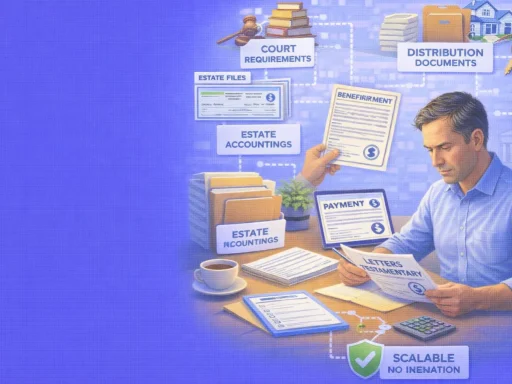


The phone call comes on a Tuesday. Your mother has passed. Between the grief, the funeral arrangements, and the family logistics, someone hands you a manila folder. Inside is her will. You are named as executor.
You have never done this before and you are now responsible for filing the will with the probate court, obtaining letters testamentary, inventorying every asset your mother owned, notifying creditors, paying debts and taxes, preparing accountings for the court and the beneficiaries, and distributing what remains — all while complying with state-specific deadlines, court requirements, and documentation rules that vary from jurisdiction to jurisdiction.
The paperwork alone can be staggering. A typical probate case generates dozens of documents, many of which require notarized signatures, sworn affidavits, or court-certified copies. Miss a deadline, file the wrong form, or submit an improperly executed document, and the court can sanction you, remove you from your role, or hold you personally liable for losses to the estate.
According to the IRS, the estate administrator’s first responsibility is to provide the probate court with an accounting of the assets and debts of the deceased. But before you can account for anything, you need the legal authority to act — and getting that authority is itself a multi-step document process.
This guide walks through every major document an estate executor or administrator encounters, from the initial probate petition through final distribution. It covers which documents require notarization, how court requirements vary by state, how to handle real estate transfers, the tax filings the IRS expects, and the practical systems that keep an estate administration on track.
Getting Your Authority: Letters Testamentary and Letters of Administration
Before you can access a single bank account, sell a single asset, or sign a single document on behalf of the estate, you need formal legal authority from the probate court. That authority comes in the form of either letters testamentary or letters of administration.
Letters Testamentary
If the deceased left a valid will and named you as executor, the court issues letters testamentary after approving the will and confirming your qualifications. These letters are the single most important document you will carry during the entire administration. Banks, title companies, brokerage firms, insurance companies, and government agencies all require letters testamentary before they will allow you to act on the estate’s behalf.
To obtain letters testamentary, you file a petition for probate with the court in the county where the deceased lived or owned property. You submit the original will, a certified death certificate, and your personal identification. Most courts charge a filing fee — anywhere from $50 to over $1,200 depending on the jurisdiction and estate value. A hearing is scheduled where the judge evaluates the will’s validity and your fitness to serve as executor.
Once approved, the court issues the letters. Request multiple certified copies — at least six to ten. Every bank, every brokerage, and every title company will want their own original certified copy. Some institutions require the letters to have been issued within the last 60 days, so you may need to request fresh copies periodically throughout the administration.
Letters of Administration
If the deceased died without a will (intestate), the court appoints an administrator — typically a surviving spouse or next of kin — and issues letters of administration. These letters grant the same authority as letters testamentary, but the administrator distributes assets according to the state’s intestacy laws rather than the wishes expressed in a will.
The application process is similar: file a petition, provide the death certificate, attend a hearing, and receive the letters. The administrator may be required to post a surety bond — essentially an insurance policy that protects the estate if the administrator mismanages assets. The bond premium typically runs 0.5% to 1% of the bond amount, which is usually set equal to the estate’s total value.
The Oath of Office
In many states, the executor or administrator must take an oath before a notary public or the court clerk, swearing to faithfully and honestly discharge the duties of the office. North Carolina, for example, the personal representative must take an oath or affirmation before a notary public or the Clerk, attesting that they will faithfully discharge their duties. In a testate estate, the oath includes attesting to the belief that the submitted document is the valid will of the deceased.
This oath is one of the first documents in the probate process that requires notarization. If you cannot appear at the courthouse to take the oath in person, check whether your state allows the oath to be administered remotely through RON.
The Inventory: Documenting What the Estate Owns
Within a specific timeframe after receiving your letters — typically four months in most states — you must file an inventory with the court listing every asset under your supervision and control.
What the Inventory Includes
The inventory should cover real estate (with legal descriptions and current market values), bank accounts, brokerage and investment accounts, retirement accounts (IRAs, 401(k)s, pensions), life insurance policies where the estate is the beneficiary, vehicles, business interests, personal property of significant value (jewelry, artwork, collectibles, antiques), digital assets (cryptocurrency, online accounts with monetary value), and intellectual property.
Each asset must be valued as of the date of death. Some assets require professional appraisals — real estate, business interests, and unique personal property like artwork or jewelry. The court may require you to file an application to appoint an appraiser, and the appraiser’s report becomes part of the court file.
Assets That Do Not Go Through Probate
Not everything the deceased owned passes through probate. Assets with named beneficiaries — life insurance proceeds, retirement accounts with beneficiary designations, and payable-on-death bank accounts — transfer directly to the named beneficiary outside of probate. Property held in joint tenancy with right of survivorship passes automatically to the surviving co-owner. Assets held in a revocable living trust are administered by the trustee, not the executor.
These non-probate assets do not appear on the inventory you file with the court (though they may be relevant for tax purposes). Understanding this distinction prevents you from overcomplicating the inventory and attempting to control assets that are not under your authority.
Documents That Require Notarization During Probate
Probate generates a continuous stream of documents over months or years. Several categories routinely require notarized signatures.
Affidavits
Affidavits are sworn statements made under penalty of perjury. In probate, you will encounter affidavits of notice (confirming you notified heirs and beneficiaries), affidavits of heirship (identifying the deceased’s legal heirs when there is no will), affidavits of domicile (confirming where the deceased legally resided), and affidavits supporting the probate of a lost or destroyed will.
Every affidavit requires the signer to swear or affirm the truth of the statements before a notary public or other authorized officer. The notary administers the oath and applies their seal, creating a legally binding sworn statement.
Real Estate Deeds
When the estate includes real property that must be transferred to a beneficiary or sold to a third party, a new deed must be executed. The executor signs the deed on behalf of the estate. That signature must be notarized because the deed will be recorded with the county recorder’s office, and counties require notarized signatures on all recorded documents.
The type of deed depends on the circumstances. An executor’s deed transfers property from the estate to a beneficiary or buyer, reciting the executor’s authority under the letters testamentary. A quitclaim deed may be used between family members but offers no warranties about the title.
Small Estate Affidavits
Many states offer a simplified probate process for estates below a certain value threshold. Instead of full probate, the heirs can file a small estate affidavit — a sworn statement listing the estate’s assets, debts, and heirs. In Texas, the small estate affidavit covers estates with $75,000 or less in assets (excluding homestead and exempt property), and every distributee with legal capacity must sign and swear to the affidavit before a notary.
Small estate affidavits are one of the most common notarization needs in estate administration because they bypass the full probate process entirely, relying instead on the notarized sworn statements of the heirs.
Beneficiary Receipts and Releases
When you distribute assets to beneficiaries, you should obtain a signed receipt from each recipient confirming what they received. Many executors also obtain a release — a document in which the beneficiary acknowledges the distribution and releases the executor from further liability regarding those assets.
Virginia, for example, requires that a proper voucher or signed receipt from each recipient of a specific bequest or distribution must accompany the estate accounting filed with the Commissioner of Accounts. Notarizing these receipts adds a layer of protection for the executor, creating a verified record that the beneficiary voluntarily acknowledged the distribution.
Powers of Attorney Within Probate
Situations arise where the executor cannot personally handle every task. If you live in a different state from where the estate is being administered, you may grant a power of attorney to a local attorney or trusted person to sign documents, attend hearings, or manage property on your behalf. This POA must be notarized and may need to be filed with the court.
Court-Required Accountings
The accounting is the document that proves you managed the estate properly. It is a detailed financial report showing every dollar that came into and went out of the estate during your administration.
What the Accounting Includes
A complete estate accounting covers beginning assets (the inventory values), all receipts (interest, dividends, rental income, refunds, insurance proceeds, and any other income received by the estate), gains and losses on asset sales, all disbursements (debts paid, taxes filed, professional fees, court costs, funeral expenses, and administrative expenses), and distributions to beneficiaries.
Each line item must be supported by documentation — bank statements, receipts, invoices, canceled checks, broker statements, or signed settlement sheets. The court or commissioner reviews the accounting to verify that the executor managed the estate’s assets properly and distributed them correctly.
Filing Deadlines
Accounting deadlines vary by state. In Virginia, the first accounting is due within 16 months of qualification, covering a period not exceeding 12 months. Subsequent accountings are due every 16 months until the estate is closed. In California, under Probate Code Section 10951, the executor must file a final accounting along with a petition for final distribution when the estate is ready to be closed.
Missing an accounting deadline can result in sanctions from the court, removal as executor, or personal liability. Some states issue a summons requiring you to appear before the court to answer for delinquency, which can result in fines or imprisonment for persistent non-compliance.
The Final Accounting and Petition for Distribution
When all debts are paid, all taxes are filed, and the estate is ready to close, you prepare a final accounting and file a petition for final distribution. The final accounting shows the complete financial history of the estate from the date of death through the proposed distribution. The petition asks the court to approve the distributions and discharge you from your duties.
Beneficiaries review the final accounting and have the opportunity to object. If no objections are filed (or if objections are resolved), the court approves the distribution and issues an order closing the estate. You then distribute the remaining assets according to the will or intestacy laws, obtain receipts from each beneficiary, and file proof of distribution with the court.
Tax Filings the Executor Must Handle
The IRS considers the deceased person’s tax return and the estate’s tax return as separate obligations. The executor is responsible for both.
The Deceased’s Final Income Tax Return
File a final Form 1040 for the deceased, covering income from January 1 through the date of death. The filing deadline is the normal April 15 following the year of death (or the extended deadline if applicable). If the deceased was married, the surviving spouse may file a joint return for that year.
The Estate’s Income Tax Return: Form 1041
If the estate generates income after death — from interest, dividends, rental income, or asset sales — it must file its own income tax return on Form 1041. The estate is a separate taxpayer with its own EIN (which you must apply for). Form 1041 is due on the 15th day of the fourth month after the end of the estate’s tax year.
Estate Tax Return: Form 706
The federal estate tax applies only to large estates. For 2025, the estate tax exemption is $13.99 million per individual. If the estate’s gross value exceeds this threshold, you must file Form 706 within nine months of the date of death (with a six-month extension available). Most estates fall well below this threshold and do not owe federal estate tax, but some states impose their own estate taxes at much lower thresholds — Massachusetts at $2 million, New York at $6.94 million, and several others in between.
Obtaining an EIN
You will need a separate Employer Identification Number (EIN) for the estate. Apply online through the IRS website — the process takes minutes and the EIN is issued immediately. You need the EIN to open an estate bank account, file estate tax returns, and report estate income.
What No Other Guide Covers: The 60-Day Certified Copy Problem
Every probate guide explains that you need certified copies of letters testamentary. None of them explain the specific timing problem that catches executors off guard during the longest and most complex phase of estate administration.
How the Problem Works
You receive your letters testamentary in February. Order ten certified copies. You use two at banks in March. Use one at a brokerage firm in April. You use one to list the house for sale in May.
In August, a buyer is found. The title company needs a certified copy of the letters testamentary to proceed with closing. You pull a copy from your folder and hand it over. The title company rejects it. Their policy requires letters issued within the last 60 days. Your copies are six months old.
You now need to return to the probate court, request new certified copies, wait for processing (which can take days to weeks depending on the court’s backlog), and coordinate the new copies with the title company’s closing schedule. If the buyer has a rate lock expiring or a contract deadline approaching, the delay can jeopardize the sale.
This 60-day recency requirement is not a legal requirement in most states — it is an institutional policy imposed by banks, title companies, and brokerage firms. But it is nearly universal. Financial institutions want to verify that you are still the authorized representative and that no changes have been made to your appointment since the letters were issued.
How to Manage the Problem
First, understand which institutions in your estate administration have recency requirements and what those requirements are. Ask each bank, brokerage, and title company at the start of the process: “How recent must my certified copies be?” Document the answers.
Second, do not order all your certified copies at once. Order three or four copies initially for immediate needs. Then order additional copies strategically, timed to coincide with specific transactions. If you know a real estate closing is scheduled for September, order fresh certified copies in late August.
Third, build a relationship with the probate clerk’s office. In many courts, ordering additional certified copies is a simple process — fill out a request form, pay a small fee ($5 to $20 per copy), and receive the copies within a few business days. Knowing the turnaround time at your specific court allows you to plan ahead.
Fourth, consider asking your probate attorney to keep certified copies on hand and order fresh ones as needed. Attorneys who handle probate regularly have established processes with the court clerk and can often obtain copies faster than an individual executor.
Building a Document Management System for Estate Administration
Estate administration can take six months to several years. Organizing documents from the start prevents chaos later.
The Estate Administration Binder
Create a physical or digital binder organized into sections: court documents (petition, letters testamentary, court orders, hearing notices), asset inventory (appraisals, account statements, property records, vehicle titles), creditor claims (notice to creditors proof of publication, individual claims received, payments made), tax documents (deceased’s final return, estate income tax returns, estate tax return if applicable, EIN confirmation), accounting records (bank statements, receipts, invoices, check registers), distribution records (beneficiary receipts, releases, deed transfers), and correspondence (letters to and from beneficiaries, creditors, financial institutions, and government agencies).
Tracking Deadlines
Probate has rigid deadlines that vary by state. Create a calendar with every deadline from the date of your appointment forward. Common deadlines include notice to heirs and beneficiaries (typically 30 days after appointment), notice to creditors (timing varies — often within 30 to 60 days), inventory filing (typically four months), creditor claim period (usually four to six months after notice publication), first accounting (varies — 12 to 16 months in many states), tax return deadlines (April 15 for the final 1040, nine months after death for Form 706), and final accounting and petition for distribution (after all debts, taxes, and claims are resolved).
Set alerts for each deadline. Missing a deadline can result in personal liability, court sanctions, or removal from your role.
Using RON for Estate Documents
Remote online notarization is valuable during estate administration because the executor, beneficiaries, witnesses, and other parties are often in different locations. A beneficiary in California can sign and notarize a receipt and release through RON without traveling to the executor in Texas. An executor can notarize an affidavit of heirship from home rather than scheduling a trip to the courthouse.
RON is particularly useful for real estate transfers. If the estate owns property in another state, the executor can sign and notarize the executor’s deed through RON rather than traveling to the property’s location or arranging a mail-away signing.
Before using RON for court-filed documents, confirm with the specific probate court that they accept remotely notarized documents. Most courts do, but some still require in-person notarization for certain filings.
Frequently Asked Questions
What is the difference between letters testamentary and letters of administration?
Letters testamentary are issued when the deceased left a valid will naming an executor. Letters of administration are issued when there is no will and the court appoints an administrator. Both grant the same legal authority to manage the estate. The key difference is that an executor distributes assets according to the will, while an administrator distributes them according to state intestacy laws.
How many certified copies of letters testamentary should I request?
Request at least six to ten certified copies initially. Every bank, brokerage firm, and title company will require their own copy. Be prepared to order additional fresh copies throughout the administration, as many institutions require letters issued within the last 60 days.
Which probate documents require notarization?
Affidavits (of notice, heirship, domicile, and other sworn statements), real estate deeds signed by the executor, small estate affidavits, the executor’s oath of office (in many states), and powers of attorney used during estate administration all typically require notarization. Beneficiary receipts and releases benefit from notarization even when not strictly required.
What is an estate accounting and when is it due?
An estate accounting is a detailed financial report showing all income, expenses, and distributions during the administration. Filing deadlines vary by state — Virginia requires the first accounting within 16 months of appointment, while California requires a final accounting when the estate is ready to close. Missing the deadline can result in sanctions, fines, or removal as executor.
Can I use remote online notarization for probate documents?
Yes, in most jurisdictions. RON is particularly useful when the executor, beneficiaries, or other parties are in different locations. However, confirm with your specific probate court that they accept remotely notarized documents before relying on RON for court-filed paperwork. Some courts still require in-person notarization for certain filings.
What tax returns must the executor file?
The executor must file the deceased’s final Form 1040 income tax return, the estate’s income tax return (Form 1041) if the estate earns income after death, and the federal estate tax return (Form 706) if the estate exceeds the federal exemption threshold ($13.99 million for 2025). State estate tax returns may also be required depending on the state.
What happens if I miss a probate deadline?
Consequences vary by state but can include court sanctions, fines, personal liability for losses to the estate, removal from your appointment as executor or administrator, and in extreme cases of persistent non-compliance, contempt proceedings. Set calendar alerts for every deadline and maintain regular communication with your probate attorney.
Do I need a probate attorney?
While not legally required in most states, a probate attorney is strongly recommended — especially for estates with real property, complex assets, multiple beneficiaries, or potential disputes. Attorney fees are paid from the estate, not from your personal funds. The cost of an attorney is typically far less than the cost of mistakes that result from navigating probate without legal guidance.
Conclusion:
Serving as an executor or administrator is one of the most consequential responsibilities a person can take on. You are managing someone else’s life’s work — their property, their savings, their final wishes — under court supervision, with legal deadlines, and with personal liability for mistakes.
The executors who handle this well are not necessarily the ones with legal backgrounds. They are the ones who organize early, track deadlines religiously, document everything, and get professional help when the complexity exceeds their expertise. Order fresh certified copies before they need them. They file accountings on time. They notarize every affidavit properly. And they treat the estate’s assets with the same care they would give their own.
The probate court does not expect you to be a lawyer. It expects you to be diligent, honest, and organized. Build your document system on the day you receive your letters. Maintain it through every transaction. And when the final accounting is approved and the last distribution is made, you will have fulfilled your obligation to someone who trusted you enough to put your name in their will.
For notarized affidavits, real estate deeds, beneficiary receipts, and other estate documents that require a notary’s seal, BlueNotary provides remote online notarization with 24/7 availability — so executors and administrators can handle probate paperwork from any location without delays.