



Every state in America has different rules for remote online notarization. Some require specific technology platforms. Others mandate particular identity verification methods. A few still do not permit RON at all. And when a document crosses state lines, questions arise about whether a notarization valid in one state will be accepted in another.
The SECURE Notarization Act represents Congress’s attempt to solve this problem by establishing federal minimum standards for RON and guaranteeing interstate recognition. The legislation has strong bipartisan support and backing from major industry groups, yet it remains stuck in the legislative process while critics raise concerns about state preemption and consumer protection.
This guide explains what the SECURE Act would do, where it stands in Congress, the arguments for and against it, and what the current state-by-state patchwork means for anyone who needs documents notarized.
What Is the SECURE Notarization Act?
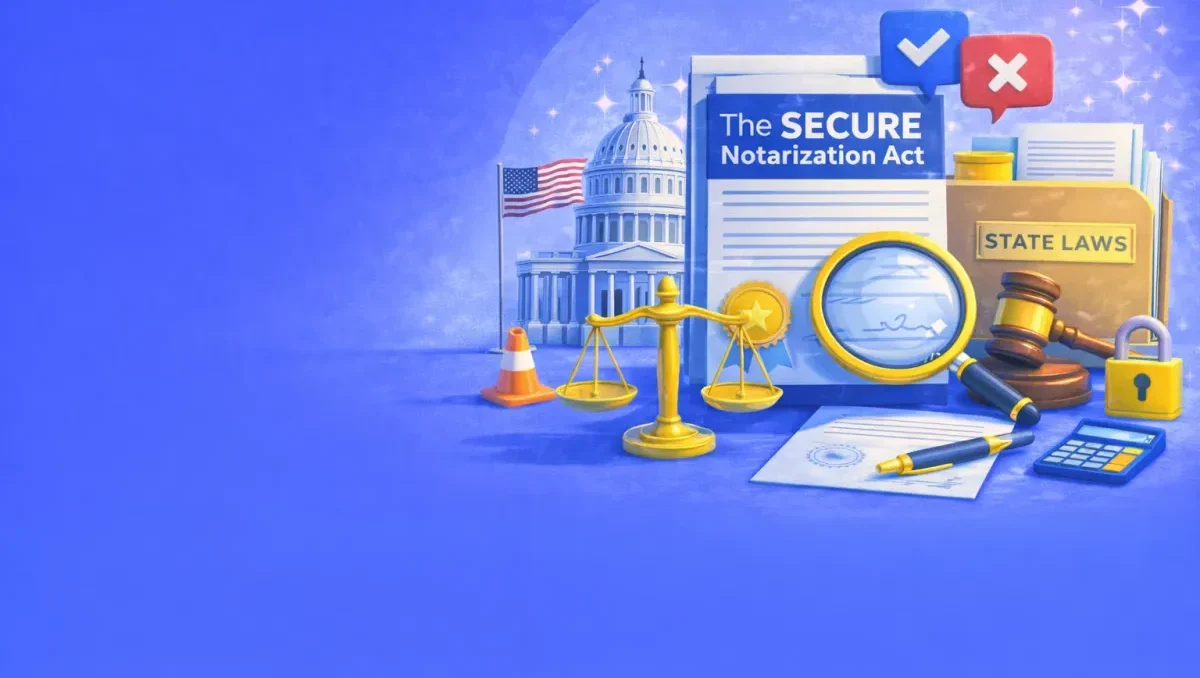
The Securing and Enabling Commerce Using Remote and Electronic Notarization Act—known as the SECURE Notarization Act—is federal legislation that would authorize notaries across the United States to perform remote online notarizations for transactions involving interstate or international commerce.
The bill has been introduced in multiple sessions of Congress:
- 2020: First introduced as S. 3533 (Senate) during the COVID-19 pandemic
- 2021-2022: Reintroduced as H.R. 3962 (House) and S. 1625 (Senate)
- 2023-2024: Introduced as H.R. 1059 (House), passed the House by voice vote
- 2025: Reintroduced as H.R. 1777 (House) and S. 1561 (Senate)
The legislation is sponsored by Senator Kevin Cramer (R-ND) and Senator Mark Warner (D-VA) in the Senate, demonstrating bipartisan support for the measure.
Current Status (2025)
As of early 2025, the SECURE Notarization Act has been reintroduced in the 119th Congress:
House: H.R. 1777 was introduced on March 3, 2025, by Representative Cliff Bentz (R-OR). The bill has been referred to the Committee on Energy and Commerce.
Senate: S. 1561 was introduced on May 1, 2025, by Senators Cramer and Warner. The bill was referred to the Committee on the Judiciary.
In the previous Congress (118th), the House version passed by voice vote—indicating broad support—but the Senate did not act on the legislation before the session ended. The bill must start the legislative process again in the new Congress.
The legislation has historically enjoyed strong bipartisan support, with both Republican and Democratic sponsors. Industry groups are actively lobbying for its passage, while some state officials and privacy advocates have raised concerns.
What the SECURE Act Would Do
The legislation would make several significant changes to how remote online notarization works across the United States:
Authorize Nationwide RON
The SECURE Act would permit every notary public commissioned under state law to perform remote online notarizations for transactions affecting interstate or international commerce. This means:
- Notaries in states that currently prohibit RON could perform remote notarizations
- Notaries could serve signers located anywhere, not just within their state
- Military personnel and Americans abroad would have easier access to notary services
- Businesses operating across state lines would have consistent access to RON
Establish Minimum Federal Standards
The legislation sets baseline technical and procedural requirements for RON:
Identity verification: Notaries must verify signer identity using multifactor authentication. This typically includes knowledge-based authentication (questions based on personal history) and credential analysis (verification of government-issued ID).
Tamper-evident technology: Electronic documents must use technology that clearly shows if any alteration has occurred after notarization.
Audio-visual recording: The notarization session must be recorded and retained, creating a permanent record of the transaction.
Communication technology: The notary and signer must communicate via real-time audio-visual technology that allows the notary to see, hear, and communicate with the signer throughout the session.
Guarantee Interstate Recognition
Perhaps most significantly, the SECURE Act would require:
- All federal courts to recognize notarizations performed by any state’s notary
- All states to recognize notarizations performed by notaries from other states when the notarization involves interstate commerce or relates to another state’s public acts, records, or judicial proceedings
This would eliminate uncertainty about whether a document notarized in one state will be accepted in another.
Preserve State Authority
The legislation explicitly states that it does not:
- Require any notary to perform remote notarizations (participation remains voluntary)
- Prevent states from establishing their own additional requirements
- Preempt state laws based on the Uniform Law Commission’s model acts
- Affect state laws governing wills, trusts, or powers of attorney
- Change state laws regarding the practice of law
- Impact recording requirements for land records
- Infringe on state data privacy laws
States could continue to regulate their own notaries and could impose requirements beyond the federal minimum.
Address Fraud Prevention
The SECURE Act includes provisions to combat notary fraud:
Notario restrictions: The bill prohibits notaries who are not licensed attorneys from using terms like “notario” or “notario público” that could mislead immigrants into believing the notary can provide legal services.
State enforcement authority: States retain full authority to sanction notaries, including denying, revoking, or suspending commissions for misconduct.
False advertising prohibitions: The legislation addresses false or misleading advertising by notaries.
Arguments in Favor
Supporters of the SECURE Notarization Act offer several compelling arguments:
Consistency and Certainty
The current patchwork of 50 different state laws creates confusion and uncertainty. A document notarized in Virginia using that state’s procedures might face questions when used in California, which has different requirements. Federal standards would provide certainty that a properly executed RON will be accepted anywhere.
Senator Cramer has stated: “This patchwork of state regulations really leaves consumers without consistent access to some notary services. Our bill would bring certainty and simplicity.”
Access for Underserved Populations
RON is particularly valuable for people who cannot easily visit a notary in person:
Military families: Service members deployed overseas and their families often struggle to find notary services. RON allows them to complete important transactions from anywhere in the world.
Elderly and disabled individuals: People with mobility limitations or health conditions can complete notarizations from home rather than arranging transportation to a notary’s location.
Rural residents: In areas with few notaries, RON eliminates the need to travel long distances.
Time-constrained professionals: People with demanding work schedules can complete notarizations outside traditional business hours.
Enhanced Security
Proponents argue that RON is actually more secure than traditional in-person notarization:
Multi-layer identity verification: RON requires knowledge-based authentication and credential analysis—security measures rarely used in paper notarizations.
Permanent recording: The audio-visual recording creates evidence that can be reviewed if questions arise about the transaction.
Tamper-evident technology: Electronic documents show clear evidence if altered, unlike paper documents that can be modified without detection.
Audit trails: Every action during a RON session is logged and traceable.
The American Land Title Association, Mortgage Bankers Association, and National Association of Realtors all support the legislation, arguing it would modernize real estate transactions while maintaining security.
Economic Efficiency
Eliminating the need for in-person meetings saves time and money for both individuals and businesses. Real estate closings, in particular, can proceed more quickly when participants do not need to coordinate physical meetings.
Building on Existing Framework
The SECURE Act follows the model of the Electronic Signatures in Global and National Commerce Act (ESIGN) and Uniform Electronic Transactions Act (UETA), which established complementary federal and state frameworks for electronic signatures. Supporters argue this approach has worked well for e-signatures and would work equally well for notarization.
Arguments Against
Critics of the SECURE Notarization Act raise several concerns:
State Preemption Concerns
California Attorney General Rob Bonta has been a vocal critic, arguing that the legislation would preempt stronger state consumer protections:
“If signed into law, the SECURE Notarization Act would require states to recognize remote online notarizations that meet certain minimum standards, with forced reciprocity that would inevitably result in a race to the bottom regarding consumer protections.”
California enacted its own RON law (SB 696) in 2023 with extensive privacy protections, including prohibitions on sharing consumer information and specific data security requirements. Critics argue the federal law would undermine these protections by forcing California to accept notarizations from states with weaker rules.
Privacy Vulnerabilities
The Electronic Frontier Foundation and other privacy advocates have criticized the legislation for:
Inadequate privacy standards: The bill requires collection and retention of sensitive personal information (video recordings, identification documents, biometric data) but does not establish strong minimum privacy protections.
No prohibition on data sale: The legislation does not prohibit RON platforms from selling or sharing data collected during notarization sessions.
Data breach risks: Electronic records of notarization sessions could be vulnerable to data breaches, exposing sensitive personal and financial information.
The EFF wrote: “This bill fails to require strong minimum privacy standards while simultaneously requiring the collection and retention of personally identifying and necessarily sensitive information that notaries normally wouldn’t collect in the first place.”
Race to the Bottom
Critics worry that mandatory interstate recognition would encourage businesses to seek notarizations in states with the weakest requirements. If every state must accept notarizations from every other state, there is no incentive for states to maintain strong consumer protections—and significant incentive for states to attract notary business by minimizing requirements.
Fraud Concerns
While supporters argue RON is more secure, some critics note that remote identity verification is not foolproof. Knowledge-based authentication can be defeated by criminals who have obtained personal information through data breaches. Credential analysis may not detect sophisticated forgeries. The lack of physical presence makes it harder to detect coercion or incapacity.
State Laboratory of Democracy
The traditional argument for federalism holds that states serve as “laboratories of democracy,” experimenting with different approaches to determine what works best. Critics argue that federal standards would short-circuit this process before states have fully developed and tested their RON frameworks.
The Current State Patchwork
Understanding what the SECURE Act would change requires understanding the current landscape:
States with Permanent RON Laws
As of early 2025, 45 states and the District of Columbia have enacted permanent RON legislation. The states without permanent RON laws are:
- Georgia
- Mississippi
- South Carolina
- Louisiana
- Rhode Island (permits temporary RON under specific conditions)
Connecticut has enacted RON but excludes real estate transactions, creating a unique limitation.
Variation in Requirements
Even among states that permit RON, requirements vary significantly:
Technology platforms: Some states require notaries to use platforms approved by the Secretary of State. Others allow any platform meeting certain technical standards. A few leave technology choices entirely to notaries.
Identity verification: Most states require knowledge-based authentication and credential analysis, but specific requirements differ. Some states require credential analysis to verify specific security features; others have more general requirements.
Recording retention: Retention periods for audio-visual recordings range from 5 to 10 years depending on the state.
Notary qualifications: Some states require additional training and certification for RON. Others allow any commissioned notary to perform remote notarizations.
Document restrictions: Some states prohibit RON for certain documents, such as wills, trusts, or real estate transfers. Others allow RON for all document types.
Signer location: Most states allow notaries to serve signers located anywhere. A few restrict RON to signers within the state or within the United States.
Interstate Recognition Today
Even without federal legislation, interstate recognition generally works:
Constitutional foundation: The Full Faith and Credit Clause of the U.S. Constitution provides that states must recognize the “public Acts, Records, and judicial Proceedings” of other states. Since notaries are public officials, their official acts should fall within this protection.
Uniform acts: Multiple uniform acts adopted by states over the past century provide for interstate recognition of notarial acts. These include the Uniform Acknowledgments Act (1894), Uniform Recognition of Acknowledgments Act (1968), and Revised Uniform Law on Notarial Acts (2010, amended 2018).
Procedural neutrality: Courts have historically recognized notarial acts from other states without requiring that those acts comply with the receiving state’s specific procedures. As long as the notarization was valid under the law of the state where it was performed, it should be recognized elsewhere.
Practical acceptance: In practice, RON documents are widely accepted across state lines. Title companies, lenders, courts, and government agencies routinely accept remotely notarized documents from other states.
Remaining Uncertainty
Despite these protections, some uncertainty remains:
Public policy exception: The Full Faith and Credit Clause has a public policy exception that allows states to refuse recognition in certain circumstances. While this exception has rarely been applied to notarial acts, a state strongly opposed to RON could theoretically invoke it.
Real estate recording: County recorders in some jurisdictions have questioned whether to accept remotely notarized documents, creating practical obstacles even if legal recognition is clear.
Litigation risk: Without explicit federal standards, documents notarized remotely face at least theoretical risk of challenge, creating uncertainty for transactions where legal certainty is paramount.
What This Means for Users
Whether or not the SECURE Act passes, here is what the current landscape means for people who need documents notarized:
If You Need a Document Notarized
RON is available to almost everyone. Even if your state does not authorize its own notaries to perform RON, you can typically use a notary from another state. California, for example, does not authorize its notaries to perform RON (implementation is ongoing through 2030), but California residents can use RON services from notaries in other states.
Interstate recognition generally works. Documents notarized remotely in compliance with the notarizing state’s laws are generally accepted in other states. While edge cases exist, the vast majority of RON transactions proceed without recognition issues.
Check with the recipient. For important transactions, confirm with the receiving party (the lender, title company, court, or government agency) that they will accept a remotely notarized document. This is good practice regardless of how the document is notarized.
Choose reputable platforms. Work with established RON platforms that comply with applicable state laws and maintain proper security measures. Platforms like Bluenotary ensure compliance with the notarizing state’s requirements and maintain the records necessary to demonstrate validity if questions arise.
If You Are a Notary
Know your state’s laws. If your state authorizes RON, understand the specific requirements—technology standards, identity verification procedures, recording retention, and prohibited document types.
Stay informed about federal developments. The SECURE Act could change the landscape significantly if passed. Monitor legislative progress and prepare for potential changes.
Understand interstate implications. Even if your state does not authorize RON, the federal legislation could authorize you to perform remote notarizations for interstate commerce transactions.
If You Are a Business
Develop consistent procedures. Whether using RON or traditional notarization, establish clear procedures that comply with applicable laws and create defensible records.
Plan for federal legislation. If the SECURE Act passes, it could simplify multi-state operations. Consider how your procedures would need to change.
Address privacy concerns. Regardless of federal requirements, implementing strong privacy protections for notarization data is good practice and may be required by state law.
What Happens Next
The SECURE Notarization Act faces several possible paths:
Passage
If both the House and Senate pass the legislation and the President signs it, federal RON standards would take effect. States would need to recognize out-of-state RON, and notaries nationwide could perform remote notarizations for interstate commerce.
Given the bill’s bipartisan support and industry backing, passage remains possible, though timing is uncertain.
Continued Stagnation
The bill could continue to pass the House but stall in the Senate, as happened in the previous Congress. Industry groups would continue lobbying, and the legislation would likely be reintroduced in future sessions.
State Action Fills the Gap
With or without federal legislation, states continue to adopt and refine RON laws. If all 50 states eventually adopt permanent RON legislation with strong interstate recognition provisions, the need for federal action diminishes.
The Uniform Law Commission’s model acts provide a framework for state laws that facilitate interstate recognition without federal intervention.
Modified Legislation
Congress could pass a modified version of the SECURE Act that addresses critics’ concerns—for example, by adding stronger privacy requirements or allowing states to impose additional restrictions that would apply to out-of-state notarizations accepted in that state.
Industry Support and Coalition Building
The SECURE Notarization Act enjoys remarkably broad industry support, with organizations spanning real estate, financial services, insurance, and technology sectors advocating for its passage.
Real Estate Industry
The real estate sector has been among the most vocal supporters:
American Land Title Association (ALTA): ALTA CEO Diane Tomb has stated: “Senators Cramer and Warner have been longstanding champions in recognizing the clear benefits of extending RON access to all Americans and leading this bipartisan legislation, which offers a safe and secure path to remotely close real estate and mortgage transactions.”
National Association of Realtors (NAR): NAR views the legislation as essential to modernizing real estate transactions. Shannon McGhan, NAR’s Executive Vice President and Chief Advocacy Officer, called it “a commonsense, bipartisan bill” that ensures Americans can “buy, sell, and finance property with confidence in today’s digital age.”
Mortgage Bankers Association (MBA): MBA has made SECURE Act passage a top policy priority. Bill Killmer, MBA’s Senior Vice President of Legislative and Political Affairs, noted: “The SECURE Notarization Act would make the mortgage closing process more convenient for consumers by creating federal minimum standards to allow notaries in all states to perform remote online notarization transactions.”
Financial Services
Beyond real estate, the financial services industry broadly supports the legislation:
American Council of Life Insurers (ACLI): ACLI President and CEO David Chavern emphasized that “families need practical, modern tools to plan for their financial futures,” supporting RON for insurance documents and estate planning.
Banking associations: Various banking groups support the legislation as a means to streamline lending processes and serve customers more efficiently.
Technology Providers
RON platform providers naturally support federal standardization, which would expand their addressable market and reduce compliance complexity.
State Officials
While some state officials oppose the legislation, others actively support it:
North Dakota Governor Doug Burgum: “Modernizing the notarization process with secure technology will help North Dakotans and all Americans conduct personal and financial transactions from the safety of their own homes.”
Implementation Considerations
If the SECURE Act passes, implementation would involve several practical considerations:
Technology Platform Compliance
RON platforms would need to ensure compliance with federal minimum standards while also meeting any additional state requirements. This could require:
- Updates to identity verification processes
- Enhanced tamper-evident technology
- Standardized recording and retention capabilities
- Audit trail improvements
Most established platforms already meet or exceed the proposed federal standards, so implementation should be relatively straightforward for compliant providers.
Notary Training and Certification
Notaries in states that currently prohibit RON would need training on:
- Technology platform operation
- Identity verification procedures
- Recording and retention requirements
- Interstate commerce considerations
States would likely develop or adopt training programs, though the federal legislation does not mandate specific training requirements.
Regulatory Adaptation
State regulatory agencies would need to:
- Update rules to accommodate federal standards
- Establish procedures for interstate recognition
- Modify enforcement approaches for the new framework
- Coordinate with other states on compliance issues
Consumer Education
Public awareness efforts would help consumers understand:
- Their right to use RON for interstate transactions
- How to verify a RON is properly performed
- Privacy rights regarding their notarization records
- How to report problems or fraud
The Broader Context
The debate over the SECURE Notarization Act reflects broader tensions in American governance:
Federal standards vs. state autonomy: When should the federal government establish uniform rules, and when should states experiment with different approaches?
Industry efficiency vs. consumer protection: How do we balance the economic benefits of streamlined processes against the need to protect individuals from fraud and privacy violations?
Technology adoption vs. security: How quickly should legal systems adapt to technological change, and what safeguards are necessary?
These questions have no simple answers, and reasonable people disagree about where to draw the lines.
Frequently Asked Questions
What is the SECURE Notarization Act?
The Securing and Enabling Commerce Using Remote and Electronic Notarization Act is federal legislation that would authorize all U.S. notaries to perform remote online notarizations for interstate commerce transactions and require all states to recognize these notarizations. It establishes minimum standards for identity verification, tamper-evident technology, and audio-visual recording.
Has the SECURE Act passed?
As of early 2025, no. The House passed the bill by voice vote in the 118th Congress (2023-2024), but the Senate did not act before the session ended. The bill has been reintroduced in the 119th Congress as H.R. 1777 (House) and S. 1561 (Senate) and is currently in committee.
Who supports the SECURE Act?
The bill has bipartisan sponsorship from Senators Kevin Cramer (R-ND) and Mark Warner (D-VA). Industry supporters include the American Land Title Association, Mortgage Bankers Association, National Association of Realtors, American Council of Life Insurers, and numerous real estate and financial services organizations.
Who opposes the SECURE Act?
Critics include California Attorney General Rob Bonta, who argues the bill would preempt stronger state consumer protections. The Electronic Frontier Foundation and other privacy advocates have criticized the bill’s lack of strong privacy requirements. Some state officials are concerned about loss of state control over notarization standards.
Can I use RON now without federal legislation?
Yes. Forty-five states and D.C. have permanent RON laws. Even if your state does not authorize its own notaries to perform RON, you can typically use a notary from another state, and the notarization will generally be recognized in your state under existing interstate recognition principles.
Would the SECURE Act affect state laws?
The Act would establish minimum federal standards but explicitly preserves state authority to regulate notaries, impose additional requirements, and enforce state laws. However, critics argue that mandatory interstate recognition would effectively undermine state laws by requiring states to accept notarizations that do not meet their own standards.
How many states currently allow RON?
Forty-five states and the District of Columbia have permanent RON legislation as of early 2025. The remaining states are Georgia, Mississippi, South Carolina, Louisiana, and Rhode Island (which permits temporary RON). Connecticut allows RON but excludes real estate transactions.
What would change if the SECURE Act passes?
Notaries in all states could perform RON for interstate transactions. All states would be required to recognize out-of-state RON. Federal minimum standards would apply. However, states could still impose additional requirements on their own notaries.
Conclusion:
The SECURE Notarization Act represents a significant effort to bring consistency to remote online notarization across the United States. If passed, it would:
- Authorize all U.S. notaries to perform RON for interstate transactions
- Establish minimum federal standards for identity verification and security
- Guarantee that RON performed in any state will be recognized in all states
- Preserve state authority to regulate their own notaries and impose additional requirements
The legislation has strong bipartisan support and industry backing but faces concerns about state preemption and privacy protection.
In the meantime, the current system of 45+ state laws with varying requirements continues to function. Interstate recognition generally works, though with less certainty than federal standards would provide. Users can access RON services regardless of their state’s own laws by using notaries from states that authorize remote notarization, often through established platforms such as Bluenotary, which facilitate compliant and secure remote notarization across state lines.
Whether through federal legislation or continued state action, the trend toward broader RON adoption and acceptance appears irreversible. The only questions are how quickly this transition occurs and what safeguards accompany it.