



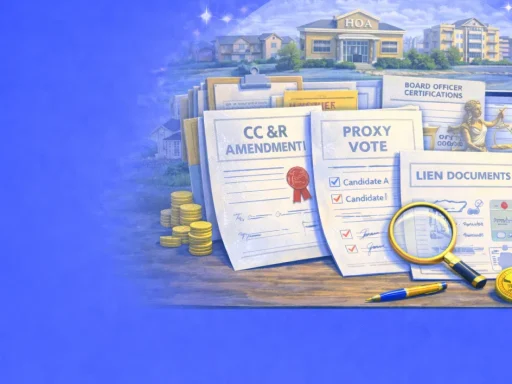


Homeowners associations and condominium associations generate substantial documentation throughout their operations. From amending governing documents to filing liens and certifying board actions, proper documentation ensures legal compliance and protects all parties involved.
This guide covers the essential document requirements for property managers, board members, and homeowners. Understanding these requirements helps associations operate effectively while avoiding costly legal challenges.
Understanding Association Governing Documents
Every HOA and condominium association operates under a hierarchy of governing documents. These documents establish the legal framework for community operations and define the rights and responsibilities of owners and the association.
Document Hierarchy
Association documents follow a specific order of authority. State and federal laws take precedence over all association documents. Below statutory law, the recorded Declaration of Covenants, Conditions, and Restrictions (CC&Rs) holds the highest authority among association documents. Bylaws rank below CC&Rs, and operating rules rank below bylaws.
This hierarchy matters when conflicts arise between documents. A rule cannot override a bylaw provision, and a bylaw cannot contradict the CC&Rs. Similarly, no association document can conflict with applicable state or federal law. Understanding this hierarchy helps boards and owners identify which provisions control in any given situation.
Types of Governing Documents
The Declaration of Covenants, Conditions, and Restrictions serves as the primary governing document. Filed with the county recorder’s office, CC&Rs run with the land and bind all current and future property owners. They govern property use restrictions, maintenance responsibilities, assessment authority, architectural guidelines, and enforcement rights.
Articles of Incorporation establish the association as a legal entity. Filed with the state secretary of state’s office, articles define the corporate structure and nonprofit status. They identify the association’s name, purpose, and registered agent.
Bylaws govern internal association operations. They establish procedures for meetings, elections, voting, board composition, officer duties, and committee formation. Unlike CC&Rs, bylaws typically are not recorded with the county but remain internal governance documents.
Operating rules address day-to-day community management. They cover matters like pool hours, parking regulations, pet policies, and common area usage. Rules must remain consistent with higher-level documents and applicable law.
CC&R Amendment Requirements
Amending CC&Rs requires careful attention to procedural requirements. Failure to follow proper procedures can render amendments invalid and expose the association to legal challenges.
Approval Thresholds
Most CC&Rs specify the percentage of owner approval required for amendments. Common thresholds range from 60% to 75% of all owners, though some older documents require even higher percentages such as 90%. The specific threshold varies by association and must be verified in the existing CC&Rs.
Some states provide statutory default approval requirements. California Civil Code Section 4270(a) establishes requirements including approval by the percentage specified in the CC&Rs, certification by the designated officer, and recording in the county where the development is located. Arizona requires at least 67% approval unless the declaration specifies a different percentage.
Certain CC&R provisions may require additional approvals beyond owner votes. Mortgagee consent is often required for amendments affecting lender interests, such as changes to insurance requirements, assessment priority, or maintenance obligations. Some declarations require developer approval during the declarant control period.
Voting Procedures
CC&R amendment votes must follow proper procedures. Most states require secret ballot voting for association elections and certain other matters. California’s Davis-Stirling Act mandates specific secret ballot procedures for CC&R amendments, including double-envelope systems and independent inspectors of elections.
The proposed amendment text must be delivered to members with the ballot. This ensures all voters understand exactly what they are approving. Summaries alone typically do not satisfy notice requirements.
Written ballots allow owners to vote without attending meetings in person. Many associations conduct CC&R amendment votes primarily through mail ballots, with meeting attendance serving to establish quorum rather than conduct voting.
Execution and Recording
Once approved, CC&R amendments require proper execution before recording. The amendment must be certified in writing by the officer designated in the CC&Rs or, if none is designated, by the association president. This certification confirms the amendment received the required approval.
The executed amendment must be signed and notarized before recording. County recorder offices have specific formatting requirements, including margin specifications and notarization standards. Failure to meet these requirements can result in rejection of the recording.
Recording fees vary by county. Many counties also require specific cover sheets for recorded documents. Contact your county recorder’s office to confirm current requirements before attempting to record amendments.
Court Petition for Reduced Approval Threshold
Older CC&Rs with supermajority requirements often make amendment practically impossible due to owner apathy. Many states provide a mechanism for associations to petition the court to reduce the required approval percentage when the original threshold cannot reasonably be achieved.
In California, Civil Code Section 4275 allows associations to petition the superior court for an order reducing the affirmative vote percentage needed for amendment. The association must demonstrate that achieving the original threshold is impractical despite reasonable efforts.
Proxy Voting Requirements
Proxy voting allows owners to authorize another person to vote on their behalf at association meetings. While proxy rules vary significantly by state and association, understanding proper procedures ensures valid elections and meeting results.
State Law Variations
State laws differ substantially regarding proxy voting in HOAs and condominiums. Some states permit proxy voting unless the governing documents prohibit it. Others prohibit proxies unless the governing documents specifically authorize them. Still others have detailed statutory requirements for proxy form and execution.
Florida requires proxy documents to be dated, state the meeting date, time, and location, and be signed by the authorized owner. Florida proxies automatically expire 90 days after the original meeting date. The state distinguishes between general proxies and limited proxies, with limited proxies functioning essentially as absentee ballots for specific items.
Oregon’s ORS 94.660 allows proxy voting unless the governing documents state otherwise. Valid Oregon proxies must indicate the date and be signed by the owner. South Carolina requires proxies to be effective when received by the secretary or tabulating officer, with default validity of 11 months but no longer than three years.
Proxy Form Requirements
A valid proxy form should contain several key elements. First, it must identify the meeting date, time, and location for which the proxy is given. Second, it should clearly name the proxy holder who will vote on the owner’s behalf. Third, the owner granting the proxy must sign the document.
Some associations use directed proxies that specify how the proxy holder should vote on particular matters. Others use general proxies that give the proxy holder discretion to vote as they see fit. The governing documents may specify which type is permitted or required.
Many associations provide standard proxy forms to ensure compliance with all requirements. Using association-provided forms reduces the risk of invalid proxies due to missing elements.
Signature and Notarization
Most states do not require notarization of proxy forms. A simple signature by the unit owner typically suffices to authorize the proxy. However, some associations’ governing documents may impose notarization requirements beyond what state law mandates.
The owner must personally sign the proxy. Having someone else sign on the owner’s behalf generally invalidates the proxy unless proper power of attorney documentation exists. Electronic signatures may be acceptable depending on state law and governing document provisions.
If your governing documents require notarization or witness signatures for proxies, those requirements must be followed even if state law does not mandate them. Review your specific documents to determine applicable requirements.
Proxy Holders
Who may serve as a proxy holder depends on state law and governing documents. Some states require proxy holders to be association members. Others allow any person the owner designates, including family members, neighbors, or attorneys.
Board members and property managers should exercise caution when serving as proxy holders. Accumulating numerous proxies can create appearance issues even when technically permissible. Some associations prohibit board members from holding proxies to avoid conflicts of interest.
Associations may limit the number of proxies any single person may hold. This prevents proxy accumulation that could unduly influence election outcomes. Check your governing documents for any such limitations.
Assessment Lien Documents
When owners fail to pay assessments, associations may place liens on the delinquent properties. Proper documentation throughout the lien process protects the association’s collection rights and ensures enforceability.
Pre-Lien Notice Requirements
Before recording a lien, associations must typically provide notice to the delinquent owner. State laws specify notice content, timing, and delivery methods. Failure to provide proper notice can invalidate the lien.
Texas requires two notices before filing an assessment lien. The first notice must be sent by first-class mail or email. The second notice must be sent by certified mail at least 30 days after the first notice. The association may only file the lien 90 days after sending the second notice.
Florida requires written notice of the delinquency and any other amounts owed before filing a lien claim. The notice must be sent by certified mail with return receipt requested and by first-class mail to the owner’s last known address.
Document all notices carefully, including delivery confirmations and return receipts. This documentation proves compliance with notice requirements if the lien is later challenged.
Lien Content Requirements
A valid assessment lien must contain specific information. Requirements vary by state but typically include property description, owner name, association name and address, assessment amounts due, and due dates.
Florida law requires liens to state the parcel description, record owner name, association name and address, assessment amount due, and due date. The lien secures unpaid assessments plus interest, late charges, and reasonable collection costs and attorney fees.
Some states require liens to be signed by an authorized association officer. Others require notarization. Check your state’s specific requirements before preparing lien documents.
Recording Requirements
Assessment liens must typically be recorded with the county recorder’s office to be enforceable against third parties. Recording provides constructive notice of the lien’s existence to potential purchasers and lenders.
County recorders have specific formatting requirements for recorded documents. These may include minimum margins, font sizes, and notarization placement. Documents that fail to meet formatting requirements may be rejected.
Recording fees vary by county. Plan for these costs in the association’s collection process. Some associations recover recording fees from the delinquent owner as part of collection costs.
Lien Priority
Assessment lien priority determines the order of payment when property is sold or foreclosed. Priority depends on state law, the CC&Rs, and when various liens were recorded.
In many states, assessment liens have priority over liens recorded after the CC&Rs but are subordinate to first mortgages recorded before the assessment became delinquent. This means the first mortgage holder gets paid before the association in most foreclosure scenarios.
Some states grant assessment liens “super lien” status for a limited amount of assessments. Super liens have priority even over first mortgages, giving associations greater collection leverage. The super lien amount is typically limited to a certain number of months of regular assessments.
Lien Release
When delinquent amounts are paid in full, the association must provide a lien release or satisfaction. This document, when recorded, removes the lien from the property’s title.
Lien releases should be recorded promptly after payment. Failure to release satisfied liens can create title problems for owners attempting to sell or refinance. Some states impose penalties on lienholders who fail to timely release satisfied liens.
The person paying the debt is entitled to a satisfaction upon full payment. Ensure your collection procedures include prompt preparation and recording of lien releases.
Board Officer Certifications
Board officers certify various association actions and documents. Proper certification confirms that actions were properly authorized and documents are authentic.
Certification of Resolutions
Corporate resolutions authorize specific board actions. The secretary typically certifies that a resolution was duly adopted by the board of directors. This certification confirms the resolution was properly passed at a meeting with appropriate notice and quorum.
A secretary’s certificate should identify the association, state the date of the board meeting, confirm notice was properly given, state that quorum was present, recite the resolution text, and confirm the resolution was adopted by the required vote. The secretary signs and dates the certification.
Third parties such as banks, title companies, and government agencies often require certified resolutions before dealing with the association. For example, opening a bank account typically requires a certified resolution authorizing the account and designating signers.
Officer Certificates
Officer certificates confirm the identity and authority of association officers. They typically list current officers, their titles, and their authority to act on behalf of the association.
Title companies and lenders frequently require officer certificates when associations are parties to real estate transactions. The certificate confirms who has authority to sign documents on the association’s behalf.
Officer certificates should be updated whenever officer positions change. Maintaining current certificates expedites transactions and avoids delays when documents must be signed.
Board Member Certification Requirements
Some states require board members to complete certification courses. Florida mandates that newly elected or appointed directors complete an approved four-hour education course within 90 days of taking office. Directors must also sign written certifications affirming they have read and will uphold the governing documents.
Florida’s requirements apply to HOAs, condominium associations, cooperative associations, and mobile home associations. The certification course covers board responsibilities, fiduciary duties, and applicable laws. Directors must complete continuing education annually, with the hours required depending on association size.
Virginia requires annual association registration with the Common Interest Community Board. While not individual director certification, this registration helps ensure association compliance with state law.
California requires associations to file a statement of information with the Secretary of State identifying officers and the principal place of business. Common interest developments must also file a statement of CID identifying the development type.
Written Consents
When boards act by written consent without a meeting, proper documentation is essential. Written consents must be signed by the required number of directors, typically a majority or unanimous consent depending on the bylaws.
Written consent documents should clearly state the action being taken and be signed by each consenting director with the date of signature. All signed consents should be filed with the meeting minutes.
Some states limit the types of actions that may be taken by written consent. Check your state’s nonprofit corporation law and your bylaws for any restrictions.
Estoppel Certificates and Resale Documents
When properties within associations are sold, various disclosure documents are required. These documents protect buyers by disclosing association financial information and the seller’s account status.
Estoppel Certificates
An estoppel certificate provides an official statement of amounts owed to the association by a particular owner. Once issued, the association is typically bound by the certificate’s representations and cannot later claim additional amounts were owed.
Florida law requires estoppel certificates to include extensive information: owner name, unit designation, assessment amounts, payment status, pending violations, capital contribution or transfer fees, and contact information for other associations. Certificates are effective for 30 days if delivered electronically or 35 days if delivered by mail.
States regulate fees associations may charge for estoppel certificates. Florida caps the base fee at $250, with additional amounts permitted for delinquent accounts and expedited delivery. Total maximum fees can reach $500 under certain circumstances.
Resale Certificates
Resale certificates provide comprehensive disclosure about the association to prospective purchasers. Unlike estoppel certificates that focus on the seller’s account, resale certificates address the overall association’s financial health and governance.
Washington’s Condominium Act requires sellers to provide resale certificates containing 19 categories of information, often totaling over 100 pages. This includes financial statements, reserve studies, pending litigation, insurance information, and copies of governing documents.
Buyers typically have a period to review resale certificates and may have rescission rights if the certificate reveals undisclosed material issues. Washington allows buyers to void purchase agreements if the resale certificate is not provided, regardless of contract contingencies.
Delivery Requirements
Associations must deliver estoppel certificates and resale documents within specified timeframes. Florida requires estoppel certificates to be delivered within 10 business days of receiving a written request and payment.
Failure to timely deliver required documents can have serious consequences. The association may be estopped from collecting amounts not disclosed. In some jurisdictions, sellers may be unable to complete closings without required association documents.
Associations should have efficient systems for processing document requests. Property management companies often handle these requests as part of their services.
Remote Online Notarization for Association Documents
Many association documents require notarization before recording or to verify authenticity. Remote Online Notarization (RON) provides a convenient option for completing these requirements.
Documents Requiring Notarization
CC&R amendments must be notarized before recording with the county recorder. The officer certifying the amendment signs before a notary who acknowledges the signature.
Assessment lien documents may require notarization depending on state law and county recorder requirements. Notarization adds authenticity verification and may be required for enforceability.
Deeds, easements, and other conveyance documents affecting association property require notarization. Board resolutions authorizing such transactions should be certified and may also require notarization for recording.
RON Benefits for Associations
BlueNotary enables board officers to complete notarized documents remotely without scheduling in-person appointments. This is particularly valuable when officers are geographically dispersed or have limited availability for in-person meetings.
RON sessions are recorded, providing an audit trail of the signing process. This documentation can prove valuable if document authenticity is later questioned.
Property managers handling multiple associations can efficiently process documents requiring notarization through RON platforms rather than coordinating in-person signings across numerous board officers.
State RON Acceptance
Approximately 47 states now authorize RON for various documents. However, acceptance for specific document types varies. Verify that your state and county accept RON documents for the specific purpose before proceeding.
Some counties may have additional requirements for RON documents beyond standard notarization. Contact your county recorder’s office to confirm acceptance of RON documents for recording.
Document Retention Requirements
Associations must maintain records for specified periods. Proper retention protects the association’s interests and ensures compliance with legal requirements.
Permanent Retention
Certain documents should be retained permanently. These include articles of incorporation, bylaws, CC&Rs and all amendments, and association formation documents. Recorded documents affecting title to association property should also be permanently retained.
Board meeting minutes should be retained for the life of the association. Minutes document the board’s decision-making process and provide evidence of proper authorization for association actions.
Timed Retention
Financial records, tax returns, and audits should typically be retained for seven years. This period covers most statutes of limitations for tax and financial matters.
Contracts should be retained for four years after the contract term ends. This covers potential breach of contract claims that might arise after contract completion.
Texas law specifically addresses HOA retention requirements, mandating permanent retention of governing documents and amendments, seven-year retention for financial records and meeting minutes, and four-year retention for contracts.
Electronic Record Keeping
Most states permit electronic record retention. Digital storage provides efficient access and protection against physical document loss. Ensure electronic records are properly backed up and accessible.
When converting paper records to electronic format, maintain the originals for any documents that might require production of original signatures. Recorded documents should be retained in their recorded form showing recording information.
Common Documentation Errors
Avoiding common errors prevents costly legal challenges and ensures association documents achieve their intended purposes.
Amendment Errors
Failing to achieve required approval thresholds invalidates amendments. Carefully count and verify all votes before certifying amendment approval.
Recording amendments without proper notarization causes rejection. Verify notarization requirements before submitting documents for recording.
Inconsistencies between amendment text distributed to voters and the recorded amendment create enforceability questions. Ensure the recorded document exactly matches what voters approved.
Lien Errors
Inadequate pre-lien notices can void liens. Document all notice delivery and maintain proof of mailing.
Incorrect property descriptions in liens create title problems. Verify legal descriptions against recorded plats and deeds.
Failure to timely release satisfied liens exposes associations to liability. Implement systems to ensure prompt release upon payment.
Certification Errors
Certifying actions not properly authorized exposes officers to personal liability. Verify meeting minutes and voting records before signing certifications.
Outdated officer certificates cause transaction delays. Update certificates promptly when officers change.
Missing signatures or dates on consent documents may invalidate the underlying action. Use checklists to ensure complete execution.
Frequently Asked Questions
What percentage of owners must approve a CC&R amendment?
The required percentage is specified in your existing CC&Rs and varies by association. Common thresholds range from 60% to 75%, though some older documents require higher percentages. If your documents are silent, state law may provide a default requirement.
Do proxy forms need to be notarized?
Most states do not require proxy notarization. However, your governing documents may impose notarization requirements beyond state minimums. Review your bylaws and CC&Rs to determine your specific requirements.
How long does an association have to provide an estoppel certificate?
Timeframes vary by state. Florida requires delivery within 10 business days of receiving a written request and payment. Other states may have different requirements or leave the timeframe to governing documents.
What happens if the association fails to release a lien after payment?
Failure to release satisfied liens can expose the association to liability. Many states impose penalties or allow the former debtor to recover damages. Release liens promptly upon full payment to avoid these issues.
Are board members required to be certified?
Certification requirements vary by state. Florida requires board members to complete approved education courses within 90 days of election or appointment. Most other states do not mandate board certification, though continuing education is often recommended.
Can CC&R amendments be recorded without notarization?
No. County recorders require notarization for recorded documents. The officer certifying the amendment must sign before a notary public whose acknowledgment appears on the document.
How long must associations retain meeting minutes?
Meeting minutes should generally be retained permanently or for the life of the association. Minutes document the board’s decision-making process and may be needed to verify authorization for past actions.
What information must be included in an assessment lien?
Requirements vary by state but typically include property description, owner name, association name and address, assessment amounts due, and due dates. Some states require additional information such as attorney contact information for accounts in collection.
Conclusion:
HOA and condominium association documentation requires attention to detail and understanding of applicable requirements. CC&R amendments need proper approval thresholds, execution, and recording procedures. Proxy voting must comply with state law and governing document provisions.
Assessment lien documents protect association collection rights when properly prepared and recorded. Pre-lien notices, lien content requirements, and recording procedures must all be followed to ensure enforceability.
Board officer certifications verify the authenticity and authorization of association actions. Directors must understand certification requirements, including any state-mandated education or registration requirements.
Estoppel certificates and resale documents facilitate property transfers within associations. Timely delivery of accurate information protects all parties to real estate transactions.
Remote online notarization provides convenient options for completing notarization requirements. Property managers and board officers benefit from the flexibility RON offers for executing documents requiring notarial acknowledgment.
Proper documentation protects associations from legal challenges and ensures smooth community operations. Working with experienced legal counsel helps associations navigate complex documentation requirements and avoid costly errors.
Property managers play crucial roles in maintaining documentation systems and ensuring compliance with retention requirements. Establishing efficient processes for document preparation, execution, and storage benefits the entire community.
Understanding these documentation requirements empowers board members, property managers, and homeowners to participate effectively in association governance. Well-documented associations operate more smoothly and face fewer disputes over procedural matters.