



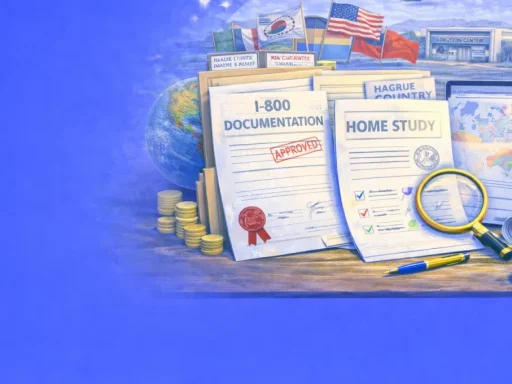


International adoption involves extensive documentation. Adoptive families must navigate federal immigration requirements, foreign country procedures, and proper document authentication. Understanding these requirements helps families prepare for a successful adoption journey.
This guide covers Hague versus non-Hague country requirements. We’ll explain I-800 and I-600 documentation, home study notarization, and authentication chains for different countries. You’ll learn the step-by-step process for preparing your adoption dossier.
Understanding the Hague Adoption Convention
The Hague Convention on Protection of Children and Co-operation in Respect of Intercountry Adoption is an international treaty. It establishes standards for intercountry adoptions and protects children from trafficking and exploitation. The United States became a party to this Convention on April 1, 2008.
Purpose and Protections
The Convention aims to ensure adoptions serve children’s best interests. It prevents abduction, sale, and trafficking of children. Additionally, it establishes cooperation between countries through designated Central Authorities. For the United States, the Department of State serves as the Central Authority.
The Convention requires that children be deemed adoptable before placement. Birth parents must provide informed, freely given consent. No improper financial gain can influence the adoption. Furthermore, prospective parents cannot contact birth parents until matching requirements are met.
Convention Countries
More than 100 countries currently participate in the Hague Adoption Convention. These include popular adoption destinations like China, Colombia, India, Philippines, and South Korea. The Department of State maintains an updated list of Convention countries on their website.
When adopting from a Convention country, families must follow Hague procedures. This includes working with accredited adoption service providers. It also requires specific USCIS forms and approval sequences. Non-compliance can result in significant delays or inability to bring your child home.
Hague vs. Non-Hague Country Requirements
The country you adopt from determines which process you must follow. Convention countries require Hague procedures. Non-Convention countries follow the orphan petition process. Each process has distinct documentation requirements.
Hague Convention Country Process
For Convention countries, you must use Form I-800A and Form I-800. The process follows a specific sequence that cannot be altered. You cannot adopt or accept a placement before receiving USCIS approval. Out-of-order adoptions may prevent your child from obtaining a U.S. visa.
The Hague process includes these sequential steps. First, choose an accredited or approved adoption service provider (ASP). Second, complete a home study meeting Hague requirements. Third, file Form I-800A with USCIS to establish eligibility and suitability. Fourth, receive approval and forward documents to the Convention country. Fifth, receive a child referral and Article 16 report. Sixth, file Form I-800 for the specific child. Finally, complete the adoption and obtain an immigrant visa.
Non-Hague Country Process (Orphan Petition)
For non-Convention countries, you use Form I-600A and Form I-600. The child must qualify as an “orphan” under the Immigration and Nationality Act (INA). This definition requires that the child have no parents. Alternatively, the child must have a sole or surviving parent who cannot provide care and has released the child for adoption.
The orphan process provides slightly more flexibility. You may adopt or obtain legal custody before filing Form I-600. However, USCIS must still determine the child qualifies as an orphan. Children receive IR-3 or IR-4 immigrant visas depending on circumstances.
Key Differences
Several important differences exist between the two processes. Convention adoptions require accredited or approved ASPs. Non-Convention adoptions don’t have this federal requirement. However, working with experienced agencies remains advisable.
Timing requirements also differ significantly. Convention adoptions prohibit accepting placements before I-800A approval. Non-Convention adoptions allow adoption before completing immigration paperwork. However, pre-adoption without I-600A approval creates risks.
Approval validity periods vary as well. Form I-800A approval lasts 15 months from fingerprint completion. Form I-600A approval lasts 18 months from approval date. Both can be extended under certain circumstances.
Form I-800A: Suitability Determination
Form I-800A establishes your eligibility and suitability to adopt from a Convention country. USCIS uses this application to determine whether you can provide proper care for an adopted child. The form requires extensive documentation and a comprehensive home study.
Filing Requirements
You must be a U.S. citizen to file Form I-800A. If unmarried, you must be at least 25 years old when you later file Form I-800. If married, both spouses must file jointly. Your spouse must be a U.S. citizen, lawful permanent resident, or have lawful status.
The filing fee is currently $775 per application. Additionally, each adult household member must pay an $85 biometrics fee. This covers fingerprinting and background checks. USCIS accepts credit cards, debit cards, and electronic bank transfers for payment.
Required Documentation
Form I-800A requires several supporting documents. You must provide proof of U.S. citizenship. Marriage certificates and divorce decrees establish marital status. Birth certificates for existing children are necessary. Additionally, you need a completed home study meeting federal requirements.
Foreign language documents require certified translations. The translator must certify the translation is complete and accurate. They must also confirm competency to translate from the foreign language into English. Submit translations with original documents or certified copies.
Processing Timeline
After filing, expect a receipt notice within two weeks. Biometrics appointments typically occur four to six weeks after filing. USCIS processes Form I-800A in approximately 4.5 months on average. Processing times vary based on workload and individual circumstances.
Upon approval, you receive Form I-797, Notice of Action. This approval remains valid for 15 months from fingerprint completion date. You may request one free extension. A second extension requires an additional fee.
Form I-800: Convention Adoptee Petition
Form I-800 determines whether a specific child qualifies as a Convention adoptee. You file this petition after accepting a child referral and receiving the Article 16 report. USCIS provisionally approves the petition before you complete the adoption.
Filing Requirements
You must have an approved, valid Form I-800A before filing Form I-800. The Convention country must have proposed placing a specific child with you. You must accept this placement before filing. The child must be under 16 when the petition is filed, with limited exceptions for siblings.
The filing fee is $775 for the first child. Additional petitions for birth siblings during the same I-800A approval period have no fee. File Form I-800 before your I-800A approval expires.
Article 16 Report
The Article 16 report is crucial documentation from the Convention country. This report contains the child’s medical and social history. It includes information about the child’s background and family of origin. The report also establishes the child’s adoptability and necessary consents.
You receive at least two weeks to review this report. During this time, consider the child’s needs and your ability to meet them. You may consult medical professionals about health conditions. After review, you either accept or decline the referral.
The Article 16 report must accompany Form I-800. You also need a statement from your primary provider. This statement, signed under penalty of perjury, certifies the report is a true copy. Additionally, include a summary of medical and social information provided about the child.
Provisional Approval
USCIS reviews Form I-800 to determine if the child qualifies as a Convention adoptee. If approved, USCIS issues provisional approval. This approval allows you to proceed with the adoption. USCIS forwards the case to the U.S. Embassy or Consulate in the child’s country.
The consular officer then reviews the case for visa eligibility. They send an “Article 5 Letter” to the Convention country’s Central Authority. This letter confirms the child may immigrate to the United States. Only after receiving this confirmation should you finalize the adoption.
Form I-600A and I-600: Orphan Petition Process
For non-Convention countries, Forms I-600A and I-600 establish adoption eligibility. These forms follow the “orphan” process under the Immigration and Nationality Act. The requirements differ from Hague procedures in several important ways.
Form I-600A Requirements
Form I-600A is optional but recommended. Filing it before identifying a child provides advance processing. This establishes your suitability while you search for a child. The home study and supporting documents accompany this application.
You must be a U.S. citizen to file. If unmarried, you must be at least 24 when filing I-600A and 25 when filing I-600. Married couples must file jointly. The filing fee and biometrics requirements mirror Form I-800A.
Approval of Form I-600A lasts 18 months. This gives you time to identify a child and complete the adoption. You may request extensions if needed. Upon approval, USCIS can notify the U.S. Embassy in your target country.
Form I-600 Requirements
Form I-600 classifies a specific orphan as your immediate relative. You file this after identifying a child to adopt. The child must meet the INA definition of “orphan.” This requires no parents, or a sole parent unable to provide care who has released the child.
You may file Form I-600 with an approved I-600A. Alternatively, you can file both forms together (combination filing). This approach works when you’ve already identified a child. USCIS determines suitability and orphan status simultaneously.
Required documentation includes the child’s birth certificate. You need proof of orphan status, such as death certificates or relinquishment documents. Final adoption decrees or custody orders are necessary. Evidence meeting pre-adoption requirements for your state is also required.
Filing Locations
Filing locations depend on your residence and circumstances. U.S. residents typically file with the USCIS office having jurisdiction. Those residing abroad file with the DHS or consular officer in that country. Under certain circumstances, Form I-600 may be filed at U.S. Embassies with approved I-600A.
Consular officers can only accept I-600 petitions with prior I-600A approval. If you adopted abroad without filing I-600A first, file with the appropriate USCIS office. Do not file directly with a consular officer in these cases.
Home Study Requirements
The home study is foundational to any international adoption. This comprehensive assessment evaluates your suitability as adoptive parents. It must be prepared by someone authorized under federal and state requirements.
Who Can Prepare Home Studies
For Hague Convention adoptions, specific requirements apply. The home study preparer must be an accredited agency, approved person, or supervised provider. Public domestic authorities may also prepare home studies. The preparer must be authorized to conduct intercountry adoption home studies.
For non-Hague adoptions, state requirements primarily govern. However, using a Hague-accredited agency is still recommended. This provides flexibility if you later consider a Convention country. It also ensures compliance with federal standards.
Content Requirements
Home studies must address numerous topics. These include your physical and mental health. Financial stability and employment status are evaluated. The preparer assesses your home environment and neighborhood. Your motivation to adopt receives thorough examination.
Background checks are extensive for international adoptions. Every adult household member must undergo fingerprinting. Child abuse and neglect clearances are required for each state of residence since age 18. Local police clearances confirm no criminal record.
The home study must include personal interviews. The preparer visits your home at least once. They interview you and your spouse separately and together. They also interview other household members as appropriate.
Additional Hague Requirements
Convention adoptions impose additional home study requirements. The study must address country-specific eligibility criteria. It must evaluate your understanding of international adoption challenges. Assessment of preparation for potential attachment issues is necessary.
Hague adoptions require ten hours of additional pre-adoption training. Topics include parenting children with special needs. Training covers attachment issues and country conditions. It addresses the international adoption process specifically.
The home study must be no more than six months old when submitted. If circumstances change, updates are required. Significant changes after approval require notifying USCIS. An amended or updated home study may be necessary.
Notarization Requirements
Home study documents require proper notarization. Employment verification letters need notarized signatures. Net worth statements must be notarized. Police clearance letters typically require notarization as well.
The home study preparer must personally sign the final report. For entity preparers, an authorized officer signs. Any updates or amendments require the same signature requirements. The signature date establishes the document’s validity period.
Authentication Chains for Adoption Documents
Authentication makes your documents legally valid in foreign countries. The process varies based on whether the destination country participates in the Hague Apostille Convention. Understanding this distinction is essential for proper document preparation.
Hague Apostille Convention Countries
The Apostille Convention simplifies document authentication. A single apostille certificate replaces multiple certifications. More than 125 countries currently participate in this Convention. Many adoption countries accept apostilled documents.
For apostille countries, follow these steps. First, have personal documents notarized by a notary in your state. Second, obtain apostille certification from your state’s Secretary of State. The apostille authenticates the notary’s signature and seal. No additional authentication is needed for Convention member countries.
State-issued documents like birth certificates don’t require notarization. The issuing authority’s seal is sufficient. Submit certified copies to the Secretary of State for apostille. Marriage certificates and divorce decrees follow this process.
Non-Apostille Countries (Chain Authentication)
Non-apostille countries require lengthier authentication. This process involves multiple certification levels. Each level authenticates the signature of the previous certifying official. The chain typically includes four or more steps.
The chain authentication process follows this sequence. First, have documents notarized by a notary in your state. Second, obtain county clerk certification of the notary’s commission. Third, submit to your state Secretary of State for authentication. Fourth, obtain U.S. Department of State authentication. Fifth, have the destination country’s embassy or consulate legalize the documents.
This process takes significantly longer than apostille authentication. Each step may require several days to weeks. Embassy legalization requirements vary by country. Contact the relevant embassy for specific procedures and fees.
State Authentication Authorities
Each state has a designated apostille authority. This is typically the Secretary of State’s office. Some states use different offices for authentication. For example, Pennsylvania uses the Secretary of the Commonwealth.
Fees vary by state, ranging from $2 to $20 per document. Processing times also vary significantly. Walk-in service may provide same-day processing. Mail-in requests typically take one to three weeks.
Texas limits adoption-related authentication fees to $100 per child. Other states may have similar fee caps for adoption documents. Verify with your state’s Secretary of State for specific policies.
Federal Documents
Federal documents follow a different authentication path. FBI background checks require U.S. Department of State authentication. Naturalization certificates and passports need federal apostilles. The Department of State Authentications Office handles these requests.
Federal apostilles cost $20 per document. Processing takes approximately five weeks or longer by mail. Expedited processing may be available for urgent situations. Walk-in service can reduce waiting time to two to three weeks.
Dossier Preparation
Your adoption dossier is the collection of authenticated documents. Each adoption country specifies required documents. Common elements include identity verification, financial proof, and health assessments. Proper preparation prevents delays and rejections.
Common Dossier Documents
Most countries require similar foundational documents. Birth certificates verify your identity and age. Marriage certificates establish marital status. Divorce decrees prove prior marriages ended properly. Passports provide identity verification and photos.
Financial documents demonstrate ability to support a child. Employment letters verify job status, salary, and stability. Bank statements show available resources. Net worth statements summarize assets and liabilities.
Medical documents address health suitability. Physician letters confirm physical ability to parent. Medical examination forms may be required. Some countries have specific health requirements or restrictions.
Home study documents form the dossier’s core. The completed home study report is essential. Supporting clearances and background checks accompany it. Reference letters may be included separately or within the home study.
Country-Specific Requirements
Each country adds unique requirements. Some require photos of your home’s interior and exterior. Others need family photos showing existing children. Letters of intent explaining your motivation may be required.
Religious documentation matters in some countries. Church membership letters or clergy references may be needed. Some countries restrict adoption to certain religious affiliations. Others require proof of no religious discrimination.
Power of attorney documents authorize in-country representatives. These must be specifically worded for the destination country. Many countries provide required forms or language. Proper notarization and authentication are essential.
Document Multiplication
Most countries require multiple copies of each document. Some need original documents with certified copies. Others accept all certified copies. Your agency provides specific requirements for your destination country.
Create multiple originals when possible. Have several copies notarized simultaneously. Obtain multiple certified copies of government-issued documents. This preparation prevents delays if documents are lost or additional copies are needed.
Translation Requirements
Foreign countries require documents in their official language. Certified translations must accompany English documents. Translators must certify accuracy and their qualifications. Some countries have approved translator lists.
Translation timing matters. Some countries accept translations done in the United States. Others require in-country translation. Your agency advises on specific requirements. Consider having translations completed before apostille to include them in authentication.
Remote Online Notarization for Adoption Documents
Remote Online Notarization (RON) offers convenience for adoption families. Approximately 47 states now permit RON for various documents. However, acceptance varies by destination country and document type.
Benefits of RON
RON provides flexibility for busy families. You can notarize documents from home at convenient times. This is especially helpful when multiple documents need notarization. It also assists families living far from traditional notary services.
The technology creates comprehensive records. Video recordings document each session. Identity verification is thorough and auditable. These records can support document authenticity if questions arise.
Important Considerations
Not all countries accept RON-notarized documents. Some specifically require traditional in-person notarization. Your state Secretary of State must be able to apostille RON documents. Verify acceptance before using remote notarization.
Texas explicitly states some countries don’t accept RON documents. Even with proper state authentication, rejection remains possible. Contact your adoption agency before using RON. They know current requirements for your specific destination country.
Some document types may not qualify for RON. Certain affidavits or declarations may require in-person appearance. State laws govern which documents can use remote notarization. Verify eligibility before scheduling your session.
Post-Adoption Documentation
Completing the adoption overseas requires additional documentation. You need documents to bring your child home. Post-adoption requirements in your state may also apply.
Obtaining the Child’s Documents
After adoption finalization, obtain a new birth certificate. Most countries issue amended birth certificates listing adoptive parents. This certificate is needed for passport applications. Processing times vary by country.
Your child needs a passport from their country of citizenship. They are not yet U.S. citizens when departing. The country of origin issues this passport. Your agency guides you through this process.
Medical examination results are required for the visa. Panel physicians designated by the U.S. Embassy conduct these exams. Results are provided to the consular officer. Address any medical issues discovered during examination.
Immigrant Visa Issuance
The U.S. Embassy schedules your visa interview. Bring all required documentation to this appointment. The consular officer reviews your case and the child’s medical examination. For Hague adoptions, they issue a Hague Certificate confirming Convention compliance.
Convention adoptions result in IH-3 or IH-4 visas. Non-Convention adoptions result in IR-3 or IR-4 visas. The visa type affects automatic citizenship acquisition. Children with IH-3 or IR-3 visas acquire citizenship upon U.S. entry.
U.S. Arrival and Citizenship
Upon arriving in the United States, your child becomes a lawful permanent resident. Children entering on IH-3 or IR-3 visas automatically acquire citizenship. This occurs under the Child Citizenship Act of 2000.
Children entering on IH-4 or IR-4 visas require readoption. You must complete adoption in your state of residence. After readoption, apply for a Certificate of Citizenship. This documents your child’s U.S. citizenship status.
State Post-Adoption Requirements
Many states require post-placement visits and reports. Social workers assess the child’s adjustment to your family. Reports go to the adoption agency and possibly to the child’s country of origin. Complete these requirements according to your state’s timeline.
Some states require readoption even for children with IH-3 or IR-3 visas. This obtains a state birth certificate for your child. It also ensures the adoption is recognized under state law. Your agency advises on specific requirements.
Frequently Asked Questions
What is the difference between I-800A and I-600A?
Form I-800A is for adoptions from Hague Convention countries. Form I-600A is for non-Convention countries. The forms have similar purposes but different requirements. Use the form matching your destination country’s Convention status.
How long is my home study valid?
For Hague adoptions, home studies are valid for one year after approval. For non-Hague adoptions, state requirements typically govern validity. Home studies must be no more than six months old when submitted to USCIS. Updates are required if significant changes occur.
Do I need an apostille or embassy legalization?
This depends on your destination country. Apostille Convention member countries accept apostilles. Non-member countries require chain authentication including embassy legalization. Your adoption agency provides specific guidance.
Can I use remote online notarization for adoption documents?
Possibly, but verify acceptance first. Some countries and states don’t accept RON-notarized documents. Even properly authenticated RON documents may be rejected abroad. Consult your agency before using remote notarization.
What is an Article 16 report?
The Article 16 report comes from the Convention country’s Central Authority. It contains the child’s medical and social history. It establishes the child’s adoptability and required consents. You receive this report before accepting a child referral.
How long does the international adoption process take?
Timeframes vary significantly by country. Most international adoptions take one to three years. Processing times for USCIS forms add several months. Country-specific procedures and wait times create additional variation.
What happens if my I-800A approval expires before I find a child?
You may request extensions. The first extension is free if requested before expiration. A second extension requires payment of another fee. File Form I-800A Supplement 3 to request extensions.
Do both spouses need to travel to the child’s country?
Requirements vary by country. Some countries require both parents to be present for court hearings. Others allow one parent to complete the process. Convention requirements may also affect who must travel. Your agency advises on specific requirements.
Conclusion:
International adoption requires meticulous document preparation. Understanding whether your destination country follows Hague procedures is the first step. This determines which USCIS forms to file and what process to follow.
Proper authentication ensures your documents are accepted abroad. Apostille certification works for Convention member countries. Chain authentication applies to non-member countries. Allow adequate time for these processes in your adoption timeline.
Home studies form the foundation of your adoption application. They must meet both federal requirements and state standards. For Hague adoptions, additional training and specific content requirements apply. Keep home studies current throughout your adoption journey.
Working with experienced adoption service providers simplifies the process. They understand country-specific requirements and documentation. They guide you through authentication and dossier preparation. Their expertise helps prevent costly delays and rejections.
Your adoption dossier represents your family to the child’s country of origin. Careful preparation demonstrates your commitment and capability. Proper notarization and authentication establish document authenticity. Complete and accurate documentation supports a successful adoption.
BlueNotary provides RON services for adoption documents. The platform connects families with licensed notaries for secure sessions. This can streamline the preparation of your adoption dossier.
The journey to bringing your child home requires patience and attention to detail. Each document serves a purpose in protecting your child and completing the adoption. With proper preparation, you can navigate these requirements successfully. Your new family awaits at the end of this documentation journey.