


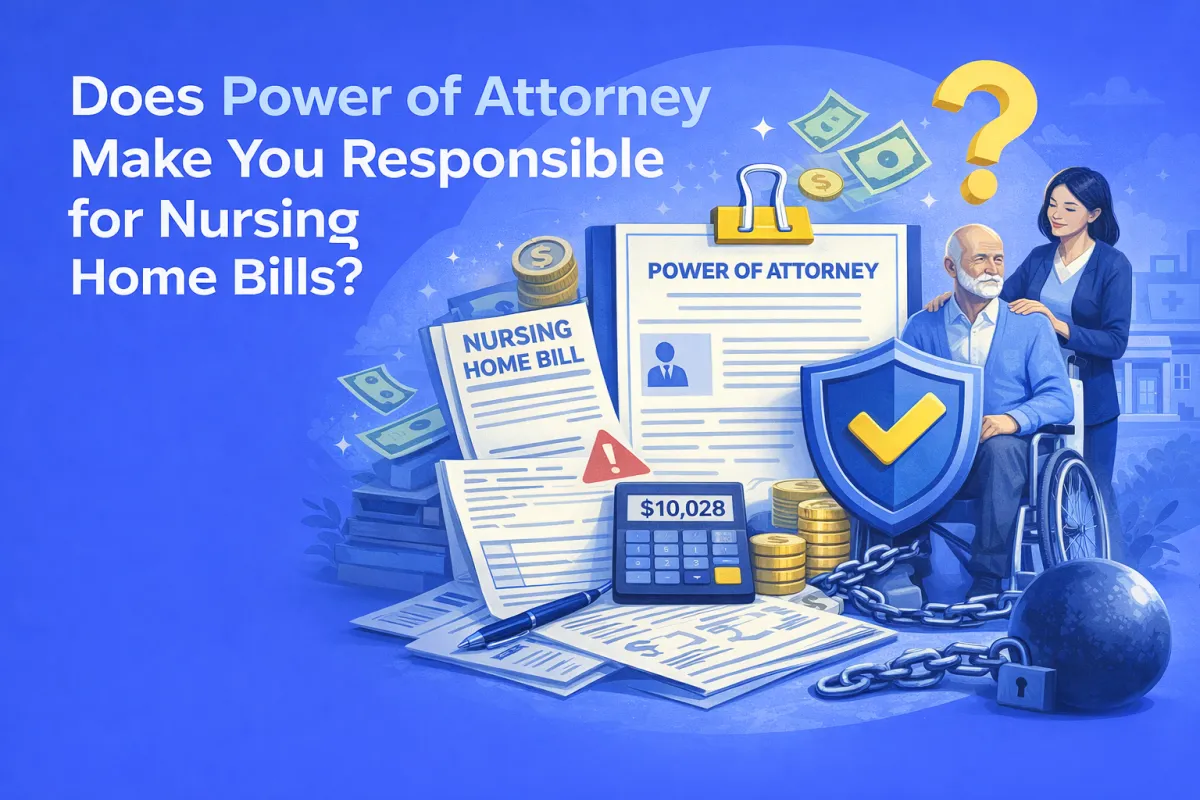

No, having Power of Attorney does not make you personally responsible for someone else’s nursing home bills. You manage their money to pay their bills—but the debt belongs to them, not you. However, there are situations where you could accidentally become liable. Here’s what you need to know to protect yourself.
The Short Answer: No, But There’s a Catch
If you have Power of Attorney for someone in a nursing home, you are NOT automatically responsible for paying their bills out of your own pocket.
Here’s the key thing to understand: A Power of Attorney (POA) gives you the legal right to manage someone else’s money and make decisions for them. It does NOT make their debts your debts.
Your job as POA is to use their money to pay their bills. You’re like a manager handling someone else’s finances—not a co-signer who shares their debt.
However (and this is important): You CAN become personally responsible for nursing home bills if you sign the wrong paperwork. Many families accidentally take on debt they didn’t have to. Keep reading to learn how to avoid this.
What Is Power of Attorney? (Simple Explanation)
A Power of Attorney is a legal document that lets one person (called the “agent” or “attorney-in-fact”) make decisions for another person (called the “principal”). Think of it like being given the keys to someone’s car—you can drive it for them, but it’s still their car.
When someone creates a POA, they’re saying: “I trust this person to handle things for me if I can’t do it myself.”
There are different types of Power of Attorney, and the type matters when it comes to nursing home situations:
Types of Power of Attorney
Financial Power of Attorney
This lets you handle someone’s money matters: paying bills, managing bank accounts, selling property, filing taxes, and dealing with insurance. This is the type most relevant to nursing home bills.
Healthcare Power of Attorney (Medical POA)
This lets you make medical decisions for someone: choosing doctors, approving treatments, deciding about surgery, and making end-of-life care choices. It doesn’t give you control over their money.
Durable Power of Attorney
“Durable” means the POA stays valid even if the person becomes mentally incapacitated (like with dementia or Alzheimer’s). This is crucial for elder care—without the “durable” designation, the POA would become useless right when you need it most.
General vs. Limited Power of Attorney
A General POA gives broad authority over most decisions. A Limited POA only covers specific tasks (like selling one particular house). For nursing home situations, you usually need a General Durable Financial POA.
Why Having POA Doesn’t Make You Responsible for Their Bills
This is the part that confuses most people, so let’s be crystal clear:
When you accept Power of Attorney, you become an agent—someone who acts on behalf of another person. You’re not becoming a co-owner of their assets or a co-debtor of their obligations.
Here’s an analogy: If your boss asks you to buy office supplies using the company credit card, you’re not personally responsible for paying that credit card bill. You’re acting as an agent of the company. The same principle applies to POA.
Your responsibilities as a POA agent include:
- Using their money to pay their bills — This is your main job
- Acting in their best interest — This is called “fiduciary duty”
- Keeping good records — Track every transaction
- Not mixing their money with yours — Keep finances completely separate
Your responsibilities do NOT include:
- Paying their bills with your own money
- Taking on their debts
- Guaranteeing their financial obligations
How You Could Accidentally Become Responsible (And How to Avoid It)
Here’s where it gets tricky. While POA itself doesn’t make you liable, there are several ways you could accidentally take on responsibility for nursing home bills:
Trap #1: Signing as a “Responsible Party”
This is the most common way people accidentally become liable.
When you admit someone to a nursing home, they’ll hand you a stack of paperwork. Buried in there is often a line asking you to sign as the “responsible party” or “guarantor.” If you sign this, you’re personally agreeing to pay the bills if the resident can’t.
Important: Federal law (the Nursing Home Reform Act) actually prohibits nursing homes from requiring a third party to guarantee payment as a condition of admission for Medicaid-eligible residents. But many facilities still try to get family members to sign these agreements.
How to protect yourself: When signing any nursing home paperwork, always sign as “[Your Name], as Agent for [Principal’s Name] under Power of Attorney.” Never sign as yourself personally. If they insist you sign as a guarantor, you have the right to refuse.
Trap #2: Using Your Own Money
If you start paying nursing home bills from your personal bank account (even with the intention of being “reimbursed later”), you may have a hard time proving you’re not responsible for future payments.
How to protect yourself: Always pay from the principal’s accounts. Keep their money completely separate from yours. If their accounts run low, that’s when you explore Medicaid or other options—not when you start using your own funds.
Trap #3: Filial Responsibility Laws
Here’s something many people don’t know: About 30 states have “filial responsibility laws” that can make adult children legally responsible for their parents’ care, including nursing home bills. This is separate from POA—it’s based on your relationship as their child.
These laws are rarely enforced, but there have been cases where nursing homes successfully sued adult children for unpaid bills. States with filial responsibility laws include Pennsylvania, New Jersey, California, Ohio, and many others.
How to protect yourself: Consult with an elder law attorney in your state to understand your potential exposure. Proper Medicaid planning can often help avoid these situations.
Trap #4: Mismanaging Their Assets
If you misuse your POA powers—spending their money on yourself, making bad investments, or failing to pay their bills when they had the funds to cover them—you can be held personally liable for the damage.
How to protect yourself: Keep detailed records of every transaction. Only use their money for their benefit. When in doubt about a financial decision, consult with an attorney.
What Happens When Their Money Runs Out?
Nursing home care is expensive—often $8,000 to $12,000 per month or more depending on location. Many people’s savings simply can’t keep up. So what happens when the money runs out?
Medicaid
Medicaid is a government program that helps pay for long-term care for people with limited income and assets. Once someone “spends down” their assets to the Medicaid threshold (which varies by state, but is often around $2,000 in countable assets), they may qualify for Medicaid to cover nursing home costs.
As POA, you may need to help with the Medicaid application process. This involves gathering financial documents, completing applications, and potentially working with a Medicaid planning attorney.
Medicare
Medicare (the health insurance for people 65+) only covers skilled nursing care for a limited time—up to 100 days, and only after a qualifying hospital stay. It does NOT cover long-term custodial care in a nursing home. Many families are surprised to learn this.
Long-Term Care Insurance
If the person has a long-term care insurance policy, this can help pay for nursing home costs. As POA, you’d work with the insurance company to file claims and ensure benefits are being paid properly.
Veterans Benefits
Veterans and surviving spouses may qualify for Aid and Attendance benefits, which can provide additional monthly income to help pay for care. This is an often-overlooked resource.
Your Actual Duties as Power of Attorney
Now that we’ve covered what you’re NOT responsible for, let’s talk about what you ARE responsible for:
1. Act in Their Best Interest (Fiduciary Duty)
This is your core obligation. Every decision you make must be for their benefit, not yours. If you’re ever unsure whether something is in their best interest, that’s a sign to pause and think carefully—or consult an attorney.
2. Manage Their Finances Responsibly
Pay their bills on time, manage their investments appropriately, file their taxes, and handle insurance matters. You’re essentially running their financial life.
3. Keep Detailed Records
Document everything. Keep receipts, bank statements, and records of every transaction. If anyone ever questions your management, you’ll need to prove you acted properly. Many states actually require POA agents to provide accountings if requested.
4. Keep Their Money Separate
Never mix their funds with your own. Don’t deposit their money into your account. Don’t pay their bills from your account and “reimburse yourself later.” Keep everything separate and documented.
5. Follow the POA Document
The POA document itself defines what you can and can’t do. Some POAs are broad; others are limited. Stay within the boundaries of what you’ve been authorized to do.
How to Sign Nursing Home Paperwork (Without Becoming Liable)
When you’re signing admission paperwork or contracts for a nursing home, HOW you sign matters enormously. Here’s the right way to do it:
The Correct Way to Sign
Always sign in this format:
[Principal’s Name] by [Your Name], Attorney-in-Fact
Or:
[Your Name], as Agent for [Principal’s Name] under Power of Attorney
This makes clear that you’re signing on behalf of someone else—not personally guaranteeing anything.
What to Watch Out For
- “Responsible Party” lines — Cross these out or add “as agent only”
- Personal guarantee clauses — Refuse to sign or have them removed
- Joint liability language — Red flag—have an attorney review
- Blank signature lines without context — Always add your agent designation
What If They Won’t Accept Your Signature?
If a nursing home refuses to admit someone unless you personally guarantee payment, know that this is often illegal—especially for Medicaid-eligible residents. You can:
- Ask to speak with their administrator or legal department
- Cite the Nursing Home Reform Act
- Contact your state’s long-term care ombudsman
- Consult with an elder law attorney
Creating a Power of Attorney: The Notarization Requirement
If you don’t yet have a Power of Attorney document—or if you need to update an existing one—it’s important to know that most states require POA documents to be notarized to be legally valid.
Notarization means a notary public (an official witness approved by the state) watches the person sign the document and verifies their identity. This helps prevent fraud and ensures the person signing actually intended to grant these powers.
Get Your Power of Attorney Notarized with BlueNotary
If you need to get a Power of Attorney document notarized, you don’t have to track down a notary at a bank or lawyer’s office. BlueNotary offers online notarization that lets you complete the process from home—which can be especially helpful when dealing with elderly family members who may have difficulty traveling.
With BlueNotary, you can:
- Connect with a licensed notary over video call
- Get documents notarized in about 15 minutes
- Complete the process from any device with a camera
- Notarize from home—no travel required for elderly family members
Need to get a Power of Attorney notarized? Visit BlueNotary.us to get started.
When You Should Talk to an Elder Law Attorney
While this guide covers the basics, elder care and nursing home finances can get complicated. Consider consulting with an elder law attorney if:
- You’re being pressured to sign as a guarantor
- The nursing home is threatening to discharge the resident over unpaid bills
- You need help with Medicaid planning or applications
- You’re unsure whether the POA document gives you the authority you need
- You live in a state with filial responsibility laws
- There are disputes among family members about care decisions
- The person’s estate is complex or there are significant assets to protect
- You’re concerned about potential legal liability
Elder law attorneys specialize in exactly these issues and can help you navigate the specific laws in your state.
Frequently Asked Questions
Is Power of Attorney responsible for nursing home bills?
No. Having Power of Attorney does not make you personally responsible for someone else’s nursing home bills. Your job is to manage their finances and use their money to pay their bills. You only become liable if you sign a personal guarantee or mismanage their funds.
Can a nursing home sue me for my parent’s unpaid bills?
Generally no—not just because you have POA. However, if you signed as a personal guarantor or “responsible party,” or if your state has filial responsibility laws, you could potentially be held liable. Always sign as “agent” and never as a personal guarantor.
What happens if my parent can’t afford nursing home care?
When someone’s funds are depleted, Medicaid may cover nursing home costs. The person must meet income and asset requirements. As POA, you can help with the Medicaid application. Other options include Veterans benefits, long-term care insurance, or discussing payment plans with the facility.
What is fiduciary duty?
Fiduciary duty means you’re legally required to act in the best interest of the person who gave you Power of Attorney. You must manage their money carefully, avoid conflicts of interest, keep good records, and never use their assets for your own benefit.
Can I be held liable if I mismanage their finances?
Yes. If you misuse POA powers—such as spending their money on yourself, making reckless investments, or failing to pay bills when funds were available—you can be held personally liable for damages and may face legal consequences.
Do I have to use my own money to pay for their care?
No. As POA, you are only responsible for managing their money to pay for their care. You are not required to use your personal funds. If their money runs out, you should explore Medicaid, Veterans benefits, or other assistance programs—not your own bank account.
What are filial responsibility laws?
Filial responsibility laws exist in about 30 states and can make adult children legally responsible for their parents’ necessary care, including nursing home bills. This is separate from POA—it’s based on your family relationship. These laws are rarely enforced but have been used successfully by some facilities.
Does Medicare pay for nursing home care?
Medicare only covers skilled nursing care for up to 100 days, and only after a qualifying hospital stay. It does NOT cover long-term custodial care in a nursing home. Many people are surprised by this limitation.
How should I sign nursing home documents?
Always sign as: “[Your Name], as Agent for [Principal’s Name] under Power of Attorney.” This makes clear you’re acting on their behalf, not personally guaranteeing anything. Never sign as a “responsible party” or guarantor.
Does a Power of Attorney need to be notarized?
Most states require POA documents to be notarized to be legally valid. This helps prevent fraud by having an official witness verify the identity of the person granting the power. Online notarization services like BlueNotary can make this process easier.
The Bottom Line
Having Power of Attorney for someone in a nursing home is a serious responsibility—but it doesn’t automatically make you responsible for their bills. Your job is to manage their finances responsibly and use their money to pay for their care.
The key things to remember:
- POA makes you a manager of their money, not a co-debtor
- Always sign as “agent”—never as a personal guarantor
- Keep their money separate from yours
- Document everything
- When in doubt, consult an elder law attorney
- Know your state’s laws regarding filial responsibility
Taking on POA for an aging parent or loved one is an act of love and responsibility. Understanding your actual obligations—and what you’re NOT responsible for—helps you fulfill that role effectively while protecting yourself.
Need to get a Power of Attorney document notarized? BlueNotary offers fast, convenient online notarization from the comfort of home.