






Navigating the world of notary journal requirements can feel like trying to read a map with 50 different legends. There’s no single federal law that standardizes the practice, which means the rules change every time you cross a state line.
Some states, like California, are famous for their incredibly detailed record-keeping mandates for every single notarial act. Others simply suggest it as a good idea, while a few don’t have any formal rules on the books at all. This guide is designed to cut through the confusion, giving you a clear, state-by-state breakdown of notary journal requirements so you can stay compliant no matter where you’re commissioned.
Understanding Your Notary Journal Compliance Obligations

Think of your notary journal as more than just a simple logbook. It’s your professional shield and a powerful tool for preventing fraud. This journal is your official, chronological record of every act you perform, creating a reliable trail of evidence if a transaction is ever questioned or ends up in court. Even if your state doesn’t legally require a journal, keeping one is a universal best practice that protects the public, your clients, and you.
The regulatory landscape is a true patchwork. Across the United States, roughly 42 states either require notaries to keep a journal or strongly recommend it. The differences can be stark. California, for instance, has one of the strictest sets of rules, requiring you to log the date, time, type of notarization, and even collect a right thumbprint for certain real estate documents. You can dive deeper into the specific state-by-state record-keeping mandates to see just how much they vary.
Core Pillars of Journal Compliance
To make sense of all these different regulations, it helps to break them down into a few core areas that nearly every state law addresses. Once you get a handle on these concepts, you’ll be well on your way to perfect record-keeping, whether you’re doing a traditional pen-and-paper notarization or using a Remote Online Notarization (RON) platform.
This guide will walk you through these key pillars for every state:
- Required Journal Entries: This covers the exact pieces of information you have to record for each act, like how you identified the signer and what kind of document you notarized.
- Journal Retention Periods: This is the minimum amount of time you must keep your journal safe after your commission ends. It could be five years, ten years, or even permanently.
- Electronic Journal Standards: For notaries using digital journals, especially for RON, these are the specific technical and security rules you must follow, such as using tamper-evident technology and maintaining secure backups.
A well-kept journal is your best defense. It provides powerful evidence that you followed procedure and acted properly, which can be invaluable if you’re ever accused of making a mistake.
The Anatomy of a Rock-Solid Journal Entry

A proper notary journal entry is your best defense. It’s the foundation of a sound notarial act, and while specific notary journal requirements by state vary, a handful of core details are nearly universal. If you master these fundamental elements, every entry you make will serve as a clear and indisputable record, protecting the public, your signers, and your own commission from liability.
A critical best practice—and a legal requirement in many states—is to complete the entry chronologically at the time of the notarization. You have to do this while the signer is physically present. This simple habit prevents a world of headaches, ensuring you capture every detail, especially the signer’s signature, before they walk out the door.
Core Data Fields for Every Notarization
Think of this as the “who, what, when, and where” of the notarial act. It’s the basic information that frames the entire transaction.
- Date and Time of Notarization: Pinpoint the exact moment the signer appeared before you. This chronological record is vital if a document’s timing is ever questioned.
- Type of Notarial Act: Be specific. Was it an acknowledgment or a jurat? Getting this right is a fundamental part of the job. You can dive deeper into what a notary acknowledgment is in our detailed guide.
- Document Description: Briefly describe the document you notarized. Listing the title, like “Deed of Trust” or “Power of Attorney,” and its date is usually sufficient.
Documenting Signer Identification
If there’s one part of the journal entry you can’t afford to get wrong, it’s this one. Properly identifying your signer is the very heart of what we do as notaries. A sloppy or incomplete record of how you verified someone’s identity could jeopardize the entire notarization.
Just jotting down “ID shown” won’t cut it. Your entry needs to be specific enough to stand up in court.
- Signer’s Full Name and Address: Always get the signer’s printed name and their current home address.
- Signer’s Signature: The signer needs to sign the journal on the line item corresponding to their notarization.
- Method of Identification: This is where precision matters most. Note whether you identified the person through “Personal Knowledge,” a “Credible Witness,” or an ID. If you used an identification document, record the type (e.g., “Driver’s License”), the state that issued it, the ID number, and the expiration date.
Some states have extra rules. California, for instance, requires a right thumbprint in the journal for any document affecting real property, like deeds or deeds of trust, as well as for powers of attorney.
Finally, always record the fee you charged for the service. If you didn’t charge anything, write “$0” or “No Fee” to make it clear. Keeping a clean record of fees prevents any confusion or disputes later on. Accuracy isn’t just a goal; it’s your legal duty.
State-by-State Quick Reference Guide
Trying to keep track of notary journal requirements by state can feel like untangling a giant knot. For notaries and compliance managers, especially those working in multiple states, the rules are anything but uniform. What’s a hard-and-fast rule in one state is just a friendly suggestion in the next.
This quick reference guide is built to cut through that confusion. It lays out the essential journaling rules for all 50 states in a simple, at-a-glance format.
Think of this table as your first stop for verifying core journaling duties. It gives you a snapshot of the most important details: whether you need a journal, how long you have to keep it, and if you’re allowed to use a digital one. It’s a fast way to check what’s needed, whether you’re handling a traditional in-person notarization or one online.
A Quick Heads-Up: Laws can and do change. While we keep this guide current, it’s always smart to double-check the latest regulations directly with your state’s commissioning authority. We’ve put together a handy list of Secretary of State websites to make that easier for you.
How to Read This Guide
To get the most out of this information, you need to understand the details in each column. A simple “Yes” or “No” doesn’t always paint the full picture. Sometimes, specific acts, like performing a remote online notarization (RON), trigger entirely different requirements.
- Journal Required: This column tells you if keeping a journal is mandatory, simply recommended as a best practice, or not mentioned in state law. Pay close attention to notes like “Yes (RON only),” which means an electronic journal is specifically required just for remote notarizations.
- Retention Period: This is the minimum time you must securely store your journal after your last entry is made or your commission term ends. These timeframes vary wildly, from just a few years to 10 years or more.
- Electronic/RON Journal Permitted: This confirms whether your state allows you to use a digital journal instead of—or along with—a traditional paper one. This is a critical detail for notaries using platforms like BlueNotary for remote services.
50-State Notary Journal Requirements at a Glance
The following table breaks down the core journal requirements for every U.S. state. It’s designed for quick lookups, so you can find the information you need in seconds and get back to your work.
| State | Journal Required (Yes/No/Recommended) | Retention Period | Electronic/RON Journal Permitted |
|---|---|---|---|
| Alabama | No | N/A | Yes |
| Alaska | Yes (RON only) | 10 Years | Yes |
| Arizona | Yes | 5 Years after last entry | Yes |
| Arkansas | Yes (Recommended for all) | 10 Years | Yes |
| California | Yes | 10 Years | Yes |
| Colorado | Yes | 10 Years | Yes |
| Connecticut | Recommended | N/A | Yes |
| Delaware | Yes | 10 Years | Yes |
| Florida | Yes (RON only) | 10 Years | Yes |
| Georgia | No | N/A | Yes |
| Hawaii | Yes | 10 Years | Yes |
| Idaho | Yes (RON only) | 10 Years | Yes |
| Illinois | Yes | 7 Years | Yes |
| Indiana | Yes (RON only) | 10 Years | Yes |
| Iowa | Yes (RON only) | 10 Years | Yes |
| Kansas | Yes | 10 Years | Yes |
| Kentucky | Yes (RON only) | 10 Years | Yes |
| Louisiana | Yes | 10 Years after death | Yes |
| Maine | No | N/A | Yes |
| Maryland | Yes | 10 Years | Yes |
| Massachusetts | Yes | 10 Years | Yes |
| Michigan | Yes (RON only) | 10 Years | Yes |
| Minnesota | Yes | 10 Years | Yes |
| Mississippi | Yes | 10 Years | Yes |
| Missouri | Yes | 10 Years | Yes |
| Montana | Yes | 10 Years | Yes |
| Nebraska | Yes (RON only) | 10 Years | Yes |
| Nevada | Yes | 7 Years after commission ends | Yes |
| New Hampshire | Yes (RON only) | 10 Years | Yes |
| New Jersey | Yes | 10 Years | Yes |
| New Mexico | Yes | 10 Years | Yes |
| New York | Yes (RON only) | 10 Years | Yes |
| North Carolina | No | N/A | Yes |
| North Dakota | Yes (RON only) | 10 Years | Yes |
| Ohio | Yes | 10 Years | Yes |
| Oklahoma | Yes (RON only) | 10 Years | Yes |
| Oregon | Yes | 10 Years | Yes |
| Pennsylvania | Yes | 10 Years | Yes |
| Rhode Island | Yes (Recommended for all) | 10 Years | Yes |
| South Carolina | No | N/A | Yes |
| South Dakota | Yes (RON only) | 10 Years | Yes |
| Tennessee | Yes | 10 Years | Yes |
| Texas | Yes | 10 Years after last entry | Yes |
| Utah | Yes | 10 Years | Yes |
| Vermont | Yes | 10 Years | Yes |
| Virginia | Yes (RON only) | 5 Years | Yes |
| Washington | Yes | 10 Years | Yes |
| West Virginia | Yes | 10 Years | Yes |
| Wisconsin | Yes (RON only) | 5 Years | Yes |
| Wyoming | Yes | 10 Years | Yes |
As you can see, the requirements are all over the map. Keeping a detailed journal is always a professional best practice, even when not legally required, as it serves as your best defense if a notarization is ever questioned.
Journal Retention Periods and Secure Storage Practices
Your work as a notary doesn’t end when the ink is dry and the signer has walked away. A huge part of your professional responsibility is safeguarding your journal for the long haul. State laws mandate specific retention periods, which dictate exactly how long you must keep these records. This isn’t just busywork; it’s a critical rule that ensures a notarization can be verified years down the road, forming a cornerstone of accountability and trust.
These retention periods are all over the map, but they typically range from five to ten years after the date of the last entry or, in some cases, even after your notary commission expires. For instance, states like California and Texas, which see a high volume of legally significant transactions, require a full 10-year retention period. This is a serious, long-term commitment that sticks with you even if you decide to hang up your stamp and not renew your commission.
This chart breaks down the common rules for notary journals across the country, showing what’s required versus what’s simply recommended or permitted.
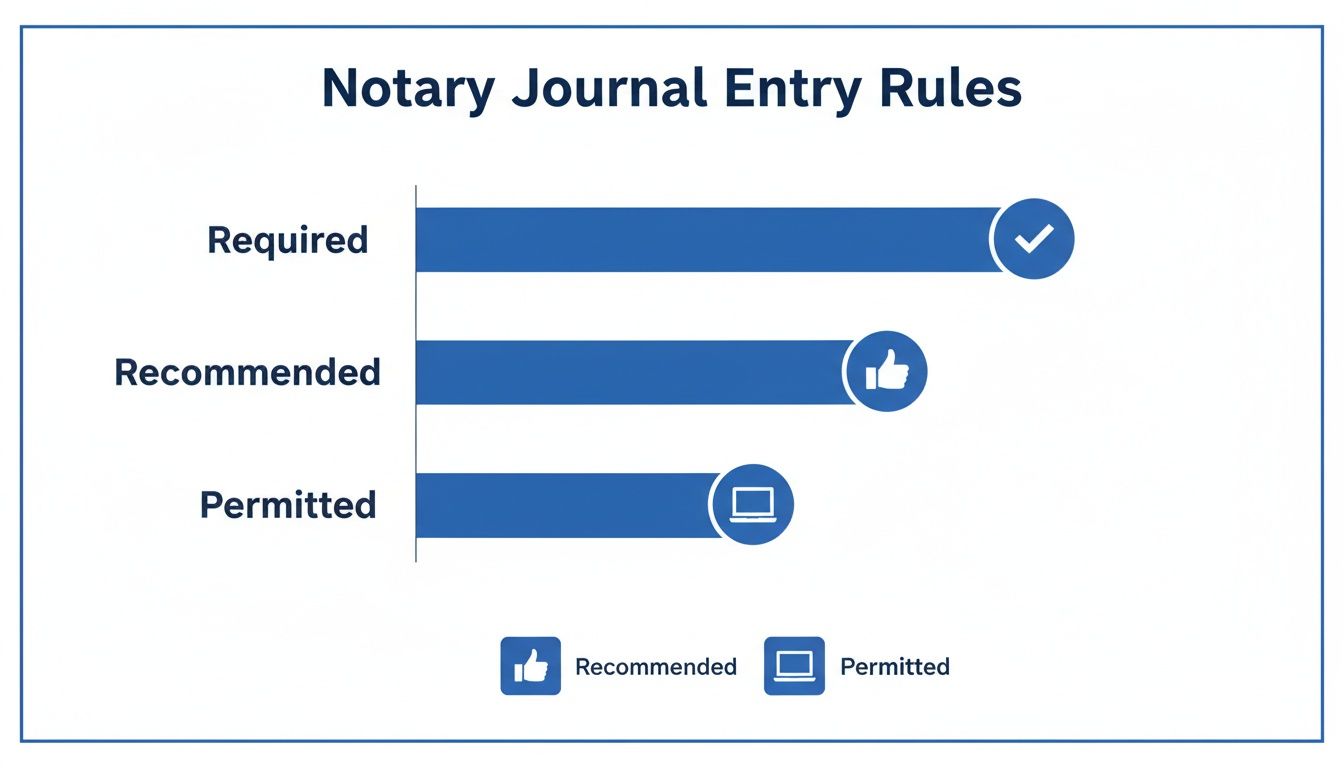
As you can see, there’s a clear trend toward making journals mandatory and embracing electronic formats. This really speaks to where the industry is headed—a digital-first approach to compliance and record-keeping.
Secure Storage for Physical and Electronic Journals
Holding onto the journal is one thing; keeping it secure is another, and it’s just as important. Your journal is filled with sensitive, non-public information, and you’re legally on the hook to protect it from being lost, stolen, or seen by unauthorized eyes.
If you’re using a traditional paper journal, that means keeping it locked up in a secure place that only you can access. Never leave it lying around in public or on a desk in a shared office. It deserves the same level of security as your official notary seal.
Electronic journals, particularly for Remote Online Notarization (RON), come with their own set of high-tech security rules. State laws usually specify that these digital records must be:
- Tamper-Evident: The platform must be able to show if any changes were made after the original entry was completed, preserving the record’s integrity.
- Securely Backed Up: You need a bulletproof method for backing up your electronic journal so a technical glitch doesn’t wipe out your records.
- Protected by Controlled Access: The system should ensure that only the notary can create or modify the entries.
Platforms like BlueNotary are built from the ground up to manage these digital requirements for you. They offer secure, cloud-based storage with encrypted backups and strict access controls, taking the heavy lifting of security and long-term storage off your shoulders.
The High Stakes of Journal Retention
Don’t underestimate the importance of these rules, because the consequences for non-compliance are severe. Retention periods are not suggestions. New Mexico, for example, demands a strict 10-year hold on all notarial records. Nationally, journals have played a key role in 78% of notary fraud prosecutions since 2015, helping authorities piece together transaction details to recover millions.
If your journal is lost or stolen, states like New Mexico require you to notify the Secretary of State immediately, and penalties can climb as high as $5,000. To get a better sense of these strict rules, you can review New Mexico’s official journal requirements on the state’s website.
Electronic Journals and Remote Online Notarization (RON)

The world of notarization has changed dramatically with the rise of digital transactions. Electronic journals aren’t just a modern perk anymore; in many cases, they’re a legal requirement. As more states give the green light to Remote Online Notarization (RON), the rules for recording these acts have become far more detailed and technical. If you’re a notary working online, getting a handle on the specific notary journal requirements by state for RON is absolutely essential.
An electronic journal for RON isn’t just a digital version of a paper logbook. It has to meet much higher security and verification standards. State regulators know that remote transactions come with unique risks, so they’ve put rules in place to protect the integrity of the digital record. This means the platform you choose needs to do more than just let you type in entries. You can get a better feel for these features by learning about what makes a compliant remote online notary platform tick.
Must-Have Technical Standards for E-Journals
When a state requires an electronic journal for RON, they’re looking for specific technical safeguards. These features are designed to create a secure, complete, and unchangeable record of the notarial act, forming the foundation of a trustworthy digital process.
Here are the features you’ll almost always see required:
- Tamper-Evident Technology: The system must have a way to show if an entry has been changed after it was saved. This is what makes the journal a reliable piece of evidence that can hold up in court.
- Secure and Redundant Backups: States will require your e-journal to be backed up reliably. You can’t risk losing your records to a computer crash or technical glitch. Most good cloud-based platforms will handle this for you automatically.
- Controlled Access and Authentication: You, the commissioned notary, should be the only person who can create and manage your journal entries. Secure login measures are a must to keep unauthorized people out.
One of the most powerful features of a RON journal is its ability to directly link each entry to the audio-video recording of the notarization itself. This creates a unified, indisputable audit trail that leaves no room for doubt about what happened during the session.
How State Rules Shape RON Journals
The widespread adoption of RON has completely changed journal requirements. Most states now authorize remote notarizations, and a huge number of them specifically demand tamper-evident electronic journals for these acts. This puts the pressure on notaries to find and use platforms that can keep their records compliant.
For instance, Arizona requires permanent electronic journals for all its RON notaries—paper journals are not an option for remote acts. Meanwhile, Virginia mandates “electronic records” for every e-notarial act.
It’s also really important to understand that some states draw a clear line between in-person and remote notarizations. Even if your state is fine with a paper journal for traditional, face-to-face signings, it will almost certainly require a secure electronic journal for any notarization you perform online. For notaries who offer both types of services, this could mean keeping two different journals—one paper, one digital—to stay compliant.
Platforms like BlueNotary are built specifically to meet these tough digital standards. They automate the creation of a compliant, secure e-journal entry for every single RON session, taking the guesswork out of compliance so you can focus on your clients.
Common Journaling Mistakes to Avoid
Even the most seasoned notaries can make small mistakes that spiral into big headaches. Your journal is your single best line of defense when a notarization is questioned, but simple errors can tank its credibility and expose you to serious liability. Let’s walk through the most common slip-ups I see, so you can avoid them entirely.
The root of most errors? Rushing. The number one mistake is failing to complete the journal entry right then and there, with the signer present. This is how you end up with missing signatures or incomplete fields—blunders that can invalidate the entire record. It’s a simple rule, but you have to stick to it every single time.
Incomplete or Vague Entries
A journal entry with holes in it is almost as bad as no entry at all. For example, just writing “ID checked” doesn’t cut it. You need to record the specific type of ID, the issuing state, the ID number, and its expiration date. This isn’t just a suggestion; this level of detail is a core part of most notary journal requirements by state.
The same goes for vague document descriptions. “Deed” tells a court nothing. Was it a “Quitclaim Deed” or a “Deed of Trust”? Be specific.
- Weak Entry: “Signed a document for John Smith.”
- Strong Entry: “John Smith, identified via Texas Driver’s License #12345, exp. 12/31/2028, signed a Power of Attorney document dated 05/15/2024.”
See the difference? One is ambiguous, while the other creates a rock-solid, verifiable record of what actually happened.
Recording Prohibited Information
While detail is key, you can also get into trouble by recording too much. Never, ever write down a signer’s full Social Security Number or a complete credit card number. This is a massive compliance failure and a huge privacy breach.
State laws are crystal clear on this. Illinois, for example, explicitly forbids notaries from recording identification numbers in their entirety. Always double-check your state’s specific rules to know exactly what is and isn’t allowed.
Here’s a pro-tip: Ditch the abbreviations. While “DL” for Driver’s License seems obvious to you, it could cause confusion down the road. To make sure your journal is easily understood by anyone, especially in a legal challenge, it’s always best practice to write out the full term.
Other Critical Errors to Watch For
A few other bad habits can destroy your journal’s integrity. Pre-filling entries before the signer even arrives is a huge no-no. You’re making assumptions about a notarization that hasn’t happened yet—details can and do change. Record the facts as they happen, not before.
Finally, failing to secure your journal is a critical misstep. This applies to a physical book left unattended on a desk just as much as an electronic journal on an unsecured computer. Improper storage is an open invitation for tampering or a data breach. Remember, you are legally on the hook for protecting the sensitive information in that journal for the entire retention period your state requires.
Making Journal Compliance Work for Your Business
Trying to keep up with the patchwork of notary journal requirements by state is a huge headache for any business, especially if you operate in more than one. You’re juggling different retention periods, unique data fields for each state, and separate rules for electronic journals. It’s a recipe for human error, and one slip-up—a missing detail in an entry or a lost journal—can lead to serious legal trouble, fines, and a hit to your company’s reputation.
This is where a dedicated digital notarization platform stops being a “nice-to-have” and becomes your core compliance tool. A platform like BlueNotary is built to automatically handle these complex rules. It embeds compliance right into the notarization workflow, so you can be confident that every transaction meets the specific legal standards for the signer’s location.
Creating Automatic, Tamper-Evident Records
With a paper journal, one of the biggest struggles is making sure every single required field is filled out correctly for every transaction. An integrated digital platform solves this problem by design. It automatically generates a complete, compliant journal entry for every notarial act, capturing all the essential information without any chance of someone forgetting a detail.
Even better, these electronic journals are designed to be tamper-evident. Once an entry is logged, any attempt to change it is immediately flagged. This isn’t just a neat feature; it’s a fundamental requirement for electronic journals in most states that permit Remote Online Notarization (RON) because it guarantees the record’s integrity.
Think of it this way: a compliant electronic journal isn’t just a digital version of a notebook. It’s a secure, verifiable record. Each entry is cryptographically sealed, giving it a level of security that a paper journal can’t hope to match and creating an audit trail that holds up under legal scrutiny.
Secure Storage That Goes Beyond State Rules
Meeting long-term storage requirements, which can be 10 years or more in many states, is a logistical nightmare with paper. Physical journals can get lost, stolen, or destroyed in a fire or flood. A well-built enterprise platform gets rid of these risks by using secure, cloud-based storage that often exceeds what the state mandates.
Here’s how a digital platform handles storage compliance:
- Automated Retention: The system automatically holds onto journal records for the legally required period, so you don’t have to manage physical archives or set calendar reminders.
- Redundant Backups: Your records are copied across multiple secure servers. This protects you from data loss if there’s a hardware failure or some other catastrophe.
- Controlled Access: Strict permissions ensure only authorized personnel can view journal entries, which is crucial for protecting your clients’ sensitive information and maintaining privacy.
A Searchable, All-in-One Audit Trail
For any business, being able to pull up a past notarization quickly is non-negotiable. The real power of a platform like BlueNotary is that it creates a complete audit trail where everything is linked together. The electronic journal entry is tied directly to the audio-video recording of the session, the documents from the identity verification process, and the final notarized document itself.
This gives you a single, searchable record. Instead of sifting through dusty boxes of old journals, your compliance team can find a specific transaction in seconds using a name, date, or document type. This is incredibly valuable for internal audits, responding to legal requests, or just confirming the details of an old transaction. It gives your business the tools to manage compliance confidently and efficiently.
Common Questions About Notary Journals
Even with a solid grasp of your state’s rules, real-world situations pop up that the statutes don’t always cover clearly. Let’s dig into some of the most frequent questions notaries ask about keeping their journals.
Getting the details right on these practical issues is just as critical as filling out your entries correctly. These scenarios test your professional responsibility and understanding of the rules that protect both you and the public.
What Happens If I Lose My Notary Journal?
Losing your journal is a big deal and you need to act fast. If your journal is lost, stolen, or just goes missing, the very first thing you must do is immediately report it to your state’s commissioning authority—usually the Secretary of State’s office.
Most states have a specific protocol and timeline for reporting a lost journal. Ignoring this can bring on serious consequences, like fines or even losing your commission. It’s also a good idea to make a note of the last entry you remember making; this can help if any fraudulent activity comes up and protects you from potential liability.
Can I Use One Journal for Different Notarization Types?
This question comes up a lot, especially for notaries who handle both traditional in-person signings and Remote Online Notarizations (RON). The short answer is: it all depends on your state’s laws.
Many states that allow RON require a completely separate, secure electronic journal for any remote notarizations. This is because eJournals have to be tamper-evident and often need to be electronically linked to the audio-video recording of the session. A standard paper journal just can’t do that.
- For Traditional Acts: Your trusty bound paper journal is typically fine.
- For RON Acts: You’ll almost certainly need a secure electronic journal built for the task.
Always double-check your state’s specific RON laws to see if you need to keep two separate journals. It’s the only way to be sure you’re compliant.
What Should I Do with My Journal When My Commission Expires?
Your duties don’t end just because your commission does. You are legally on the hook for storing your journal securely for the full retention period required by your state, which can be 10 years or even longer.
This means keeping it safe from loss, theft, and prying eyes, even after you’ve stopped notarizing. Some states even tell you exactly what to do with your journal if you retire or pass away, like turning it over to the county clerk. Whatever you do, never just throw a journal away before its time is up—it’s still an official public record.
Simplify your compliance and eliminate guesswork. BlueNotary provides a secure, all-in-one platform with automated, tamper-evident electronic journaling that meets the strictest state requirements. Learn more about how BlueNotary can protect your business and streamline your notarizations.


