
Most people discover they are unprepared at the worst possible moment. A family member falls ill. Then a storm destroys the house. A bank requests documents that no one can find. That panic is completely avoidable.
A personal document readiness plan solves this problem before a crisis hits. It tells you which documents to gather, when to update them, how to store them safely, and how to give trusted people emergency access. Think of it as a master filing system for your life.
Only 32% of Americans have a complete estate plan, according to a 2024 study by Caring.com. That means two-thirds of adults leave their families unprepared. Building a personal document readiness plan takes a few hours. Skipping it can cost your family months of stress and thousands in legal fees.
This guide covers every step: which documents you need, which require notarization, how to organize them, and how to create emergency access for the people who matter most.
What Is a Personal Document Readiness Plan?
A personal document readiness plan is a structured system for gathering, organizing, updating, and securing every critical document an adult needs. It covers legal, medical, financial, and identity records. It also defines who can access those documents in an emergency and exactly how they can do so. Without a clear plan, families lose time and money hunting for records during a crisis.
This plan does not replace an attorney or financial advisor. Instead, it ensures that all the right documents exist, they are current, and the right people can find them fast.
The Core Documents Every Adult Needs
Identity and Vital Records
Your identity documents form the foundation of your plan. Without them, you cannot replace anything else. These records include your birth certificate, Social Security card, current passport, and state-issued driver’s license or ID card.
Keep original copies in a fireproof, waterproof container at home. Store digital scans in encrypted cloud storage as a backup. If you were born outside the United States, include your naturalization certificate or permanent resident card in this group.
Marriage certificates, divorce decrees, and adoption orders belong in this category too. Vital records offices can reissue most of these documents. However, that process often takes weeks. Keeping originals on hand saves significant time and frustration.
Legal and Estate Planning Documents
This category covers the documents that protect you and your family when you cannot speak for yourself. Every adult needs four core legal documents.
A last will and testament states how you want your assets distributed after your death. It also names a guardian for minor children. Without a will, a court makes those decisions without your input.
A durable financial power of attorney gives a trusted person authority over your finances if you become incapacitated. Banks and investment firms may refuse a POA that looks outdated or incomplete. Hurley Elder Care Law recommends reviewing this document every three to five years and after any major life event.
A healthcare power of attorney designates someone to make medical decisions on your behalf. This differs from a financial POA in scope and purpose. Hospitals need this document to speak with your representative about your care.
An advance directive records your end-of-life medical wishes. It tells doctors whether you want life support, artificial nutrition, or specific interventions if you cannot communicate. Most states require either notarization or two witnesses to make this document legally valid.
Financial Documents
Gather and organize your key financial records in one place. These include bank statements, investment account summaries, retirement account details, and insurance policy documents.
For each account, record the institution name, account number, and contact information. Note the names of any listed beneficiaries. Beneficiary designations on retirement accounts and life insurance override what your will says. The Consumer Financial Protection Bureau recommends reviewing these designations after every major life event to ensure they reflect your current wishes.
Also include your two most recent tax returns. Creditors, lenders, and courts frequently request them. Two to three years of returns covers most scenarios.
Medical and Healthcare Documents
Your medical documents help providers give you the right care. They also help your family make informed decisions in a crisis.
Maintain a current medication list with dosages and the prescribing doctor’s name. Include your medical history, known allergies, and your primary care physician’s contact details. Keep copies of your health insurance cards and the full policy documents.
If you have a chronic condition, keep relevant diagnostic records in your file. These records speed up care when switching providers. They also prevent unnecessary duplicate testing.
Which Documents Require Notarization?
Not every document in your plan needs a notary. But the ones that do are often the most critical. Knowing which ones require notarization prevents serious problems later.
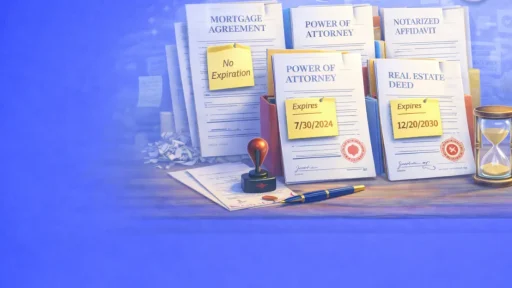
Powers of attorney nearly always require notarization. Most states also require two witnesses. If a financial institution receives a POA without proper notarization, they can legally reject it. The National Notary Association confirms that banks and lenders often apply their own signing requirements on top of state law.
Trusts must be signed and notarized to be legally valid. A trust that lacks proper execution can be challenged in court and may not hold up.
Living wills and advance directives require notarization in most states, or at least two witnesses. Requirements vary by state. Always confirm your state’s specific rules before signing.
Wills typically do not require notarization to be valid. However, adding a self-proving affidavit, a notarized statement from your witnesses, simplifies probate. It removes the need for witnesses to appear in court later.
Getting documents notarized used to mean scheduling an in-person appointment. Remote online notarization removes that barrier entirely. Through platforms like BlueNotary, you can complete legally binding notarizations from any device, without leaving home. This matters most when you need to execute estate planning documents quickly or live far from a notary office.
How to Build a Document Organization System
The Physical Filing Method
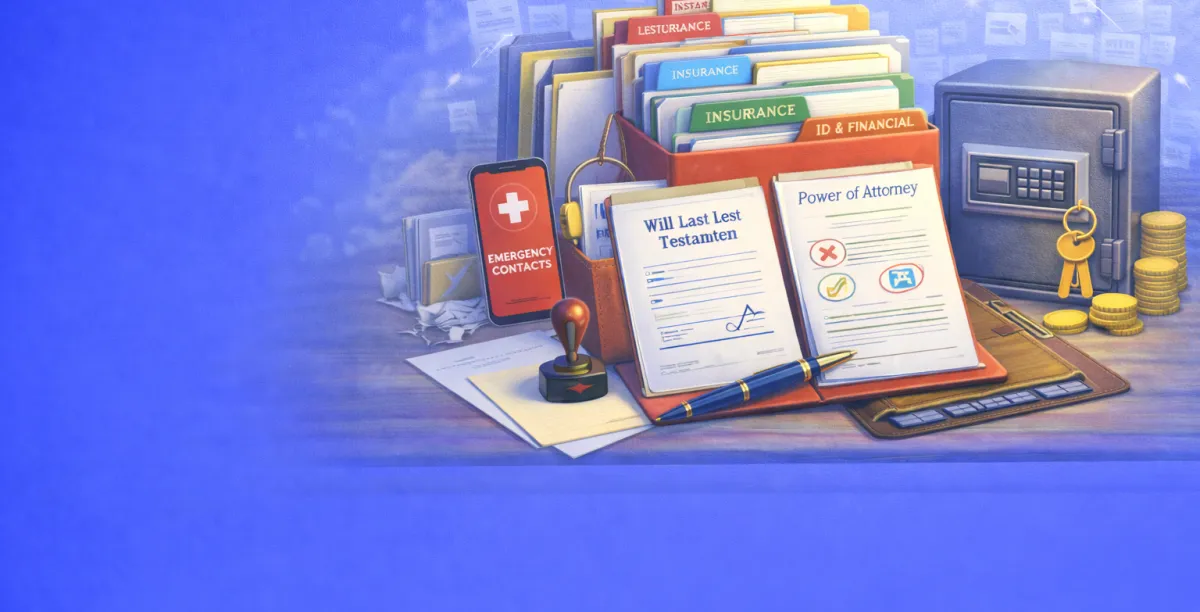
A physical document system starts with a fireproof, waterproof home safe or a lockable filing cabinet. Use labeled folders or a binder with clearly marked tabs.
Organize folders by category: Identity, Legal, Financial, Medical, Property, and Insurance. Use simple, consistent labels throughout. Do not crowd everything into one folder. The goal is to locate any document in under two minutes.
Tell your emergency contact where the safe or cabinet is located. Give them the combination or a sealed envelope with access instructions. A system only one person can open is not a system at all.
The Digital Backup Method
Scan every document in your plan and save it to an encrypted digital storage location. Google Drive, Dropbox, and Apple iCloud all offer strong encryption and two-factor authentication. Enable both on whichever platform you choose.
Name your files consistently. A format like “2025_Will_JohnSmith” works well across all document types. Group files into clearly labeled folders that mirror your physical system. Do not rely on a single digital location alone. Store a second encrypted copy on a USB drive kept in a different physical place.
Update your digital backup whenever you update a physical document. Set a calendar reminder to audit your digital files every six months. Outdated digital copies create serious confusion during an emergency.
Your Document Update Schedule: When to Review Each Document
Documents are not static. Life changes. Laws change. Relationships change. Reviewing your documents on a set schedule prevents problems from growing silently over time.
| Document | Recommended Review Frequency | Key Triggers for Immediate Update |
|---|---|---|
| Will | Every 3-5 years | Marriage, divorce, death of a beneficiary |
| Durable Financial POA | Every 3-5 years | Change of agent, illness, relocation |
| Healthcare POA | Every 3-5 years | Change of agent, divorce |
| Advance Directive | Every 5 years | Significant health change |
| Beneficiary Designations | Annually | Marriage, divorce, birth, death |
| Insurance Policies | Annually | Major asset changes, life events |
| Passport | Every 10 years (upon expiration) | Before international travel |
| Medical Records | Annually | New diagnoses, medication changes |
Many estate attorneys use a simple rule called the “6 D’s.” Review all documents after any of these triggers: a new decade, a death, a diagnosis, a divorce, a significant financial change, or a change in domicile. Any one of these events can make your existing documents legally insufficient or no longer accurate.
Emergency Access Planning: How to Help Your Family Find What They Need
Organizing your documents is only half the job. The other half is ensuring the right people can access them when you cannot guide them yourself.
Start with a one-page Emergency Access Summary. This sheet should sit at the top of your physical binder. Share a digital copy with one trusted person you have chosen in advance. It should list the location of every key document, account numbers, emergency contact names, insurance policy numbers, and your attorney’s or financial advisor’s phone number.
Tell your designated emergency contact exactly where your document system is stored. Walk them through it in person when you can. Show them how to open the safe, find the binder, and access your digital files. A verbal explanation given once is not enough on its own.
Consider using a secure digital vault service designed for estate access. Platforms built specifically for this purpose allow you to share emergency access with a verified trusted contact. According to Ready.gov, having financial and legal records accessible in a disaster significantly reduces family recovery time. A family that knows where to look and how to access your files spends their energy supporting each other, not searching for paperwork.
Review your Emergency Access Summary every time you update any document in your plan. Keep it current. An outdated access summary is nearly as harmful as having no plan at all.
What No Other Guide Covers: The Notarization Execution Gap
Most document readiness guides stop at the list. They tell you what documents to collect. Almost none address the specific problem that happens when you try to execute those documents correctly.
Here is what goes wrong in practice. An adult creates a will and a power of attorney. They do not get them notarized according to their state’s current requirements. Or they use a notary who is not authorized for that document type. Then a bank rejects the POA years later when the family needs it most.
The National Notary Association notes that financial institutions can reject a power of attorney for technical deficiencies. This happens even when the document appears complete on its face. When that rejection occurs, the family must go back to court. That process can take months and cost thousands of dollars.
The fix is direct. Before filing any document in your readiness plan, verify its notarization requirements against your current state’s law. Use a notary familiar with legal document standards in your state. If your state allows remote online notarization, use it. RON creates a video-recorded session and a tamper-evident digital seal. That level of documentation gives banks, courts, and hospitals strong confidence in the document’s legitimacy.
Do not assume a document signed ten years ago is still accepted today. State laws change. Your agent may have relocated. A document valid when signed may no longer meet the current standard of the institution reviewing it. Audit your documents not just for content but for execution quality. This is the step most readiness guides skip entirely. It is also the step that causes the most real-world failures.
Frequently Asked Questions
What is a personal document readiness plan?
A personal document readiness plan is a structured system for gathering, organizing, updating, and protecting your most critical documents. It covers legal, medical, financial, and identity records. It also defines who can access your documents in an emergency and how they can do so quickly.
What documents should every adult have at home?
Every adult needs identity records (birth certificate, passport, Social Security card), legal documents (will, durable financial POA, healthcare POA, advance directive), financial records (bank statements, insurance policies, retirement account details), and medical records (medication list, health history, insurance cards). Store originals safely and maintain a digital backup.
How often should I update my important documents?
Review your will and powers of attorney every three to five years at minimum. Update beneficiary designations annually. Revisit all documents immediately after any major life event, such as marriage, divorce, a birth, a death, a serious diagnosis, or a move to a new state.
Which documents need to be notarized?
Durable financial and healthcare powers of attorney require notarization in most states, usually alongside two witnesses. Trusts must be signed and notarized to be enforceable. Advance directives require notarization or witnesses depending on the state. Wills typically do not require notarization, but a notarized self-proving affidavit simplifies the probate process.
What is the best way to organize important documents at home?
Use a fireproof, waterproof safe or lockable filing cabinet with labeled folders organized by category: Identity, Legal, Financial, Medical, Property, and Insurance. Pair this physical system with an encrypted digital backup stored in a cloud service with two-factor authentication enabled. Review and update both systems every six months.
How do I make sure my family can access my documents in an emergency?
Create a one-page Emergency Access Summary listing each document’s location, account numbers, key contacts, and access instructions. Share it with a trusted person and walk them through the system in person. Consider a secure digital vault designed for estate access that allows controlled, verified emergency sharing.
What happens if my documents are out of date?
Banks, hospitals, and courts can refuse outdated documents. An older power of attorney may be rejected by a financial institution. An advance directive that does not meet current state law may not be honored by a hospital. Outdated beneficiary designations can also override your will and direct assets to unintended people.
Can I notarize important documents remotely?
Yes. Most states now allow remote online notarization. A notary and signer meet via live video call. The notary verifies identity electronically and applies a tamper-evident digital seal to the document. RON sessions are video-recorded, which many institutions consider more verifiable than traditional paper notarizations.
Conclusion:
A personal document readiness plan is not a one-time project. It is an ongoing system. You build it once and maintain it over time. The result is that your family never has to search for what they need during a crisis.
Start with the basics. Gather your identity records first. Create or locate your core legal documents. Organize everything by category, set a review schedule, and stick to it. Tell your trusted contact where everything is and how to access it.
When you need to get legal documents properly notarized or updated, BlueNotary makes the process simple. You complete the session online, from any device, without scheduling an in-person appointment.
Your documents protect your family. Getting your personal document readiness plan in order is one of the most practical decisions you can make as an adult.