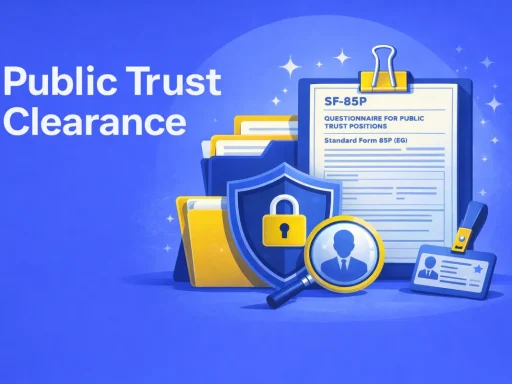


Public trust clearance is NOT a security clearance—it’s a background check for federal jobs that handle sensitive but unclassified information. The process takes 2 weeks to 6 months depending on the risk level. You’ll fill out SF-85 (low risk), SF-85P (moderate risk), or SF-86 (high risk). Here’s everything you need to know about the process, timeline, and what might disqualify you.
What Is Public Trust Clearance?
Public trust clearance is a type of background investigation required for certain federal jobs and government contractor positions. It determines whether you can be trusted to work in a “position of public trust”—jobs that involve access to sensitive information, federal systems, or responsibilities that could affect public health, safety, or finances.
Important distinction: Public trust clearance is NOT the same as a security clearance. Security clearances (Confidential, Secret, Top Secret) are for jobs requiring access to classified national security information. Public trust clearances are for positions that handle sensitive but unclassified information.
Think of it this way: A security clearance lets you see classified military documents. A public trust clearance lets you work with Social Security records, Medicare data, IRS systems, or federal IT networks—sensitive stuff, but not classified.
Who Needs Public Trust Clearance?
Public trust positions exist across many federal agencies and their contractors. Common examples include:
Government Agency Jobs
- Social Security Administration — Claims representatives, IT staff
- IRS — Customer service reps, tax examiners, IT specialists
- Centers for Medicare & Medicaid Services — Healthcare data analysts, claims processors
- Department of Health and Human Services — Various administrative and technical roles
- Veterans Affairs — Healthcare workers, benefits processors
- Federal IT positions — System administrators, network engineers, developers
Government Contractor Jobs
Many private companies that contract with federal agencies require employees to have public trust clearance. This is especially common in IT services, healthcare administration, financial services, and data management.
The Three Risk Levels of Public Trust Clearance
Public trust positions are categorized into three risk levels, each requiring a different level of investigation:
Low Risk (Tier 1)
- Form: SF-85 (Questionnaire for Non-Sensitive Positions)
- Timeline: Usually 2-4 weeks
- What they check: Basic criminal history, employment verification, education verification
- Typical jobs: Entry-level federal positions with minimal access to sensitive data
Moderate Risk (Tier 2)
- Form: SF-85P (Questionnaire for Public Trust Positions)
- Timeline: Usually 1-3 months
- What they check: Criminal history, credit history, employment history (7 years), education, references, interviews with people who know you
- Typical jobs: IT specialists, claims processors, positions with access to personal data (SSN, financial records, medical records)
High Risk (Tier 4)
- Form: SF-86 (same form used for security clearances)
- Timeline: Usually 3-6 months (sometimes longer)
- What they check: Everything in moderate risk PLUS more extensive interviews, 10-year history review, deeper financial investigation, foreign contacts
- Typical jobs: Senior IT roles, positions with major policy influence, jobs affecting public health/safety, financial systems administrators
How to Apply for Public Trust Clearance: Step by Step
You don’t apply for public trust clearance on your own—your employer (or prospective employer) initiates the process. Here’s how it works:
Step 1: Get a Job Offer
The process starts when you receive a job offer for a position that requires public trust clearance. The offer is usually contingent on you successfully obtaining clearance.
Step 2: Complete the Appropriate Form
Your employer will tell you which form to complete:
- SF-85 for Low Risk positions
- SF-85P for Moderate Risk positions
- SF-86 for High Risk positions
You’ll fill this out through e-QIP (Electronic Questionnaires for Investigations Processing), an online system. The form asks about your personal history, employment, education, residences, references, foreign contacts, and more.
Step 3: Background Investigation
The Defense Counterintelligence and Security Agency (DCSA) or another authorized agency conducts the investigation. They’ll verify the information you provided and may contact your references, former employers, neighbors, and others who know you.
Step 4: Interview (If Required)
For moderate and high-risk clearances, an investigator may interview you in person. They’ll ask about anything that needs clarification—gaps in employment, financial issues, foreign contacts, or any discrepancies in your application.
Step 5: Adjudication
After the investigation, an adjudicator reviews all the information and decides whether to grant or deny clearance. They consider the “whole person” concept—looking at your entire history and circumstances, not just individual issues.
Step 6: Notification
You’ll receive written notification of the decision. If denied, you have the right to appeal.
What Can Disqualify You from Public Trust Clearance?
There’s no automatic disqualification for most issues—adjudicators look at the whole picture. But certain factors raise red flags:
Criminal History
- Recent convictions are more concerning than old ones
- Crimes of dishonesty (fraud, theft, forgery) are particularly problematic for trust-based positions
- Violent crimes raise serious concerns
- Drug offenses depend on recency, severity, and rehabilitation
Mitigating factors: Time passed since offense, evidence of rehabilitation, circumstances of the crime, age at the time
Financial Problems
- Significant debt — especially if you’re not making payments
- Bankruptcy — recent bankruptcies are more concerning
- Tax liens or unpaid taxes — this is a big red flag for government positions
- Collections accounts — especially if ignored
- Gambling problems — suggests poor judgment and potential vulnerability
Mitigating factors: Active payment plans, circumstances beyond your control (medical bills, job loss), financial counseling, improved financial situation
Drug Use
- Illegal drug use — recency matters significantly
- Marijuana — still federally illegal; recent use is problematic
- Drug trafficking or manufacturing — very difficult to overcome
Mitigating factors: Passage of time (generally 1-3 years minimum for marijuana, longer for harder drugs), treatment completion, changed lifestyle, no intention to use again
Dishonesty on the Application
This is often worse than the underlying issue. If you lie or omit information on your SF-85/85P/86 and investigators discover it, that dishonesty itself can disqualify you—even if the original issue might have been mitigated.
Bottom line: Be honest. Disclose everything. It’s better to explain an issue than to be caught hiding it.
Other Concerns
- Foreign influence — close ties to foreign nationals or governments
- Employment problems — being fired for misconduct, unexplained gaps
- Mental health issues — only if they affect judgment or reliability (seeking treatment is NOT disqualifying)
- Alcohol abuse — DUIs, treatment history, current drinking habits
Tips for Getting Approved
1. Be 100% Honest
Disclose everything, even if it’s embarrassing. Investigators will likely find it anyway, and lying is often worse than the underlying issue. Use the “Additional Comments” sections to explain circumstances.
2. Gather Information Before Starting
Before filling out e-QIP, collect:
- Addresses for everywhere you’ve lived (7-10 years)
- Employment history with supervisor names and contact info
- Names and contact info for references
- Details of any financial issues, arrests, or other reportable events
- Foreign travel dates and details
3. Address Problems Proactively
If you know you have issues (bad credit, old arrest), start addressing them now. Set up payment plans, get documentation of rehabilitation, gather character references. Show that you’ve taken responsibility.
4. Choose Good References
Select people who know you well and can speak to your character, reliability, and trustworthiness. Give them a heads-up that investigators may contact them. Don’t list family members unless specifically requested.
5. Respond Quickly to Requests
If investigators ask for additional information, provide it promptly. Delays on your end extend the process and can look bad.
How Long Does Public Trust Clearance Last?
Public trust clearances typically need to be reinvestigated every 5 years (though this can vary by agency and position). During reinvestigation, you’ll complete updated forms and go through a similar process.
Your clearance is tied to your position. If you leave the job, the clearance doesn’t automatically transfer. A new employer requiring public trust clearance may be able to use your existing investigation (reciprocity) or may need to conduct a new one.
Documents You May Need for Public Trust Clearance
During the public trust clearance process, you may need various supporting documents. Some situations require notarized documents, including:
- Name change documentation — Court orders, marriage certificates
- Sworn statements — Affidavits explaining circumstances
- Financial documentation — Payment agreements, debt settlement letters
- Character references — Sometimes need to be notarized
Need Documents Notarized? BlueNotary Can Help
If you need any documents notarized for your public trust clearance application—affidavits, sworn statements, or supporting documentation—BlueNotary offers convenient online notarization.
With BlueNotary:
- Connect with a licensed notary over video call
- Get documents notarized in about 15 minutes
- No need to leave your home or office
- Available 24/7—don’t let notarization delay your application
Need to notarize documents for your clearance application? Visit BlueNotary to get started.
Frequently Asked Questions
What is public trust clearance?
Public trust clearance is a background investigation for federal jobs that handle sensitive but unclassified information. It’s not a security clearance—it’s for positions of trust that don’t require access to classified national security information.
How long does public trust clearance take?
It depends on the risk level: Low risk (SF-85) typically takes 2-4 weeks. Moderate risk (SF-85P) takes 1-3 months. High risk (SF-86) can take 3-6 months or longer.
Can I get public trust clearance with bad credit?
Possibly. Bad credit isn’t automatically disqualifying, but it raises concerns about financial responsibility. Having a payment plan, showing improvement, or demonstrating that circumstances were beyond your control (medical bills, job loss) can help mitigate the issue.
Can I get public trust clearance with a criminal record?
It depends on the nature and recency of the offense. Minor, old offenses with evidence of rehabilitation may not disqualify you. Serious crimes, crimes of dishonesty, or recent offenses are more problematic. Each case is evaluated individually.
Will marijuana use disqualify me?
Recent marijuana use can be disqualifying since it’s still federally illegal. Generally, you need at least 1-3 years of abstinence, though there’s no official bright-line rule. Be honest about past use and demonstrate you’ve stopped.
What’s the difference between public trust and security clearance?
Security clearances (Confidential, Secret, Top Secret) are for access to classified national security information. Public trust clearances are for positions handling sensitive but unclassified information. The investigation processes are similar, but they serve different purposes.
What forms do I fill out for public trust clearance?
SF-85 for Low Risk positions, SF-85P for Moderate Risk positions, or SF-86 for High Risk positions. You’ll complete these through the e-QIP online system after receiving a job offer.
How far back does the background check go?
For SF-85P (moderate risk), they typically look at 7 years of history for employment, residence, and most issues. SF-86 (high risk) looks at 10 years. Some questions (like felony convictions) may ask about your entire lifetime.
Can I appeal if I’m denied?
Yes. If denied, you’ll receive a Statement of Reasons explaining why. You can respond to the concerns, provide additional documentation, and request reconsideration. The appeals process varies by agency.
Do I need to be a U.S. citizen?
Generally, yes. Most public trust positions require U.S. citizenship. Some positions may be available to lawful permanent residents or have specific immigration status requirements. Check the job posting for specific requirements.
The Bottom Line
Public trust clearance is a background investigation—not a security clearance—required for federal jobs and contractors handling sensitive unclassified information. The process examines your reliability, trustworthiness, and judgment.
The key things to remember:
- Three risk levels: Low (SF-85), Moderate (SF-85P), High (SF-86)
- Timeline: 2 weeks to 6 months depending on level
- Honesty is critical: Lying is often worse than the underlying issue
- Most issues can be mitigated: Time, rehabilitation, and changed circumstances matter
- Reinvestigation every 5 years: Maintain your eligibility by continuing to live responsibly
If you have concerns about your background, address them proactively. Get documentation, set up payment plans, gather character references. The “whole person” concept means adjudicators consider your entire situation—one issue doesn’t automatically disqualify you.
Need to notarize supporting documents for your clearance application? BlueNotary offers fast, convenient online notarization.