

Last updated: May 2026
Remote online notarization (RON) allows you to get documents legally notarized through a live video session with a commissioned notary public, using multi-factor identity verification and digital signatures that carry the same legal weight as in-person notarization. The process takes 15–30 minutes, works in over 45 states, and eliminates the need to travel to a notary's office. This article explains how RON works, what it costs, which documents qualify, and how to complete your first session.
If you've heard the term "RON" thrown around and aren't sure what it means, how it works, or whether your document qualifies, this article covers all of it — including what it costs and how to actually get started.
What Is Remote Online Notarization?
Remote online notarization (RON) is the process of having a document notarized by a commissioned notary public through a live, two-way audio-video session conducted entirely online. The signer, the notary, and any witnesses are connected via a secure platform — no one needs to be in the same room, or even the same state.
The notary verifies your identity through multi-factor authentication, witnesses your electronic signature in real time, and then applies a digital notarial seal to the document. That seal is cryptographically tied to the document, meaning any tampering afterward is detectable.
RON is distinct from a simple electronic signature. An e-signature is just a digital version of your handwritten name. Remote online notarization adds the notary's official certification — the same legal weight as an in-person notarization, delivered through a screen.

How Does Remote Online Notarization Work?
The process is more structured than a regular video call. Here's what actually happens during a remote online notarization session:
Upload your document: You submit the document through a RON platform like BlueNotary before the session begins. The platform converts it into a signable digital format.
Verify your identity: This is the most important step. You'll complete knowledge-based authentication (KBA) — a series of questions pulled from your personal records that only you should know. You'll also photograph your government-issued ID, which the system scans for security features.
Connect with the notary: You join a live video session with a commissioned notary public. Both of you can see and hear each other in real time. The notary confirms your identity and witnesses the signing.
Sign electronically: You apply your electronic signature to the document while the notary watches. The session is recorded and stored as part of the official record.
Notary applies the digital seal: The notary applies their official digital certificate and seal. This cryptographically locks the document — any post-signing changes are automatically flagged.
Receive your completed document: The finalized, notarized document is delivered to you digitally, usually within minutes of the session ending.
The entire process typically takes 15–30 minutes from start to finish, including identity verification.
Is Remote Online Notarization Legal?
The answer is yes — in most of the United States. As of 2026, over 45 states have enacted laws specifically authorizing remote online notarization. The remaining states either have emergency provisions or are in the process of passing permanent legislation.
Federal law also supports RON. The Electronic Signatures in Global and National Commerce Act (ESIGN) established that electronic records and signatures carry the same legal weight as their paper counterparts, laying the groundwork for RON's legal validity.
One important nuance: state laws vary. Some states require the notary to be commissioned in that state. Others allow notaries to serve signers located anywhere. In our work with clients on remote online notarization, we've consistently seen that platforms like BlueNotary handle this compliance layer automatically — you don't need to research which state's rules apply to your transaction.
Documents notarized through RON are also recognized across state lines under full faith and credit principles, meaning a document notarized in Virginia can be used in California.
Remote Online Notarization vs. Traditional Notarization
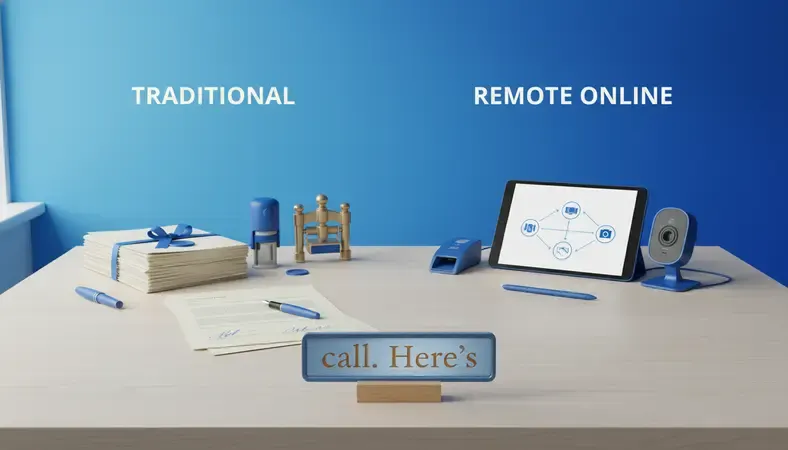
Both methods produce the same legal result — a notarized document that courts, lenders, and government agencies will accept. The differences are about process, convenience, and security features.
Side-by-Side Comparison
| Feature | Remote Online Notarization | Traditional In-Person Notarization |
|---|---|---|
| Location required | Anywhere with internet | Must be physically present |
| Scheduling | Often same-day or on-demand | Requires appointment |
| Identity verification | Multi-factor (KBA + ID scan + video) | Visual ID check only |
| Document format | Digital | Physical paper |
| Session recording | Yes — stored as legal record | No recording |
| Tamper detection | Built into digital seal | Not available |
| Turnaround time | Minutes | Hours to days |
| Geographic limits | None (within authorized states) | Must be in same location |
The security case for remote online notarization is actually stronger than traditional notarization in several ways. A notary checking a physical ID can't detect a sophisticated fake. RON platforms run the ID through automated verification software and require the signer to answer personal questions — a much harder bar to clear.
What Documents Can Be Notarized Online?
Most documents that can be notarized in person can also be notarized through remote online notarization. Common examples include:
- Real estate documents: Deeds, mortgage refinances, purchase agreements, and closing documents
- Legal documents: Powers of attorney, affidavits, sworn statements, and court-related templates
- Estate planning: Wills, trusts, and advance healthcare directives
- Business documents: Contracts, partnership agreements, and commission agreements
- Financial documents: Loan documents, promissory notes, and authorization forms
- Personal documents: Consent forms, name change documents, and vehicle titles
There are some exceptions. Certain states restrict RON for specific document types — some wills and trusts, for example, may require witnesses to be physically present in addition to the notary. A few document categories (certain immigration forms, some government filings) have separate federal requirements that may not accommodate RON yet.
When in doubt, the platform you use should flag any restrictions before you schedule a session.
How to Get a Document Notarized Online
The practical steps are straightforward. Here's how to go from "I need this notarized" to "done":
Prepare your document: Have the document ready as a PDF or Word file. Don't sign it yet — the notary needs to witness your signature in real time.
Choose a RON platform: BlueNotary (bluenotaryonline.com) is one option built specifically for this. Look for a platform that's compliant with your state's RON laws and offers on-demand notary availability.
Create an account and upload your document: Most platforms take a few minutes to set up. Upload your document and specify what type of notarization is needed (acknowledgment, jurat, etc.).
Complete identity verification: Before the session, you'll answer KBA questions and photograph your ID. This step happens on the platform, not during the video call.
Connect with a notary: Schedule a session or join an on-demand queue. You'll be connected via video with a commissioned notary public.
Sign and receive your document: Sign during the session. The notary seals it digitally. Your completed, notarized document arrives in your inbox or document dashboard.
The only technical requirements are a device with a camera and microphone, a stable internet connection, and a valid government-issued ID.
Remote Online Notarization Costs and Fees
Remote online notarization typically costs between $25 and $50 per notarization. That's comparable to in-person notary fees when you factor in travel time and scheduling hassle.
Here's how pricing generally breaks down:
- Per-session fees: Most platforms charge per notarization, not per document page. A single session covering multiple signatures on one document usually counts as one notarization.
- Subscription plans: High-volume users — title companies, law firms, real estate agents — often get better rates through monthly or annual plans.
- Platform fees vs. notary fees: Some platforms bundle both; others separate the platform fee from the notary's fee. Read the pricing page carefully.
- Rush or on-demand premiums: Immediate sessions sometimes cost slightly more than scheduled ones.
Key Insight: Many states cap notary fees by law, but those caps often apply only to the notary's portion — not the platform's service fee. The total cost you see on a RON platform may be higher than the state-mandated notary fee alone.
For individuals doing a one-time notarization, the per-session model works fine. Our team has reviewed dozens of business RON implementations, and the pattern is clear: for businesses processing dozens of documents monthly, a platform with volume pricing makes more financial sense.
Common Questions About Remote Online Notarization
Can I use remote online notarization if I'm outside the United States?
Yes, in most cases. Many RON platforms allow signers located abroad to complete a session, as long as the notary is commissioned in a U.S. state that permits international signers. The document itself must be intended for use under U.S. law. You'll still need a valid, unexpired government-issued ID and a device with a camera and microphone.
How long does a remote online notarization session take?
Most sessions run 10–20 minutes once identity verification is complete. The identity verification step (KBA questions and ID scan) adds another 5–10 minutes before you connect with the notary. Budget 30 minutes total for your first session.
Is the video recording stored permanently?
RON platforms are required by law in most states to retain session recordings for a minimum period — typically 5–10 years depending on the state. The recording serves as the official journal entry for the notarial act, replacing the paper journal a traditional notary keeps.
Can a notarized document from a RON session be rejected?
A properly executed remote online notarization should be accepted anywhere a traditional notarization is accepted. Rare rejections happen when the receiving party (a foreign government, for example) doesn't recognize electronic notarizations, or when a specific document type has additional requirements the RON session didn't meet. Always confirm requirements with the receiving party before scheduling.
What's the difference between RON and IPEN?
RON (remote online notarization) happens entirely online — notary and signer are in different locations. IPEN (in-person electronic notarization) means the notary and signer are physically together, but they use electronic documents and digital signatures instead of paper. Both are legal in most states, but RON offers the location flexibility that most people are actually looking for.
Key Takeaways
Remote online notarization delivers the same legal result as in-person notarization — with stronger identity verification, a built-in audit trail, and no travel required. It's legal in over 45 states and accepted across state lines for most document types.
Written by the BlueNotary team — Remote Online Notarization Platform practitioners. Ready to get started? Visit BlueNotary to learn more.