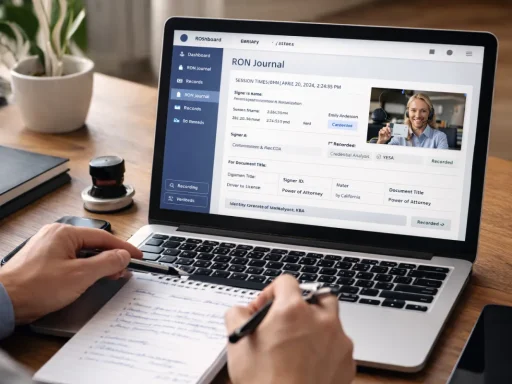
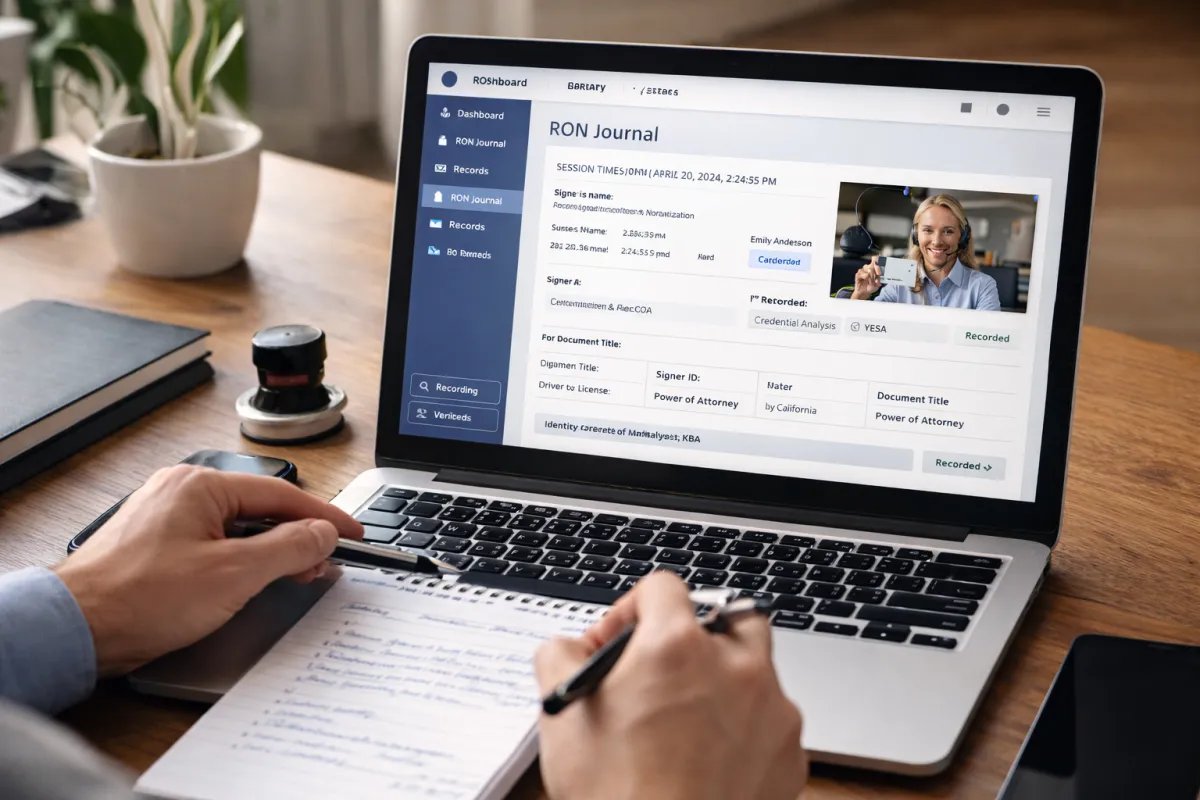

A remote online notarization (RON) journal is a digital record of every notarization performed via video call. It includes the signer’s identity verification, document details, date and time, and an audio-video recording of the session. Most states require RON notaries to maintain these journals for 5-10 years. Here’s what must be recorded, how it differs from traditional notary journals, and what platforms handle automatically.
What Is a Remote Online Notarization Journal?
A remote online notarization journal is the official record a notary keeps of every online notarization they perform. Unlike traditional paper journals, RON journals are entirely digital and include something paper can’t: an audio-video recording of the actual signing session.
Every time a notary witnesses a signature via video call, they must document specific information about the transaction. This creates a verifiable trail that protects the notary, the signer, and anyone who relies on the notarized document.
The journal serves two main purposes: compliance with state laws and protection against fraud claims. If someone later disputes a notarization, the journal (including the video recording) provides evidence of exactly what happened.
What Must Be Recorded in a RON Journal?
State requirements vary, but most RON journals must include:
Signer Information
- Full legal name of each signer
- Signer’s address (physical location at time of signing)
- Type of ID used (driver’s license, passport, state ID)
- ID number, issuing state/country, and expiration date
- Identity verification method used (credential analysis, knowledge-based authentication)
Document Information
- Type of document (power of attorney, deed, affidavit, etc.)
- Description or title of the document
- Number of pages (some states)
Notarization Details
- Date and time of notarization
- Type of notarial act (acknowledgment, jurat, oath, copy certification)
- Fee charged
- Notary’s digital signature and seal
Audio-Video Recording
This is the key difference from traditional journals. Most states require RON notaries to record the entire video session—from identity verification through signing. The recording must capture:
- The signer’s face and voice
- The identity verification process
- The notary asking required questions (“Are you signing willingly?”)
- The actual signing of the document
- The notary applying their digital seal
RON Journal vs. Traditional Notary Journal
Traditional Paper Journal
- Handwritten entries in a bound book
- Signer’s physical signature in the journal
- Thumbprint (required in some states)
- No recording of the session
- Stored by the notary (risk of loss, damage, theft)
RON Digital Journal
- Electronic entries created automatically by the platform
- Digital signatures
- Full audio-video recording of session
- Identity verification records (credential analysis, KBA results)
- Tamper-evident audit trail
- Stored securely in the cloud (encrypted, backed up)
State Requirements for RON Journals
Each state that permits remote online notarization has its own journal requirements. Here are common variations:
Retention Period
How long must you keep RON journal entries and recordings?
- 5 years: Arizona, Colorado, Idaho, Indiana, Nevada, Ohio, Oklahoma, Tennessee, Utah
- 7 years: Montana, North Dakota
- 10 years: Florida, Michigan, Minnesota, Texas, Virginia, Washington
- Varies: Some states have different periods for journals vs. recordings
Recording Requirements
- Required: Most RON states mandate audio-video recording
- Optional: A few states allow but don’t require recording
- Storage: Must be kept in a secure, tamper-evident format
Identity Verification Documentation
Most states require the journal to document which identity verification methods were used:
- Credential analysis: Software verifies the ID is genuine (checks security features, not expired)
- Knowledge-based authentication (KBA): Signer answers questions about their background (previous addresses, loans, etc.)
- Biometric verification: Facial recognition matching signer to their ID photo (some states)
How RON Platforms Handle Journaling
Good news: RON platforms handle most journal requirements automatically. When you use a platform like BlueNotary, the system:
- Records the session automatically — Video starts when the session begins
- Captures signer information — Name, address, ID details from the verification process
- Logs identity verification — Credential analysis results, KBA pass/fail
- Timestamps everything — Date, time, duration of session
- Stores records securely — Encrypted, backed up, tamper-evident
- Maintains retention compliance — Keeps records for required period
This automatic journaling is a major advantage over traditional notarization, where the notary must manually record everything.
Accessing RON Journal Records
Who Can Access?
- The notary: Can access their own journal entries and recordings
- State authorities: Secretary of State or notary regulating agency can audit records
- Courts: Can subpoena records if notarization is challenged
- Signers: May request copies of their own session records (varies by state)
When Records Are Needed
- Fraud investigations: Video proves whether signer appeared willingly
- Forgery claims: Recording shows who actually signed
- Competency questions: Video can show signer’s mental state during signing
- Identity disputes: Credential analysis and KBA records prove verification
- State audits: Regulators can verify notary compliance
Notary Responsibilities
Even though platforms automate most journaling, RON notaries still must:
- Use an approved RON platform — Must meet state technology requirements
- Verify identity properly — Follow state-required verification methods
- Confirm willingness — Ask if signer is signing voluntarily (on recording)
- Ensure recording quality — Make sure audio and video are clear
- Maintain access to records — Know how to retrieve journal entries if needed
- Comply with retention requirements — Ensure records are kept for required period
The Bottom Line
A remote online notarization journal is your official record of every online notarization—and it’s more comprehensive than any paper journal. The audio-video recording requirement creates an evidence trail that protects everyone involved.
Key takeaways:
- RON journals are digital and include audio-video recordings
- Most states require 5-10 year retention
- RON platforms automate most journal requirements
- Recordings can be accessed for audits, court cases, and fraud investigations
- Notaries must ensure compliance with state-specific requirements
Looking for a RON platform that handles journaling automatically? BlueNotary manages recording, storage, and compliance—so you can focus on performing notarizations.
Frequently Asked Questions
What is a remote online notarization journal?
A digital record of every notarization performed via video call. It includes signer information, document details, identity verification records, and an audio-video recording of the session. Required by most states that allow RON.
How long must RON journal records be kept?
Depends on your state. Most require 5-10 years. Florida, Texas, Virginia, and several others require 10 years. Check your state’s RON laws for specific requirements.
Do I have to record every RON session?
Most states require audio-video recording of the entire session. A few states make it optional. The recording must capture identity verification, the notary’s questions, and the actual signing.
Who stores the RON journal—the notary or the platform?
The RON platform typically stores journal entries and recordings securely. The notary maintains access and is responsible for ensuring records are kept for the required retention period. If you change platforms, you may need to transfer records.
Can signers request a copy of their RON session recording?
Policies vary by state and platform. Some states allow signers to request copies of their own sessions. Check your state’s laws and your platform’s policies for specifics.
What happens to RON records when a notary’s commission expires?
Records must still be maintained for the required retention period. Most platforms continue storing records after commission expiration. Some states require notaries to transfer records to the Secretary of State or a successor notary.