



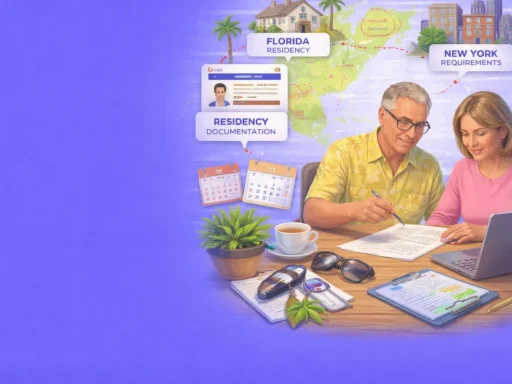


You spend October through April in Scottsdale. May through September in Minneapolis. Your driver’s license says Arizona. Voter registration says Minnesota. Your will was drafted under Minnesota law. Your healthcare directive sits at your Arizona condo. And your financial power of attorney was executed with one witness and a notary — which met Minnesota’s requirements but may not satisfy Arizona’s.
Your adult daughter needs to use that power of attorney at your Arizona bank while you recover from surgery. The bank refuses it. They need an Arizona-compliant document with two witnesses and a notary. You are in a hospital bed. You cannot sign new documents. The bill for your medical transport is due in 48 hours.
This is not an edge case. It is the most common legal crisis snowbirds face, and it is almost entirely preventable.
Domicile vs. Residency: The Distinction That Determines Everything
You can have residences in multiple states. You can only have one domicile. This distinction controls which state taxes your income, which state taxes your estate when you die, which state’s laws govern your will, and which state’s courts have primary jurisdiction over your legal affairs.
What Domicile Means
Domicile is the one state you consider your permanent home — the place you intend to return to whenever you leave. It is determined by a combination of objective facts and subjective intent. No single factor is decisive. Tax authorities, courts, and auditors look at the totality of your circumstances.
The five primary factors that states evaluate are where you spend the most time, which home is larger and more valuable, where your sentimental and high-value personal possessions are kept, where your active business interests are maintained, and where your spouse and minor children (if any) reside.
The 183-Day Rule and Its Traps
Most high-tax states use a 183-day rule for statutory residency. If you maintain a permanent place of abode in the state and spend 183 or more days there during a tax year, the state considers you a resident for income tax purposes — regardless of where your domicile is.
This creates a trap for snowbirds. Even if you successfully establish domicile in Florida (no income tax), spending 183 or more days in New York means New York can tax your full income as if you never left. And New York counts any part of a day spent in the state as a full day. A morning flight out of JFK on June 15 means June 15 counts as a New York day.
The practical implication is clear: track your days in each state meticulously. Use a calendar, a spreadsheet, or a location-tracking app. Save airline boarding passes, hotel receipts, toll records, and credit card statements that document your physical location. In an audit, vague recollections do not hold up. Documented evidence does.
Establishing Domicile in a No-Tax State
If you are moving your domicile from a high-tax state to Florida, Texas, Arizona, or another tax-favorable state, take affirmative steps that demonstrate intent. File a Declaration of Domicile with the county clerk in your new state (Florida requires this and many snowbirds use it). Obtain a driver’s license in the new state and surrender your old one. Register to vote in the new state and cancel your registration in the old state. Register your vehicles in the new state. Use the new state address on your federal tax return, bank accounts, brokerage accounts, insurance policies, and all official correspondence.
Make the new-state home your primary residence in every measurable way. The home in your domicile state should ideally be the larger and more valuable of the two. Move sentimental items, family heirlooms, and valuables to the domicile-state home. Transfer your primary banking relationships, safe deposit boxes, and religious or community organization memberships.
Northern states with estate taxes — New York, New Jersey, Connecticut, Massachusetts, Illinois, Minnesota, and others — have financial incentives to claim you as a resident. Their auditors are sophisticated and increasingly use digital tracking methods including cell phone geolocation records, E-ZPass toll data, and credit card transaction histories to challenge domicile claims. The burden of proof rests on you.
Legal Documents That Cause Multi-State Problems
Not all legal documents travel well across state lines. Some are recognized everywhere with minimal friction. Others are routinely challenged, questioned, or rejected when presented in a state other than where they were executed.
Powers of Attorney: The Biggest Problem Area
Powers of attorney create the most headaches for snowbirds because they are heavily state-specific. Each state sets its own execution requirements — how many witnesses are needed, whether notarization is mandatory, what specific language the document must contain, and what powers the agent can exercise.
About 65% of states mandate notarization for financial powers of attorney. The remaining states technically allow witnesses as an alternative, but a 2025 American Bar Association study found that 82% of financial institutions reject powers of attorney that lack notarization, even in states where witnesses alone are legally sufficient.
The execution requirements vary significantly. Florida, Iowa, Kansas, Kentucky, Maryland, North Carolina, and Utah require both two witnesses and a notary. California, Michigan, South Dakota, and Washington require either notarization or two witnesses (but not necessarily both). Many other states require either two witnesses or a notary. Some states also require the agent to sign alongside the principal.
For snowbirds, the practical solution is to execute every power of attorney with above-minimum formalities. Even if your home state only requires one witness, sign with two witnesses and a notary. This approach meets the requirements of virtually every state and reduces the chance of a bank or institution refusing to honor the document.
Better yet, consider executing separate powers of attorney for each state where you spend significant time. A Florida financial POA for your Florida bank accounts and property, and a New York financial POA for your New York accounts and property. Each document follows the execution rules of the state where it will be used. Keep both sets current. Ensure the agents named in each document understand which one applies where. And do not allow one POA to inadvertently revoke the other — make sure the language in each document preserves the validity of the other.
Healthcare Directives
Healthcare directives — living wills, healthcare proxies, and medical powers of attorney — create different problems. A directive executed in Minnesota may not be recognized at an Arizona hospital. Arizona may require specific statutory language that the Minnesota form does not contain. The Arizona hospital’s legal department may not be familiar with Minnesota’s healthcare directive laws and may refuse to act on an unfamiliar document during a medical emergency.
The stakes here are life and death. If your healthcare directive is not honored in the state where you need emergency medical care, your wishes may be overridden.
Execute healthcare directives that comply with both states’ laws. Many attorneys who serve snowbird clients draft directives using language that satisfies the requirements of both the home state and the winter state. Alternatively, carry two separate directives — one for each state — with clear instructions about which applies where.
Keep physical copies of your healthcare directives in both homes, in your wallet or purse (a folded summary card with your agent’s contact information), and accessible to your named healthcare agent in digital format.
Wills and Trusts
Wills generally travel better than powers of attorney. Most states recognize wills that were validly executed under the law of the state where they were signed. If your will met Minnesota’s requirements when you signed it in Minnesota, Arizona will usually recognize it.
However, snowbirds who own real property in both states face a specific risk: ancillary probate. When you die, your will goes through probate in your domicile state. But real estate located in another state must go through a separate probate process in that state — called ancillary probate. This means double the legal fees, double the court proceedings, and months of additional delays for your family.
The solution is a revocable living trust. Property titled in the name of your trust passes outside of probate entirely. If your Minnesota home and your Arizona condo are both held in your trust, neither requires probate in either state. Your successor trustee manages both properties under the terms of the trust without court involvement.
State-Specific Notarization Requirements for Snowbirds
Notarization requirements vary by state. Understanding the differences prevents documents from being rejected when you present them in your other state.
Execution Formalities by State
Each state sets its own rules for who can notarize, what identification the notary must verify, and what additional formalities are required. Most states require the signer to appear before the notary and present a valid government-issued photo ID. Some states require the notary to keep a journal of all notarizations performed. Others do not.
For snowbirds, the critical variable is witness requirements. Some documents (particularly powers of attorney and real estate deeds) require witnesses in addition to notarization. The number of witnesses and whether they must be disinterested (unrelated to the signer and not named in the document) varies by state.
When executing a document that will be used in multiple states, default to the most stringent requirements. Two disinterested witnesses plus notarization satisfies the requirements of virtually every state. It takes a few extra minutes and costs nothing additional, but it can prevent a document from being rejected months or years later when you actually need it.
Remote Online Notarization Across State Lines
RON adds a layer of convenience for snowbirds. You can notarize a document through a RON platform regardless of which state you are physically in at the time. The notarization complies with the law of the notary’s commissioning state, not the state where you happen to be sitting.
This means a snowbird in their Arizona condo can use a RON platform with a Florida-commissioned notary to notarize a document for use in Florida. Or a snowbird in their Minnesota home can notarize closing documents for an Arizona property sale through a RON platform with an Arizona-commissioned notary.
More than 45 states now authorize RON. Documents notarized through RON are valid across the United States under the Full Faith and Credit Clause. RON platforms operate 24/7, eliminating the need to coordinate notarization appointments with your seasonal schedule.
For snowbirds, RON solves the timing problem that has plagued seasonal residents for decades. You no longer need to schedule all your notarizations during the narrow window when you are physically present in the right state. You can handle documents for either state from either location, at any time.
Timing Your Notarizations Strategically
Smart snowbirds do not wait for document needs to arise. They anticipate them and schedule notarizations around their seasonal migration pattern.
The Pre-Migration Document Review
Before each seasonal move, review all your legal documents. Are your powers of attorney current? Has your healthcare directive been reviewed in the last two to three years? Are there any anticipated real estate transactions, financial changes, or legal matters in the coming months that might require notarized documents?
Execute or refresh any documents that are due for renewal before you leave. If you are heading to Arizona in October, notarize your Arizona-specific documents in September while you are still in Minnesota (using RON if needed). If you are returning to Minnesota in May, handle Minnesota-specific documents in April while you are still in Arizona.
This front-loading approach means you always arrive in each state with current, properly executed documents. You are never scrambling to find a notary at the last minute — or worse, trying to get a document notarized in the wrong state.
The Annual Document Audit
Once a year, conduct a thorough audit of every legal document in your portfolio. Check that each document is still current and accurate. Verify that named agents, executors, and trustees are still willing and able to serve. Confirm that both states’ requirements are met. Update any documents that reference addresses, account numbers, or other details that have changed.
Schedule this audit for the same time each year — many snowbirds find that late summer (before the fall migration south) works well. It becomes a routine part of your seasonal transition rather than an emergency response to a crisis.
Emergency Notarization Planning
Despite the best planning, emergencies happen. A medical crisis, an unexpected real estate issue, or a legal matter can require notarized documents on short notice.
Know your options in advance for both states. Identify a mobile notary in each location who can come to you on short notice. Have your RON platform account set up and tested — do not wait until an emergency to create an account and figure out the technology. Keep your U.S. passport or driver’s license current and accessible for identity verification.
If you are hospitalized or physically incapacitated, your healthcare agent or financial power of attorney agent may need to act on your behalf. But they can only act if the documents granting them authority are current, properly executed, and accepted by the institutions where they need to act. This circles back to the same point: prepare documents before you need them, not during a crisis.
What No Other Guide Covers: The Institutional Acceptance Gap
Every snowbird guide discusses which state’s laws apply to which documents. None of them address the practical problem that actually causes the most grief: institutional rejection of legally valid documents.
How the Gap Works
Your power of attorney is perfectly legal. It was executed under Minnesota law with proper witnesses and notarization. It grants your daughter authority to manage your financial accounts. Minnesota law is clear. The document is valid.
But your Arizona bank has its own internal policies. The compliance department has a checklist. They want a POA executed on their specific form. Want it signed within the last 12 months. They want Arizona-specific language. They want a certification from an attorney stating the POA is currently in effect and has not been revoked.
None of these requirements are mandated by Arizona law. They are internal bank policies designed to reduce the bank’s liability. But when your daughter presents the document, the branch manager shrugs and says their legal department will not approve the transaction without their requirements being met. Review takes two to three weeks. Your medical transport bill is due in 48 hours.
This gap between legal validity and institutional acceptance is the single most frustrating problem snowbirds encounter. A document can be 100% legal and still be 0% useful if the institution you need to use it with will not accept it.
How to Close the Gap
First, execute documents using the highest possible formality. Two witnesses, notarization, and an attorney certification (a statement from your attorney confirming the document was validly executed and remains in effect) satisfies most institutional requirements in both states.
Second, proactively provide your powers of attorney to every financial institution where you have accounts — before you need them. Walk into your Arizona bank in October, present the POA, ask them to review it and place a copy on file. If they have objections, you can address them while you are still healthy and present. Do the same at your Minnesota bank before you leave in the fall.
Third, ask each institution whether they have their own POA form. Many banks and brokerage firms do. If possible, execute their form in addition to your general POA. It takes 15 extra minutes and eliminates the institutional acceptance problem entirely for that specific institution.
Fourth, refresh your POA every two to three years. Even if the law does not require it, institutions are more comfortable with recent documents. A POA signed last year gets far less pushback than one signed eight years ago.
Finally, include a provision in your POA that explicitly references the Uniform Power of Attorney Act (UPOAA). States that have adopted the UPOAA require institutions to honor properly executed POAs and impose liability on institutions that wrongfully refuse. Even if the institution is not familiar with the provision, an attorney’s letter citing it often resolves the dispute quickly.
Tax Implications of Getting Residency Wrong
The financial consequences of a failed domicile change can be enormous, particularly for retirees in high-tax states.
Income Tax Exposure
If New York successfully claims you as a statutory resident (183 days plus a permanent place of abode), you owe New York income tax on your entire worldwide income — even if your domicile is Florida. For a retiree with $200,000 in annual income from pensions, Social Security, and investments, New York income tax can exceed $12,000 per year.
New York’s top income tax rate for individuals is among the highest in the country. Add New York City’s additional income tax for city residents, and the combined rate exceeds 12% on high incomes. The potential annual savings for a snowbird who successfully establishes Florida domicile can range from $5,000 to $30,000 or more depending on income level.
Estate Tax Exposure
The stakes are even higher at death. New York imposes an estate tax on estates valued above $6.94 million (as of 2025), with rates up to 16%. New Jersey repealed its estate tax in 2018 but continues to impose an inheritance tax on transfers to non-lineal heirs. Massachusetts taxes estates above $2 million. Connecticut, Illinois, and Minnesota also impose estate taxes at varying thresholds.
Florida has no state estate tax and no state income tax. Successfully establishing Florida domicile can save an estate hundreds of thousands of dollars in state estate taxes alone.
But if your domicile documentation is inconsistent — if you kept your Minnesota voter registration, your Minnesota driver’s license, and your Minnesota club memberships — the northern state’s tax authority can challenge your Florida domicile claim and impose estate taxes as if you never left. Your family then faces a contested domicile dispute during probate, with attorneys in two states, audits of your daily location records, and potential double taxation on your estate.
Notarized Declarations and Residency
Several documents that support your domicile claim benefit from notarization. Florida’s Declaration of Domicile, filed with the county clerk, should be notarized. An affidavit of residency — a sworn statement of your intent to make the new state your permanent home — carries more weight when notarized. Letters to your former state canceling voter registration and surrendering your driver’s license should be sent by certified mail and copied for your records.
Create a residency binder — a physical or digital collection of all documents supporting your domicile claim. Include your Declaration of Domicile, your new-state driver’s license, voter registration confirmation, vehicle registrations, daily travel logs, and copies of all correspondence with your former state. Notarize the affidavit of residency and include it in the binder. Update the binder annually.
Frequently Asked Questions
Can my power of attorney from one state be used in another state?
Generally yes, under the Full Faith and Credit Clause of the U.S. Constitution. However, individual institutions (banks, hospitals, brokerages) may refuse to honor it if it does not meet their internal requirements or the second state’s execution standards. For maximum acceptance, execute every POA with two witnesses and a notary, even if your home state requires less.
How many days can I spend in my northern state without triggering tax residency?
Most high-tax states use a 183-day rule. Spending fewer than 183 days in the state generally avoids statutory residency. However, some states count any part of a day as a full day. Track your days carefully and maintain documentation of your physical location through travel receipts, flight records, and toll records.
Do I need separate healthcare directives for each state?
It is strongly recommended. Healthcare directives are state-specific, and a hospital in your winter state may not recognize an out-of-state form during an emergency. Execute directives that comply with both states’ laws, or carry two separate state-specific directives with clear instructions about which applies where.
Can I use remote online notarization for documents in either state?
Yes. RON platforms operate across state lines. A snowbird in Arizona can use RON with a Florida-commissioned notary for Florida documents, or vice versa. More than 45 states authorize RON, and documents notarized through RON are recognized nationwide. This eliminates the need to time notarizations around your seasonal schedule.
What is ancillary probate and how do I avoid it?
Ancillary probate occurs when you own real estate in a state other than your domicile state. At death, that property must go through a separate probate process in the state where it is located. A revocable living trust avoids this entirely. Property titled in the trust passes outside of probate, regardless of which state it is in.
How often should I update my legal documents as a snowbird?
Review all legal documents annually — powers of attorney, healthcare directives, wills, and trusts. Refresh powers of attorney every two to three years, even if nothing has changed. Institutions are more comfortable with recent documents. Update documents immediately after major life events such as marriage, divorce, death of a named agent, or significant changes to your financial situation.
What should I bring to a notarization appointment as a snowbird?
Bring a valid government-issued photo ID (U.S. passport or current driver’s license), the unsigned document to be notarized, and any witnesses required by the state’s execution standards. For powers of attorney, bring both the principal and the agent if possible. If using RON, ensure you have a stable internet connection, a camera-equipped device, and your ID ready for credential analysis.
Can a northern state still tax me if I establish Florida domicile?
Yes, if you trigger statutory residency by spending 183 or more days there and maintaining a permanent place of abode. Domicile and statutory residency are separate concepts. You can have Florida domicile and still owe income tax to New York if you spend too many days in New York. Track your days, maintain documentation, and consult a tax professional familiar with multi-state residency.
Conclusion:
Splitting your life between two states doubles the sunshine. It also doubles the legal complexity. Every power of attorney, healthcare directive, will, and trust must work in both states — not just technically, but practically, at the moment you actually need it, at the institution where you present it, in the state where the emergency happens.
The snowbirds who avoid crises are the ones who prepare before the crisis arrives. They execute documents with above-minimum formalities. Carry state-specific versions of critical documents. They pre-register their powers of attorney with every bank and brokerage. Tack their days in each state like accountants. They review and refresh their documents annually. And they test their notarization access — RON account, mobile notary contacts, document copies — before they ever need it in an emergency.
Your seasonal migration should feel like freedom, not a legal minefield. Build the document infrastructure once, maintain it annually, and the paperwork takes care of itself while you enjoy the weather in whichever state has the better forecast.
For a RON platform that lets you notarize documents for either state from either location with 24/7 availability, BlueNotary provides remote online notarization designed for the multi-state realities of seasonal living.