




If you’ve ever signed a legal document before a notary public, you may have encountered the term “jurat.” But what is a jurat, and why is it essential in legal proceedings? A jurat is a critical component of notarization that adds legal weight to sworn statements and affidavits. Understanding jurats is vital whether you’re executing an affidavit, sworn declaration, or any document requiring oath-based verification. With modern conveniences like Blue Notary Online, getting jurat notarizations has become easier and more accessible than ever before.
This comprehensive guide explains what a jurat is, its purpose, how it differs from acknowledgments and affidavits, and which documents require this type of notarization.
What is a Jurat?
A jurat is a notarial certificate attached to or included in a document in which the signer swears or affirms that the contents of the document are true and correct. The term “jurat” comes from the Latin word “jurare,” which means “to swear.”
Key Elements of a Jurat
A jurat contains several essential components:
- Venue: The location (state and county) where the notarization takes place
- Sworn statement: Language indicating the signer took an oath or affirmation
- Signer’s signature: Made in the physical or virtual presence of the notary
- Date of notarization: When the oath was administered
- Notary’s signature and seal: Official attestation by the notary public
- Notary’s commission details: Name, commission number, and expiration date
What is a Jurat Notary?
A jurat notary refers to a notary public performing jurat notarizations. When acting as a jurat notary, the notary public must:
- Witness the signer sign the document in their presence
- Administer an oath or affirmation to the signer
- Verify the signer’s identity through acceptable identification
- Complete the jurat certificate with all required information
- Affix their official seal and signature
What is the Main Purpose of a Jurat?
The main purpose of a jurat is to verify under oath that the contents of a document are truthful. Specifically, jurats serve several critical functions:
Primary Functions
- Oath administration: The signer swears or affirms the document’s truthfulness under penalty of perjury
- Legal accountability: Creates legal consequences for making false statements
- Identity verification: Confirms the signer’s identity through proper documentation
- Signature witnessing: Ensures the signature is genuine and made voluntarily
- Evidentiary value: Adds weight to documents used in legal proceedings
The sworn nature of a jurat makes it particularly important for court filings, affidavits, and depositions where truthfulness is paramount.
What is a Jurat Example?
Understanding what is a jurat example helps clarify how these certificates appear on documents.
Standard Jurat Format Example
State of California,
County of Los Angeles,
Subscribed and sworn to (or affirmed) before me on this _____ day of _______, 20___,
by _________________________ (name of signer), proved to me on the basis of
satisfactory evidence to be the person who appeared before me.
_________________________________
Signature of Notary Public
[NOTARY SEAL]
_________________________________
Name of Notary Public (typed or printed)
My commission expires: __________
What is a Jurat in California?
What is a jurat in California specifically? California has statutory requirements for jurat wording under California Government Code Section 8202. A California jurat must include:
- The specific venue (county and state)
- Statement that the document was “subscribed and sworn to (or affirmed)”
- Proof of identity based on “satisfactory evidence”
- Date of notarization
- Notary’s signature and official seal
- Notary’s printed name and commission expiration
California distinguishes between “sworn” (religious oath) and “affirmed” (non-religious declaration), giving signers the choice based on personal preference.
Common Jurat Examples in Practice
- Affidavits: Sworn statements of fact
- Depositions: Testimony taken under oath outside of court
- Sworn declarations: Statements replacing oral testimony
- Verification of pleadings: Court documents requiring oath
- Immigration documents: I-9 forms and certain visa applications
What is a Jurat in an Affidavit?
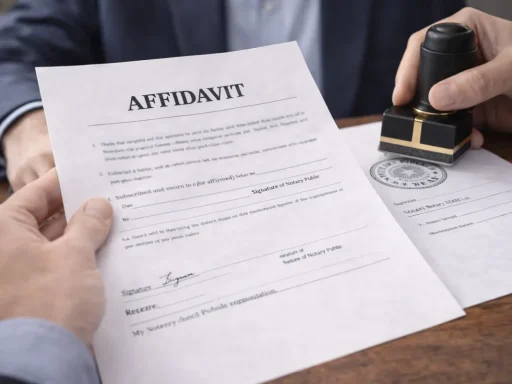
What is a jurat in an affidavit? This is where the jurat’s importance becomes most evident. An affidavit is a written statement made under oath, and the jurat is the notarial certificate that validates this oath.
Jurat’s Role in Affidavits
In an affidavit, the jurat:
- Appears at the end of the document
- Confirms the affiant (person making the affidavit) swore to the document’s truthfulness
- Provides notarial certification that proper procedures were followed
- Makes the affidavit admissible as evidence in legal proceedings
- Subjects the affiant to perjury charges if statements are false
An affidavit without a properly executed jurat may not be accepted by courts or other legal authorities.
What is a Jurat in Court?
What is a jurat in court context? Courts rely heavily on jurats to ensure the integrity of submitted documents.
Court Applications
- Affidavits of service: Proving documents were properly served
- Financial affidavits: Income and asset disclosures in family law
- Witness statements: Written testimony submitted to court
- Motions and petitions: Supporting sworn statements
- Probate documents: Executor affidavits and inventories
Courts require jurats because they:
- Deter false statements through perjury consequences
- Provide evidentiary reliability
- Maintain procedural integrity
- Protect the judicial system from fraudulent filings
What is a Jurat in Law?
From a legal perspective, what is a jurat in law means understanding its binding nature and consequences.
Legal Implications
- Perjury liability: False statements in jurat-notarized documents can result in criminal prosecution
- Evidentiary weight: Jurat documents carry presumption of truthfulness
- Admissibility: Properly executed jurats make documents admissible in legal proceedings
- Contractual validity: Some agreements require jurat notarization for enforceability
- Regulatory compliance: Many government filings mandate jurat notarization
Making a false statement in a document with a jurat can lead to perjury charges, fines, and imprisonment.
Acknowledgment vs Jurat: Key Differences
A common confusion is the difference between acknowledgment vs jurat. While both are notarial acts, they serve different purposes.
Comparison Table
| Aspect | Jurat | Acknowledgment |
| Oath required | Yes, signer swears to truthfulness | No oath required |
| Signature timing | Must sign in notary’s presence | Can sign before appearing |
| Purpose | Verifies content truthfulness | Verifies signature authenticity |
| Common uses | Affidavits, depositions, sworn statements | Deeds, contracts, powers of attorney |
| Wording | “Subscribed and sworn to before me” | “Acknowledged before me” |
| Identity verification | Required in all states | Required in all states |
When to Use Each
Use a jurat when:
- Content truthfulness needs verification
- Document will be submitted to court
- Oath or affirmation is legally required
- Making sworn statements
Use an acknowledgment when:
- Verifying signature identity only
- Executing deeds or property transfers
- Signing contracts and agreements
- No oath is necessary
What is the Difference Between a Jurat and an Affidavit?
What is the difference between a jurat and an affidavit? This is a critical distinction:
Affidavit vs. Jurat
- Affidavit: The actual document containing sworn statements of fact
- Jurat: The notarial certificate attached to the affidavit proving it was sworn to
Relationship: An affidavit requires a jurat to be legally valid. The jurat is the notary’s certification that the affidavit was properly executed under oath.
Analogy: Think of an affidavit as a letter and the jurat as the postmark that validates when and where it was sent.
What Documents Require a Jurat?
Understanding what documents require a jurat helps ensure proper notarization.
Common Documents Requiring Jurats
- Legal affidavits: All types of sworn statements
- Depositions: Out-of-court sworn testimony
- Verification of pleadings: Court filings requiring oath
- Sworn financial statements: Loan applications, bankruptcy filings
- Immigration forms: Certain I-9 and visa documents
- Administrative hearing documents: Government agency proceedings
- Sworn inventories: Estate and probate matters
- Medical affidavits: Disability claims, insurance matters
- Statutory declarations: When specifically required by law
- Certifications under penalty of perjury: Tax documents, government forms
Industry-Specific Requirements
- Real Estate: Rarely requires jurats (acknowledgments more common)
- Legal: Most affidavits and court documents
- Financial: Loan modifications, fraud affidavits
- Immigration: Sponsorship affidavits, declaration forms
- Corporate: Shareholder resolutions, corporate affidavits
Jurat Notarization Process
Step-by-Step Procedure
- Document review: Notary reviews the document to ensure it’s complete
- Identity verification: Signer presents valid government-issued ID
- Oath administration: Notary asks if signer swears/affirms truthfulness
- Signature witnessing: Signer signs document in notary’s presence
- Certificate completion: Notary completes jurat certificate
- Seal affixing: Notary applies official seal and signature
- Record keeping: Notary logs transaction in journal
Modern Online Jurat Notarization
With remote online notarization (RON), jurats can now be completed virtually:
- Video conference with notary
- Identity verification through credential analysis
- Electronic signature and seal
- Secure digital recording of session
- Fully legal and accepted in most states
Best Practices for Jurat Documents
- Never pre-sign: Always sign in the notary’s presence
- Bring valid ID: Government-issued photo identification required
- Read before signing: Understand what you’re swearing to
- Complete all blanks: No information should be left incomplete
- Keep copies: Maintain records of all notarized documents
- Verify notary credentials: Ensure notary is properly commissioned
- Check requirements: Confirm jurat is the correct notarial act needed
Conclusion
So, what is a jurat? It’s a powerful notarial certificate that validates sworn statements under oath, creating legal accountability and evidentiary weight for important documents. Understanding the difference between acknowledgment vs jurat, knowing when jurats are required, and recognizing their role in affidavits and court proceedings empowers you to handle legal documents correctly.
Whether you’re executing an affidavit, submitting court documents, or completing any sworn statement, the jurat ensures your document meets legal standards and carries the weight of truthfulness. For convenient and secure jurat notarization services, Blue Notary offers professional online notarization that meets all legal requirements, making the process simple and accessible from anywhere.
Remember, a properly executed jurat isn’t just a formality—it’s your sworn promise of truthfulness with real legal consequences. Always take this responsibility seriously and ensure your jurat documents are executed correctly.