






When you buy a house, a lot of attention goes to the price, the inspections, and the mortgage. But behind the scenes, there’s a crucial player making sure the property you’re buying is actually yours to own, free and clear. That’s the title company.
So, what is a title company? Think of them as the unsung heroes of the real estate world—part private investigator, part insurance agency, and part neutral referee, all rolled into one. Their entire job is to protect your property rights.
The Unseen Guardian of Your Property Purchase

A title company’s main mission is to dig into a property’s past, looking for skeletons in the closet. These could be old debts, lingering ownership disputes, or other legal claims that could threaten your ownership down the road. They find these issues before you buy, then protect you and your lender from any surprises that might pop up later.
This idea isn’t new. The first title insurer was actually established way back in 1876 in Pennsylvania, born out of the need to protect buyers from mistakes and hidden problems in public land records. Today, it’s a massive industry, with the U.S. title insurance market projected to hit around $17.1 billion in 2025. You can get a better sense of the title insurance market size on ibisworld.com.
Three Core Functions of a Title Company
To really get what a title company does, it helps to break down their work into three key services. Each one is a critical step toward a smooth, secure closing.
- The Title Search: This is the detective work. Title professionals dive deep into public records—deeds, mortgages, court judgments, tax records—to confirm the seller has the legal right to sell the property to you.
- Title Insurance: This is your safety net. After the search, the company issues insurance policies that protect both you (the owner) and your lender from financial loss if a title problem is ever discovered in the future.
- Escrow and Closing Services: A title company usually acts as the impartial third party that handles all the money and paperwork. They hold the buyer’s funds and the seller’s deed in a secure account until every condition of the sale has been met. For a deeper dive, check out our guide on what it means to be in escrow.
To make it even clearer, here’s a simple breakdown of these essential functions.
Core Functions of a Title Company at a Glance
| Core Function | What It Is | Why It Matters |
|---|---|---|
| Title Search | A thorough investigation of a property’s public records and legal history. | It uncovers hidden issues like liens, unpaid taxes, or ownership disputes before you buy. |
| Title Insurance | An insurance policy that protects the owner and lender from future title claims. | It provides financial protection against unforeseen legal problems with your ownership rights. |
| Escrow & Closing | Acting as a neutral third party to manage the exchange of funds and documents. | It ensures that all money, keys, and legal documents are transferred correctly and securely on closing day. |
These three pillars work together to ensure a safe and legitimate transfer of property.
In essence, a title company provides peace of mind. They confirm that the property you are about to purchase is free from any legal entanglements, ensuring that once you get the keys, the home is unequivocally yours.
What a Title Company Actually Does: The Four Core Jobs
While we can talk about the big picture, the real work of a title company boils down to four distinct, essential services. Think of them as the four legs of a table—each one is critical to supporting the entire real-tangle transaction and making sure it doesn’t wobble or collapse later on.
These services work in a specific order, building on one another to get you from an accepted offer to a set of keys in your hand. Let’s walk through them: the title search, title insurance, escrow and closing, and finally, the disbursement.
1. The Title Search: Digging Into the Property’s Past
The first thing a title company does is launch a title search. This is basically a deep-dive investigation into the property’s history. A title professional, sometimes called an abstractor, heads to the public records—courthouse files, county land records, tax archives—and starts pulling every document tied to that specific piece of land.
This isn’t just about seeing who owned it last. They’re on the hunt for anything that could cause trouble for a new owner. These “defects” or “clouds” on the title can be surprisingly common. They’re looking for things like:
- Unpaid property taxes or liens from a contractor who was never paid for a new roof.
- A forgotten heir from a previous owner who could suddenly show up with a valid claim to the property.
- Clerical errors, forgeries, or inconsistencies in old deeds that muddle who legally owns what.
- Old mortgages that were paid off but never officially recorded as satisfied.
Finding these problems upfront gives the seller a chance to fix them before you sign on the dotted line, preventing a legal nightmare down the road.
2. Title Insurance: Your Shield Against the Unknown
After the title search is done and any obvious issues are cleared up, the next step is title insurance. This is a common point of confusion. Unlike homeowner’s insurance that protects you from future events like a fire, title insurance protects you from the past.
It’s a one-time premium you pay at closing, and it acts as a financial shield against any title defects that might have been missed in the initial search—or ones that are impossible to find, like a forged signature on a 50-year-old document.
There are two kinds of policies, and it’s crucial to know the difference:
- Lender’s Policy: Your mortgage lender will almost certainly require this. It protects their investment in your property. If a title issue pops up, the lender is covered up to the amount of the loan.
- Owner’s Policy: This one is for you. It protects your financial stake—your down payment and your equity—for as long as you or your heirs own the property.
An owner’s policy is your ultimate safety net. Without it, a surprise claim from an unknown party could force you into a costly legal battle or, in the worst-case scenario, lead to losing your home entirely.
3. Escrow and Closing: The Neutral Zone for the Big Exchange
Next up are the escrow and closing services. Here, the title company steps into the role of a neutral third party. They become the official “escrow agent” or “closing agent,” creating a secure holding area for all the money, documents, and instructions involved in the sale.
Think of them as the trusted intermediary. They hold all the critical pieces of the puzzle in a secure escrow account until every single condition in the purchase agreement has been met. This includes:
- The buyer’s earnest money and down payment funds.
- The loan documents and money wired from the lender.
- The signed deed from the seller.
This process ensures a fair exchange. The seller doesn’t hand over the deed until they know the money is secure, and the buyer doesn’t part with their money until they know the title is ready to be legally transferred to them.
4. Disbursement: Making Sure Everyone Gets Paid
The final act is the disbursement. Once all the paperwork is signed, sealed, and delivered, and the new deed is on its way to be officially recorded with the county, the title company puts on its accountant hat. Their job is to make sure every dollar goes exactly where it’s supposed to go.
Following the settlement statement (like the Closing Disclosure) with precision, the closing agent pays everyone involved. They’ll pay off the seller’s remaining mortgage, cut checks for the real estate agents’ commissions, settle any outstanding property taxes, and finally, wire the net proceeds to the seller. This final, meticulous step ensures the transaction is closed out cleanly and correctly, with a clear paper trail for every penny.
From Contract to Keys: A Closing Timeline
Getting your purchase agreement signed is an incredible feeling, but it’s really just the starting gun for the closing process. As soon as that ink is dry, the title company springs into action, orchestrating a complex series of steps to get you to closing day. The whole journey usually takes somewhere between 30 and 60 days.
This timeline gives you a bird’s-eye view of the major milestones.
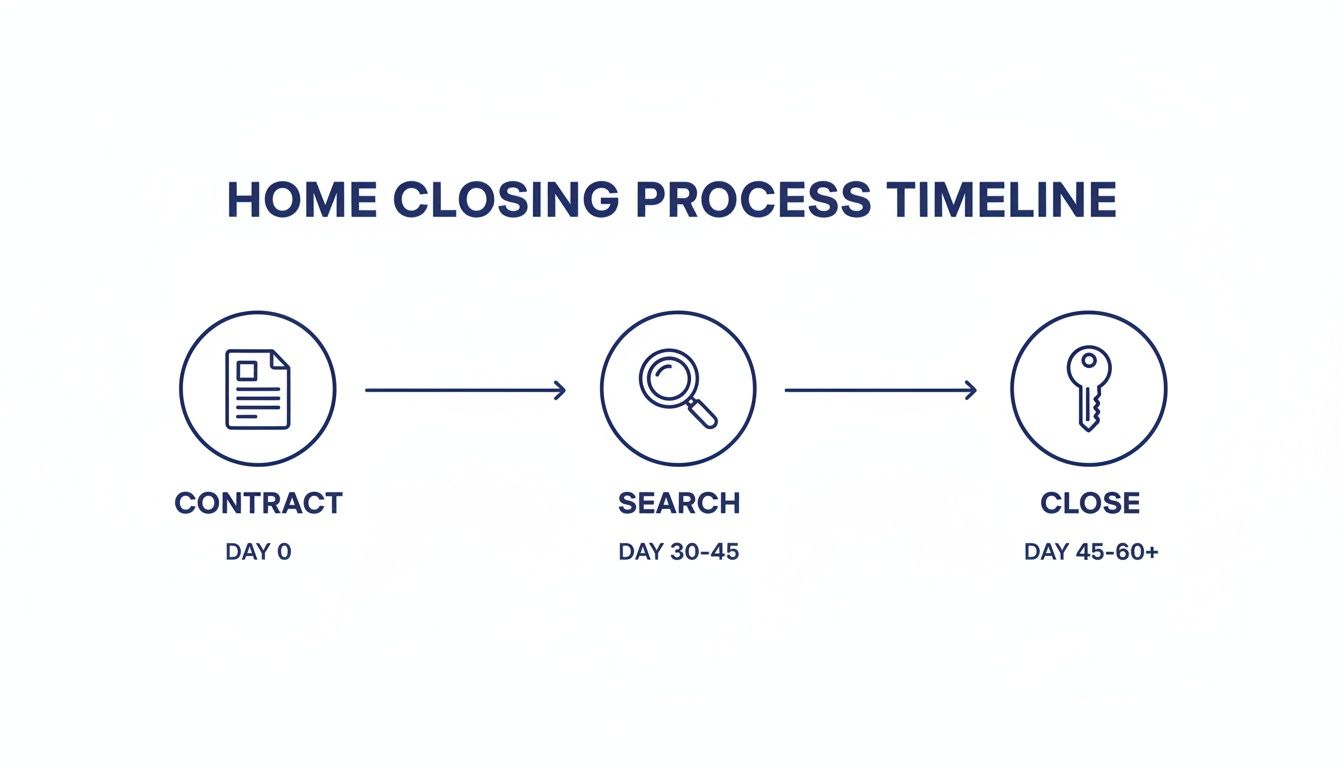
As you can see, the process flows from the initial handshake on the contract, through the nitty-gritty title search, and finally to the closing table where the keys change hands.
Opening Escrow and Digging into the Title Search
Once the buyer and seller have both signed the contract, a copy is whisked off to the title company to officially open escrow. At this point, they’ll set up a secure, neutral account and take in the buyer’s earnest money deposit. This is the official kickoff.
Right away, the real detective work begins. The title company orders a full title search, which means digging through decades of public records tied to the property. This is easily the most labor-intensive part of the job, as examiners are on the hunt for anything that could throw a wrench in the works, from forgotten mortgages to surprise liens.
Clearing the Path and Prepping for Closing Day
If the search does turn up a problem—what we call a “cloud” on the title—the title company shifts into problem-solving mode. They’ll work directly with the seller to clear the title. This could mean anything from settling an old contractor’s bill to tracking down an ex-spouse for a signature on a release form.
With a clean title in hand, the focus turns to preparing the mountain of paperwork for the big day. The title company coordinates with the buyer’s lender to get the final loan package and meticulously prepares the settlement statement. One of the most important documents you’ll see is the Closing Disclosure (CD), which by law must be sent to the buyer at least three business days before closing to review all the final numbers.
The Closing Disclosure is a five-page, government-standardized form that spells out every last detail of your mortgage. It confirms your loan terms, breaks down your monthly payments, and lists all the fees and costs you’ll pay to finalize the loan.
The Big Day: Closing and Recording the Deed
Closing day is when everyone gathers to sign the final documents. Traditionally, this happens at the title company’s office, but new tools like Remote Online Notarization are making this more flexible. A closing agent will expertly guide everyone through the stack of papers, making sure every signature and initial is exactly where it needs to be.
After the last signature is down and all the money has been wired and accounted for, the title company has one last, crucial job: recording the deed. They take the newly signed deed and mortgage to the county recorder’s office to be officially entered into the public record. This is the legal act that officially makes you the new owner, completing your journey from contract to keys.
Tackling the Problems a Title Search Can Uncover

Ideally, every title search comes back perfectly clean. But in the real world, it’s common to find snags that can complicate or even stop a sale in its tracks. These issues are often called “title defects” or “clouds,” and this is where a great title company really shines—shifting from investigator to expert problem-solver.
These problems are more frequent than most people think, running the gamut from simple clerical errors to messy legal disputes. Thankfully, most can be fixed with the right expertise. Think of the title search as just one piece of the puzzle; it fits into a larger framework of due diligence. This comprehensive real estate due diligence checklist gives a great overview of the whole process.
Unraveling Liens and Unpaid Debts
One of the most common issues uncovered is an outstanding lien. Simply put, a lien is a legal claim a creditor has on a property because of an unpaid debt. This gives them the right to force a sale to get the money they’re owed.
Let’s say the title search finds a contractor’s lien from a kitchen remodel done five years ago. The title company will flag this for the seller, who is responsible for paying it off. Once paid, the title professionals get a “lien release” from the contractor and file it publicly, which officially clears that debt from the property’s record.
A few other common liens include:
- Unpaid property taxes: The title company ensures all overdue taxes are paid out of the seller’s proceeds at closing.
- Mortgage liens: They work with the seller’s lender to pay off the existing mortgage so the title is free and clear for the new owner.
- Child support or IRS liens: These more serious liens absolutely must be settled before the property can legally change hands.
Correcting Errors and Gaps in Ownership
Sometimes, the problem isn’t a debt but bad paperwork. Public records aren’t perfect, and a small mistake from decades ago can create big questions about who truly owns the property today.
A simple typo in a legal description or a misspelled name on a past deed can create a “break in the chain of title,” making it unclear who legally owns the property.
When something like this happens, the title company’s legal team might file a corrective deed to fix the mistake in the public record. In more complicated cases—like finding an unknown heir who never signed off on a sale—the team has to play detective, tracking that person down to sign a quitclaim deed and give up any potential claim.
Another classic issue is discovering an unknown easement. This gives another party the right to use a piece of your property for a specific purpose. For instance, the local utility company may have a legal right to access power lines in the backyard. The title company identifies these easements so the buyer knows exactly what limitations exist before they sign on the dotted line. With their expertise, even the most tangled title issues can be resolved, clearing the path for a smooth closing.
How Technology Is Modernizing the Closing Process
If you picture a real estate closing, you probably imagine a stuffy conference room with a mountain of paperwork waiting to be signed. For decades, that’s exactly what it was. But that scene is quickly becoming a thing of the past.
The industry is finally trading in its paper-filled briefcases for secure digital platforms. This shift is making the entire closing process faster, safer, and a whole lot more convenient for everyone involved. For a modern title company, this isn’t just about adding a few new tools; it’s a fundamental change in how they operate.
What was once a purely administrative, paper-pushing role has transformed into a tech-forward hub for managing one of the biggest transactions of your life. And it’s working—the U.S. title insurance industry saw its net operating gain improve by 39.1% year over year, a success largely driven by this digital evolution. You can get a closer look at these changes in this overview of key industry trends for 2025.
The Biggest Game-Changer: Remote Online Notarization (RON)
Without a doubt, the single biggest leap forward is Remote Online Notarization (RON). This technology lets a commissioned notary legally witness and certify your signature on closing documents over a secure video call.
Instead of taking a half-day off work to drive to an office, you can close on your home from your kitchen table, a hotel room, or even from the other side of the world. All you need is a computer or smartphone. RON is a lifesaver for military members deployed overseas, professionals who travel constantly, or anyone who simply values their time. Our guide to eClosing platforms breaks down exactly how this powerful technology works.
Locking Down Transactions with Modern Security Tools
Of course, moving such a high-stakes process online means security has to be ironclad. That’s why title companies now rely on a whole suite of digital tools designed to protect you and your money from fraud.
- Digital Identity Verification: Before you can sign anything, you’ll go through a sophisticated identity-proofing process. This often involves scanning your driver’s license or passport and using facial recognition to confirm you are who you say you are.
- Secure E-Signatures: Forget about “wet ink.” Legally binding electronic signatures now create a secure and verifiable record. Every signature is encrypted and timestamped, making it far more secure than a physical scribble on a page.
- Comprehensive Audit Trails: This is a crucial security layer. Every single action taken on a document—who viewed it, when they viewed it, and the precise moment they signed—is logged automatically. This creates a tamper-proof digital record of the entire closing from start to finish.
The table below highlights just how much has changed.
Traditional Closing vs. Digital Closing
| Process Step | Traditional Method | Modern Digital Method (with RON) |
|---|---|---|
| Scheduling | Coordinate multiple parties for a single in-person meeting. | Flexible scheduling for a remote video session. |
| Document Review | Sifting through a large stack of physical papers. | Reviewing digital documents online ahead of time. |
| Identity Check | Notary visually inspects a physical ID. | Multi-factor authentication & biometric ID analysis. |
| Signing | Manually signing dozens of pages with a pen. | Applying secure, encrypted e-signatures in minutes. |
| Notarization | Physical stamp and signature in a logbook. | Digital certificate and seal applied to the document. |
| Record Keeping | Storing and transporting bulky paper files. | Secure, tamper-evident digital audit trail is created. |
These advancements show that technology isn’t just about moving faster.
Technology isn’t just about speed; it’s about adding layers of security and transparency that were impossible with traditional paper-based methods. The result is a closing process that is not only more efficient but also significantly more secure.
This is how the modern title company is evolving. They’re no longer just the guardians of a property’s past—they are also the architects building the future of real estate, making it safer and more accessible for everyone.
Choosing the Right Title Company for Your Transaction
Picking a title company is a bigger deal than most people think. It’s one of those behind-the-scenes decisions that can make or break your closing experience. Get it right, and the whole process feels seamless. Get it wrong, and you’re in for a world of delays and headaches.
Your real estate agent or lender will probably have a few go-to companies they trust, and that’s a great starting point. But remember, the choice is ultimately yours. A little bit of homework now can save you a lot of stress later.
Start with the basics: reputation and communication. A top-notch title company keeps you in the loop. You should never have to wonder what’s going on or chase someone down for an update. Dig into online reviews and testimonials—what are actual clients saying about their experience?
Key Questions to Ask a Potential Title Company
Before you sign on the dotted line, have a real conversation with them. Asking a few sharp questions can tell you everything you need to know about their process and whether they’re the right fit.
Here are a few questions I always recommend asking:
- What are your fees, and can I get an itemized breakdown? A good company won’t shy away from this. They should be able to give you a clear, detailed list of every charge. Transparency is far more important than just finding the rock-bottom price.
- Who will be my main point of contact? You want a dedicated person—a closing agent or coordinator—who knows your file inside and out. Being shuffled between different people in different departments is a recipe for frustration.
- Do you offer modern closing options? In today’s world, flexibility is key. Ask if they use tools like e-signatures or offer Remote Online Notarization (RON) for closings. This can be a massive time-saver.
A title company’s job is to give you peace of mind. If you find their answers confusing or their fee schedule murky from the get-go, consider it a red flag for the kind of service you can expect down the road.
At the end of the day, you’re not just looking for an experienced company. You’re looking for a partner who uses modern, secure practices to make your life easier. By asking the right questions, you’re putting yourself in the driver’s seat for a smooth and successful closing.
Your Top Questions About Title Companies, Answered
Jumping into a real estate deal always stirs up a few questions. Let’s tackle some of the most common ones people ask about title companies and their role in the process.
Is Title Insurance a One-Time Cost?
Yes, it absolutely is. Title insurance is a one-time premium you pay at the closing table.
Unlike other types of insurance that require monthly or annual payments, an owner’s policy protects you and your heirs for the entire time you own the property—all from a single payment.
Who Actually Chooses the Title Company?
This really depends on where you live and what your purchase contract says. In many places, the buyer gets to make the final call.
However, it’s very common for sellers or real estate agents to recommend a company they trust and have worked with before. No matter who suggests a company, it’s smart to do a little homework to make sure they’re the right fit for you.
What’s the Difference Between a Title Company and an Escrow Company?
Think of it this way: a title company focuses on researching the property’s history (title search) and protecting you from future claims (title insurance). An escrow company, on the other hand, acts as a neutral middleman, holding onto all the money and important documents until the deal is officially done.
But here’s the key: most of the time, these two roles are handled by the same business. A full-service title company offers both title and escrow services under one roof, which makes the closing process much smoother with a single point of contact for everyone.
For more general questions about buying a home and getting a loan, you might find this resource helpful: Frequently Asked Questions about real estate and mortgages.
At BlueNotary, we provide the secure, modern tools that title companies use to deliver a seamless and efficient closing experience.