



Taking a legal document across borders is rarely as simple as it looks. Foreign governments need formal proof that a document is genuine before accepting it. That is exactly where the apostille definition becomes critical. An apostille is an official certificate that authenticates a public document for use in another country. Without it, courts, schools, employers, and government agencies abroad may reject even fully notarized paperwork. Understanding what an apostille is, and why it matters, saves real time and prevents costly mistakes.
Table of Contents
ToggleApostille Definition: What the Term Really Means
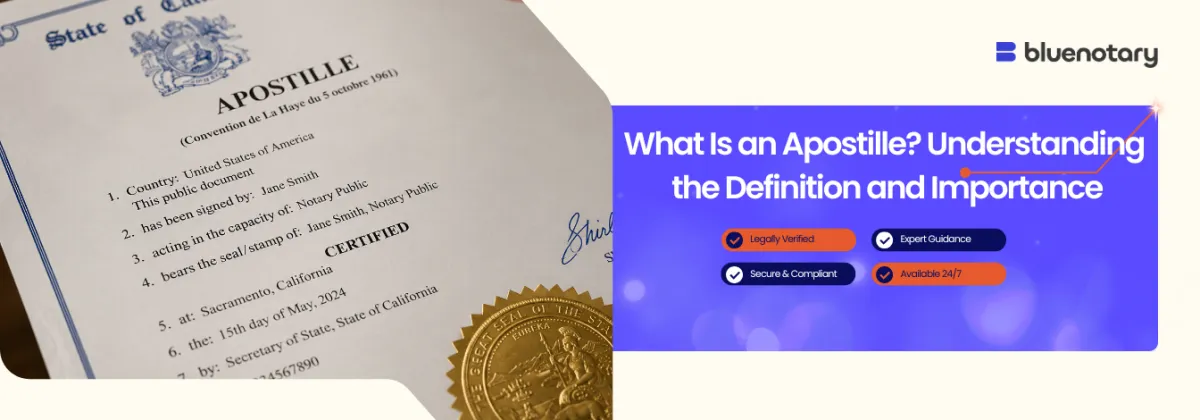
The apostille definition, at its core, is straightforward. An apostille is a standardized certificate that verifies the authenticity of a public document for international use. Merriam-Webster Legal defines it as a certificate authenticating the seal and signature of an official on a public document for use in another country.
The word comes from the French term meaning “annotation” or “side note.” The definition for apostille in international law is a one-page certificate that a designated government authority attaches to your original document. That certificate confirms the document originated from a legitimate source. Notably, it does not validate the content of the document. Instead, it confirms the authority and authenticity of the official who signed or sealed it.
The Hague Convention and the Apostille Definition
The modern apostille definition exists because of the Hague Apostille Convention of 1961. Before this international treaty, getting a foreign document recognized required a long chain of authentication steps through multiple government offices. The Convention replaced that entire process with a single, universally accepted certificate.
According to the Hague Conference on Private International Law, 129 countries are currently contracting states of the Convention. Over 12 million digital apostilles were issued globally in 2025 alone. Each member country agrees to recognize apostilles issued by other members. That mutual recognition makes cross-border document use faster, cheaper, and far more dependable for individuals and businesses with international needs.
What an Apostille Actually Certifies
Many people confuse what an apostille does and does not verify. Knowing this distinction prevents frustration when submitting documents abroad.
An apostille certifies:
- The authenticity of the signature on the document
- The official capacity of the person who signed the document
- The identity of any official seal or stamp present on the document
An apostille does NOT certify:
- The truth or accuracy of the document’s content
- That a contract or agreement is legally enforceable in a foreign country
- That the document meets every requirement of the receiving country’s laws
The US Department of State makes this distinction clear. An apostille confirms the origin and authority behind the document, not what the document says. This detail matters greatly when preparing sensitive records for foreign use.
When Do You Need an Apostille?
You need an apostille when a Hague Convention member country requires your document to be formally authenticated before accepting it. Common situations include:
- Working or studying abroad: Employment contracts, academic transcripts, and diplomas frequently need apostille certification before foreign institutions accept them.
- Getting married internationally: Birth certificates and marriage licenses typically require apostilles for foreign civil registries.
- Business and legal filings: Powers of attorney, incorporation papers, and court judgments need apostilles when filed in another Hague member country.
- International adoption: Adoption agencies and foreign courts regularly require apostille-certified background checks and personal records.
- Inheriting overseas property: Estate and probate documents often need apostilles to satisfy foreign courts or notaries.
- Immigration and visa applications: Many residency and visa processes require apostille-authenticated civil documents to proceed.
If the receiving country is not a Hague Convention member, a different process called full legalization applies. USAGov provides clear guidance on both pathways and which countries fall into each category.
The Apostille Process: Step by Step
Getting an apostille in the United States follows the same core sequence regardless of which state you are in. Fees and timelines do vary, but the underlying steps stay consistent.
- Step 1 – Notarize the document if required: Many authorities require notarization before accepting a document for apostille processing. Our guide on how to notarize a document covers the full process from start to finish.
- Step 2 – Identify the correct issuing authority: State-issued documents go to your state’s Secretary of State office. Federal documents go to the US Department of State’s Office of Authentications in Washington, D.C.
- Step 3 – Submit the document with required fees: Mail or deliver the document along with any forms and payment. Some states offer walk-in processing for faster turnaround.
- Step 4 – Receive the apostille certificate: A government official attaches the apostille to your document and returns it to you. Processing times range from a single business day to several weeks.
For detailed state-by-state instructions, our 50-state apostille guide covers every state’s fees, timelines, and submission rules in one place.
Apostille Definition vs. Notarization: Understanding the Difference
The apostille definition often gets confused with notarization. Both relate to document authentication, but they serve entirely different purposes.
Key differences at a glance:
- Notarization verifies the identity of a signer and confirms the person signed willingly. A commissioned notary public handles this step within the country.
- An apostille authenticates the document for formal recognition in a foreign country. A government authority, not a notary, issues it.
- Notarization is domestic. An apostille is international.
- An apostille often comes after notarization. The two steps frequently work together in sequence.
According to the National Notary Association, notaries commonly prepare documents that then move through the apostille process. That close connection means understanding both services is important for anyone dealing with cross-border paperwork.
For a deeper breakdown, our article on apostille vs. notarization explains when you need one, both, or neither. Additionally, our detailed apostille process guide walks through the Hague Convention requirements and exactly when notarization is not enough on its own.
Conclusion
The apostille definition is clear once you see it in context. An apostille authenticates a public document so foreign governments in Hague Convention countries accept it without any additional legalization. It confirms the authority behind the document, not the document’s actual content. Whether you need one for work, study, legal filings, or personal records abroad, knowing the process puts you in full control. When your documents need notarization before the apostille process begins, BlueNotary provides secure Remote Online Notarization from any location, at any time.
Frequently Asked Questions
What is the apostille definition in simple terms?
An apostille is an official certificate that authenticates a public document for use in a foreign country. It confirms the document came from a legitimate authority. Countries that signed the 1961 Hague Apostille Convention accept apostilles as valid proof of a document’s origin and authenticity.
How do I define apostille for legal purposes?
To define apostille legally, it is a standardized authentication certificate issued by a designated government authority. It verifies the signature on the document, the signer’s official capacity, and any official seal present. It does not certify the accuracy of the document’s content, only its origin.
What is the definition of an apostille certificate?
An apostille certificate is the official one-page document a government authority attaches to your authenticated paperwork. It includes the certifying authority’s name, the country of origin, the date, and an official seal or signature. Over 129 countries recognize this certificate under the Hague Convention.
What is the definition for apostille when used in international law?
In international law, the definition for apostille is a simplified authentication mechanism created by the 1961 Hague Convention. It replaces the traditional multi-step legalization process with a single certificate that member countries mutually recognize. This significantly reduces the time and cost of document verification across borders.
Do I need notarization before getting an apostille?
Often yes. Many government authorities require documents to carry a notary’s seal before issuing an apostille. Notarization confirms the signer’s identity, while the apostille then certifies the notary’s own authority for international recognition. The two steps frequently follow one another in sequence.
Which countries accept apostilles?
As of 2026, 129 countries are contracting members of the Hague Apostille Convention and therefore accept apostilles. If the destination country is not on that list, a full legalization process through the destination country’s embassy or consulate applies instead.
How long does it take to get an apostille in the US?
Processing times vary by state and submission method. Some states process apostilles within one to three business days. Others take two to four weeks. Federal apostilles through the US Department of State typically take eight to twelve weeks. Expedited services are available in many states for urgent requests.
What documents commonly need an apostille?
Documents that frequently require an apostille include birth certificates, marriage certificates, divorce decrees, academic diplomas, transcripts, background checks, powers of attorney, court orders, and business incorporation documents. Any public document intended for official use in a Hague Convention member country may require one.