




So, what does it really mean to notarize a document? It’s the process of having a state-commissioned official, known as a Notary Public, formally verify your identity and witness your signature. This simple act is a powerful deterrent against fraud, confirming that you signed freely and willingly.
Once that notary seal is applied, your document becomes a self-authenticating legal instrument, giving it significant weight and credibility.
Understanding Modern Document Notarization
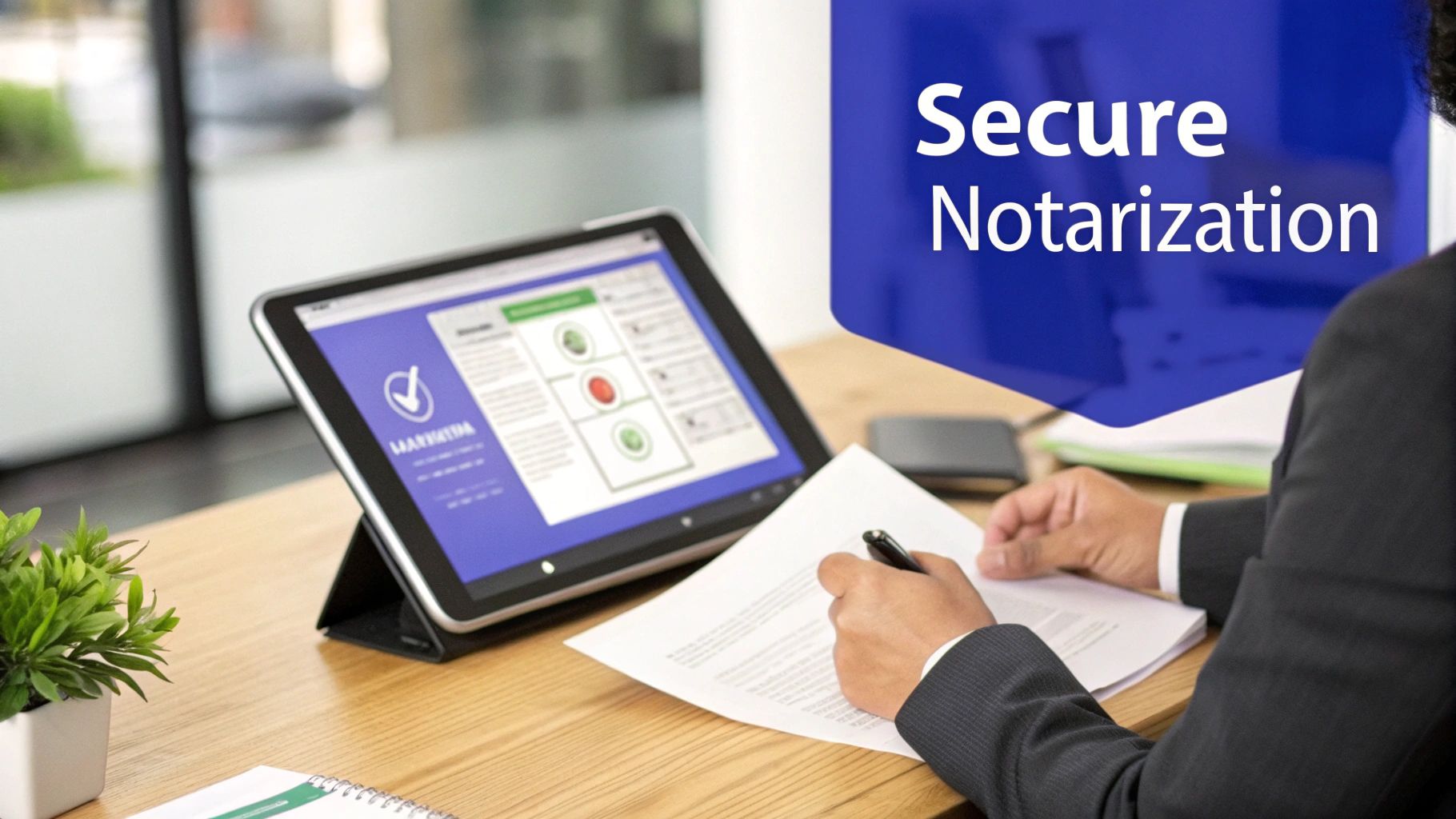
A notarization is much more than just a fancy stamp and a signature in a logbook. Think of it as a fundamental security measure for your most critical agreements, whether they’re for a real estate closing or a personal power of attorney.
At its heart, the notary is confirming three things: you are who you claim to be, you aren’t being forced to sign, and you appear to understand what you’re signing. This official verification is essential for high-stakes documents that could otherwise be easily challenged, preventing messy legal disputes down the road. The notary’s seal essentially creates a public record that the signing happened under proper, verifiable circumstances.
The Evolution from Paper to Pixels
For years, getting a document notarized meant one thing: an in-person meeting. You had to track down a local notary, drive to their office, hand over your physical ID, and sign a paper document right in front of them. It worked, but it was often a hassle, especially for businesses juggling documents across multiple states.
Now, we have a game-changing alternative: Remote Online Notarization (RON). This approach lets you get a document notarized from anywhere, using a secure audio-video link to connect with a commissioned remote notary. It’s the same legal act, just done smarter and more efficiently through digital tools.
How Digital Notarization Strengthens Security
Platforms like BlueNotary are leading this charge, completely rethinking what it means to notarize documents for a modern business. These systems build multiple layers of verification into one smooth process, making it not only faster but often more secure than the old-school method.
Here’s how they add extra layers of security:
- Identity Verification: Sophisticated software scans your government-issued ID for tell-tale signs of tampering that the naked eye could easily miss.
- Knowledge-Based Authentication (KBA): You’ll answer a few personal questions sourced from public data records—something only the real you would know.
- Biometric Analysis: Some platforms even use facial recognition to match your live video feed to the photo on your ID, adding another powerful check.
- Tamper-Evident Audit Trails: The entire audio-video session is recorded and securely stored, creating an ironclad electronic record of the entire event.
By weaving these digital safeguards together, RON creates a robust, verifiable record that slashes the risk of fraud. For law firms, title companies, and banks, this isn’t just a convenience; it’s a vital part of managing risk in today’s world. This guide will walk you through both the traditional and remote options, so you’re ready to handle any notarization that comes your way.
Getting Ready for Your Notarization
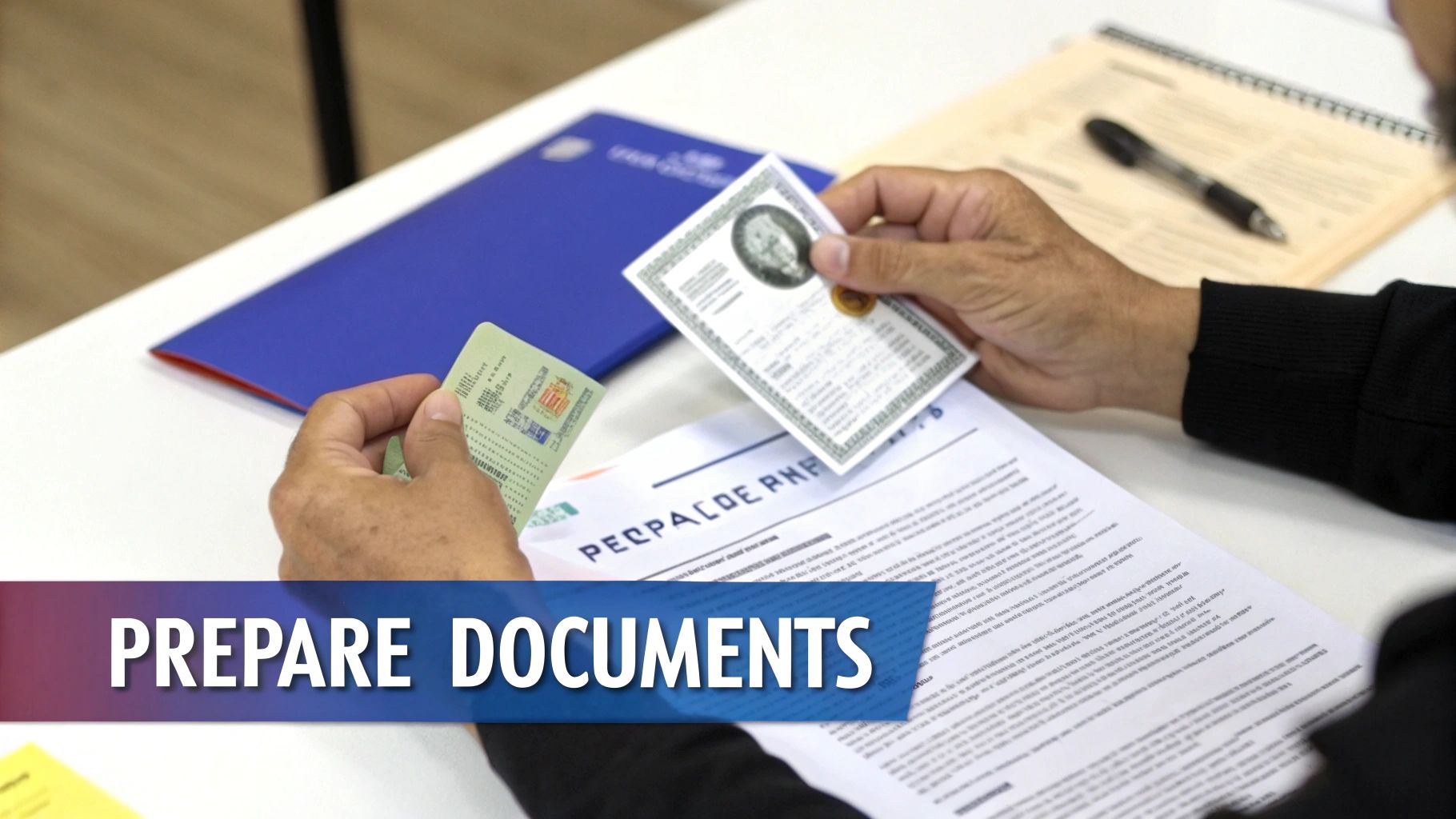
Whether you’re meeting a notary in person or online, a smooth session starts long before you ever say hello. I’ve found that proper preparation is the single biggest factor in preventing the kinds of delays or rejections that can completely derail a critical transaction. Think of it as setting the stage—a little work upfront ensures everything goes off without a hitch.
This is especially true for businesses closing on time-sensitive deals. A small oversight like an expired ID or a missing witness can bring a mortgage closing or a major corporate agreement to a screeching halt, costing you both time and money.
The Golden Rule: Do Not Sign Anything Yet
If you take only one piece of advice, let it be this: do not sign the document beforehand. I can’t tell you how many times I’ve had to turn someone away because they signed their papers at the office that morning. The notary’s entire job is to witness you signing, so if they don’t see it happen, they can’t proceed.
Signing in advance is a guaranteed rejection, and you’ll likely have to start over with a fresh document. It’s a common mistake, but an easily avoidable one.
A notarization validates the act of signing, not just the document itself. Always wait until the notary gives you the green light to sign.
Gathering Your Identification
Verifying who you are is the absolute cornerstone of the notarial act. Without a valid ID, the process stops before it even starts. The notary is legally on the hook for confirming your identity, so they’ll need to see a current, government-issued photo ID.
Make sure you have one of these ready:
- State-Issued Driver’s License
- U.S. Passport or Passport Card
- State-Issued Identification Card (a non-driver ID)
- Military ID
The ID must not be expired. Seriously, even being expired by one day is a dealbreaker. Also, check that the name on your ID is a close match to the name printed on your document. A missing middle initial is usually fine, but a completely different name is a major red flag that will halt the session.
Preparing Your Documents
Before your appointment, give your documents a final once-over. Make sure every single blank is filled in. A notary can’t legally touch a document with empty spaces, as that could open the door to fraud down the road. Fill everything out—except for the signature and date lines. Leave those for the session.
Understanding how to prepare legal documents is a crucial first step. If you run into sections you don’t understand, the notary can’t help you; they are prohibited from giving legal advice. You’ll need to circle back with the person who drafted the document or your attorney to get clarification.
What to Do If You Need a Witness
Some documents, especially things like wills and certain powers of attorney, require witnesses. This isn’t a notary’s rule; it’s a legal requirement dictated by state law or the document itself.
It’s your responsibility to find and arrange for your own witnesses. They’ll need to be present with you for an in-person session or join the same video call for a remote one.
A few key points for managing witnesses:
- They must be impartial. A witness can’t be named in the document or stand to gain anything from it.
- They need ID, too. Each witness has to show the notary their own valid, unexpired government-issued photo ID. No exceptions.
- Give them a heads-up. Let your witnesses know what to expect. Tell them they’ll need their ID and will be signing in front of the notary so they come prepared.
Taking these few steps can transform a potentially stressful process into a simple, straightforward transaction.
The Traditional In-Person Notarization Process
Even with all the fantastic online options available today, it’s still helpful to have a solid grasp of the classic, in-person notarization. This is the process most of us grew up with, and it remains a perfectly valid way to get your important documents sealed and witnessed. The core idea is the same whether you’re online or face-to-face: prove who you are and sign on the dotted line.
The first move is always to find a commissioned Notary Public. Thankfully, they’re not hard to track down. You can usually find one at your local bank, a shipping store like a UPS Store, or pretty much any law firm or real estate office. For businesses that handle a lot of paperwork, having a go-to local notary is a huge time-saver.
Locating a Notary on Your Terms
What if getting to a notary’s office is a pain? That’s where a mobile notary public comes in. These professionals will meet you wherever you need them—your office to sign a stack of corporate papers, a hospital room for a last-minute power of attorney, you name it. This level of convenience is a game-changer.
The demand for mobile notaries has exploded. In fact, the market is projected to hit $2.6 billion by 2035. Much of that growth comes from big companies in finance and real estate who need to process tons of loan packages and property deeds. Sending a notary to the client just makes more sense than having everyone travel, slashing operational costs and speeding things up.
What Happens During the In-Person Session
Once you’re face-to-face with the notary, the actual process is pretty simple and follows a strict protocol.
First, you’ll hand over your valid, government-issued photo ID. The notary is trained to inspect it carefully, matching your face to the photo and ensuring the name on the ID matches the one on your document.
Next, they’ll make sure you know what you’re signing and that you’re doing it of your own free will. They might ask a simple question like, “Do you understand the document you are about to sign?” Once they’re satisfied, you’ll sign the document right there in front of them. The notary then fills out their certificate, signs it, and applies their official notary seal or stamp.
A key thing to remember: The notary isn’t there to give you legal advice or interpret the document for you. Their job is strictly to verify your identity and witness your signature.
Finally, the notary records the whole event in their official journal. This logbook is a permanent, secure record of the notarization, which can be crucial if the document’s validity is ever challenged down the road. If you’re weighing your options, you can learn more about the specifics of in-person notarization to compare it with newer methods. The whole in-person meeting can be over in 15 minutes or take up to an hour, really depending on how complex the document is and how prepared you are.
How Remote Online Notarization Actually Works
Remote Online Notarization, or RON, takes the entire notarial process and puts it into a secure digital space. Instead of driving to meet a notary, you connect with a commissioned professional through a live audio-video session. It lets you notarize a document from practically anywhere. This isn’t just a simple video call, though; it’s a carefully structured process with multiple layers of security and legal compliance built right in.
Let’s use a platform like BlueNotary as our example to see how this modern workflow unfolds. From the second you upload your document, a series of automated checks and balances kicks in, creating an experience that’s often far more secure and verifiable than the old-school, in-person method.
The traditional process is pretty straightforward, as you can see below.
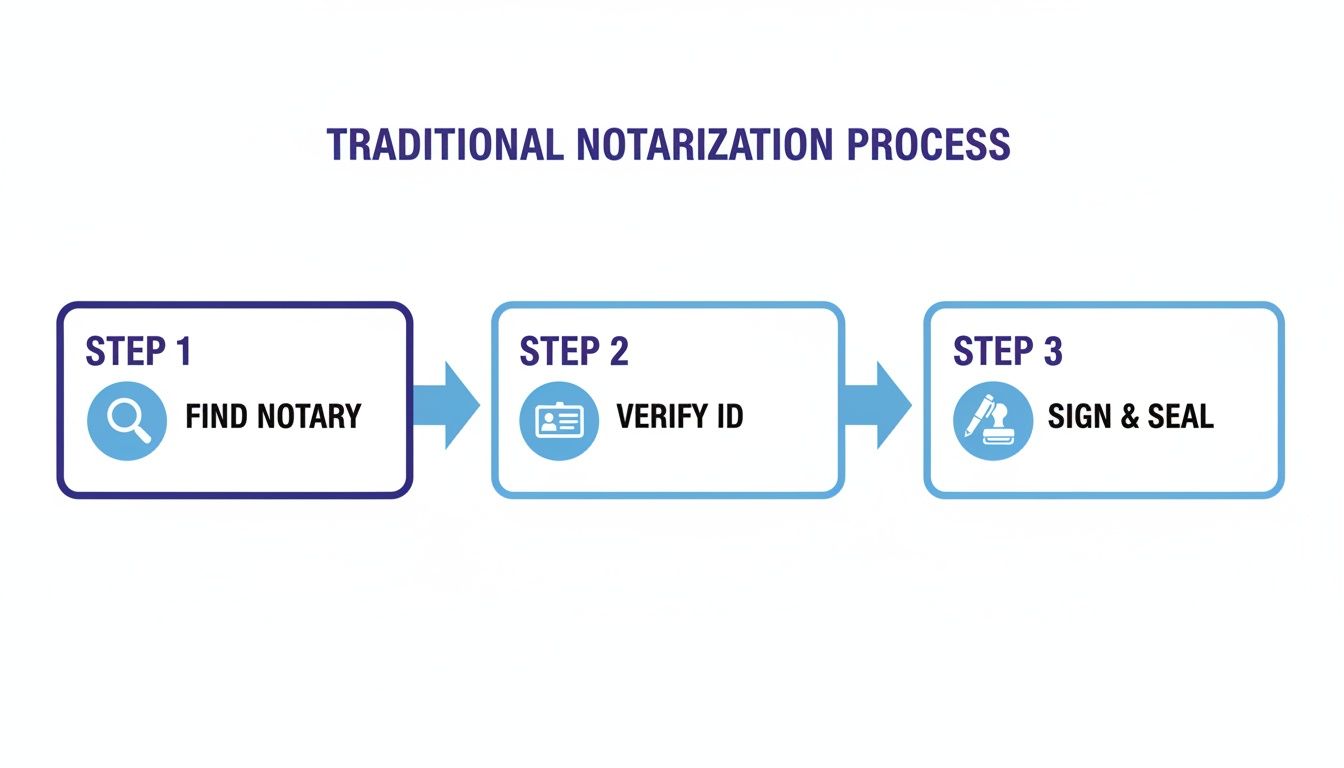
This simple flow—finding a notary, verifying your ID, and signing—is the core of any notarization. RON platforms take these essential functions and elevate them with serious security upgrades.
Kicking Off The Digital Process
Your journey begins the moment you upload your document into a secure portal. Unlike just emailing a sensitive file, RON platforms provide an encrypted environment. This first step is crucial because the platform immediately preps the document for digital signatures and applies safeguards to prevent anyone from tampering with it.
Once it’s uploaded, you’ll be prompted to enter some key details about the signing. This sets the stage for what comes next: the identity verification. This is where the digital process really starts to flex its security muscles.
Multi-Factor Identity Verification
Before you ever see the notary, the system puts your identity through a tough, automated gauntlet. Honestly, this is one of the most powerful aspects of RON, as it uses technology to catch subtle red flags a human eye might miss.
This verification process usually involves a few key stages:
- ID Credential Analysis: You’ll use your smartphone or webcam to take pictures of your government-issued photo ID, like a driver’s license or passport. The platform’s software then scrutinizes the ID’s security features, holograms, and data to spot any signs of a fake.
- Knowledge-Based Authentication (KBA): The system generates a quick quiz with questions pulled from your personal credit and public records. These are “out-of-wallet” questions that only you should know the answer to, like, “Which of these addresses have you previously lived at?”
- Biometric Scanning: Some of the more advanced platforms add a final biometric check. They use facial recognition to compare your live image on the video feed to the photo on your government ID, making sure it’s a match.
This layered approach is a powerful defense against identity fraud. By combining what you have (your ID), what you know (KBA answers), and who you are (biometrics), RON builds a very high level of confidence in the signer’s identity.
The Live Audio-Video Session
After you pass the identity checks, you enter a live, face-to-face session with a commissioned online notary. Think of it as the digital equivalent of sitting across the table from a notary. The notary will greet you, visually confirm your identity one last time, and make sure you understand the document you’re about to sign.
During this recorded session, the notary will ask you to verbally confirm that you’re signing willingly. This direct interaction is a legal requirement, fulfilling the “personal appearance” mandate found in most notarization laws.
The entire audio-video conference is recorded and stored securely. This recording becomes a permanent part of the official record, creating an undeniable audit trail of the whole event. If the notarization is ever challenged in court, this recording provides powerful proof that everything was done by the book. For businesses, this digital record is a huge compliance asset. You can dive deeper into the specifics of how a remote online notary operates to understand the technology involved.
Applying Your Electronic Signature
Once the notary gives you the green light, the platform will prompt you to apply your electronic signature, or e-signature, with a simple click. Behind the scenes, the system attaches a secure, cryptographically-sealed signature that is uniquely linked to you and that specific document.
This digital signature is fully compliant with federal laws like the ESIGN Act and the Uniform Electronic Transactions Act (UETA). These laws give electronic signatures the same legal weight as a traditional “wet ink” signature.
The notary then finishes the job by adding their own electronic signature and digital seal. This seal contains verifiable information about their commission, making the notarization official. The final document is now tamper-evident—any change made after the fact would invalidate the digital seal, protecting the document’s integrity for good.
Traditional Notarization vs Remote Online Notarization (RON)
To really see the difference, it helps to put the two methods side-by-side. The old way has worked for centuries, but RON brings a level of security, convenience, and record-keeping that simply wasn’t possible before.
| Feature | Traditional In-Person Notarization | Remote Online Notarization (BlueNotary) |
|---|---|---|
| Location | Must be physically present with the notary. | Can be anywhere in the world with an internet connection. |
| Scheduling | Requires finding a notary and coordinating schedules. | On-demand or scheduled sessions, often available 24/7. |
| Identity Verification | Visual ID check by a human; prone to error. | Multi-factor: ID analysis, KBA, and optional biometrics. |
| Security | Relies on a physical journal and stamp. | Encrypted documents, tamper-evident seals, and secure audit trails. |
| Record Keeping | A physical journal entry, which can be lost or damaged. | A comprehensive, tamper-proof digital record, including the video. |
| Time to Complete | Can take hours or days, including travel. | Typically completed in 10-15 minutes. |
| Cost | Varies by state; may include travel costs. | Transparent, flat-fee pricing. |
| Fraud Prevention | Limited to the notary’s ability to spot a fake ID. | Advanced technology flags potential fraud that the human eye can’t see. |
This comparison makes it clear why so many individuals and businesses are making the switch. While traditional notarization is still a valid option, RON offers a modern, robust, and far more efficient alternative for today’s needs.
The growth in this field is undeniable. The online notary service market is now valued at around $2 billion and is projected to maintain a strong 15% compound annual growth rate through 2033. For industries like real estate, online notarization has slashed mortgage closing times by as much as 70%—a clear testament to its efficiency and impact. You can read the full research on these trends in the online notary market to see just how quickly things are changing.
Navigating State Laws and Legal Compliance
When you get a document notarized, you’re doing more than just stamping a piece of paper. You’re tapping into a legal framework that varies from state to state, which can feel like a tangled mess, especially if your business operates nationally.
The good news? There’s a core legal principle that cuts through the confusion and makes modern notarization possible across the country. It’s called interstate recognition.
Put simply, a notarization that’s done legally in one state has to be recognized as valid in every other state. So, if a document is notarized online by a commissioned remote notary in a RON-friendly state like Virginia, it carries the same legal weight whether it’s presented in California or New York. This is the legal bedrock that makes Remote Online Notarization such a powerful tool for business.
The Bedrock of Interstate Recognition
This whole idea of states respecting each other’s official acts isn’t new; it’s rooted in the “full faith and credit” clause of the U.S. Constitution. While each state has its own rules for how someone becomes a notary, the act of notarization itself is honored across state lines.
This is precisely why a platform like BlueNotary is so essential for businesses. It takes the guesswork out of the equation. The platform ensures every session is handled by a properly commissioned notary in a state with clear RON laws. For industries like finance and real estate, where a document’s validity is everything, that built-in compliance is non-negotiable.
Where the Details Really Matter: Industry-Specific Rules
Some industries have a much higher bar for compliance. A tiny error on a real estate deed or a Power of Attorney for aging parents can create massive legal and financial headaches down the road.
- Real Estate: Title companies and lenders can’t afford mistakes on closing documents. RON platforms used for real estate must meet very specific state requirements for electronically recording documents with county clerks.
- Legal Services: For law firms drafting wills, trusts, and affidavits, the proof of signing has to be ironclad. The rules for notarizing specific legal instruments can get granular, so knowing the state-specific quirks is critical.
- Financial Services: Banks and investment firms use notarizations for everything from loan agreements to account forms. Here, you often see federal regulations intersecting with state notary laws, adding another layer of complexity.
For businesses in these high-stakes fields, using a compliant RON platform isn’t just about being efficient—it’s a fundamental part of managing risk.
The global notarization market is surging, and North America is at the forefront, thanks to the sheer volume of real estate and legal paperwork. Just last year, it was estimated that delays from old-school, in-person notarization drove up processing costs for title companies by 15-20%. That trend is pushing everyone toward digital solutions and shows why a reliable RON platform has become essential.
Taking Documents Global: Apostilles and Authentications
So what happens when your document needs to be used in another country? This is where you run into an extra layer of verification called an apostille or authentication. Think of an apostille as a special certificate from the Secretary of State that officially confirms your notary’s commission is legitimate.
Remote online notarization is often the perfect first step in this process. You can get the document notarized quickly and then send it to the appropriate Secretary of State’s office to get the apostille attached.
This can be a tricky process, so my advice is always to check the requirements of the destination country first. A great place to start is your state’s official guidelines. You can find what you need by checking this list of Secretary of State websites to make sure you’re following the right steps from the get-go.
Got Questions About Notarization? We’ve Got Answers.
When it’s time to get a document notarized, questions inevitably come up. It doesn’t matter if you’re a real estate firm processing stacks of closing documents or just an individual signing a one-time affidavit—a little bit of knowledge goes a long way in preventing headaches and delays.
Let’s walk through some of the most common questions we hear every day. My goal is to give you clear, practical answers so you can handle your next notarization with confidence.
What Kinds of Documents Actually Need a Notary?
A whole host of documents need a notary’s stamp to be considered legally binding. The common thread here is the need for an impartial third party to officially verify who is signing the document and to witness the act itself.
Here’s a quick look at where you’ll almost always run into this requirement:
- Real Estate: This is probably the biggest one. Think deeds, mortgage documents, and property transfer forms. Without a notary’s seal, these can’t be officially recorded.
- Legal & Estate Planning: Life-changing documents like wills, trusts, and powers of attorney absolutely must be notarized. This ensures they can stand up in court and truly represent the signer’s wishes.
- Financial Services: Banks and credit unions often require notarization for things like loan agreements, vehicle title transfers, and applications for a line of credit.
- Business Operations: Smart companies will notarize key documents to add a layer of legal protection. This includes things like articles of incorporation, partnership agreements, and high-value contracts with clients or vendors.
The bottom line? If the integrity of a document and the identity of the person signing it are critical, chances are you’ll need a notary.
Can I Just Have a Family Member Notarize My Document?
This is a question that cuts right to the core of what a notary does, and the answer is a hard no. You should avoid this at all costs.
A notary public’s entire purpose is to be an impartial, unbiased witness. Notarizing a document for a family member creates a massive conflict of interest that can completely torpedo the notarization.
Most states have laws that specifically forbid notarizing for immediate family (spouse, parent, child, sibling). But even if your state’s rules are a bit vague, it’s still a huge ethical misstep and just plain bad practice.
Think of it this way: if a document notarized by a relative ever gets challenged in court, it could easily be thrown out. The whole point is to remove doubt about the signing, and using a family member introduces a ton of it. Always find a neutral, third-party notary to protect your document.
How Long Is a Notarization Good For?
This is a really common misconception. The notarization itself—the stamp, signature, and date—never expires. It’s a permanent record stating that on a specific day, a specific person appeared before the notary, proved who they were, and signed the document.
What can expire is the document the notary signed.
For example:
- A temporary power of attorney might have an end date written directly into it.
- A rental agreement is only valid for the term specified in the lease.
A notary’s commission also has an expiration date, but that only affects their ability to perform new notarizations. Every notarization they completed while their commission was valid remains legitimate forever. It’s like a snapshot in time that permanently validates the moment of signing.
What Happens if the Notarization Is Done Wrong?
An incorrect notarization isn’t a small problem—it can be a disaster, potentially making an entire legal document worthless. The stakes are really high, which is why every detail matters.
Some of the most common mistakes include:
- The notary simply forgets to apply their seal or sign the notarial certificate.
- Failing to properly check the signer’s ID to confirm it’s valid and not expired.
- Notarizing a document that still has blank spaces that need to be filled in.
- Getting the location wrong (e.g., listing the county where the lawyer’s office is instead of the county where the signing actually happened).
If you find a mistake, the only real fix is to start over and have the document re-notarized correctly. If a bad notarization isn’t caught and ends up in a legal dispute, a judge could refuse to accept the document entirely. This is exactly why using a reputable platform is so important for businesses; automated workflows and secure audit trails cut down on human error and make sure every step is documented and verifiable.
Ready to modernize how you execute and secure your most important documents? BlueNotary offers a comprehensive platform that combines secure identity verification, remote online notarization, and compliant e-signatures into one seamless workflow. Explore how BlueNotary can bring confidence and efficiency to your business today.