




Think of digital identity verification solutions as the digital bouncer for the internet. These systems are the gatekeepers that check someone’s credentials remotely, ensuring they are who they claim to be before granting access to sensitive services or high-value transactions.
What Exactly Is Digital Identity Verification?
Remember the last time you went to a bank to make a big withdrawal? The teller almost certainly asked to see your driver’s license. That simple, in-person check is all about building trust and stopping theft. Digital identity verification does the exact same thing, just for the online world—and with much more advanced technology.
At its core, it’s designed to answer one critical question: “Is this person really who they say they are?”
Without a reliable way to answer that, things we take for granted—like opening a new bank account from our couch, signing a legal document on the go, or closing a real estate deal from another state—would be riddled with risk. These solutions build a foundation of digital trust that allows modern business to happen.
The Problem These Solutions Solve
The fundamental challenge with any online interaction is the lack of physical presence. Anonymity is a fraudster’s best friend, opening the door for everything from basic identity theft to sophisticated financial crimes. Digital identity verification closes that gap, forging a secure link between a person’s real-world, government-issued identity and their digital self.
The skyrocketing demand for this technology tells the whole story. The global identity verification market was valued at over $9.8 billion in 2022 and is expected to balloon to more than $33.9 billion by 2030. This isn’t just hype; it’s a direct response to tougher regulations, the explosion of digital business, and an endless cat-and-mouse game with fraudsters.
At its heart, digital identity verification is about creating certainty in an uncertain digital space. It’s the technological handshake that confirms both parties are legitimate before anything of value is exchanged.
Core Components at a Glance
Modern identity verification isn’t a one-and-done check. It’s a sophisticated, multi-layered process where each step adds another piece to the puzzle, confirming a user’s identity with incredible accuracy. To see how these components work together in the financial world, check out these insights into verified bank-to-bank payments and open banking identity verification.
Here’s a quick rundown of the main technologies that make it all work.
Core Components of Digital Identity Verification
| Component | Primary Function | Example Use Case |
|---|---|---|
| Document Verification | Scans government-issued IDs for signs of tampering, forgery, or expiration. | A new customer uploads a photo of their driver’s license to open an investment account. |
| Biometric Verification | Matches a user’s live selfie to the photo on their official ID using facial recognition. | A client confirms their identity with a quick face scan before digitally signing a will. |
| Liveness Detection | Confirms the user is a real, live person and not just a photo, mask, or deepfake video. | A user is prompted to turn their head or smile during the selfie capture process. |
These components work in concert to create a robust defense, making it incredibly difficult for an imposter to slip through the cracks.
How Modern Identity Verification Technology Works
To really get a handle on today’s digital identity verification solutions, you have to look under the hood. It’s not just one thing; it’s a stack of three distinct but connected technologies. Together, they answer a simple question: “Is this person really who they say they are?”
Think of it like a digital bouncer, but way smarter. Each layer of security builds on the one before it, creating a powerful defense against fraud that’s still quick and easy for legitimate users. Let’s pull back the curtain on these three core pillars.
The First Layer: AI-Powered Document Verification
Everything starts with a government-issued ID. This is the bedrock of identity—a driver’s license, passport, or national ID card. The first step uses AI to act like a digital forensics expert, scrutinizing an uploaded picture of that document with incredible detail.
This isn’t just about matching a name to a face. The software is trained to instantly analyze dozens of security features built into that specific type of ID.
- Hologram and Microprint Analysis: It looks for the official holographic overlays and tiny, almost invisible text that forgers find nearly impossible to copy correctly.
- Font and Template Matching: The system has a massive library of authentic document templates. It checks the fonts, layout, and machine-readable zones (MRZ) against the real deal to spot any inconsistencies.
- Data Consistency Checks: It runs a logic check on the information itself. Does the date of birth make sense? Has the expiration date been digitally altered?
This first step confirms the ID document itself is legit and hasn’t been doctored. It’s the first link in the chain of trust.
The Second Layer: Biometric Verification
Okay, so the document is real. But does it actually belong to the person holding it? That’s where biometrics come in. Using sophisticated facial recognition, the system captures a live selfie or video and creates a unique digital map of the user’s face.
This is worlds beyond the simple face unlock on your phone. These professional systems measure dozens of nodal points—the exact distance between the eyes, the width of the nose, the specific curve of the jawline—to generate a “faceprint.” This mathematical signature is then compared to the photo on the government ID. A high match score provides strong evidence that the user is the rightful owner.
This one-two punch of document and biometric analysis is the engine of the modern identity industry. In fact, biometric methods account for over 70% of revenue in the digital identity market. It’s easy to see why industries like banking and finance, with their strict compliance rules, have gone all-in on this approach. You can get a sense of the scale by exploring concepts like thumbprint ID safety holograms and web protection.
The Third Layer: Liveness Detection
Here’s the final, and maybe most important, piece of the puzzle. This layer answers the question: “Is this a real, live person on the other end right now?” Scammers are crafty. They’ll try to spoof biometric systems with a high-resolution photo, a recorded video, or even a disturbingly realistic mask.
This is where liveness detection shuts them down. It’s the ultimate defense against impersonation.
Active Liveness: This approach asks the user to do something simple, like smile, blink, or turn their head. It’s easy for a human but incredibly difficult to fake with a static image or a basic video loop.
Passive Liveness: This is even more advanced. The software analyzes the video feed for subtle, involuntary cues that prove you’re real. It looks for things like natural skin texture, the way light reflects in your eyes, and tiny muscle movements. All this happens in the background without the user having to do a thing.
By confirming “liveness,” the system effectively slams the door on the most common types of impersonation fraud. It’s what makes the whole process secure from beginning to end. You can dig deeper into how to reduce fraud risk with BlueNotary’s biometric-first approach right here.
This map helps visualize how these three technologies are the pillars supporting a truly secure digital identity.
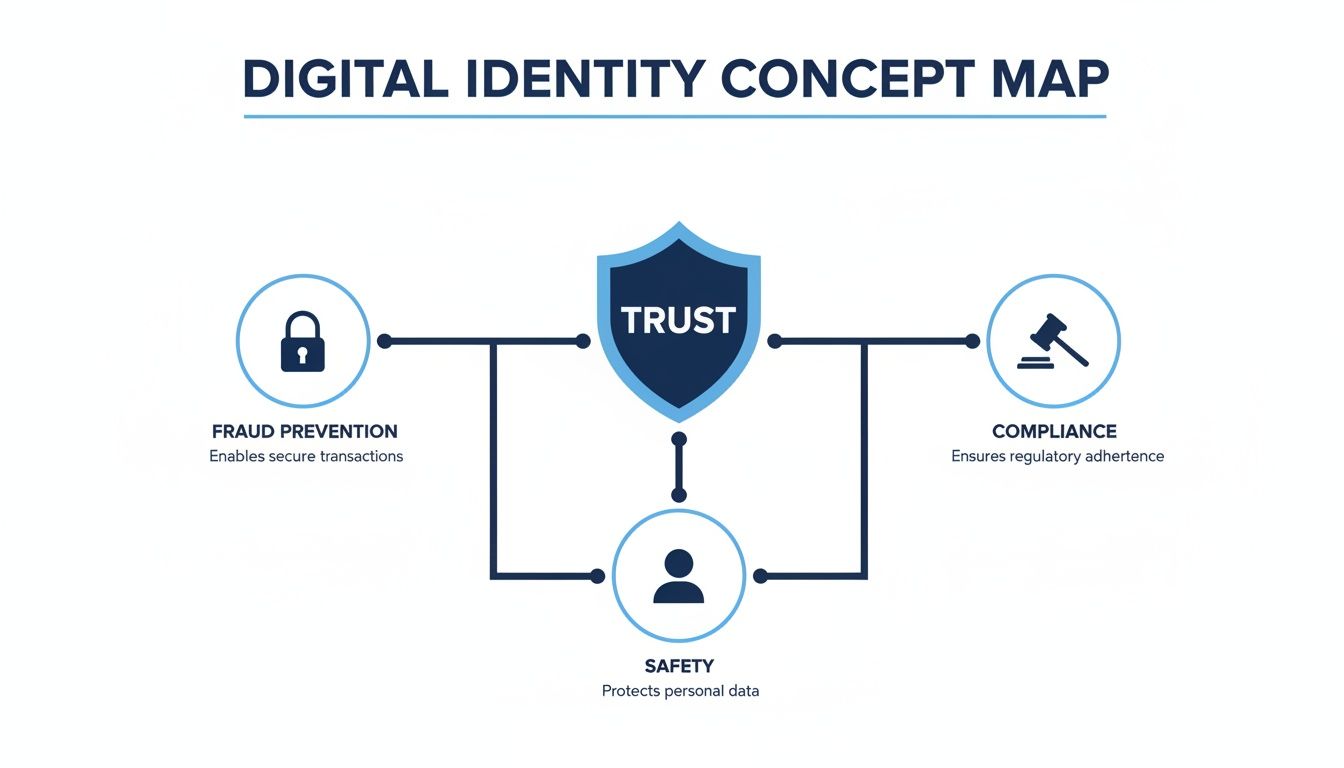
It’s a clear reminder that these systems aren’t just about stopping bad actors; they’re about building a foundation of trust and safety for everyone online.
Navigating The Complex World of Compliance and Security
When you’re dealing with high-stakes digital transactions, compliance and security aren’t just afterthoughts—they’re the bedrock of trust. Think of these regulations as the digital equivalent of a building code. They ensure every interaction is built on a solid, secure foundation, protecting everyone involved from a potential collapse.
These rules aren’t just arbitrary red tape. They’re smart safeguards that create a predictable and safe environment for business. Without them, the digital world would be the Wild West, and no one would have the confidence to get important deals done.
The Why Behind KYC and AML
Two acronyms you’ll hear constantly are KYC (Know Your Customer) and AML (Anti-Money Laundering). It’s easy to get lost in the jargon, but their purpose is incredibly straightforward and crucial.
- KYC is the “who are you?” check. It’s all about verifying that your customers are who they say they are. This is your first and best defense against someone trying to open an account under a false name to commit fraud.
- AML is the “what are you doing?” check. This part involves keeping an eye on transactions for any unusual activity that might signal financial crimes, like money laundering or terrorist financing.
These two work hand-in-hand to keep bad actors out. For financial institutions, law firms, and other regulated businesses, following these rules isn’t just about avoiding hefty fines—it’s about being a good corporate citizen and protecting the integrity of the system.
Data Privacy as a Digital Bill of Rights
Beyond the financial side, there’s a whole other set of laws focused on protecting personal data. You can think of regulations like Europe’s GDPR (General Data Protection Regulation) and California’s CCPA (California Consumer Privacy Act) as a kind of digital bill of rights for consumers.
These laws make it clear that a person’s information—their name, address, even their biometric data—belongs to them. Businesses are simply borrowing it, and they have a massive responsibility to keep it safe.
The best digital identity verification solutions are built with a “privacy-by-design” mindset. This means data protection isn’t just bolted on at the end. It’s woven into the very fabric of the system, ensuring sensitive information is handled with extreme care from the get-go.
This commitment to privacy is absolutely non-negotiable. A single data breach can shatter a company’s reputation overnight, which is why rock-solid data security is a must-have when you’re choosing a provider.
Core Security Practices You Cannot Ignore
Compliance tells you the “what” and “why,” but strong security practices deliver the “how.” Any worthwhile digital identity verification solution is built on proven security measures that protect data at every single step.
One of the most critical is encryption. Imagine you had to send a priceless diamond in the mail. You wouldn’t just drop it in an envelope; you’d put it in a locked, unbreakable box. That’s exactly what encryption does for data. It scrambles information into an unreadable code while it’s moving and while it’s stored, making it completely useless to anyone who shouldn’t have it.
For industries that handle sensitive health information, this level of security isn’t just a good idea—it’s the law. To see these principles in action, you can learn more about how BlueNotary is HIPAA compliant, ensuring patient data is always locked down. It’s a great example of a deep commitment to regulatory standards that applies across all high-trust sectors.
At the end of the day, navigating compliance and security means finding a partner who gets that these aren’t just boxes to check. They’re fundamental commitments that build trust, ensure safety, and keep modern business moving forward.
How Different Industries Use Identity Verification
The real magic of digital identity verification isn’t in the tech itself—it’s in seeing how it solves real-world, high-stakes problems. This is where the abstract concept of digital trust becomes a concrete business advantage, protecting everything from a simple bank account opening to a multi-million dollar real estate deal.
Every industry has its own unique pressures, whether it’s navigating a maze of regulations or fending off specific types of fraud. That’s why a one-size-fits-all approach just doesn’t cut it. The best solutions are tailored to secure the critical moments that define a business.
Let’s look at how this plays out on the ground in a few key sectors.
Fortifying Financial Institutions
For banks, credit unions, and lenders, solid identity verification isn’t just a good idea—it’s the law. They’re on the front lines, dealing with constant threats like account takeover fraud while juggling strict KYC (Know Your Customer) and AML (Anti-Money Laundering) rules. This is why the financial sector has been a massive driver behind the explosion in identity checks, which are on track to exceed 70 billion globally in 2024.
Think about opening a new investment account. Not long ago, that meant schlepping to a branch with a folder full of documents. Now, it can be done from your couch in minutes.
- You start by uploading a picture of your driver’s license, which is instantly analyzed for authenticity.
- Next, a quick selfie-style video scan matches your face to the ID photo, confirming you’re the legitimate owner.
- Liveness detection technology makes sure you’re a real, live person and not a fraudster holding up a static photo.
This seamless process does more than just onboard a new customer quickly. It establishes their identity with a high degree of certainty, ticks all the regulatory boxes, and builds trust from day one.
Securing High-Value Real Estate Transactions
In the world of real estate and title services, everything is built on certainty. When a property transaction involves hundreds of thousands, or even millions, of dollars, you simply can’t afford any doubt about who is buying and who is selling. Wire fraud is an ever-present nightmare in this field, where one convincing but fraudulent email can divert closing funds into a criminal’s account.
Imagine a title company managing a sale where the buyers and sellers are in different states. Getting everyone verified remotely and securely is the only way to keep the deal on track.
For title companies, digital identity verification is the modern-day equivalent of an ironclad handshake. It provides indisputable proof of who is signing the closing documents, protecting all parties and the integrity of the property transfer.
By insisting that every signatory completes a robust identity check—often combining document analysis, biometrics, and knowledge-based questions—the title company removes the risk of impersonation. This creates a secure, auditable trail that proves the rightful owners authorized the sale, effectively shutting the door on common fraud schemes.
Upholding Validity in the Legal World
Law firms and estate planners deal with some of the most critical documents in a person’s life, from last wills and testaments to complex corporate agreements. The entire validity of these documents hangs on the confirmed identity of the people signing them. A signature that can be questioned later can unravel everything, leading to brutal legal challenges and invalidated agreements.
Take a law firm drafting an estate plan for a client. The firm needs absolute proof that the individual signing the will is who they say they are and isn’t being coerced. Using a platform that bundles identity verification with eSignature and remote online notarization (RON) is a game-changer.
The entire signing event is recorded in a secure audio-visual session. The system captures a tamper-evident audit trail and locks in the signer’s identity through multiple, layered checks. This creates a powerful, non-repudiable record that provides rock-solid evidence if the document’s authenticity is ever challenged in court. It turns a signature into a highly secure, verifiable act, protecting both the client’s final wishes and the firm’s professional integrity.
While the core technology is similar, its application varies significantly based on the industry’s specific needs and risk profile. Here’s a quick breakdown:
Industry-Specific Applications of Identity Verification
| Industry | Primary Use Case | Key Benefit |
|---|---|---|
| Financial Institutions | New customer onboarding and account access. | Meets strict KYC/AML compliance requirements and prevents account takeover fraud. |
| Title Companies | Verifying buyers and sellers for property closings. | Prevents real estate wire fraud and protects the integrity of high-value transactions. |
| Law Firms & Estate Planners | Confirming signatory identity for wills, contracts, and trusts. | Creates legally defensible, non-repudiable documents and reduces litigation risk. |
| Lenders (Mortgage/Auto) | Validating borrower identity for loan applications. | Speeds up the lending process securely and minimizes identity-related loan fraud. |
Each of these examples highlights a crucial point: digital identity verification is not just about security. It’s about enabling trust so that business can be conducted efficiently and confidently, no matter the distance.
Choosing The Right Identity Verification Solution
Picking a provider for digital identity verification solutions can feel overwhelming. With so many choices out there, it’s easy to get lost. The real goal isn’t just to buy a piece of software; it’s to find a partner who will help secure your business without driving your customers away.
To make the right choice, you have to look past the shiny marketing brochures and start asking the tough questions. The best solutions strike a delicate balance between ironclad security and a smooth, frustration-free experience for your users.
Evaluate Technical Accuracy And Reliability
First things first: does it actually work? A solution’s core job is to correctly identify legitimate users and, just as importantly, spot the fraudsters. If a system constantly flags real customers by mistake (a false positive), you’re going to alienate the very people you’re trying to serve. On the flip side, if it lets sophisticated fakes slip through, you’re opening the door to massive risk.
When you’re talking to vendors, ask for their stats.
- False Acceptance Rate (FAR): This is the scary one. It tells you how often an imposter gets through. You want this number to be as close to zero as possible.
- False Rejection Rate (FRR): This is the frustrating one. It measures how often a legitimate user gets blocked. A high FRR means you’re losing good customers.
A reputable provider will be upfront about these metrics. They should be able to walk you through how their technology is designed to keep both rates incredibly low. This is the foundation—get this wrong, and nothing else matters.
Prioritize A Seamless User Experience
Security that feels like a chore is bad for business. If your sign-up or verification process is slow, confusing, or just plain difficult, people will leave. In fact, a staggering 92% of users will abandon an onboarding process if it’s too complicated.
The ideal verification flow guides the user through each step with simple instructions and quick feedback. It should feel less like a police interrogation and more like a modern, hassle-free security check. This user-first approach is what turns a clunky tool into a genuine asset for your company.
The best identity verification flows are practically invisible to the user. They are fast, intuitive, and get the job done with minimal effort, building trust through competence rather than complexity.
A smooth experience is non-negotiable if you want to maximize conversions and keep your business growing.
Ensure Scalability And Future-Proofing
Your business won’t stand still, and your identity verification platform shouldn’t either. Can it handle a sudden surge in new customers? What happens during a promotional rush? You need a solution built on a scalable, cloud-based architecture that can handle high-volume periods without breaking a sweat.
This is more important than ever, given where the industry is heading. The digital identity market is projected to explode from USD 51 billion in 2025 to USD 80 billion by 2030. This boom is driven by new regulations and constant tech advancements. The partner you choose today must be agile enough to keep up with the changes of tomorrow. To get a better sense of these trends, you can explore the full research on digital identity market growth.
Look For Effortless Integration And Clear Pricing
Finally, let’s talk about the practical side of things. How easily can you plug this into your existing systems? A great provider will offer well-documented APIs and SDKs that make integrating with your website, app, or internal platform a straightforward process. Good technical support here is a must-have, not a nice-to-have.
Pricing should be just as clear. Steer clear of vendors with convoluted pricing tiers and hidden fees designed to trip you up. A partner worth their salt will offer a simple, predictable model—whether it’s pay-per-verification, a subscription, or a tiered plan—that makes sense for your business. That way, you can budget effectively without any nasty surprises.
Beyond Verification: An Integrated Transaction Platform
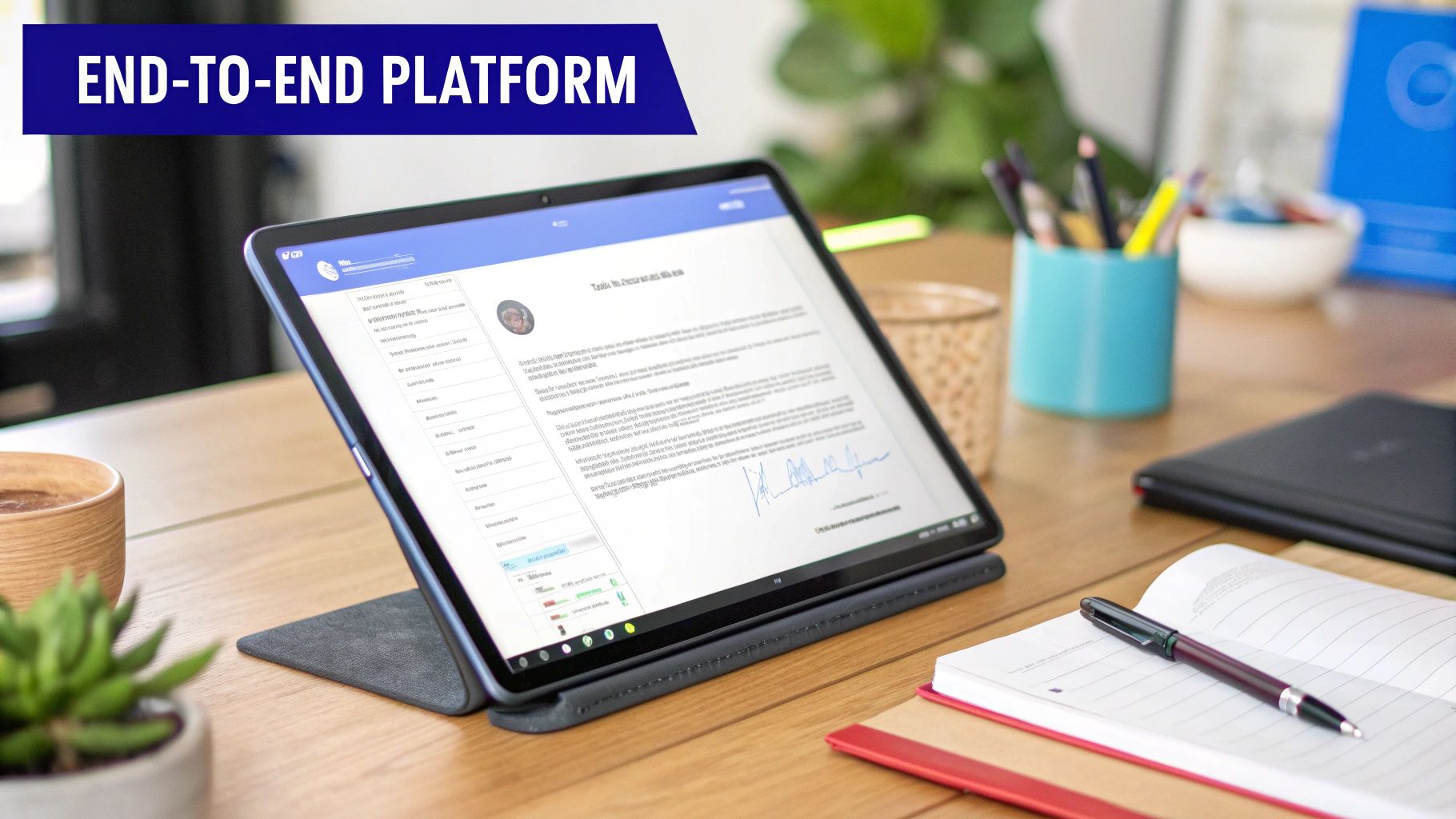
Successfully verifying someone’s identity is really just the starting line, not the finish. So, what’s next? That person still has a contract to sign, a deed to execute, or a loan to finalize. A standalone ID check, even a great one, becomes a frustrating roadblock if it doesn’t seamlessly connect to the actual transaction.
This is where you can really see the power of an integrated platform. Instead of juggling separate tools for identity proofing, eSignatures, and notarization, a unified solution pulls everything into one secure, logical workflow. It’s a shift in thinking—from simply checking an ID to securing the entire life of a high-value agreement.
Unifying The Document Workflow
Picture this common scenario: a client needs to sign and notarize a legal document, and they need it done yesterday. When you’re using separate systems, the whole thing is a clunky, disjointed mess. They might verify their identity on one platform, get bounced to another for the eSignature, and then have to figure out a third tool for notarization. Every one of those handoffs adds friction for the client and opens up potential security holes between the tools.
An integrated platform smooths out all those bumps into one fluid motion.
- Seamless Identity Proofing: The client’s identity is confirmed right inside the platform using a combination of strong document checks and biometrics.
- Integrated eSignature: Immediately after they’re verified, they can apply their legally binding electronic signature in the very same session.
- Built-in Notarization: If the document needs a notary’s seal, the remote online notarization can happen right then and there, since the identity check is already complete.
A unified platform transforms identity verification from a standalone security gate into the secure foundation for the entire transaction. It ensures the same verified individual is present at every critical step, from initial proofing to final signature.
This end-to-end approach does more than just make things easier for the user; it creates a much stronger audit trail. You’re left with a single, tamper-evident record that captures the whole story—from the initial ID scan to the final notarized stamp. That cohesive log is ironclad proof of the transaction’s integrity, which is incredibly valuable for compliance and any potential legal challenges down the road.
Platforms like BlueNotary are built on this exact principle, offering a complete stack for both identity and document execution. By connecting these crucial functions, businesses can cut down on operational drag and get deals closed faster. To see how this can plug into your own software, take a look at the various BlueNotary platform integrations available.
Frequently Asked Questions
As you dive into the world of digital identity verification, a few questions always seem to come up. Let’s tackle some of the most common ones to clear up any confusion and address the practical things you’re probably wondering about.
What’s The Difference Between Verification and Authentication?
People often use these terms interchangeably, but they refer to two very distinct, yet related, steps. The best way to get your head around it is with a quick analogy.
Imagine you’re starting a new job. Identity verification is that initial, one-time trip to HR. You present your passport or driver’s license to prove you are who you say you are, and they issue you an official employee ID badge.
Authentication, on the other hand, is what you do every day after that. It’s the simple act of swiping that badge to get into the building. You’re not re-proving your entire identity; you’re just using your pre-verified credential to gain access.
So, think of verification as the deep-dive, foundational proofing event. Authentication is the quick, ongoing process of using that established identity.
How Long Does a Digital Identity Check Actually Take?
The speed of modern identity verification is one of its most impressive features. While the exact timing can shift a bit depending on the specific checks being run or the clarity of the documents someone uploads, the entire process is incredibly fast.
For most automated platforms, a full check—from scanning a document to running a biometric match and a liveness test—is typically done in under 60 seconds. This is a game-changer compared to old-school manual methods that could drag on for hours, or even days.
Are Digital Identity Verification Solutions Really Secure?
Yes, absolutely. The entire point of these platforms is to build a fortress of security around digital transactions. They don’t just rely on one single defense; they use a multi-layered strategy to stop fraud and protect sensitive data from every angle.
Here’s how they create such a secure environment:
- Data Encryption: All personal information is scrambled into unreadable code, both while it’s in transit over the internet and when it’s stored on servers. This makes the data useless to anyone who isn’t authorized to see it.
- Advanced Fraud Detection: This is where the really clever tech comes in. Liveness detection, for instance, is designed specifically to sniff out and block sophisticated spoofing attempts, like someone trying to use a photo, a video, or even a mask.
- Strict Compliance: Reputable providers don’t play fast and loose with your data. They are built to comply with tough data privacy regulations like GDPR and CCPA, which means they’re held to high standards for handling information ethically and responsibly.
These pieces all work together to build a system you can actually trust.
Ready to move beyond standalone ID checks to a fully integrated transaction platform? BlueNotary combines robust identity verification with eSignature and online notarization in a single, secure workflow. Discover how our end-to-end solution can secure and streamline your most important agreements.