





Think about the last time you needed a document notarized. It probably involved tracking down a local notary, coordinating schedules, and then driving to an office or a bank just to sign a single piece of paper. An online notary service throws that entire outdated process out the window.
It’s the digital version of a traditional notarization. Instead of meeting a notary in person, you connect with a licensed professional through a secure video call to get your documents legally signed and sealed, all from your computer or smartphone. This is officially known as Remote Online Notarization (RON).
What Exactly Is an Online Notary Service
Let’s say you’re closing on a house but you’re traveling for work, or you need to sign a power of attorney urgently. In the past, this would have been a logistical nightmare. Online notary services solve this by creating a secure, virtual room where you and the notary can meet.
The core function is identical to the in-person experience: a commissioned notary public is there to verify your identity and witness you signing the document. They confirm you are who you claim to be and that you’re signing under your own free will. The only thing that changes is how you meet.
The Shift from In-Person to Digital
Moving from paper and pen to a fully digital workflow is about more than just convenience. It’s a massive leap forward in security and efficiency. The technology underpinning online notarization is often far more secure than the traditional, in-person method.
Here’s what makes it all work:
- Live Audio-Visual Connection: You meet the notary face-to-face over a live, two-way video call. This satisfies the legal requirement of “personal appearance” in a virtual setting.
- Advanced Identity Verification: Before anything is signed, the system runs you through a sophisticated, multi-step identity-proofing process. We’ll get into the details of that later.
- Secure Electronic Signatures: Your signature is applied electronically using cryptographic technology, which creates a tamper-evident seal on the document.
- Digital Audit Trail: The entire session is recorded—from the moment you log in to the final application of the notary’s digital seal. This creates an unshakeable, verifiable record of the entire event.
An online notary service takes a practice that’s been around for centuries and completely modernizes it. It keeps the core principles of trust and verification but adapts them for a world that demands speed, security, and the ability to get things done from anywhere.
This digital framework is what gives online notarization its legal and trusted standing. If you’re new to the idea, seeing how the pieces fit together can really make it click. To see a full breakdown of the process, you can explore a detailed explanation of online notarization and how it works step-by-step.
Why This Matters for Modern Business
At its heart, an online notary service is all about using smart technology to make a necessary process faster and more secure. This aligns perfectly with the push toward automation in banking to boost efficiency and customer satisfaction and similar trends in other industries.
Fields like real estate, finance, and law depend on notarized documents every single day. Being able to execute these tasks remotely can shrink transaction times from days down to minutes, slash operational costs, and give clients the kind of smooth, digital experience they’ve come to expect.
The Technology That Makes Online Notarization Secure
Ever wonder how a digital process, done from hundreds of miles apart, can be as secure—or even more so—than a traditional, face-to-face notarization? It’s not magic. The answer is a multi-layered fortress of technology, with each piece working together to create a secure, verifiable, and legally binding transaction.
An online notary service isn’t just a simple video call. It’s a sophisticated system built on protocols designed to stop fraud in its tracks and protect a document’s integrity from start to finish. You can see just how different—and more efficient—the process is compared to the old way of doing things.
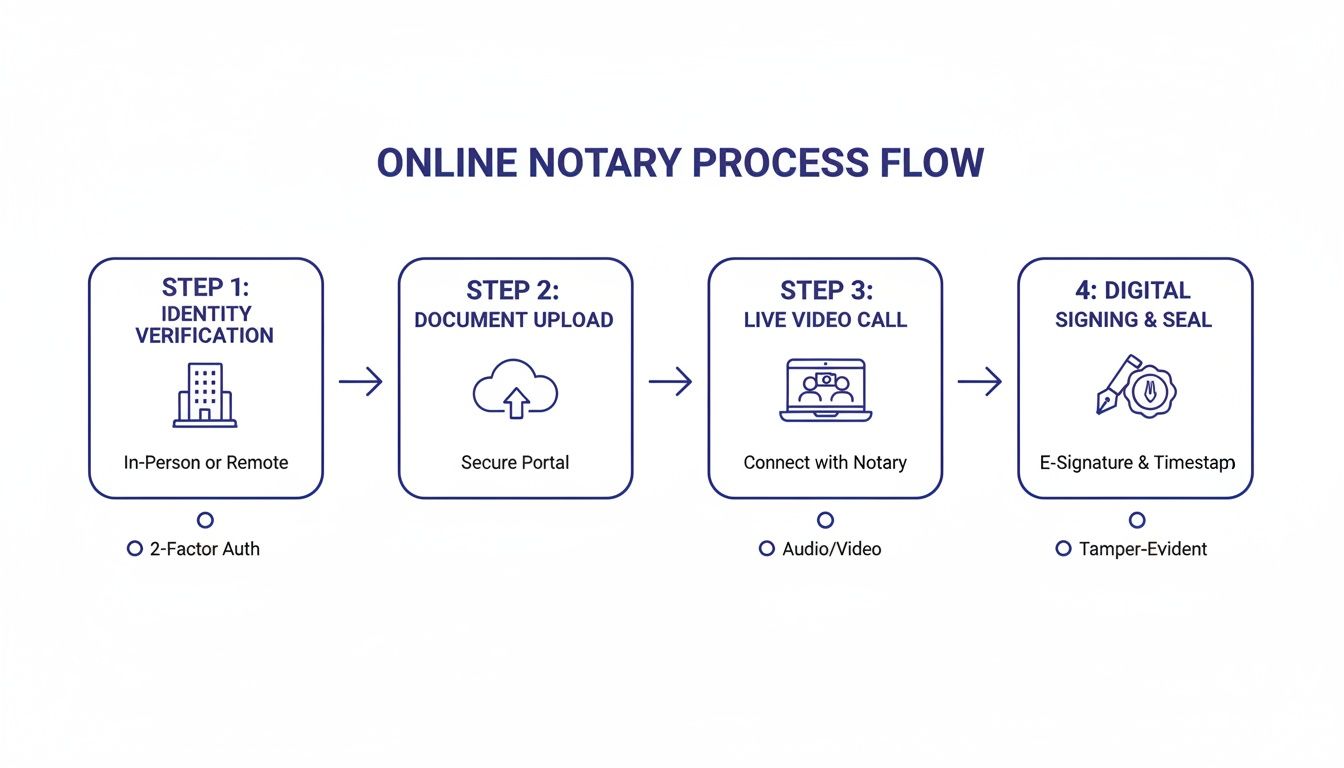
This flowchart really highlights how the online process replaces physical travel and manual paper checks with fast, technology-powered steps. Behind every one of these digital steps is a specific security measure that builds trust and legal validity.
Confirming Identity Beyond a Shadow of a Doubt
The absolute first and most crucial step is proving you are who you say you are. In-person notarizations often boil down to a quick glance at a driver’s license, an item that can be surprisingly easy to fake. Online notary platforms use a far more rigorous, multi-factor approach to lock down your identity.
It all kicks off with credential analysis. The platform’s technology scans the front and back of your government-issued ID, like a driver’s license or passport. This software isn’t just looking at the picture; it analyzes intricate security features, holograms, and data encoding to confirm the document is authentic, catching sophisticated forgeries that would fool the human eye.
Next up is Knowledge-Based Authentication (KBA). Think of this as a dynamic pop quiz generated from your personal credit and public records history. You’ll get questions like, “Which of the following streets have you lived on?” or “Which of these phone numbers was previously yours?” These are “out-of-wallet” questions that only the real you could likely answer correctly. You can get a deeper look into how these modern identity verification systems work to appreciate the full scope of this security layer.
The entire point of this multi-step verification is to build an incredibly high degree of certainty about the signer’s identity before the notarization even begins. This establishes a foundation of trust that’s tough to replicate in a purely physical setting.
The Virtual Room: The Live Audio-Visual Session
Once your identity is locked in, you enter a live, two-way video session with a commissioned notary. This is the 21st-century version of the “personal appearance” requirement that’s been central to notary law for decades. Both you and the notary have to be able to see and hear each other clearly in real-time.
This live interaction lets the notary perform their essential duties, just as they would in an office:
- Assess Awareness: The notary can observe your demeanor to make sure you understand the document’s contents and aren’t being pressured to sign.
- Confirm Intent: They can ask you directly to confirm that you are signing the document willingly.
- Witness the Signature: The notary watches you apply your electronic signature to the document right on the screen.
The entire video call is recorded, becoming a critical piece of the final, secure record of the notarization.
Locking Down the Document with Tamper-Evident Seals
After you’ve signed, the notary applies their own electronic signature and a digital seal. This isn’t just a picture of a rubber stamp; it’s a powerful cryptographic component. This digital seal is directly linked to the notary’s official commission and contains data that uniquely identifies them.
More importantly, it makes the document tamper-evident. If anyone tries to alter the document in any way after the seal is applied—even changing a single comma—the seal will break and show as invalid. This technology provides a level of post-notarization security that a paper document with an ink stamp simply can’t match. It creates a permanent, verifiable lock on the document’s contents at the exact moment it was notarized.
The Unbreakable Record: The Digital Audit Trail
Finally, every single thing that happens during an online notarization session is captured in a detailed audit trail. This is a comprehensive digital log that records everything from the second the session starts to the moment it ends.
This audit trail is the backbone of the entire process, providing an undeniable history of the transaction. A quick look at the core technologies shows how they all fit together to create a secure environment.
Core Security Features of Online Notary Platforms
| Security Component | How It Protects Your Document |
|---|---|
| Credential Analysis | Verifies government-issued IDs are authentic and not forgeries. |
| KBA Questions | Confirms identity using personal history questions only the signer should know. |
| Live Audio-Visual Link | Allows the notary to verify awareness, intent, and identity in real time. |
| Digital Seal | Creates a tamper-evident lock on the document, showing if any changes were made. |
| Comprehensive Audit Trail | Logs every action, creating an unbreakable, legally-defensible record of the entire event. |
This complete record provides powerful, verifiable evidence for any legal or compliance needs, offering a level of detail that a traditional notary’s paper journal could never achieve.
Is Online Notarization Legally Binding?
So, is a document notarized online actually legit? It’s a common question, and the answer is a firm “yes” for most situations. The legal standing of online notarization isn’t some flimsy loophole; it’s built on a solid legal foundation of federal and state laws crafted for our modern, digital reality.
This framework really starts at the federal level with two landmark acts. The Electronic Signatures in Global and National Commerce Act (ESIGN Act) of 2000, along with the Uniform Electronic Transactions Act (UETA) which most states have adopted, essentially said that electronic signatures and digital records are just as valid as their pen-and-paper predecessors. These laws really opened the door for all kinds of digital business, including notarizations.
State Laws Bring RON to Life
While the federal government set the stage, the nitty-gritty rules for online notarization are handled by individual states. Each state has its own specific laws that authorize and control how its notaries can perform Remote Online Notarization (RON). These state laws spell out everything from identity verification standards and technology requirements to how digital records must be kept.
The great news? These laws have caught on like wildfire. The push for convenient, remote options has led to a huge wave of legal acceptance across the country, completely changing how deals get done in major industries.
The move to remote online notarization really took off after 2020. By 2025, more than 45 U.S. states had permanent RON laws on the books. This shift was a game-changer for industries like real estate and lending, where speed is everything. In fact, by 2025, one top RON platform had already handled 1.5 million notarizations. Industry experts were predicting that 65% of legal services and 70% of financial‑services loan documents would be handled digitally by 2026. You can find more stats on how RON became mainstream in major U.S. markets on proof.com.
Interstate Recognition: The Secret Sauce
At first glance, a jumble of different state laws might seem like a recipe for chaos. But it all works smoothly because of a core legal principle called interstate recognition.
The idea is simple: if a notarization is performed legally by a notary following their home state’s laws, every other state will generally recognize it as valid and binding.
It’s just like a driver’s license. Your license from Texas is perfectly good for driving in Florida, even if Florida has slightly different driving rules. The same logic applies to notarization. A document notarized online by a Virginia-based notary is accepted as legally sound for a real estate closing in California.
This is the key that makes a nationwide online notary service possible. It means the physical location of the signer or the property doesn’t throw a wrench in the works, as long as the notary sticks to the rules of their commissioning state. You can dive deeper into the specifics of how cross-state notarization works and see this principle in action. This legal reciprocity is the engine that empowers businesses to operate seamlessly across the country, knowing their digitally notarized documents will stand up in court.
How Different Industries Use Online Notarization
The real value of an online notary service snaps into focus when you see it solving real-world problems. This isn’t just a minor tech upgrade; it’s a fundamental change in how critical business gets done, turning processes that used to take weeks into something you can knock out in under an hour.
Looking at the market data from 2024–2025, it’s clear where the action is: real estate closings, corporate agreements, and powers of attorney are leading the charge. Projections show that by 2026, roughly 45% of all property deals and up to 70% of corporate and financial document flows will involve some form of remote notarization. You can dig into a deeper analysis of these market drivers and growth forecasts on OpenPR.com.

Accelerating Real Estate and Mortgage Closings
For decades, the real estate industry has been drowning in paper. A typical mortgage closing involves a mountain of documents needing signatures and notary stamps, creating a logistical nightmare for buyers, sellers, and agents who are often miles apart.
An online notary service simply erases those geographical lines. Now, a homebuyer in New York can close on their new Florida condo without leaving their living room.
- Truly Remote Closings: Buyers, sellers, and agents can meet in a single, secure video session to sign the entire closing package.
- Fewer Errors, Fewer Delays: The digital platform guides everyone through the documents, so no signature gets missed—a common cause of frustrating and expensive delays.
- Faster Funding: With documents signed and delivered instantly, lenders can release funds much faster. The whole cycle just got shorter.
Streamlining Financial Services
Banks, lenders, and investment firms are constantly juggling documents that require a notary, from loan agreements to wire transfer forms. The old way—making clients schlep to a physical branch—is slow, inconvenient, and a major source of customer friction.
Online notarization provides an instant fix. Financial institutions can serve their clients securely and immediately, wherever they happen to be. This is a game-changer for time-sensitive transactions like auto loans or personal credit lines, where speed is everything.
By making notarization an on-demand service, financial firms can get agreements finalized in minutes, not days. This isn’t just about customer satisfaction; it’s about cutting the operational drag of manual paperwork and directly boosting the bottom line.
Securing Estate Planning and Legal Documents
Estate planning deals with some of the most important documents a person will ever sign—wills, trusts, and powers of attorney. These documents demand the highest standard of legal validity. Remote online notarization gives people, especially those with mobility issues or living in remote areas, a secure and accessible way to get them done right.
The legal field is another key area. For instance, litigation law practices regularly need notarized affidavits and other evidence. The secure audit trail and video recording from an online notary session create a powerful, verifiable record that can stand up in court.
Empowering Corporate and Business Operations
Every business, big or small, runs on notarized documents. Think board resolutions, shareholder agreements, international contracts, and even vendor onboarding paperwork. The need for a quick, secure notarization is constant.
With an online notary service, a corporate legal team can manage these tasks with far more speed and control. A CEO traveling overseas can execute a critical contract on the fly, or a new board member can sign their consent forms without holding up important decisions. This kind of agility is what helps a company compete in today’s fast-moving global market, making sure geography never gets in the way of progress.
Measuring the Business Impact of Going Digital
Switching to an online notary service isn’t just about keeping up with the times; it’s a smart business move with a very real, very measurable return on investment (ROI). The true value becomes clear once you look past the obvious convenience and start tallying up the impact on your bottom line, your workflow, and your client relationships.
The first thing you’ll notice is the incredible speed. A process that used to get bogged down for days—or even weeks—with coordinating schedules and mailing documents back and forth can now be wrapped up in under 15 minutes.
This isn’t just a minor improvement. It means you can close deals faster, fund loans quicker, and get critical contracts signed the moment they’re ready. That kind of agility gives you a serious leg up on the competition.
Quantifying the Hard Cost Savings
Beyond the time savings, the direct cost reductions are substantial and straightforward to calculate. Traditional notarization has a laundry list of associated costs that simply disappear when you move the process online.
Think about the concrete savings on every single document you process:
- Courier and Postage Fees: Forget overnight shipping. You’re immediately saving $20 to $50 or more per package.
- Printing and Paper Costs: All the expenses tied to paper, ink, and printer maintenance are completely eliminated.
- Administrative Overhead: Consider the countless hours your team spends playing phone tag, tracking packages, and manually filing paperwork. Automating this frees them up to focus on work that actually grows the business.
Adopting an online notary service is a direct investment in operational efficiency. By removing the friction points of paper-based workflows, you reclaim lost time and redirect resources from logistical headaches to core business growth.
This isn’t just a niche trend. The global market for online notary services is booming. Some forecasts project it to hit USD 1–2 billion by 2025, with double-digit growth driven by businesses demanding these exact efficiencies. You can find more details on this rapid market expansion and its drivers on Research Nester.
The Less Tangible but Powerful Benefits
While the hard numbers make a compelling case, some of the most powerful benefits of using an online notary service are the ones that don’t show up on a spreadsheet. These advantages have a direct impact on your brand and your position in the market.
Perhaps the biggest is the elevated client experience. When you offer a secure, on-demand notarization process, you’re sending a clear message: you respect your clients’ time and are committed to modern, hassle-free service. In competitive fields like real estate and finance, that convenience can be the very thing that sets you apart.
Then there’s the enhanced security. The technology behind Remote Online Notarization is built for fraud prevention. The combination of multi-factor identity verification, tamper-evident digital seals, and a complete video recording of the signing creates a record that is far more secure and defensible than a simple ink stamp in a paper logbook. This protects both your business and your clients.
Ultimately, the move to digital notarization delivers a one-two punch of immediate cost savings and strategic long-term gains. It makes your operations more efficient, keeps your clients happy, and tightens your security—a clear win from every angle.
How to Choose the Right Online Notary Platform
Picking an online notary service isn’t just about finding a tool; it’s about finding a partner. The right platform can make your workflow incredibly smooth, keep you secure, and leave clients impressed. The wrong one? It can create legal headaches and operational nightmares.
With so many options out there, it’s easy to get overwhelmed. Let’s cut through the noise and focus on what really matters, so you can choose a platform that fits your business like a glove.

Start with the Non-Negotiables: Compliance and Security
Before you look at a single feature, you absolutely must verify a platform’s legal and security credentials. Choosing a non-compliant service is a risk you can’t afford to take, as it could invalidate your notarizations and expose your business to serious liability.
First, confirm the platform is fully compliant with the Remote Online Notarization (RON) laws in every state where you operate. State rules are specific about things like identity proofing, video recording, and how the digital journal is kept. A reputable platform will have this information readily available.
Next, dig into their security protocols. Don’t be afraid to ask tough questions:
- Identity Verification: How do they confirm someone is who they say they are? The gold standard is a two-pronged approach: credential analysis (scanning a government-issued ID) and Knowledge-Based Authentication (KBA) (those out-of-wallet questions). Relying on just one isn’t enough.
- Tamper-Evident Sealing: Once a document is signed and notarized, how is it protected? The platform must use a cryptographically secure digital seal. This acts like a digital wax seal, instantly showing if anyone has tried to alter the document after the fact.
- Data Security: Where do the video recordings and audit trail files live? Look for platforms that use secure, encrypted cloud storage and are transparent about their data retention policies. You need to know your sensitive records are safe.
Is It Easy to Use? A Look at User Experience and Integrations
A platform can be the most secure and compliant in the world, but if it’s a pain to use, no one will want to. The user experience for both your team and, most importantly, your clients has to be dead simple.
I always tell people to get a live demo and try to break the workflow. If you, as a professional, find it confusing, imagine how your first-time client will feel. A clunky interface creates friction and can cause people to give up mid-transaction.
Beyond ease of use, think about how the platform will fit into your existing tech stack. Does it integrate with your CRM, document management system, or industry-specific software like a title production platform? Smooth integrations are the key to efficiency. They eliminate the soul-crushing task of manual data entry and reduce the risk of human error. If you want to build custom workflows, make sure the platform offers API access.
The Long-Term View: Support and Pricing
Finally, think about what the relationship will look like six months or a year down the road. When you’re in the middle of a time-sensitive closing and hit a technical snag, you need to know help is just a phone call or chat message away.
Evaluate the vendor’s customer support. Do they offer multiple ways to get in touch? Is support available during your business hours? A comprehensive knowledge base is great for self-service, but nothing beats talking to a real person when you’re in a jam.
Then there’s the price. Look closely at the pricing models—is it a per-notarization fee, a flat monthly subscription, or some hybrid? Watch out for hidden costs for things like document storage or API usage. Your goal is to find a transparent pricing structure that scales with your business and provides a clear return on your investment.
Your Questions About Online Notarization, Answered
Even after getting the big picture, it’s natural to have a few lingering questions about how online notarization works day-to-day. Most of the time, these questions boil down to three things: legal acceptance, what documents you can get notarized, and security.
Let’s tackle the most common ones head-on so you can feel completely comfortable making the switch.
Is an Online Notarization Accepted Everywhere?
This is easily the most common question, and the short answer is a confident “yes,” thanks to a legal concept called interstate recognition. This principle means that a document notarized online by a properly commissioned notary, following all the rules of their state, is generally accepted as valid in every other state.
Think of it like a driver’s license. Your California license doesn’t stop working when you cross into Nevada. The same idea applies to notarizations. While it’s always smart to double-check with the receiving party—say, a specific county recorder’s office or a foreign government—for the vast majority of transactions, an online notarization is good to go.
What Kinds of Documents Can Be Notarized Online?
If you can get it notarized in person, you can almost certainly get it notarized online. The technology is built to handle a massive range of documents, making it a flexible tool for all sorts of situations.
A few common examples include:
- Contracts and Business Agreements: Lock in that deal with a partner across the country without anyone having to travel.
- Affidavits and Sworn Statements: Make official statements for legal matters with a complete digital record.
- Real Estate Documents: From deeds to full mortgage closing packages, nearly all property documents can be handled remotely.
- Power of Attorney Forms: Securely grant legal authority to a trusted person, no matter where they are.
There are, of course, a few rare exceptions. Certain documents, like wills or some types of trusts in specific states, might still legally require an in-person signature. It’s always a good idea to confirm local rules for those highly specialized documents.
The core takeaway is that online notarization is more secure than its traditional counterpart. It replaces subjective human judgment with objective, technology-driven verification and creates a complete, verifiable digital record of the entire event.
How Secure Is It Compared to In-Person Notarization?
Here’s something that often surprises people: an online notary service is significantly more secure than the traditional, face-to-face method. Think about it—the old way relies on a notary giving a driver’s license a quick glance. Fakes have gotten pretty good.
Online platforms don’t just glance. They use a multi-step security process that leaves no room for doubt. This includes advanced software that analyzes an ID for signs of forgery, followed by knowledge-based authentication questions pulled from private data sources that only the real signer could possibly know.
On top of that, the entire audio-video session is recorded and stored with a tamper-evident audit trail. This creates a rock-solid, legally-defensible record that a simple paper journal entry can’t even begin to match, effectively slamming the door on fraud.
Ready to experience the speed and security of digital notarization? BlueNotary provides a comprehensive platform for all your e-signing and online notarization needs, with compliance and security built right in. Get your documents notarized online in minutes.