


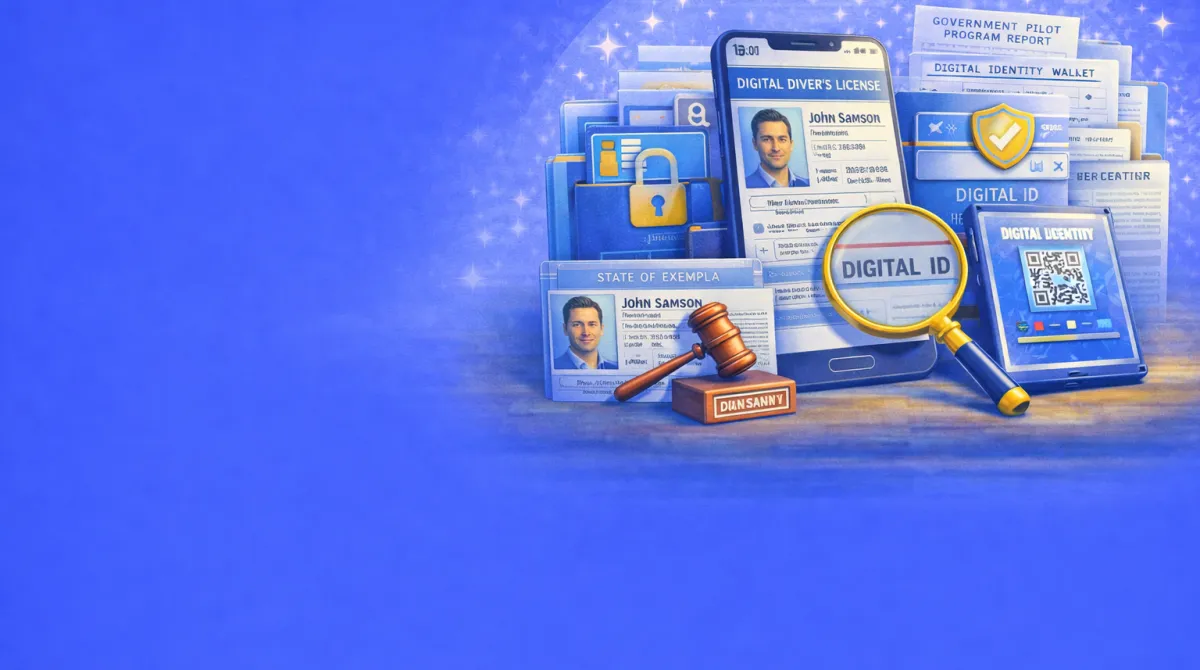

The way we prove our identity is undergoing its most significant transformation since the introduction of photo identification. Mobile driver’s licenses, digital identity wallets, and verifiable credentials are moving from pilot programs to mainstream deployment. For remote online notarization, these technologies promise to reshape how signers verify their identities.
Understanding what digital identity wallets are, where implementation stands today, and when these changes will affect notarization helps both signers and notaries prepare for the coming shift in identity verification.
What Are Digital Identity Wallets?
A digital identity wallet is a secure application on your smartphone that stores verified credentials, such as your driver’s license, state ID, or other identity documents, in a cryptographically protected format. Unlike a photo of your license stored in your camera roll, a digital identity wallet contains credentials that have been verified by the issuing authority and can be cryptographically authenticated by anyone checking them.
The key innovation lies in how these credentials work. When you present a physical driver’s license, the person checking it relies on visual inspection of security features. When you present a credential from a digital identity wallet, the verifier can cryptographically confirm that the credential was issued by a legitimate authority and has not been tampered with. The verification happens mathematically, not visually.
Digital wallets also enable something physical credentials cannot: selective disclosure. If a bartender needs to verify you are over 21, a physical license reveals your exact birthdate, address, license number, and other information they do not need. A digital wallet can provide a simple yes or no answer to “Is this person over 21?” without revealing any additional information.
Mobile Driver’s Licenses: The Foundation
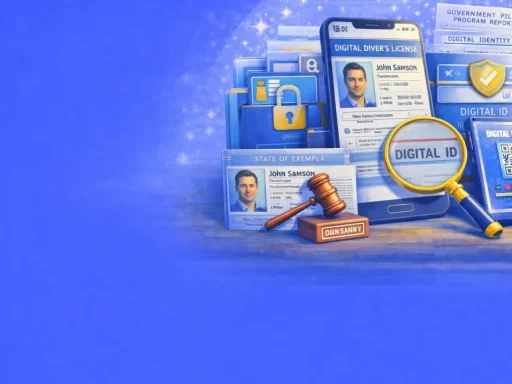
Mobile driver’s licenses (mDLs) represent the most widespread implementation of digital identity credentials in the United States. These are not simply digital images of your physical license. They are cryptographically secured credentials issued by state DMVs that can be verified electronically.
The ISO Standard
The international standard ISO/IEC 18013-5, published in 2021, established a common technical framework for mobile driver’s licenses. This standard defines how mDLs store data, communicate with verifiers, and protect privacy. Compliance with this standard ensures that a mobile license from one state can be verified by systems in another state or even another country.
The standard specifies that credentials must be stored securely on the device, protected by the device’s security features. When presenting credentials, the mDL communicates with the verifier through encrypted channels using NFC or Bluetooth. The verifier receives cryptographic proof that the credential is authentic without needing to query a central database.
Current State Adoption
As of early 2026, mobile driver’s license programs have expanded significantly across the United States. California leads in total issuance, with over 2.6 million mDLs issued through its CA DMV Wallet program. The state’s implementation supports both the ISO mDL standard and W3C Verifiable Credential formats, allowing use across various verification scenarios.
Fourteen states now support adding driver’s licenses to Apple Wallet, including Arizona, California, Colorado, Georgia, Hawaii, Illinois, Iowa, Maryland, Montana, New Mexico, North Dakota, Ohio, West Virginia, and Puerto Rico. Additional states like Louisiana, New York, Utah, and Virginia offer mDLs through state-specific apps or other wallet providers.
The number of states issuing mDLs is expected to exceed 30 by the end of 2026, driven by both consumer demand and federal encouragement. New Jersey authorized its Motor Vehicle Commission to create digital licenses in 2025, allocating $1.5 million toward implementation. Idaho’s legislature passed enabling legislation the same year.
Where mDLs Work Today
The Transportation Security Administration (TSA) now accepts mobile driver’s licenses at over 250 airport security checkpoints nationwide. Travelers with mDLs from participating states can tap their phone at equipped checkpoints for identity verification, often moving through security faster than those using physical IDs.
However, acceptance beyond TSA checkpoints remains limited. Most law enforcement agencies, businesses, and government offices do not yet have systems to verify mobile credentials. States and the TSA recommend that mDL holders continue carrying their physical licenses as backup. The acceptance infrastructure is expanding, but comprehensive coverage will take several more years.
Apple and Google Wallet Integration
The technology giants have positioned their mobile wallets as primary distribution channels for digital identity credentials, significantly accelerating adoption.
Apple Wallet
Apple’s integration allows iPhone users in participating states to add their driver’s license or state ID directly to Apple Wallet alongside payment cards and boarding passes. The credential is protected by device biometrics (Face ID or Touch ID) and the iPhone’s Secure Enclave hardware.
When presenting credentials through Apple Wallet, users maintain control over what information they share. The system displays exactly which data elements the verifier is requesting before the user authorizes disclosure. This transparency addresses privacy concerns about identity verification.
Apple has directly integrated with state DMV databases, with states maintaining authority over credential issuance and revocation. When a license is renewed or revoked, the digital credential updates accordingly.
Google Wallet
Google Wallet offers similar functionality for Android users. States like Arizona, California, Colorado, and others support adding credentials to Google Wallet. The implementation follows the same ISO 18013-5 standard, ensuring interoperability with verifiers accepting mDLs.
Samsung Wallet provides another option for Samsung device users in participating states, expanding the ecosystem of digital credential storage options.
The Network Effect
As major smartphone platforms incorporate digital identity credentials, adoption accelerates through network effects. More than 97% of American adults own a mobile phone, with approximately 85% owning smartphones. When the devices people already carry can store government-verified identity credentials, the friction of adoption decreases dramatically.
The European Digital Identity Wallet
While the United States takes a state-by-state approach, the European Union is implementing a unified digital identity framework that will affect all 27 member states.
eIDAS 2.0
The revised Electronic Identification, Authentication, and Trust Services regulation (eIDAS 2.0) took effect in May 2024 and mandates that every EU member state provide citizens with a European Digital Identity Wallet (EUDI Wallet) by the end of 2026. This regulation creates the most comprehensive government-backed digital identity framework in the world.
EUDI Wallets will allow European citizens to store and present verified credentials including national IDs, driver’s licenses, educational certificates, professional qualifications, and other attestations. The wallets must support selective disclosure, allowing users to share only necessary information rather than complete credentials.
The regulation requires that regulated services accept EUDI Wallet authentication as a recognized high-assurance option. This includes financial services, telecommunications, and government services. The framework establishes qualified trust services for electronic signatures, seals, and attestations that carry legal effect across the EU.
Implementation Timeline
Core trust services and wallet functionalities are expected to be operational by the end of 2025, with full wallet availability required by December 2026. The EU has set an ambitious target of 80% citizen adoption by 2030.
Large-scale pilot projects across 26 member states are currently testing real-world applications, involving over 350 companies and government agencies. These pilots are testing mobile driver’s licenses, healthcare credentials, educational certificates, and cross-border verification scenarios.
For businesses operating internationally, the EUDI Wallet will simplify identity verification for EU customers. A single integration could provide access to verified credentials from all EU member states, replacing fragmented national systems.
Verifiable Credentials and Decentralized Identity
Beyond driver’s licenses, a broader ecosystem of verifiable credentials is emerging that could transform how identity works across digital services.
W3C Verifiable Credentials
The World Wide Web Consortium (W3C) Verifiable Credentials standard defines a format for digital credentials that can be cryptographically verified without contacting the issuer. An employer could issue a credential attesting to your employment, a university could issue one attesting to your degree, or a professional licensing board could issue one attesting to your certification.
These credentials share common properties. They are cryptographically signed by the issuer, making forgery detectable. Can be verified by anyone without contacting the issuer. They support selective disclosure, allowing holders to share only relevant attributes. And they are portable, stored in the holder’s wallet rather than in the issuer’s database.
Decentralized Identifiers
Decentralized Identifiers (DIDs) provide a new approach to digital identity that does not depend on any single authority. A DID is a unique identifier that the holder controls, linked to cryptographic keys that prove ownership. Unlike usernames or email addresses, DIDs are not issued by any central service.
When combined with verifiable credentials, DIDs enable a model where individuals control their own identity data. You could hold credentials from multiple issuers in your wallet and present them to verifiers without any issuer knowing when or to whom you presented their credentials.
Standards Convergence
The California DMV’s implementation exemplifies how these standards are converging. The CA DMV Wallet supports both the ISO mDL format and W3C Verifiable Credential format, allowing credentials to work in different verification scenarios. This dual-format approach provides flexibility as the ecosystem matures.
NIST’s National Cybersecurity Center of Excellence is working with stakeholders across the mDL ecosystem to develop reference implementations and best practices. Their current project addresses Know Your Customer (KYC) use cases, demonstrating how mDLs and verifiable credentials can be used for financial account onboarding.
How Digital Identity Changes Notarization
Remote online notarization currently relies on several methods to verify signer identity: knowledge-based authentication (KBA), credential analysis of physical documents, biometric comparison, and real-time video observation by the notary. Digital identity wallets could transform each of these components.
Enhanced Credential Verification
Today’s credential analysis involves a signer holding their physical ID up to a camera while software analyzes the image for security features. This process has inherent limitations. Image quality varies with lighting and camera capabilities. Sophisticated forgeries can be difficult to detect in video. The analysis cannot confirm whether the credential is still valid or has been revoked.
With digital identity credentials, verification becomes cryptographic rather than visual. The platform would receive a credential directly from the signer’s wallet, verify the cryptographic signature from the issuing DMV, and confirm the credential has not expired or been revoked. Forgery becomes mathematically impossible rather than merely difficult.
This shift would significantly strengthen the first step of identity verification. A cryptographically verified credential from a state DMV provides stronger assurance than visual analysis of a physical document shown over video.
Reducing KBA Dependence
Knowledge-based authentication asks signers questions based on information from credit reports and public records. While valuable as one verification factor, KBA has known limitations. Data breaches have exposed the information these questions rely on. Some populations have thin credit files that generate inadequate questions. The system struggles with recent immigrants, young adults, and others with limited credit histories.
Digital identity credentials could supplement or potentially replace KBA for many users. A cryptographically verified government credential directly addresses the question KBA attempts to answer: Is this person who they claim to be? For signers with valid digital credentials, KBA could become a backup verification method rather than a primary requirement.
Streamlined User Experience
Current identity verification in RON requires multiple steps: uploading or capturing images of physical documents, answering KBA questions, and appearing on video for the notary’s visual verification. Each step adds time and friction. Each step can fail, requiring retry attempts or session abandonment.
Digital credential presentation could streamline this process significantly. A signer could authorize their wallet to share verified identity information with the RON platform in seconds. The platform would receive cryptographically verified data directly, eliminating image capture and analysis. The notary would receive confirmation of a verified government credential rather than viewing a physical document through video.
This streamlining benefits everyone: faster sessions for signers, reduced verification overhead for notaries, and stronger assurance for relying parties.
Privacy Improvements
When signers currently present physical identification, the notary and platform see everything on the document: full name, address, date of birth, license number, physical description, and often additional information. Much of this information is not necessary for notarization purposes.
Digital identity wallets enable selective disclosure. A signer could prove they are over 18 without revealing their exact birthdate. They could confirm their name matches the document being notarized without disclosing their home address. They could verify they hold a valid government credential without sharing the credential number.
For privacy-conscious signers, this represents a significant improvement. For platforms, it reduces the sensitive data they must protect.
Current RON Identity Verification
Understanding how identity verification works in remote online notarization today clarifies where digital credentials fit in the process.
Multi-Factor Approach
Most states with RON laws require multiple identity verification factors. The MBA-ALTA model legislation, which has influenced many state laws, specifies a three-step process: remote presentation of a government-issued ID, credential analysis of that ID, and identity proofing through either knowledge-based authentication or biometric factors.
This multi-factor approach provides defense in depth. If one method fails to detect fraud, others may catch it. The combination of credential analysis, KBA, and real-time video observation creates multiple barriers that fraudsters must overcome.
NIST Identity Assurance Levels
RON laws often reference NIST identity assurance standards. New York’s RON law, for example, requires vendors to meet NIST Identity Assurance Level 2. These standards define requirements for identity proofing, authentication, and lifecycle management.
Digital identity credentials from government sources would meet or exceed these assurance levels. A cryptographically verified credential from a state DMV represents stronger proof of identity than visual analysis of a document image.
The Notary’s Role
Regardless of technological verification methods, the notary retains essential responsibilities. The notary observes the signer through video, watching for signs of coercion, impairment, or confusion. Asks questions to assess willingness and understanding. The notary applies professional judgment that no automated system can replicate.
Digital identity credentials enhance the identity verification component but do not change the notary’s core functions. The notary remains the trusted third party who witnesses the signing and certifies that proper procedures were followed.
Timeline Expectations
When will digital identity credentials become part of standard notarization practice? Several factors influence the timeline.
State Law and Regulation
Most current RON laws specify acceptable identity verification methods and sometimes reference specific technologies or standards. Incorporating digital identity credentials may require statutory amendments or regulatory updates in many states.
Some states have flexible language that could accommodate new verification technologies through regulatory guidance. Others have specific statutory requirements that would need legislative action. The patchwork nature of RON regulation means adoption will vary state by state.
Platform Development
RON platforms must develop integrations with digital identity credential systems. This requires technical work to accept credentials in the appropriate formats, verify cryptographic signatures, and handle the communication protocols.
Major platforms are likely monitoring digital identity developments and preparing integration strategies. When adoption reaches sufficient scale to justify development investment, platform support will follow. The tipping point likely occurs when a critical mass of signers have digital credentials and begin expecting platforms to accept them.
Verifier Infrastructure
Before digital credentials can work in notarization, the entire verification chain must be ready. State DMVs must issue credentials. Smartphone platforms must support storage. RON platforms must accept and verify credentials. And critically, the cryptographic trust infrastructure must enable platforms to verify that credentials are authentic.
This infrastructure is building rapidly. The ISO mDL standard provides technical interoperability. Apple and Google wallet integrations provide distribution. State issuance programs provide credentials. The remaining gap is relying party acceptance, which is expanding but not yet comprehensive.
Realistic Expectations
Based on current trajectories, digital identity credentials will likely begin appearing in RON contexts within the next two to three years for early adopters in states with mature mDL programs and flexible RON regulations.
Broader adoption will follow as more states issue mDLs, more platforms add support, and regulatory frameworks adapt. By 2030, digital identity credentials may be a standard verification option across most RON platforms, though not necessarily replacing existing methods entirely.
The European EUDI Wallet timeline provides a useful reference. With mandated availability by December 2026 and targeted 80% adoption by 2030, Europe is establishing an aggressive but achievable digital identity roadmap.
Challenges and Concerns
Several challenges must be addressed as digital identity credentials enter mainstream use.
Digital Divide
Not everyone has a smartphone capable of running modern wallet applications. Not everyone is comfortable with digital technology. Overreliance on digital credentials could exclude populations already marginalized from digital services.
The Oklahoma Mobile ID app was discontinued after the Department of Justice found accessibility violations under the Americans with Disabilities Act. This serves as a warning that digital identity systems must be designed for universal accessibility, not just technological capability.
RON platforms and regulations will need to maintain alternative verification paths for signers who cannot or choose not to use digital credentials. Digital credentials should expand options, not restrict them.
Privacy and Tracking
Civil liberties organizations have raised concerns about digital identity systems potentially enabling government surveillance. If every credential presentation is logged centrally, authorities could track where people verify their identity and when.
The Center for Democracy and Technology and other groups have called for digital IDs that do not “phone home” every time they are used. Credentials should be verifiable without notifying the issuer. User consent should govern what data is collected and retained.
The technical standards address these concerns. ISO mDL credentials can be verified without contacting the DMV. The verification happens locally through cryptographic validation. However, implementation choices by platforms and regulators will determine whether these privacy protections are realized in practice.
Security Considerations
Digital credentials introduce new security considerations. What happens if a phone is stolen? If a wallet application is compromised? What if someone is coerced into presenting credentials?
Device security features provide the first line of defense. Biometric authentication (Face ID, fingerprint) prevents unauthorized access to credentials. Remote wipe capabilities can disable credentials on lost or stolen devices. State systems can revoke credentials if the underlying license is revoked.
The notary’s observation remains valuable here. Even with cryptographically verified credentials, the notary assesses whether the signer appears to be under duress or coercion. Technology and human judgment work together.
Preparing for the Transition
Both signers and notaries can prepare for the coming integration of digital identity credentials.
For Signers
If your state offers a mobile driver’s license, consider enrolling. Familiarity with digital credentials now will make future verification processes smoother. California, Louisiana, Arizona, Colorado, and other states have active programs with straightforward enrollment.
Understand that mDLs are currently supplements to physical credentials, not replacements. Continue carrying your physical license. Use the mDL where accepted, but do not rely on it exclusively.
Pay attention to what data you authorize sharing. Digital wallets show you exactly what information a verifier requests. Review these requests and understand what you are consenting to share.
For Notaries
Stay informed about digital identity developments in your state. When your state DMV issues mDLs, understand what they look like and how they work. Familiarity with the technology helps you adapt when platforms begin accepting digital credentials.
Expect your RON platform to handle the technical verification. Your role remains assessing the signer through observation and judgment. The credential format changes; your professional responsibilities do not.
Watch for training and guidance from your commissioning authority and professional associations. As regulations adapt to digital credentials, updated guidance will clarify how to handle these new verification methods properly.
Frequently Asked Questions
What is a mobile driver’s license?
A mobile driver’s license (mDL) is a digital version of your driver’s license stored in a smartphone app or digital wallet. Unlike a photo of your license, an mDL is a cryptographically secured credential issued by your state DMV that can be verified electronically.
How many states offer mobile driver’s licenses?
As of early 2026, over 20 states have some form of mobile driver’s license program, with more than 14 states supporting integration with Apple Wallet. The number is expected to exceed 30 states by the end of 2026.
Can I use a mobile driver’s license for notarization now?
Currently, most RON platforms require presentation of a physical government ID. As mDL infrastructure matures and RON regulations adapt, digital credential acceptance will expand. Check with your specific RON platform for current capabilities.
What is the European Digital Identity Wallet?
The EUDI Wallet is a government-backed digital identity wallet that every EU member state must provide to citizens by the end of 2026 under the eIDAS 2.0 regulation. It will store verified credentials and enable identity verification across all EU countries.
How does digital identity improve privacy?
Digital identity wallets support selective disclosure, allowing you to share only necessary information. For example, you could prove you are over 18 without revealing your exact birthdate or home address. This limits the personal data exposed during verification.
Will digital credentials replace knowledge-based authentication?
Digital credentials could supplement KBA for many users, potentially reducing reliance on questions based on credit report data. For signers without digital credentials, KBA would remain an option. The multi-factor approach will likely continue.
Are mobile driver’s licenses secure?
mDLs are protected by device security features like Face ID or fingerprint authentication and stored in hardware security modules. They are cryptographically signed by the issuing DMV, making forgery detectable. If a device is lost, credentials can be remotely disabled.
When will RON platforms accept digital identity credentials?
Early adoption could begin within two to three years in states with mature mDL programs. Broader acceptance will likely develop over the following years as infrastructure, regulations, and platform capabilities align. By 2030, digital credentials may be standard verification options.
Conclusion:
Digital identity wallets represent the most significant change in how we prove our identity since the adoption of photo identification. Mobile driver’s licenses, European digital identity wallets, and verifiable credentials are building an ecosystem where identity verification becomes cryptographic rather than visual, selective rather than comprehensive, and portable rather than document-based.
For remote online notarization, these developments promise stronger identity assurance, streamlined verification processes, and enhanced privacy protection. Cryptographically verified government credentials provide stronger proof than visual analysis of physical documents. Selective disclosure limits unnecessary data exposure. Automated verification reduces friction for signers and notaries alike.
The transition will take time. State laws must adapt. Platforms must build integrations. Infrastructure must mature. But the direction is clear. Within the next several years, digital identity credentials will become an accepted, and eventually preferred, method of signer verification.
The notary’s essential role remains unchanged through this transition. Human judgment in assessing willingness, observing for coercion, and applying professional discretion cannot be automated. Digital credentials enhance the identity verification component while preserving the human elements that make notarization trustworthy.
For secure remote online notarization that stays current with evolving identity verification technology, BlueNotary provides a platform designed to deliver strong identity assurance while adapting to the future of digital credentials.