




So, what exactly is an electronic signature for legal documents? Think of it as the digital equivalent of putting pen to paper. Under laws like the ESIGN Act in the U.S., it carries the same legal weight as a handwritten signature. But it’s much more than just a typed name—it’s a secure, verifiable process designed to confirm a signer’s identity and their clear intent to be bound by an agreement. This is why industries like law, finance, and real estate are rapidly leaving paper behind.
The Digital Gavel: Why Legal Workflows Are Going Paperless
The era of whirring printers, expensive couriers, and overflowing filing cabinets is fading fast. Legal and financial industries are in the middle of a massive shift, swapping out clunky paper trails for clean, secure digital workflows. Let’s be honest—the old way of executing legal documents was often a logistical mess, plagued by delays, high costs, and security holes.
Think about what it took to sign a simple contract. You had to print multiple copies, mail them out, wait for everyone to sign and return them, and cross your fingers that nothing got lost along the way. Every single step was a point of friction and a potential vulnerability. It was like using a physical ledger book in an age of encrypted cloud databases. It worked, but it was slow, inefficient, and a nightmare to audit.
The Inevitable Move to Digital Execution
Switching to an electronic signature for legal documents isn’t just about convenience anymore; it’s a strategic move. Law firms, real estate agencies, and lenders are all realizing that going digital gives them a serious competitive advantage. It closes deals faster, makes clients happier, and creates a much stronger, auditable record of every transaction.
This digital evolution is driven by a few undeniable benefits:
- Speed and Efficiency: Agreements get signed and returned in minutes, not days. That’s a game-changer for shortening deal cycles.
- Enhanced Security: Digital platforms use encryption, identity verification, and tamper-evident seals that are far more secure than a simple wet ink signature.
- Comprehensive Audit Trails: Every single action—from the moment a document is opened to the final click to sign—is logged. This provides undeniable proof of the entire signing process.
- Accessibility: Signers can execute documents from anywhere in the world, on any device. Geographical barriers simply disappear.
The market numbers tell the story. The global digital signature market was valued at $8.65 billion in 2024 and is projected to skyrocket to $238.42 billion by 2034. That’s a growth rate of over 40% a year. While the financial sector is leading the way, legal services are not far behind. You can dive deeper into these trends in the full report from Precedence Research.
At its core, adopting electronic signatures is about upgrading the very foundation of legal agreements. It preserves the principles of trust and verification while making the process faster, more transparent, and remarkably more secure.
This isn’t just about swapping ink for pixels. It’s about creating a modern, resilient framework for legal operations that can keep up with our connected world. In the next sections, we’ll break down the legal pillars that make this technology enforceable and explore the different types of signatures you can use.
Are Electronic Signatures Legally Binding?
This is the million-dollar question for any professional who deals with important agreements. The short answer is a resounding yes. An electronic signature for legal documents is absolutely legally binding, and the real confidence comes from understanding the powerful legal frameworks that make this possible.
Think of these laws not as stuffy legal texts, but as a global agreement that created a reliable “digital handshake.” For centuries, a contract’s power came from seeing wet ink on paper. Today, technology offers a far more secure and verifiable way to show consent, and the law has sprinted to catch up. Landmark legislation now ensures that a contract can’t be thrown out just because it was signed on a screen instead of a page.
The Legal Pillars in the United States
In the U.S., two major laws create the foundation for e-signature validity. They work in tandem to establish a consistent, reliable standard from coast to coast.
- The ESIGN Act (2000): Officially called the Electronic Signatures in Global and National Commerce Act, this is the federal law that gives electronic signatures the same legal weight as their handwritten counterparts. It states that a contract “may not be denied legal effect, validity, or enforceability solely because it is in electronic form.”
- UETA: The Uniform Electronic Transactions Act is a state-level law that nearly every state has adopted (49, to be exact). It’s designed to align state laws with the federal ESIGN Act, creating a predictable legal environment for digital business no matter where you are.
Together, ESIGN and UETA make it clear: as long as everyone involved agrees to conduct business electronically and demonstrates a clear intent to sign, the e-signature is valid. This has been a game-changer for countless industries. The legal world itself is moving this way, as highlighted by the benefits of hiring a good real estate lawyer, who now often navigate the complexities of digital closings.
The European Gold Standard: eIDAS
On the other side of the pond, the European Union operates under its own powerhouse regulation known as eIDAS (Electronic Identification, Authentication, and Trust Services). Put into effect in 2016, this framework standardizes e-signature rules across all EU member states, making cross-border business a whole lot simpler and more secure.
eIDAS is especially interesting because it created three distinct tiers of electronic signatures. Each tier comes with a different level of security and legal standing, which lets businesses match the signature type to the risk level of the transaction.
This tiered system gives businesses flexibility. A quick “I agree” click works for updating terms of service, but a multi-million dollar business deal will demand a much higher standard of verification.
To make sense of it all, here’s a quick breakdown of how these major legal frameworks compare.
Key E-Signature Laws at a Glance
This table compares the fundamental principles and scope of the major legal frameworks governing electronic signatures in the US and EU.
| Legal Framework | Jurisdiction | Core Principle | Key Requirement |
|---|---|---|---|
| ESIGN Act | United States (Federal) | Grants e-signatures the same legal status as wet ink signatures nationwide. | Parties must consent to transact electronically and show clear intent to sign. |
| UETA | United States (State) | Provides a uniform legal model for e-signatures adopted by individual states. | Ensures consistency with ESIGN, creating a predictable state-level framework. |
| eIDAS | European Union | Standardizes e-signature law across all 27 member states for cross-border trade. | Defines three tiers of signatures (Simple, Advanced, Qualified) with varying legal weights. |
When you boil it down, these laws aren’t just about technology—they’re about establishing trust. They provide the legal certainty that lets companies, law firms, and individuals sign binding agreements quickly and confidently, knowing a secure electronic signature for legal documents will stand up when it counts.
When you hear “electronic signature,” you might picture a simple typed name at the bottom of an email. But in the legal world, not all e-signatures are created equal. They don’t all carry the same legal weight or offer the same security.
Think of it like a ladder of trust. The bottom rung is fine for everyday agreements, but as the stakes get higher, you need to climb to a rung with more robust identity verification and data security. This tiered system is crucial for anyone using an electronic signature for legal documents, especially under frameworks like the EU’s eIDAS Regulation, which sets clear standards for cross-border deals.
Let’s break down what these different levels really mean.
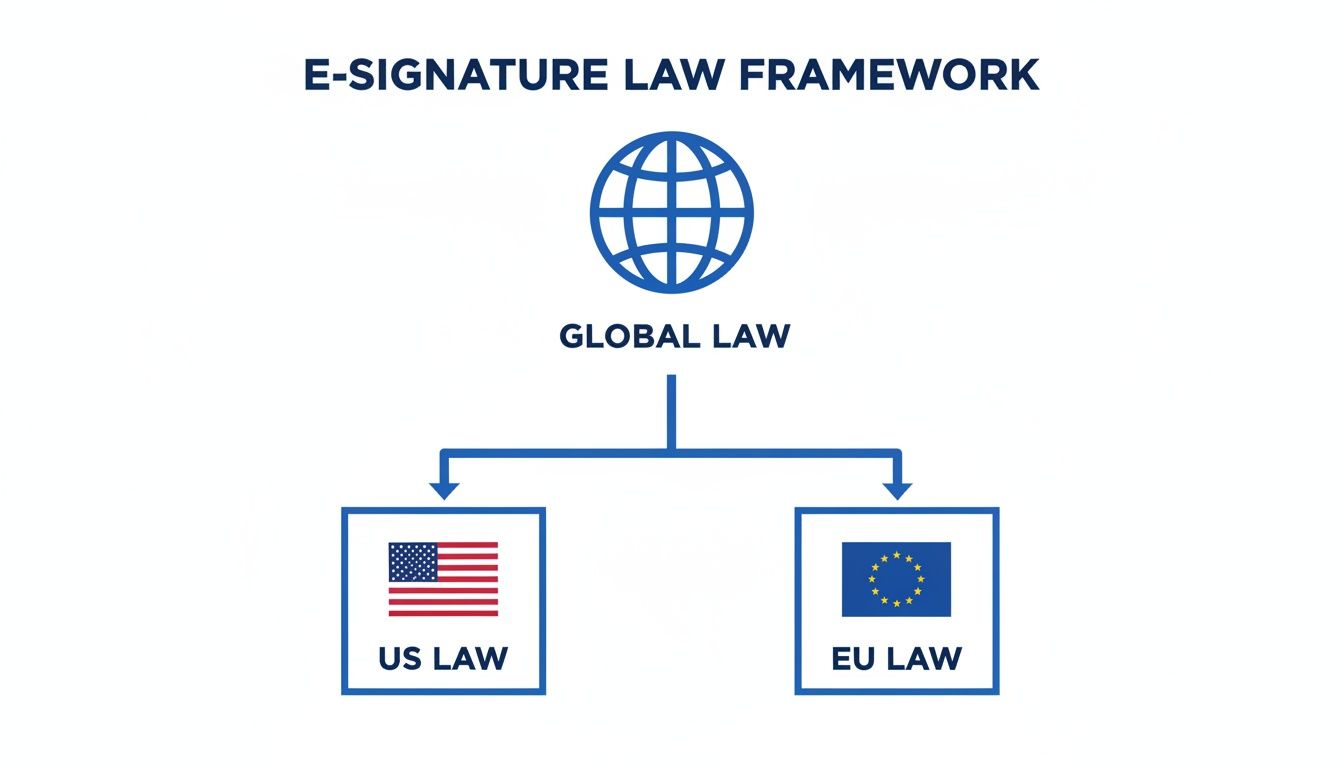
This diagram shows how global principles for e-signatures branch into specific legal frameworks, like those in the U.S. and the E.U., each with its own nuances.
The Ground Floor: Simple Electronic Signatures
The Simple Electronic Signature (SES) is the most common type you’ll run into. It’s broadly defined as any electronic data attached to a document that a person uses to sign. You use these all the time, probably without a second thought.
A few everyday examples of an SES include:
- Ticking an “I Agree” box on a website.
- Typing your name on an online form or at the end of an email.
- Pasting a scanned image of your actual signature into a Word document.
While they’re incredibly convenient, an SES offers the bare minimum in terms of security. There’s no built-in mechanism to prove who actually signed or to stop someone from changing the document afterward. For an SES to hold up in a dispute, it usually needs supporting evidence, like a solid audit trail showing the signer’s intent.
Climbing Higher: Advanced Electronic Signatures
Taking a big step up in security, we get to the Advanced Electronic Signature (AES). This isn’t just a name; it has to meet a strict set of criteria to earn the title.
An Advanced Electronic Signature must be uniquely linked to the signer, capable of identifying them, created under their sole control, and connected to the document in a way that reveals any later changes.
This is where things get more technical, involving cryptographic technology. An AES uses a digital certificate to tie your signature to your verified identity. It creates a unique “digital fingerprint” on the document at the exact moment of signing. If anyone messes with the document later—even changing a single comma—the signature is instantly invalidated. This tamper-evident seal makes an AES a much stronger choice for important contracts where knowing who signed is non-negotiable.
The Gold Standard: Qualified Electronic Signatures
At the very top sits the Qualified Electronic Signature (QES). In the European Union, this is the heavyweight champion. It is the only type of e-signature that is automatically considered the legal equivalent of a handwritten, wet-ink signature across all member states. A QES has a special legal status that flips the script: if challenged, the burden of proof is on the person questioning its validity, not the person who used it.
To reach this elite level, a QES has to meet all the requirements of an AES, plus two more make-or-break conditions:
- It must be created by a QSCD: This means using a Qualified Signature Creation Device, a highly secure piece of hardware (like a smart card) or a certified cloud service.
- It must be based on a Qualified Certificate: The signature is backed by a special certificate from a government-approved Qualified Trust Service Provider (QTSP), which involves a strict, often in-person, identity verification process.
Given its fortress-like security, the QES is reserved for the most critical documents—think court filings, real estate deeds, and major international business deals where there can be zero doubt about the signature’s authenticity.
To see how you can create a secure and valid electronic signature, platforms like BlueNotary offer tools built around these fundamental principles of security and identity verification.
How Security and Identity Verification Work
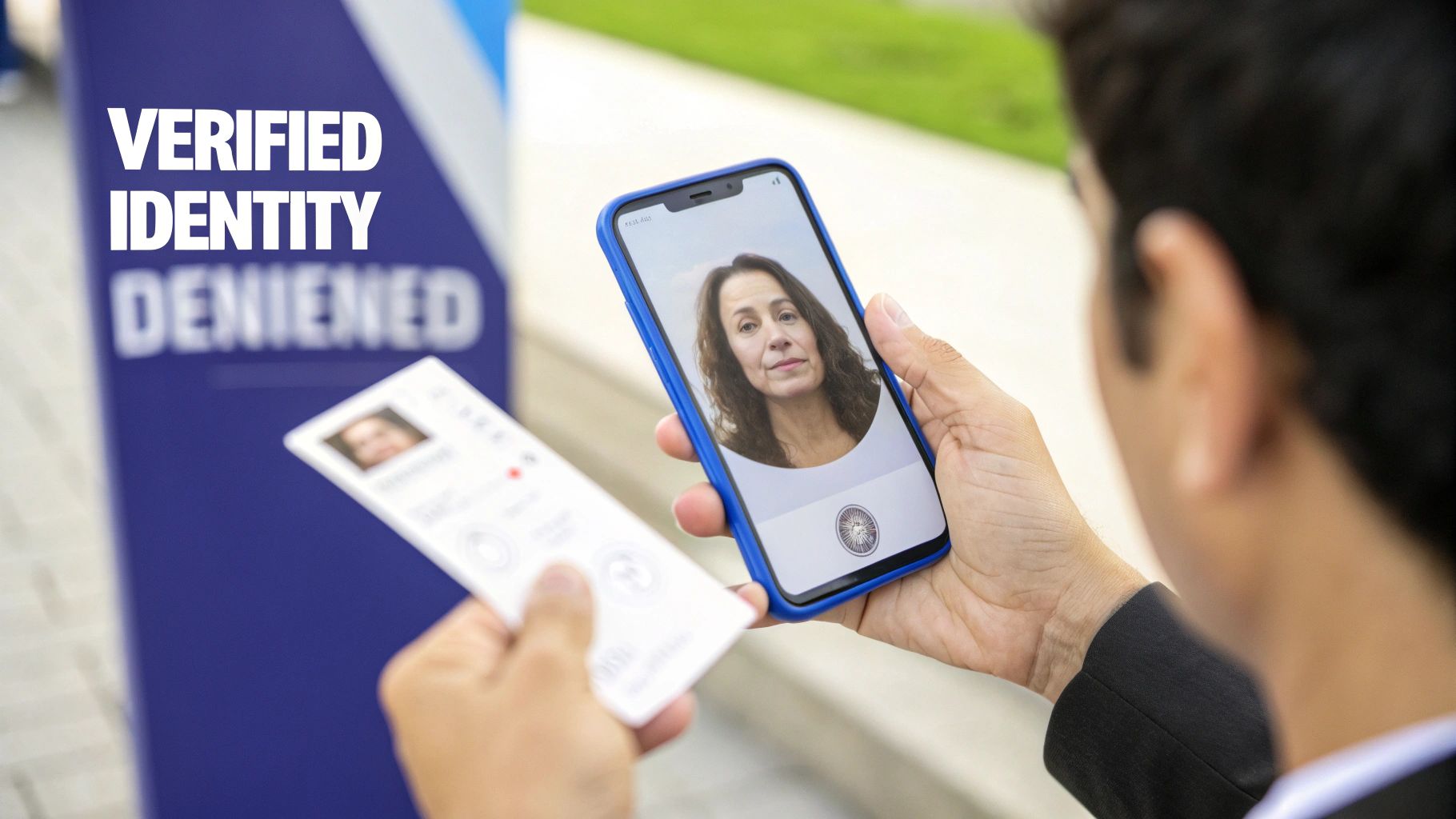
The entire legal power of an electronic signature for legal documents boils down to one critical question: how do you really know who signed it? Unlike a wet signature, which can be surprisingly easy to forge, a secure e-signature is wrapped in layers of technology. These layers work together to prove identity, lock down the document’s integrity, and build an airtight record of the entire event.
This whole system stands on three pillars: rock-solid identity verification, tamper-evident seals, and a comprehensive audit trail. When combined, they create a digital fortress that makes e-signatures more than just a convenience—they’re a genuine security upgrade.
The Digital Doorman: Identity Verification Methods
Before a signature is even placed, the platform has to confirm the signer is who they say they are. This is where advanced identity verification steps in, acting like a vigilant digital doorman for your document. The best platforms don’t just use one method; they use a multi-layered approach to authenticate a signer’s identity with a high degree of confidence.
You’ll typically see a combination of these powerful techniques:
- Government ID Analysis: The signer starts by uploading a photo of their driver’s license, passport, or other government ID. Sophisticated software scans it for tell-tale signs of tampering, verifies hidden security features, and makes sure the photo on the ID matches the person.
- Knowledge-Based Authentication (KBA): You’ve probably seen this before. It’s a short quiz with multiple-choice questions pulled from the signer’s personal credit history—things like, “Which of the following addresses have you previously lived at?” The questions are specifically designed so only the real person could possibly know the answers.
- Biometric Verification: Using a smartphone or webcam, the system runs a quick “liveness check.” It might ask the signer to turn their head or smile. Facial recognition technology then compares this live video to the photo on their ID, creating a very strong link between the physical person and the digital document. You can learn more about how these technologies work together in our guide on the identity verification process.
The Tamper-Evident Seal: Protecting Document Integrity
Okay, so we’ve confirmed the signer’s identity. The next challenge is making sure the document itself can’t be secretly altered after the fact. Once a document is signed, a cryptographic “seal” is applied. Think of it like a digital version of an old-fashioned wax seal on a scroll—if it’s broken, you know immediately that something is wrong.
This is done using something called public key infrastructure (PKI), which creates a unique digital fingerprint for the document at the exact moment of signing. If anyone tries to change anything later—even a single comma—that fingerprint changes, and the digital seal is visibly broken. This gives you undeniable proof that the version you’re looking at is the exact one that was signed.
The Digital Paper Trail: The Power of the Audit Log
The final pillar of security, and arguably the most important in a legal setting, is the audit trail. This is a detailed, time-stamped log that records every single action taken during the signing process.
An audit trail is the document’s impartial life story. It tracks who opened it, when they viewed it, the IP address they used, the exact methods of identity verification passed, and the precise moment the signature was applied.
This log creates a comprehensive, court-admissible record that can definitively prove the authenticity and integrity of the entire transaction.
The broader digital signature market is constantly evolving, with new tools like smart ID readers and even more advanced authentication systems emerging to meet security demands. The signature verification market alone is projected to hit $4,795.57 million USD by 2026, which tells you just how critical these security layers have become.
Ultimately, these interconnected features all work in concert to make an electronic signature for legal documents exceptionally trustworthy. By confirming identity, protecting the document from changes, and logging every step, the system delivers a level of security that traditional paper and ink just can’t match.
Putting E-Signatures into Practice in Your Firm
It’s one thing to understand the theory behind an electronic signature for legal documents, but seeing how it solves real-world headaches is when the lightbulb really goes on. For anyone in law, finance, or real estate today, digital workflows aren’t just a nice-to-have; they’re essential for delivering the speed, security, and client experience that people now expect.
Let’s step away from the abstract and look at a few practical scenarios. This is where e-signatures go from a concept to a critical tool that cuts through delays, erases geographical boundaries, and mitigates compliance risks.
Streamlining Cross-State Real Estate Closings
Picture this: a buyer in California, a seller in Florida, and the property is in Texas. Ten years ago, this was a logistical nightmare. You were dealing with overnight couriers, coordinating multiple in-person notary appointments, and constantly worrying about documents getting lost or signed incorrectly. The whole deal could grind to a halt for weeks just waiting for paper to move.
With electronic signatures, that entire messy process gets consolidated into a single, clean workflow. The closing agent preps the documents and sends a secure link to everyone involved. Using a platform with solid identity verification, the buyer and seller can review and sign deeds, disclosures, and settlement statements from wherever they are, in a matter of minutes.
The result? The deal closes days or even weeks faster. Plus, every signature comes with a complete, tamper-evident audit trail, giving you undeniable proof of who signed what and when.
Accelerating Complex Lending Agreements
In the lending world, time is literally money. A few days’ delay on a loan agreement can jeopardize a client’s business expansion or their dream home. The old way—printing, signing, and mailing back a mountain of paperwork—was riddled with friction and opportunities for mistakes.
Now, lenders use e-signatures to get critical agreements finalized in a fraction of the time. A loan officer can send a complex agreement to the borrower, a co-signer, and a guarantor all at once. The platform guides each person through the document, making sure no fields or signature lines are missed.
This digital acceleration is not just about convenience. It’s a strategic advantage that allows lenders to process more loans, reduce administrative overhead, and provide clients with the quick, responsive service they expect.
This shift isn’t just a trend; it’s the new standard. An impressive 78% of law firms in the United States have already adopted electronic signature solutions as part of their remote work infrastructure. That leaves a very small fraction still clinging to paper. It’s a massive vote of confidence from legal professionals who stake their reputations on security and validity.
Securing Global Business and Client Agreements
When you’re dealing with international partners, executing sensitive documents like NDAs or new client engagement letters adds another layer of complexity. Time zones and different legal jurisdictions can bog down the start of a critical business relationship. An electronic signature for legal documents slices right through those hurdles.
A law firm can send an engagement letter to a client halfway across the world, who can then sign it right from their laptop or phone. This instantly solidifies the attorney-client relationship without the week-long delay of international mail. To take it a step further, good client onboarding best practices show how e-signatures are the perfect first step in creating a smooth client journey from day one.
These examples all point to the same conclusion: electronic signatures are a game-changer for any firm that wants to be more efficient and secure. At BlueNotary, we build tools specifically for these kinds of workflows. You can learn more about our solutions for e-signing and notarization for law firms and see how they can eliminate friction in your practice, letting you focus on what really matters—serving your clients.
A Practical Checklist for Implementation
Getting an electronic signature for legal documents right involves more than just picking a software provider. It’s about building a bulletproof process that ensures every document you sign is compliant, secure, and will hold up in court. Think of this as your game plan for a smooth rollout, helping you sidestep common traps and create a workflow you can actually rely on.
Rolling out any new system can feel like a huge undertaking, but it doesn’t have to be. By breaking it down into a few common-sense steps, you can make the whole process feel much more manageable. This checklist walks you through the essentials, from figuring out your risks to managing data for the long haul.
Step 1: Assess Your Document Risk
Let’s be honest, not all documents carry the same weight. The first thing you need to do is sort your documents by how critical they are. This one step will tell you exactly how much security and identity verification you’ll need for each type.
- Low-Risk Documents: Think internal HR forms or simple consent agreements. A Simple Electronic Signature (SES) is often perfectly fine for these.
- Medium-Risk Documents: Here we’re talking about things like client engagement letters, NDAs, or most commercial contracts. These usually warrant an Advanced Electronic Signature (AES) that includes some form of identity check.
- High-Risk Documents: For the really important stuff—like real estate closings, major loan agreements, or anything under a regulatory microscope—you need the highest level of assurance. This often means signatures backed by serious, multi-factor identity proofing.
Step 2: Establish Clear Consent Protocols
This is a big one. For an e-signature to be legally binding under laws like the ESIGN Act, everyone involved has to agree to do business electronically. This isn’t just a box to check; it’s a legal cornerstone.
Your signing process must capture and save proof of explicit consent from every single signer before they even see the document. This is usually done with a clear “click to accept” statement that gets recorded in the audit trail, creating a permanent record that they agreed to the digital process.
Keep the consent language simple and direct. You should also give people an easy way to opt out and ask for paper copies if they’re not comfortable signing online. It’s about being compliant and respecting your clients’ preferences.
Step 3: Prioritize Vendor Security and Compliance
Choosing the right platform is probably the single most important decision you’ll make in this entire process. Your vendor is your compliance partner, so they need to have their security locked down tight to protect your documents, your clients, and your firm.
When you’re vetting potential platforms, here’s what you need to ask:
- What identity verification methods do you offer? You want a vendor with a full toolbox, including options like government ID analysis, Knowledge-Based Authentication (KBA), and biometrics.
- How detailed is your audit trail? The platform absolutely must create a comprehensive, tamper-evident log of every single action—who opened the document, when they signed, their IP address, and so on.
- What are your data storage and retention policies? Make sure they provide secure, encrypted storage and have flexible retention rules that match your own legal obligations for keeping client records.
A platform like BlueNotary is built to handle these requirements, giving you a secure foundation for every electronic signature for legal documents. Follow this checklist, and you’ll be able to build a digital signing process that you and your clients can trust completely.
Got Questions About E-Signatures? We’ve Got Answers.
Switching to digital ways of doing things always stirs up a few questions, and when you’re talking about an electronic signature for legal documents, you need clear, straightforward answers. Let’s tackle some of the most common questions legal and business professionals ask when they start using this technology.
So, Do Electronic Signatures Actually Hold Up in Court?
Yes, they absolutely do. In the United States, landmark federal laws like the ESIGN Act and state-level laws based on the UETA framework give e-signatures the exact same legal weight as a wet ink signature.
The key is proving a few things if challenged: you need to show the signer intended to sign, they agreed to do it electronically, and the document hasn’t been tampered with since. If you can do that, an e-signature is solid, enforceable evidence in any courtroom.
Are There Any Documents I Can’t Sign Electronically?
While the vast majority of agreements are fair game for e-signatures, a handful of specific, high-stakes documents are still exceptions to the rule. These are typically areas where the potential for fraud or undue influence is considered too high for a digital-only approach.
While it varies by state, the usual suspects include:
- Wills, codicils, and testamentary trusts
- Family law documents, like adoption papers or divorce decrees
- Certain high-value real estate transfers, like property deeds
- Official court orders and specific legal notices
It’s always smart to double-check the specific rules in your jurisdiction, as laws are constantly evolving.
The bottom line is this: while most business and legal paperwork is perfect for e-signatures, a small and very specific category of life-altering documents might still need the classic pen-on-paper treatment to be ironclad.
Is DocuSign the Same Thing as an Electronic Signature?
That’s a great question, and it’s a common point of confusion. No, they aren’t the same thing.
Think of it like this: an electronic signature is the concept—it’s the legally recognized act of signing a document in a digital format. DocuSign, on the other hand, is a well-known brand that provides a platform for creating one. It’s the difference between the idea of a “pen” and a specific brand like “Bic.” One is the tool, the other is the action.
Ready to build a signing process that’s secure, compliant, and genuinely efficient? BlueNotary provides a complete platform for identity verification, e-signing, and remote online notarization, designed for the high standards of legal and financial pros. See how BlueNotary can upgrade your workflow today.