




Think of identity verification services as the modern-day equivalent of an in-person ID check. They are the technology that lets you confidently answer the question, “Is this person really who they say they are?” when you can’t meet face-to-face. This process is the critical first step in establishing trust for any meaningful remote interaction.
Building Trust in a Digital World
How can you be certain about the identity of someone on the other side of a screen? This isn’t just a philosophical question anymore—it’s one of the biggest hurdles for businesses operating online. Not long ago, any high-stakes agreement demanded a firm handshake and a physical ID check. Today, we need a digital solution that’s just as secure but infinitely more efficient.
You can think of identity verification services as the digital bouncer for your business. In the same way a bank teller verifies a customer’s identity before opening a vault, these services act as a secure gatekeeper for your digital front door. They’re a non-negotiable defense against fraud—a problem that costs companies billions every year—and a mandatory piece of the puzzle for staying compliant in regulated industries.
This technology forges a verifiable chain of trust that underpins everything from remote online notarizations to multi-million dollar financial deals. Without it, the risk of identity theft, money laundering, and other crimes would bring the digital economy to a screeching halt.
The Foundation of Modern Verification
A truly solid identity verification system isn’t a single piece of software; it’s a layered suite of processes working in harmony. Each layer adds another coat of security, cross-referencing different aspects of a person’s identity to paint a complete and reliable picture. This multi-pronged approach is what ensures a transaction is not only quick but also legally defensible. To truly build digital trust and ensure a smooth start, integrating robust identity verification into client onboarding best practices is essential.
In sectors like finance and real estate, identity verification is not just a feature—it’s the bedrock of the entire transaction. It provides the legal and compliant assurance needed to execute high-value deals with confidence.
Modern identity verification services are built on several core pillars that work together to produce a trustworthy result. Let’s break down these key components to see how a simple selfie and a photo of a driver’s license can create a legally binding digital event.
Key Components of Modern Identity Verification
The table below outlines the core technologies and processes that form the backbone of a comprehensive identity verification service. Each one plays a distinct role in confirming that an individual is who they claim to be.
| Component | Function | Example Use Case |
|---|---|---|
| Document Verification | Scans and authenticates government-issued IDs (passports, driver’s licenses) for security features and signs of tampering. | A lender scans a borrower’s ID to begin a loan application, ensuring the document is legitimate before proceeding. |
| Biometric Analysis | Matches the live person to their ID photo using facial recognition and “liveness” checks to prevent spoofs. | A client signing a will remotely must complete a facial scan to prove they are physically present and not using a photo. |
| Data Verification | Cross-references personal information against trusted third-party databases to confirm details like address or age. | An online platform checks a user’s details against public records to meet Know Your Customer (KYC) requirements. |
| Audit Trail | Creates a secure, time-stamped record of the entire verification process, including video and data, for compliance. | A law firm retains a tamper-evident video recording of an online notarization session to defend its legality if challenged. |
Together, these elements create a powerful system that provides a high degree of assurance, allowing businesses to operate securely and efficiently in a remote-first world.
How Digital Identity Verification Actually Works
Ever wonder what’s really happening when you snap a picture of your driver’s license for a new app? It feels simple, but behind that quick selfie is a sophisticated, multi-layered security check happening in just a few seconds.
From the user’s perspective, it’s just a couple of clicks. But for the system, it’s a high-stakes process designed to confirm you are who you say you are, stopping fraudsters in their tracks. The goal is to move a person from a totally anonymous visitor to a verifiably known individual.
This entire workflow is built to tackle the core problem of digital trust—how do you know the person on the other side of the screen is legitimate?
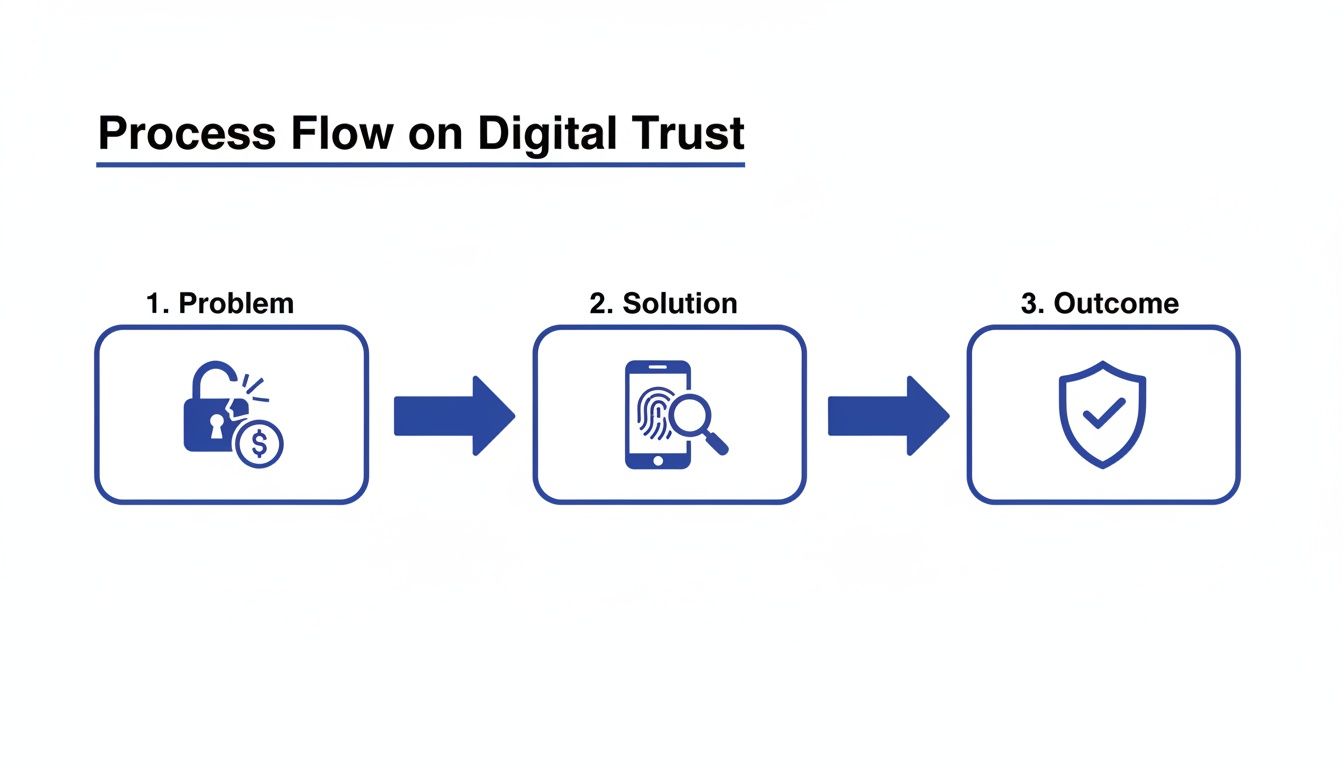
As you can see, the service acts as a bridge, transforming a high-risk, unknown user into a low-risk, verified one. This creates the foundation for secure and legally sound digital transactions.
Step 1: Data Capture and Document Analysis
The process kicks off the moment a user points their phone’s camera at a government-issued ID. The first piece of tech to jump into action is Optical Character Recognition (OCR). Think of it as a digital scanner that doesn’t just see a picture but reads the text—name, date of birth, address—and converts it into structured data the system can work with.
Extracting that data is a critical first step, and modern platforms often rely on powerful AI-enhanced OCR tools to do it with incredible accuracy. But the system is doing much more than just reading the words on the card. It’s performing a deep forensic analysis of the document itself.
Sophisticated algorithms are looking for tiny, tell-tale signs of a fake ID.
- Holograms and watermarks: It checks for the presence and precise placement of security features that are unique to that type of ID.
- Font and layout consistency: The system compares the document’s typography and design against a massive database of genuine ID templates to spot any inconsistencies.
- Microprinting and barcodes: It can even scan for microscopic text and validate the data encoded in 2D barcodes, which are nearly impossible to forge correctly.
If the ID passes this intense scrutiny, the system gains a high degree of confidence that the document is authentic. The first checkpoint is complete.
Step 2: Biometric Verification and Liveness Detection
Okay, so the ID is real. But is the person holding it the rightful owner? This is where biometric verification takes over. The user is prompted to take a selfie or a short video, and that’s when facial recognition technology gets to work.
The software maps dozens of unique points on the user’s face—the distance between their eyes, the curve of their jawline—to create a distinct biometric template. This template is then compared against the photo on the government ID. A high match score provides powerful evidence that the person in the selfie is the same person on the document.
But what if a fraudster is just holding up a picture of someone else? That’s where liveness detection comes in. To counter this, the system will ask the user to perform a simple action, like smiling, blinking, or turning their head. This proves they are a real, live person who is physically present for the verification, not just a static image or a pre-recorded video. It’s a simple but brilliant way to shut down common spoofing attacks.
This biometric-first approach is key to stopping fraud before it starts. You can learn more about how to https://bluenotaryonline.com/reduce-fraud-risk-with-bluenotarys-biometric-first-approach/.
Step 3: Cross-Referencing and Final Confirmation
For high-stakes transactions, many verification services add a final layer of confirmation called Knowledge-Based Authentication (KBA). This is where the system asks questions that, in theory, only the real person could answer.
KBA often pulls information from public and private data sources to generate multiple-choice questions like, “Which of the following streets have you previously lived on?” or “Which of these car models have you owned?”
A correct answer here provides one last data point to seal the deal.
In a matter of seconds, all of these checks are complete: document authenticity, biometric matching, liveness detection, and data cross-referencing. The system then delivers a clear pass or fail result, giving your organization the green light to proceed with confidence.
Navigating Compliance and Mitigating Risk
Simply checking an ID isn’t enough anymore. In high-stakes fields like finance, law, and real estate, the verification process itself has to withstand intense legal and regulatory scrutiny. For these businesses, compliance isn’t just a box to check—it’s the very foundation of their license to operate. A single slip-up can lead to crippling fines, a damaged reputation, and serious legal trouble.
This is where the alphabet soup of regulations like Know Your Customer (KYC) and Anti-Money Laundering (AML) comes in. These aren’t just suggestions; they are federally mandated rules designed to combat fraud and prevent the financing of illicit activities. They legally require businesses to do their homework and confirm their clients are exactly who they claim to be.
The explosive growth in this area tells the whole story. The global identity verification market is expected to jump from USD 14.82 billion in 2025 to a staggering USD 35.08 billion by 2032, a surge driven almost entirely by these strict regulatory demands. You can get a deeper look at this market expansion in the full report from Coherent Market Insights.
The Core Pillars of Verification Compliance
Modern identity verification services are built from the ground up with these rules in mind. They bake compliance directly into their workflows, transforming what could be a headache-inducing manual process into an automated, defensible system. It’s like having a digital compliance officer watching over every single transaction.
A truly compliant platform does more than just give you a “pass” or “fail.” It has to generate a comprehensive, tamper-evident record of the entire event. This is the evidence that will protect your business if a transaction is ever called into question.
Key compliance features to look for include:
- Secure Audit Trails: This is your play-by-play. A detailed, time-stamped log of every step in the verification process—from the ID presented to the results of a biometric scan and the final outcome.
- Data Retention Policies: The platform must securely store these verification records for legally required periods, which can often be several years, all while navigating a maze of data privacy laws.
- Tamper-Evident Records: Every piece of evidence, especially the video recording of a notarization, must be cryptographically sealed. This makes any subsequent alteration or tampering immediately obvious.
Industry-Specific Compliance Demands
While KYC and AML set the baseline, different industries have their own unique compliance hurdles. A solid identity verification service needs to be flexible enough to handle these specific requirements, ensuring legality across various professional contexts.
Take healthcare, for instance. Any system that touches personal health information must follow strict privacy laws. It’s vital that the technology is designed to safeguard that sensitive data. For a closer look at how a platform can be structured for this, you might be interested in our guide detailing how BlueNotary is HIPAA compliant.
In the world of remote online notarization, compliance is non-negotiable. State laws explicitly require a secure, continuous audio-video recording of the entire notarial act. This recording serves as the ultimate proof of the transaction’s integrity.
This specific rule underscores the need for a unified platform. A service that only verifies an identity but fails to handle the secure recording and storage of the signing session leaves a massive, critical compliance gap.
The Role of Technology in Risk Mitigation
Ultimately, a robust identity verification service is one of your most powerful risk mitigation tools. By automating compliance checks and creating unalterable records, these platforms shift the burden of proof from your team to a trusted technology partner. This drastically reduces the chance of human error, which is often the root cause of costly compliance violations.
Every successful verification should leave you with a defensible “proof package”—a digital file containing the ID analysis, biometric match data, and the complete audit trail. This package is your shield, offering concrete evidence that you performed the necessary due diligence for every client, every time. This proactive stance on compliance is what allows modern businesses to move fast without breaking the rules.
Identity Verification in Action Across Industries
The real power of identity verification comes to life when you see it in the wild. All the talk about biometric analysis and compliance can feel a bit abstract, but these concepts become tangible business advantages when applied to high-stakes, real-world situations. Across different industries, the core technology is the same, but how it’s used is fine-tuned to solve specific challenges—from closing a multi-million dollar real estate deal to executing a last will and testament.
Let’s break down how these services actually work for professionals on the ground, turning what was once a complex, manual process into a secure and efficient workflow.
Real Estate and Title: Secure Closings From Anywhere
For anyone in real estate or title, the closing is the make-or-break moment. Traditionally, this meant getting every single party—buyers, sellers, agents—into one room to sign a mountain of paperwork. It was a logistical nightmare, especially when dealing with out-of-state or even international clients.
Today, identity verification is the engine that makes secure online property closings possible. It’s the foundational first step, ensuring every signer is exactly who they claim to be before a single document gets notarized.
- The Problem: Trying to coordinate schedules and physical locations for an in-person closing is a massive time-sink that can delay huge deals. How can an agent be absolutely certain the person signing remotely is the one with the legal authority to do so?
- The Solution: A robust identity check right at the start of the online session. A good platform verifies the signer’s government ID and uses biometric liveness checks to confirm they are physically present, creating an unshakeable link between the individual and the transaction.
- The Benefit: Closings get done faster, with fewer errors and a much, much better client experience. Agents can finalize deals with clients anywhere in the world while creating a stronger, more defensible record of the signing than a traditional in-person meeting could ever offer.
This entire modern workflow hinges on the platform’s ability to bundle these security features into a complete digital package. To see how all the pieces fit together, check out our deep dive into the remote online notary process.
Financial Lending: Accelerating Approvals While Slashing Risk
In the high-stakes world of lending, speed and security are everything. Financial institutions are legally mandated to perform stringent Know Your Customer (KYC) checks to prevent fraud and money laundering. The old way of doing this—manual document reviews—is slow, clunky, and prone to human error, leading to sky-high abandonment rates from frustrated applicants.
Identity verification services automate this critical step. By building these checks directly into their online applications, lenders can give customers a decision in minutes, not days.
A seamless identity check can reduce loan application abandonment by over 20%. This isn’t just a minor tweak; it’s the difference between a lost customer and a closed deal, all by replacing a frustrating manual process with an instant one.
The technology works behind the scenes, cross-referencing an applicant’s information against trusted data sources. This gives the bank the assurance it needs to move forward with confidence. This kind of automation doesn’t just speed up approvals; it dramatically cuts the risk of fraudulent applications slipping through the cracks.
Law Firms: Executing Legally Binding Documents With Certainty
For law firms, the validity of a signature is everything. When you’re dealing with sensitive documents like wills, trusts, or power of attorney agreements, there can be absolutely zero doubt about the signer’s identity and intent. This is where identity verification provides the high level of assurance needed to make digital documents legally ironclad.
Picture this: an elderly client needs to update their will but is unable to travel. A lawyer can initiate a secure online session where the platform rigorously verifies the client’s identity before they e-sign the document in the virtual presence of a notary. The entire session—including the ID verification steps—is recorded and stored as a tamper-evident audit trail.
This creates an incredibly powerful piece of evidence that protects the document’s integrity from any future challenges. It turns what used to be a major logistical hurdle into a secure, convenient, and legally bulletproof event.
Identity Verification Needs by Industry
While the end goal is always to establish trust, different professional sectors prioritize different aspects of the verification process. The table below lays out these unique priorities, showing how the same core technology is valued for different reasons depending on the industry.
| Industry | Primary Use Case | Key Compliance Focus | Most Valued Feature |
|---|---|---|---|
| Real Estate & Title | Property Closings (RON) | State Notary Laws, MISMO Standards | Tamper-Evident Video Recording |
| Financial Services | Loan Origination, Account Opening | KYC, Anti-Money Laundering (AML) | Speed and API Integration |
| Legal Practices | Wills, Trusts, Affidavits | E-Sign Act, UETA, State Laws | Defensible Audit Trail |
As you can see, a real estate agent’s needs are different from a loan officer’s, which are different from a lawyer’s. A truly valuable identity verification platform is one that understands these nuances and provides the specific tools and compliance guardrails each profession requires.
How to Choose the Right Verification Partner

Picking an identity verification provider is a big deal. You’re not just buying a piece of software; you’re bringing on a partner to protect your business, keep your clients’ data safe, and make sure your transactions hold up legally. To make the right call, you need to know exactly what to look for.
This isn’t about simply finding a tool that checks IDs. It’s about investing in a system that becomes a core part of your security and your client’s experience. Get it wrong, and you could be facing compliance headaches, annoyed customers, and a clunky workflow that causes more problems than it solves. Get it right, and it becomes a powerful asset for your business.
Core Security and Compliance Credentials
Before you even start looking at fancy features, the first thing you need to check is security and compliance. Certifications aren’t just logos for a website; they’re proof from an independent party that a provider handles data protection properly. The absolute bare minimum for anyone handling sensitive personal information is a SOC 2 Type II report.
A SOC 2 audit is a deep dive into a company’s internal controls, covering:
- Security: How they protect the system from unauthorized access.
- Availability: Is the system up and running when you need it?
- Processing Integrity: Is the data processing complete, accurate, and on time?
- Confidentiality: Are they keeping sensitive information under wraps?
- Privacy: How they handle personal information according to laws and their own policies.
Choosing a provider without a SOC 2 report is like hiring a security guard without a background check. It’s a risk you simply can’t afford when your client data and reputation are on the line.
Look for a partner who is open about their security setup and how they follow data privacy laws like GDPR and CCPA. This foundational trust is a must-have.
The Power of a Unified Platform
A common mistake is trying to stitch together a bunch of single-purpose tools. You might have one service for ID checks, another for e-signatures, and a third for storing documents securely. This patchwork approach isn’t just clumsy—it’s a major security and compliance risk.
A single, unified platform that combines all these functions into one smooth workflow is a game-changer. Think about it: when a client’s identity is verified, their signature is captured, and the final document is stored all within the same secure system, you’ve created a closed loop.
This gives you a complete, tamper-evident audit trail for the entire transaction, from start to finish. You get rid of the security gaps that pop up when you’re moving sensitive data between different vendors. And for your clients, it’s a much better experience, since they can do everything in one place.
Evaluating the User Experience
The most technologically advanced identity verification service is worthless if your clients get frustrated and give up. A confusing or clunky process leads to high drop-off rates, which can kill deals before they even get off the ground. A good, clean digital ID check should take less than three minutes from start to finish.
When you’re looking at a potential partner, insist on a live demo. Better yet, go through the process yourself as if you were a client. Ask yourself:
- Are the instructions simple and easy to understand?
- How fast does the system scan an ID and run the biometric check?
- What happens if a scan fails? Does the system give helpful advice to get it right?
A smooth, intuitive interface is a tell-tale sign of a well-designed service. It shows that the provider cares just as much about customer satisfaction as they do about security. This focus on a simple, trusted process is what will ultimately drive adoption and make the whole thing a success.
Your Questions About Identity Verification, Answered
Even after you’ve got the basics down, some practical questions always come up when it’s time to actually implement an identity verification service. Let’s tackle some of the most common ones we hear from businesses, so you can move forward with confidence.
How Secure Is My Customer’s Data During This Process?
This is, rightfully, the top concern for most businesses. Top-tier identity verification providers treat data security as their most critical function. They use end-to-end encryption to protect sensitive information, both while it’s in transit and when it’s at rest in their systems.
Look for providers whose infrastructure is compliant with rigorous security standards like SOC 2 Type II. For highly sensitive transactions like remote online notarization, these platforms go even further, creating tamper-evident audit trails and secure video recordings of the entire session. The bottom line: a trustworthy provider will be completely transparent about their security protocols and certifications.
What Happens If an Automated Identity Check Fails?
First, don’t panic. A failed check rarely means you’ve caught a fraudster red-handed. More often, it’s a simple, fixable issue—a beat-up driver’s license, a poorly lit room, or just a blurry selfie from a shaky hand.
Good platforms are built for these real-world hiccups. They don’t just return a “fail” and close the door. Instead, they have smart fallbacks in place that might:
- Ask the user to try again, providing simple tips on how to get a better photo.
- Suggest they use a different form of ID, like a passport instead of a driver’s license.
- Route the session to a trained human expert for a quick manual review.
This layered approach is key. It helps legitimate customers get through without frustration while still keeping the barriers high for anyone with bad intentions.
Is Verification the Same Thing as Authentication?
This is a really important distinction, and the terms are often mixed up.
Identity verification is the one-time event that happens at the beginning of a relationship. It’s the process of confirming a person is who they claim to be, usually by matching their face to a government-issued ID. Think of it as the digital equivalent of getting your ID checked at the bank to open a new account.
Authentication is what happens every time after that. It’s the ongoing process of proving you’re still the same person to access an account you’ve already opened. This is your daily login with a password, a code sent to your phone (MFA), or using your fingerprint or Face ID.
To put it simply: Verification is the formal introduction where you prove your identity. Authentication is the secret handshake you use every time you meet after that.
Can We Plug This Into Our Existing Software?
Absolutely. Modern identity verification platforms are designed from the ground up to be integrated. The best ones provide flexible APIs (Application Programming Interfaces) that let your developers weave the verification workflow directly into your own website, mobile app, or internal dashboard.
This is a game-changer for the customer experience. Instead of being kicked out to a clunky third-party site, they can verify their identity right within your platform’s familiar environment. This smooth, uninterrupted flow dramatically reduces drop-off rates. Always ask a potential vendor for their API documentation to make sure it aligns with your tech stack and can deliver the seamless user journey you want.
Ready to build trust into every transaction? With BlueNotary, you get a unified platform that combines secure identity verification, e-signing, and legally compliant online notarization in one seamless workflow. Learn how BlueNotary can protect your business and delight your clients.