




Yes, absolutely. Electronic signatures are legally binding in most developed countries around the world, and they carry the same weight in a courtroom as a traditional wet-ink signature. Landmark laws like the ESIGN Act in the United States and the eIDAS Regulation in the European Union have created a rock-solid legal foundation for digital agreements, giving you confidence that they are fully enforceable.
Why Your Electronic Signature Is Legally Sound
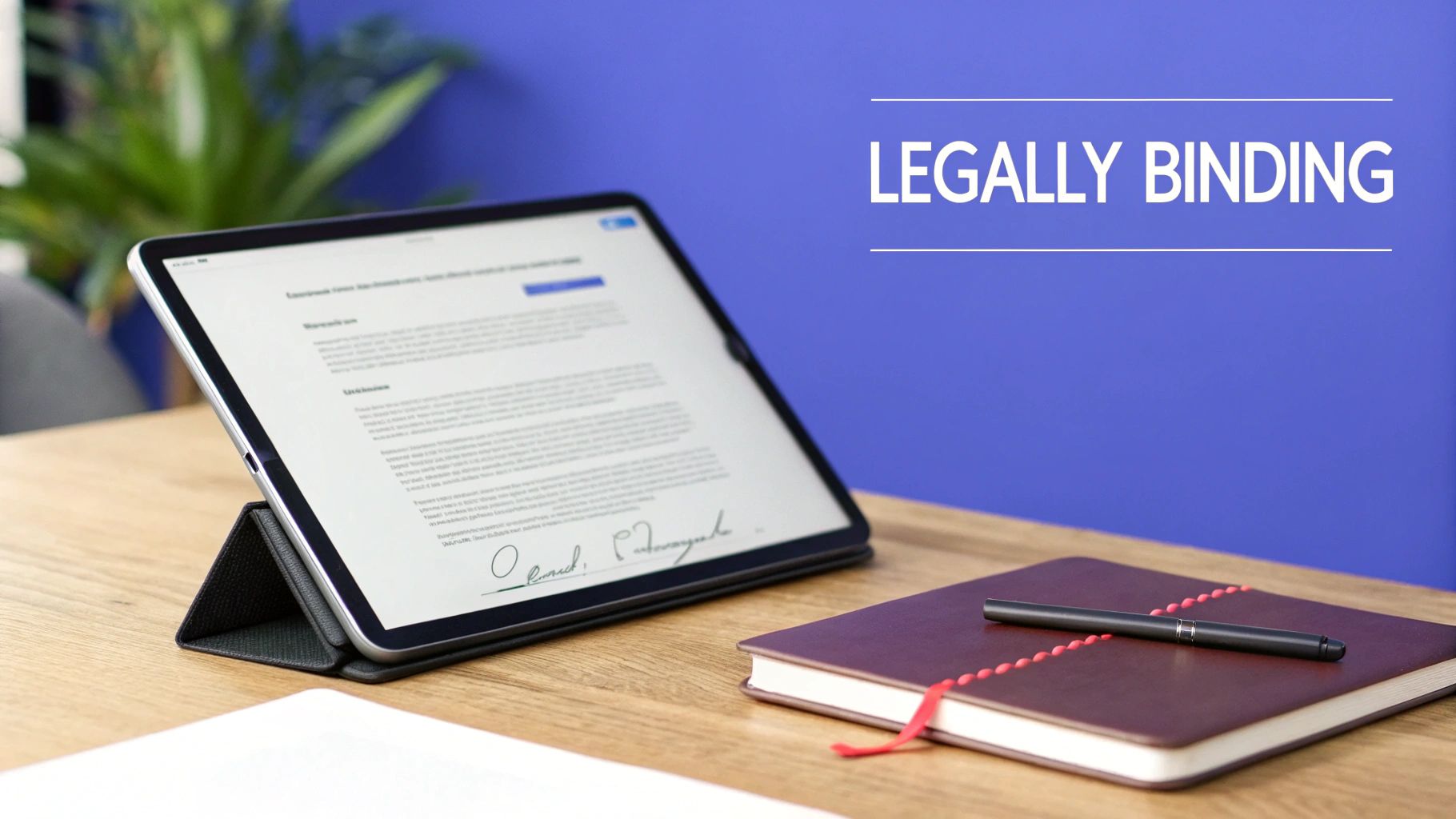
Switching from pen and paper to a screen and stylus might feel like a major shift, but legally speaking, the path has been cleared for years. The real magic behind an electronic signature’s power isn’t the technology itself—it’s the intent it represents. At their core, these laws act as universal translators, ensuring that a digital “I agree” carries the exact same meaning as scribbling your name on a paper contract.
Of course, these laws don’t just give a thumbs-up to any digital mark. They set up specific requirements that any signature process must meet to be considered valid. This framework is what makes an electronic signature more than just a name typed on a screen; it’s a verifiable action, permanently linked to a specific person and a specific document.
To make this crystal clear, nearly every electronic signature law boils down to a few universal principles. These are the non-negotiables that ensure an e-signature isn’t just a convenience but a legally enforceable act.
Core Principles of Electronic Signature Enforceability
| Principle | Description | Why It Matters |
|---|---|---|
| Intent to Sign | The signer must take a clear, affirmative action to sign. This could be drawing a signature, clicking an “Accept” button, or typing their name. | This proves the signature wasn’t accidental. It shows the person consciously and willingly agreed to the terms of the document. |
| Consent to Do Business Electronically | All parties must agree upfront to conduct the transaction using electronic methods and records instead of paper. | This ensures no one is forced into a digital process they aren’t comfortable with. It’s often the first “I agree” checkbox you see. |
| Record Integrity and Association | The signature must be permanently linked to the document it authenticates, and a secure, tamper-evident record of the signed document must be kept. | This prevents fraud. It guarantees that the document hasn’t been altered after signing and proves what was signed. |
These principles are precisely why you need a professional platform. It doesn’t just capture an image of a signature; it builds an entire evidentiary case around the transaction, proving who signed, when, and what they agreed to.
This is all summed up beautifully in the ESIGN Act itself:
The ESIGN Act defines an electronic signature as “an electronic sound, symbol, or process, attached to or logically associated with a contract or other record and executed or adopted by a person with the intent to sign the record.”
Notice how broad that is? It intentionally focuses on the signer’s intent and the link to the record, not on a specific type of technology. This is what allows for innovation while keeping the legal foundation strong. It’s this verifiable process that transforms a simple click into a binding legal commitment, making digital agreements not just faster, but powerfully enforceable.
Understanding US E-Signature Laws: ESIGN and UETA
In the United States, the legal muscle behind electronic signatures comes from a powerful one-two punch: a federal law and a set of corresponding state laws. Think of it like this: the federal government laid down the national ground rules, making digital contracts a reality, while the states built on that foundation to ensure it works smoothly everywhere. This dual approach gives businesses a clear and consistent legal roadmap for their digital agreements.
At the federal level, the cornerstone is the Electronic Signatures in Global and National Commerce Act, better known as the ESIGN Act. Passed way back in 2000, this was a landmark piece of legislation. It established a simple but profound principle for the entire country: a contract or signature can’t be thrown out in court just because it’s electronic.
Essentially, ESIGN put digital ink on the same legal footing as the real thing. Whether you type your name, click an “I Agree” button, or use a secure signing platform, your action is legally binding as long as you intended to sign.
The Role of the ESIGN Act
The beauty of the ESIGN Act is its broad, forward-thinking definition of an electronic signature. It’s defined as “an electronic sound, symbol, or process, attached to or logically associated with a contract or other record and executed or adopted by a person with the intent to sign the record.”
That definition was intentionally left open. It doesn’t get bogged down in specific technologies. Instead, it focuses on what truly matters: the signer’s intent and the signature’s secure connection to the document. This has allowed technology to evolve over the past two decades without outdating the law. To be valid under ESIGN, a signature process must show:
- Clear Intent to Sign: The person has to take a clear action showing they meant to sign.
- Logical Association: The signature must be securely linked to the specific document it belongs to.
- Record Retention: The final, signed document has to be available and reproducible for everyone involved.
UETA: Bringing Harmony to the States
While ESIGN sets the national standard, the Uniform Electronic Transactions Act (UETA) brings that same thinking down to the state level. It’s been adopted in some form by 49 states, plus the District of Columbia and other U.S. territories. UETA ensures that state laws align with the core principles of ESIGN, creating a harmonized system where electronic transactions are just as valid as paper ones.
The only state that hasn’t adopted UETA is New York, but don’t worry—they have their own very similar law, the Electronic Signatures and Records Act (ESRA), which accomplishes the same goal. This near-universal adoption means that no matter where your business is or where your customers are, the fundamental rules are the same.
This legal framework completely changed the game for American business. The U.S. ESIGN Act of 2000 was the turning point, giving electronic signatures the same legal weight as handwritten ones for most transactions. By 2025, it’s estimated that 78% of U.S. law firms will use e-signature tools as a core part of their operations. You can find more insights about this trend in legal tech reports.
The main takeaway is that U.S. federal and state laws create a solid, predictable legal environment for e-signatures. The whole system is designed to make digital business reliable and enforceable.
At the end of the day, these laws remove the guesswork. When a contract is signed digitally on a compliant platform like BlueNotary, it’s not just convenient—it’s a legally sound agreement backed by more than two decades of established law. This legal certainty lets businesses move faster, from onboarding new hires to closing major deals, all without ever touching a pen.
Navigating European Law with the eIDAS Regulation
If you do business in or with the European Union, you absolutely have to get familiar with the eIDAS Regulation. It’s the rulebook that standardizes electronic signatures across all EU member states. Instead of trying to decipher dozens of different national laws, eIDAS creates one predictable, legally sound structure. Think of it as a universal passport for digital agreements, making a signature from Spain just as binding as one from Germany.
Since it came into effect in July 2016, eIDAS has been a massive catalyst for digital business in Europe. By creating a unified legal framework, it gave companies the confidence they needed to move online. It’s no surprise that 63% of European organizations now use e-signatures in their day-to-day legal processes. This certainty is a huge reason the European digital signature market is expected to grow at a blistering 34.5% compound annual growth rate through 2034. You can see more details in this digital signature market growth report.
The Three Tiers of eIDAS Signatures
Where U.S. law is fairly broad, eIDAS gets specific by creating a clear hierarchy of signature types. This tiered system is smart because it lets you match the level of security to the importance of the document. You can think of it as a “good, better, best” approach.
- Simple Electronic Signature (SES): This is the most basic form. It’s essentially any electronic data a person uses to sign, like typing your name at the end of an email or pasting a scanned image of your handwritten signature. While it can be used in court, it has the lowest legal weight and is best for low-risk stuff—think internal HR forms or clicking “I agree” to website terms.
- Advanced Electronic Signature (AdES): This is a serious step up in security. An AdES has to be uniquely linked to the signer, capable of identifying them, and created using data that only they control (like a private key). It’s also tied to the document in such a way that you can tell if the document was altered after it was signed.
- Qualified Electronic Signature (QES): This is the top tier, the gold standard in the EU. A QES has all the security features of an AdES, but with a critical extra layer: it must be created with a Qualified Signature Creation Device (QSCD) and backed by a certificate from a Qualified Trust Service Provider (QTSP).
A Qualified Electronic Signature (QES) has the exact same legal standing and power as a wet ink signature across every single EU member state. Its validity can’t be questioned just because it’s electronic.
To make the differences clearer, let’s break down the three tiers.
Comparing eIDAS Signature Types
This table shows how each signature type stacks up in terms of requirements, legal standing, and typical uses.
| Signature Type | Key Requirements | Legal Weight | Common Use Cases |
|---|---|---|---|
| Simple (SES) | Data in electronic form logically attached to other data. | Admissible in court but has low evidentiary weight. | Clicking “I agree,” email sign-offs, basic HR documents. |
| Advanced (AdES) | Uniquely linked to the signer; capable of identifying the signer; created under the signer’s sole control; tamper-evident. | High evidentiary value; legally binding for most commercial agreements. | Sales contracts, partnership agreements, B2B transactions. |
| Qualified (QES) | All AdES requirements + created with a qualified device (QSCD) and based on a qualified certificate from a QTSP. | Legally equivalent to a handwritten signature across the entire EU. | Real estate deeds, high-value loans, court filings, official government documents. |
Choosing the right type depends entirely on the risk and legal requirements of your specific agreement.
Why Qualified Electronic Signatures Matter
The special status of a QES is a game-changer for high-stakes agreements. With a QES, the legal burden of proof flips. If a signature’s validity is ever challenged, it’s not on you to prove it’s authentic. Instead, the person challenging it has to prove it’s a fake—a much, much tougher legal battle to win.
This flowchart illustrates the top-down legal structure for e-signatures in the U.S., where the federal ESIGN Act provides the base upon which state-level UETA laws are built.
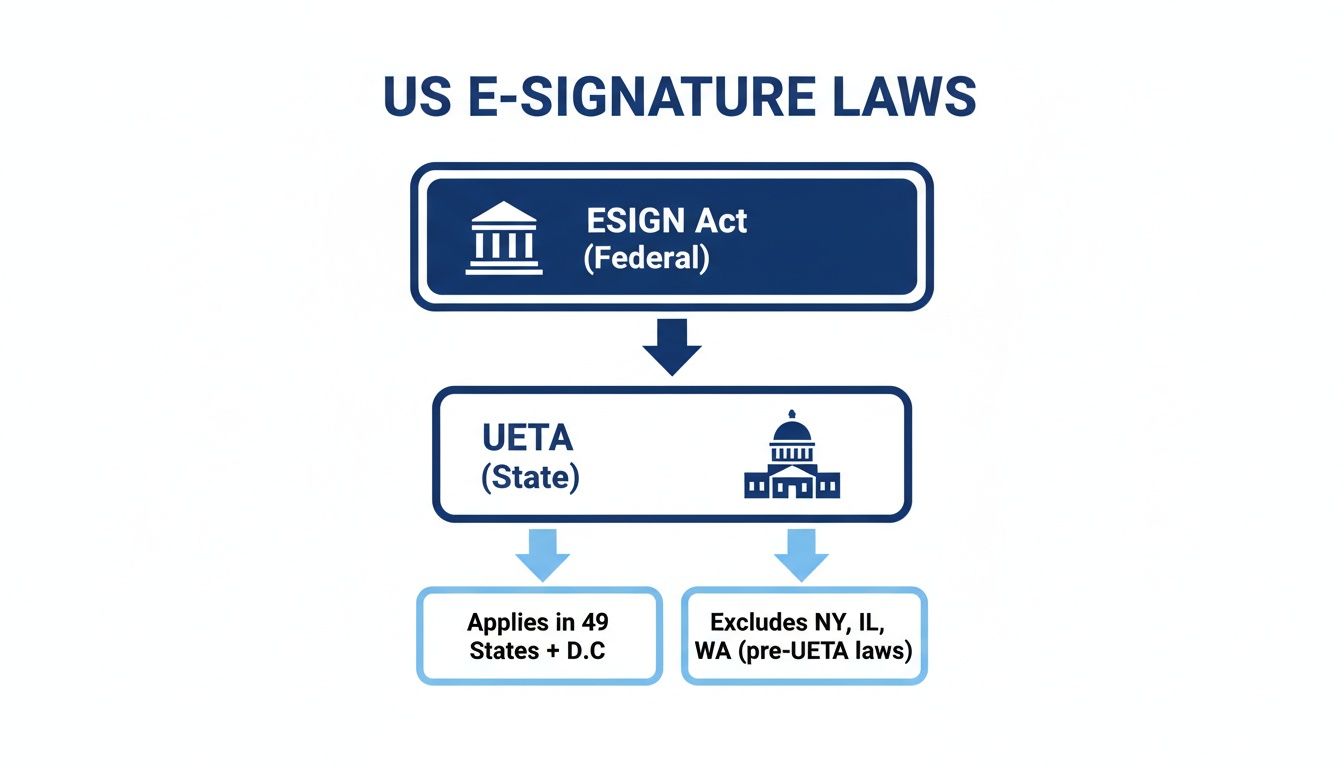
The visual shows how a national framework can provide consistency while still allowing for state-level implementation, a model that ensures broad enforceability across jurisdictions.
This high level of assurance makes QES the go-to choice for things like real estate contracts, major loan agreements, and official government submissions in the EU. And it’s only getting better. The upcoming eIDAS 2.0 revision plans to introduce a European Digital Identity Wallet, making it even simpler for citizens and businesses to manage their digital identities and securely sign documents across borders.
A Global View of Electronic Signature Laws
While the U.S. and the EU have laid down fairly clear rules for electronic signatures, the global stage is a whole different ballgame. If you’re running a business with international reach, you can’t afford to ignore these differences. Knowing the local nuances is the only way to make sure your digital agreements will actually hold up in court.
Think of it like international travel. Your passport—your e-signature platform—is generally accepted, but every country has its own specific visa or entry rules. The core ideas of showing intent and keeping the document intact are pretty universal, but local laws often add their own specific requirements. Success means sweating the small stuff and adapting your process from one country to the next.
This global patchwork of regulations means a one-size-fits-all strategy for your digital contracts is a recipe for disaster. It can leave you with major compliance gaps and agreements that aren’t worth the pixels they’re written on.
Key International E-Signature Frameworks
Many countries have looked to the foundational ideas in America’s ESIGN Act and Europe’s eIDAS regulation, but they’ve almost always added their own local flavor. Let’s look at a few major markets to see what kind of variations you can expect.
Canada: Our neighbors to the north have a system that looks a lot like the U.S. model. The federal law, PIPEDA (Personal Information Protection and Electronic Documents Act), sets the baseline. But, just like U.S. states, most Canadian provinces have their own laws that might have slightly different rules for things like consent and record keeping.
China: China’s Electronic Signature Law gives legal weight to e-signatures but puts a huge emphasis on reliability. For a signature to be considered reliable and legally binding, it must be under the signer’s exclusive control, and any changes made to the signature or the document after the fact have to be detectable. China also has very strict data residency laws, which often mean data on Chinese citizens has to stay on servers within the country.
India: India was an early adopter, recognizing electronic signatures way back in its Information Technology Act of 2000. The law creates a tiered system, similar to eIDAS, where signatures that use a digital certificate from a government-approved authority are given a stronger legal presumption of validity.
The common thread weaving through all these different legal systems is an intense focus on two things: proving who signed the document and proving the document hasn’t been altered. No matter where you are, you’ll almost certainly need to answer those two questions.
The Asia-Pacific region is especially interesting right now, with projections showing it’ll have the highest growth rate for e-signature use. This boom is fueled by strong legal frameworks like those in China and India. To give you a sense of scale, the global volume of e-signature transactions rocketed from 198 million to over 4.7 billion in just five years, and the APAC region was a huge part of that growth. You can dive deeper into these global market trends on esignglobal.com.
For companies that handle legal documents across borders, it’s also smart to get familiar with frameworks that govern how documents are accepted internationally. For example, our guide on the Hague Apostille Convention country list can be incredibly useful. It breaks down how to get documents formally legalized for use in foreign countries, which is a perfect complement to a solid e-signature strategy.
Exceptions: When You Still Need Pen and Paper
Electronic signatures are incredibly useful, but they’re not a silver bullet for every single legal document out there. Think of it this way: for most agreements, an e-signature is perfectly fine. But for certain high-stakes documents, the law still reserves a special place for a traditional, wet-ink signature.
This isn’t just about being old-fashioned. For these specific situations, the physical act of signing is a deliberate ceremony. It’s designed to make everyone pause and recognize the weight of the agreement, ensuring the commitment is clear, understood, and free from pressure. Knowing where this line is drawn is crucial for keeping your agreements legally sound.
Documents That Often Require a Traditional Signature
While the rules can differ from one state or country to another, a few types of documents almost always require a physical signature. Using a standard e-signature on these could easily make them invalid.
Keep an eye out for these common exceptions:
- Wills and Testamentary Trusts: This is the classic example. Signing a will is a monumental act, and most jurisdictions demand it be done with a physical signature in the presence of witnesses.
- Family Law Documents: Things that change the course of people’s lives—like adoption papers or divorce decrees—often fall into this category.
- Court Orders and Official Notices: Any formal document filed with a court, like pleadings or official notices, will have its own strict rules for signatures and submissions.
- Certain Real Estate Transfers: While much of the home-buying process is now digital, the final deed that officially transfers the property title often still needs a wet signature and notarization.
Why Do These Exceptions Still Exist?
What do all these documents have in common? They carry a high risk of fraud, serious disputes, or life-altering consequences. A physical, handwritten signature creates a tangible piece of evidence that’s much harder to challenge in court. The formal process of signing a will with witnesses, for example, is there specifically to head off any future claims that the signer was coerced or the signature was forged.
For something like a property deed, the law often goes a step further and requires a notary. A notary is a state-approved, impartial witness who confirms your identity and makes sure you’re signing of your own free will. This adds a powerful layer of security and legal certainty that a simple click-to-sign e-signature just can’t match.
That said, technology is catching up. Innovations like remote online notarization are now bridging that gap, offering the same level of identity verification and security for digital documents.
The bottom line is pretty straightforward: when a document has the power to transfer a family home, change a legal family structure, or finalize a court’s ruling, the law defaults to the most secure and undeniable signing method it has. Knowing these boundaries helps you use e-signatures confidently where they’re accepted and avoid problems where they’re not.
Best Practices for Ensuring Your E-Signature Is Enforceable
Knowing that electronic signatures are legally valid is one thing; making sure your specific signature process is airtight is a whole different ballgame. The real difference between a signature that holds up in court and one that gets thrown out often boils down to the evidence you can produce.
It’s not enough to just capture a signature. You have to be able to prove who signed it, what they signed, and that they absolutely intended to do so.

Think of it as building your legal case from the very beginning, long before you’d ever need one. Every step in your signing workflow should add another layer of proof, creating a rock-solid record of the entire transaction. This is where your choice of e-signature platform becomes the most critical decision you’ll make. A good platform doesn’t just get a signature; it meticulously documents the entire journey.
By taking this proactive approach to gathering evidence, you’ll naturally satisfy the core requirements set out by laws like ESIGN and eIDAS, dramatically cutting down your legal risk and making sure your agreements stick.
Fortify Identity Verification
If you ever end up in court, the first question you’ll face is, “Can you prove who actually signed this?” A simple typed name or a squiggly line drawn with a mouse might not cut it. For any agreement with real stakes, robust identity verification isn’t just nice to have—it’s essential.
Modern platforms layer on different methods of authentication to confirm a signer’s identity beyond any reasonable doubt. These are your tools for creating an undeniable link between a person and their digital signature.
- Multi-Factor Authentication (MFA): You’ve seen this everywhere. It asks signers for something they know (like a password) and something they have (a one-time code sent to their phone). It’s a simple but powerful guard against unauthorized access.
- Knowledge-Based Authentication (KBA): This method gets more personal, asking signers questions based on their private history (like past addresses or loan information). It’s information that, in theory, only they should know.
- Biometric Verification: This is the heavy-hitter. Top-tier platforms can use facial recognition or fingerprint scans to match the signer directly to their government-issued ID, offering one of the strongest forms of identity proof available today.
When you use these methods, you’re building a powerful evidentiary trail that locks down the signer’s identity, making it nearly impossible for someone to later claim, “That wasn’t me.”
Maintain an Impeccable Audit Trail
Your audit trail is your star witness. It’s a detailed, timestamped log of every single action taken on that document, from start to finish. It tells the complete story of the transaction, leaving no room for doubt.
An audit trail should capture everything: when the document was sent, when it was viewed, the IP address of the device used to sign, the exact time of each signature, and every identity verification step that was passed. This creates a clear, chronological record that is incredibly difficult to dispute.
This detailed log is gold for proving both compliance and intent. It doesn’t just show that a document was signed, but precisely how and when, preemptively answering any questions about the integrity of the process. For any business serious about its contracts, a key part of managing compliance risk effectively is documenting every single step.
Ensure Document Integrity with Tamper-Evident Technology
The final piece of this puzzle is proving that the document itself wasn’t changed—not even by a single comma—after it was signed. Modern e-signature platforms handle this with advanced cryptographic technology that creates a tamper-evident seal.
Basically, this tech locks the document down the moment it’s signed. If anyone tries to alter it afterward, the digital seal “breaks,” making the change immediately obvious. This guarantees the integrity of the signed record, which is a non-negotiable requirement of e-signature laws across the globe.
When you bring all these elements together—strong identity verification, a detailed audit trail, and a tamper-evident seal—you’ve built a legally defensible signing process. Platforms that offer these features, like the tools available for creating an electronic signature online, are built specifically to meet these high standards. They provide the technological safeguards that turn a simple digital agreement into a binding, enforceable contract ready to withstand any legal challenge.
Your Top Questions About E-Signature Legality, Answered
Even when you’ve got a good grasp of the laws, a few practical questions always pop up when it’s time to actually use electronic signatures. It’s easy to get tangled in the details, but the answers are usually more straightforward than you’d think. Let’s clear up some of the most common ones.
We’ll cover the crucial differences between signature types, everyday examples, and what really happens if an e-signature ever gets questioned.
What’s the Difference Between an Electronic and a Digital Signature?
This is a big one. Think of “electronic signature” as the broad, catch-all category. It’s any electronic process that shows you intend to sign something—from typing your name at the bottom of an email to clicking an “I Agree” button on a website. The legal weight comes from proving the intent behind the action.
A “digital signature” is a specific, much more secure type of electronic signature. It’s a technical process that uses cryptography—kind of like a unique digital fingerprint—to verify a signer’s identity and lock the document to prevent any tampering.
So, the key takeaway is simple: all digital signatures are electronic signatures, but not all electronic signatures have that advanced, built-in security of a digital one.
Can an Email Actually Count as a Legal Signature?
Absolutely. An email can create a legally binding agreement, provided it clearly shows someone intended to agree to certain terms. A simple reply like, “Sounds good, I agree to the terms you sent over,” can be enough to form a contract in many cases.
But here’s the catch: proving it. If you end up in a dispute, it’s incredibly difficult to prove who really sent that email and that the terms weren’t changed. Emails just don’t have the built-in proof you need. This is where a proper e-signature platform shines—it creates a detailed, verifiable record that eliminates all that guesswork.
What Happens if Someone Challenges an E-Signature in Court?
If an electronic signature gets challenged, the person trying to enforce the agreement has to bring the receipts, so to speak. They need to provide solid evidence showing the signature is valid. This is exactly why the quality of your e-signature platform matters so much.
Your platform’s audit trail becomes your star witness. This detailed log is court-admissible evidence, showing everything from IP addresses and timestamps to identity verification steps and a complete history of the signing ceremony.
This comprehensive record proves you’ve met the standards set by laws like ESIGN and UETA. It clearly demonstrates who signed, when they signed, and that the document is the exact same one they saw. With that kind of proof, challenging the signature becomes a serious uphill battle.
For a platform that builds this kind of legal-grade compliance right into your process, look no further than BlueNotary. We give you the secure identity verification, tamper-evident seals, and ironclad audit trails you need to make sure your electronic signatures are not just fast, but fully defensible. Explore how BlueNotary can secure your agreements today.