






Using electronic signature real estate contracts is now the way business gets done. It’s how agents, lenders, and clients can sign legally binding agreements from pretty much anywhere on the planet. This shift from paper to digital has completely changed the game, replacing slow, manual processes with a faster, more secure, and far more convenient way to handle every step of a property transaction.
The New Standard in Real Estate Deals

Let’s be honest, the days of printing thick stacks of paper, chasing down clients for in-person meetings, or paying for overnight couriers are over. For any real estate pro who wants to stay relevant, digital workflows aren’t just a nice-to-have; they’re what clients expect. Moving to e-signatures is more than a simple convenience—it’s a smart business decision that helps you close deals faster and run your operations more efficiently.
This isn’t some wild west, either. The whole process is backed by solid legal ground. Laws like the federal ESIGN Act and the state-level Uniform Electronic Transactions Act (UETA) are what give electronic signatures the exact same legal standing as a wet ink signature. That legal certainty is why multi-million dollar property deals can now happen entirely online with complete confidence.
Why Digital Is Simply Better
The numbers tell the story. As of 2025, a reported 65% of property transactions now involve e-signatures. Why the massive shift? The benefits are tangible and directly affect both your business and your client’s sanity.
Here’s a quick look at why digital is winning:
- Speed Up Closings: Forget waiting days for mail or trying to align everyone’s schedules. Deals get finalized in hours, not weeks.
- Make Clients Happy: Buyers and sellers love the ease of signing documents on their phone or laptop, wherever they are, without touching a printer.
- Boost Security and Compliance: Good e-signature platforms create a detailed, tamper-evident audit trail. This log records every single action, offering far more proof of who signed what and when than a simple scribble on paper.
- Cut Down on Admin Work: No more filing cabinets overflowing with paper. Digital documents are stored securely and can be pulled up instantly for audits or reference.
This isn’t just about replacing a pen with a click. It’s about rethinking the entire contract process to be faster, more secure, and fully trackable. That’s what builds client trust and gets deals to the finish line.
To give you a clearer picture, let’s break down the key differences between the old way and the new way.
E-Signatures vs. Traditional Signatures in Real Estate
This table offers a quick comparison of key differences between digital and paper-based contract signing processes in the real estate industry.
| Feature | Electronic Signatures | Traditional Signatures |
|---|---|---|
| Speed | Signing takes minutes; contracts can be finalized in hours. | Can take days or weeks due to mail and scheduling. |
| Security | High. Includes encryption, access control, and a digital audit trail. | Low. Vulnerable to forgery, loss, and physical damage. |
| Audit Trail | Comprehensive and automatic. Tracks every view, click, and signature. | Manual and often incomplete. Relies on witness memory. |
| Convenience | Sign from any device, anywhere, anytime. | Requires in-person meetings, printing, scanning, or mailing. |
| Cost | Reduces costs for paper, printing, postage, and storage. | Incurs costs for supplies, courier services, and physical storage. |
| Error Rate | Low. Guided signing prevents missed signatures or initials. | High. Prone to human error like missed fields or pages. |
The contrast is pretty stark. Digital workflows are simply more efficient and less risky across the board.
From First Offer to Final Closing
The real-world impact is huge. As an agent, you can manage more listings and close more deals without getting buried in paperwork. For title companies and lenders, the entire journey becomes smoother and less prone to mistakes. A well-designed digital workflow, especially one that incorporates a full eClosing process, ensures that every required signature and initial is captured correctly the first time.
No more chasing down a missing signature that threatens to delay closing. Ultimately, there’s a reason using electronic signatures on real estate contracts has become the professional standard—it’s just a smarter, better way to do business.
Getting the Legal Side of E-Signatures Right
Before you can confidently swap ink for pixels on your real estate contracts, you need a solid grasp of the laws that make it all possible. This isn’t some legal gray area; the use of electronic signatures is backed by very specific federal and state laws designed to make digital business happen. When you understand this framework, you can be sure your electronic agreements are just as binding as paper ones.
The whole thing really starts at the federal level with the Electronic Signatures in Global and National Commerce Act. You’ll usually hear it called the ESIGN Act. Passed way back in 2000, this was the game-changing law that gave electronic signatures the same legal weight as a traditional “wet ink” signature anywhere in the U.S.
In simple terms, ESIGN means that a real estate contract can’t be thrown out just because it was signed electronically. While it set the national standard, it also left the door open for states to create their own rules, as long as they didn’t undermine its main purpose.
How UETA Fits In at the State Level
This is where the Uniform Electronic Transactions Act (UETA) comes into play. Most states have adopted some version of UETA to line up their local laws with the principles of the federal ESIGN Act. Think of it as the state-level rulebook that confirms digital transactions are legally sound for business conducted within that state.
One of the most important rules under both ESIGN and UETA is consumer consent. You can’t just spring a digital document on someone. Before sending that purchase agreement for an e-signature, every single person involved has to clearly agree to do business electronically. This is usually a simple checkbox or a consent clause at the start of the signing process, but it is an absolute must-do.
The ESIGN Act and UETA work together to form a legal safety net for your electronic real estate contracts. This isn’t just about making things faster; it’s about having a legally sound process that will hold up if ever questioned.
This solid legal footing is a huge reason why digital signatures have taken off. As of 2024, North America accounts for roughly 46% of the global digital signature market revenue. This widespread trust is built on that legal foundation. As we see more international property deals, the demand for consistent global standards continues to pick up steam, a trend highlighted in recent global e-signature contract trends.
Dealing With State-Specific Rules and RON
While ESIGN and UETA give us the big picture, the devil is always in the details—and in real estate, those details vary state by state. This is especially true when it comes to documents that need a notary, like deeds and mortgages. This is where you have to pay close attention to Remote Online Notarization (RON) laws.
RON is the technology that lets a certified notary witness and notarize documents over a live audio-video call. But here’s the catch: not every state allows it. And the states that do have their own specific set of rules.
- Identity Checks: Some states are very particular about how you verify a signer’s identity, requiring things like knowledge-based authentication (KBA) questions or a detailed analysis of their government ID.
- Session Recordings: Most states that permit RON mandate that the entire video notarization session be recorded and stored securely for a long time, often 5-10 years.
- Platform Tech: You can’t just use any video chat tool. States often have a list of approved RON platforms that meet their specific security and technology standards.
You absolutely have to know the rules for the state where the property is located. For a closer look at how the technology works and which states are on board, it’s worth learning more about the specific requirements for implementing a remote online notary process. For example, if you have a property in Florida but the seller is signing from New York, you must follow Florida’s RON laws to the letter.
Juggling all these moving parts is why having a streamlined digital system is so critical. To really get a handle on it, it helps to look beyond just e-signatures and explore how legal document automation software can pull everything together. These systems integrate signing and notarization into a complete workflow, ensuring every step from the first draft to the final closing is compliant and secure.
Building a Secure Digital Signing Workflow
A legally binding electronic signature is only as strong as the security behind it. If your process has holes, you’re inviting disputes and undermining the very convenience you’re trying to create. When it comes to electronic signature real estate contracts, building a secure digital workflow isn’t just a good idea—it’s an absolute must for modern real estate.
The whole process really boils down to two things: proving who signed the document and proving the document wasn’t touched afterward.
It all starts with solid identity verification. Sure, basic email verification is a start, but for a high-stakes real estate deal, you’ve got to go further. We need to create a confident, undeniable link between the digital signature and the actual person signing. Think of it as a virtual ID check before anyone puts their digital pen to paper.
From Basic to Bulletproof Identity Checks
A simple link in an email might work for a low-stakes agreement, but it’s not going to cut it for a multi-million-dollar purchase contract. That’s where you need to layer your security. The best platforms let you choose the level of identity verification based on how much is at stake.
Here are the methods I see used most effectively in the field:
- Email and SMS Verification: This is a great first line of defense. The signer gets a one-time code on their phone, which they have to enter to even see the document. It proves they control both their email and their phone. Simple, but effective.
- Knowledge-Based Authentication (KBA): You’ve probably seen this before. It pulls from public and private records to ask multiple-choice questions only the real person should know, like, “Which of these addresses have you lived at?” Getting these right is a strong indicator of identity.
- ID Credential Analysis: This is the heavy-hitter. The signer uploads a picture of their driver’s license or another government ID. The system then analyzes it for any signs of tampering and often pairs this with a live selfie to make sure the person matches the photo on the ID.
The key is to match the verification level to the risk. For an initial offer, email and SMS might be perfectly fine. But when it’s time for the final closing package, a combination of KBA and ID analysis is the only way to go.
This entire framework of secure signing doesn’t exist in a vacuum; it’s built on a solid legal foundation.
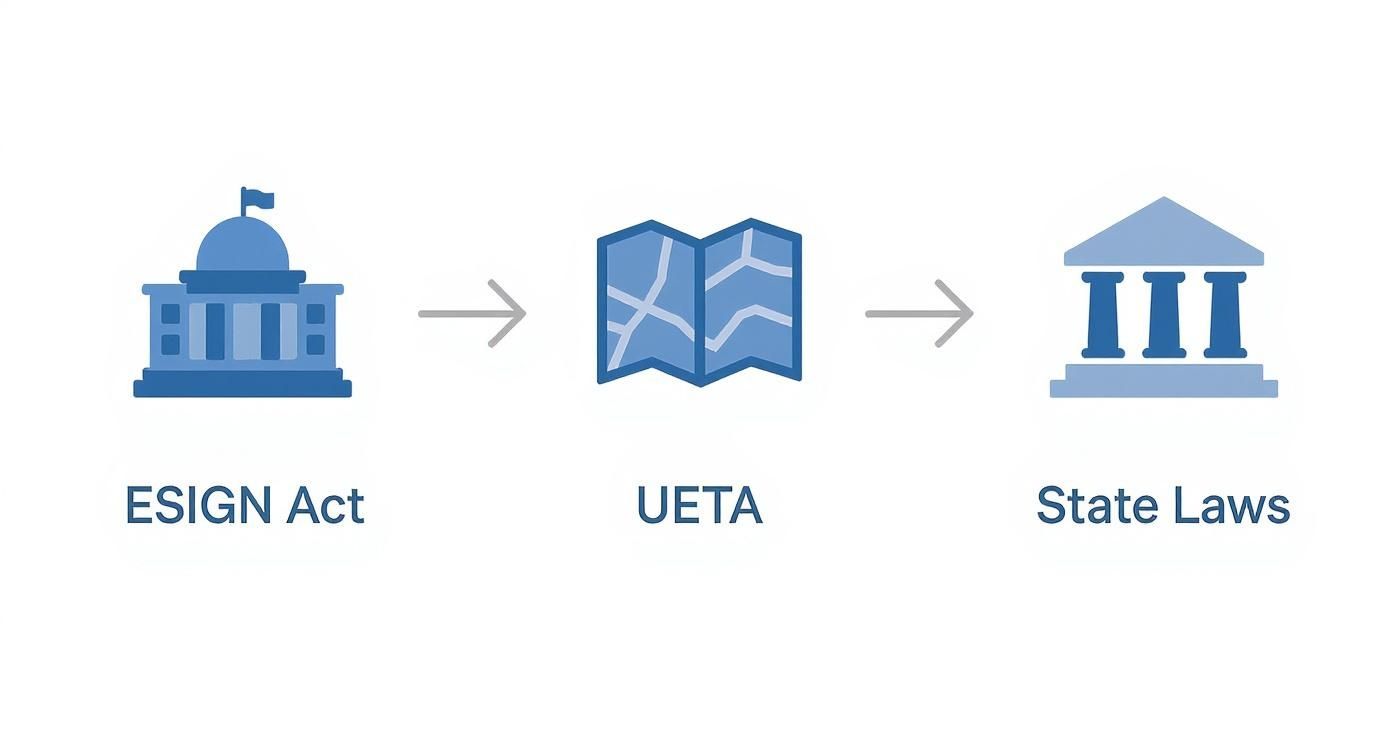
As you can see, the federal ESIGN Act sets the stage, states adopt it through UETA, and then add their own specific rules. This creates a clear, legal pathway for making digital transactions secure and enforceable.
The Power of an Indisputable Audit Trail
Once you’ve confirmed who’s signing, the next critical piece is the audit trail. This isn’t just a simple log of events. It’s a comprehensive, tamper-evident record of every single thing that happens to that document. A rock-solid audit trail is your absolute best defense if a signature is ever challenged in court.
A detailed audit trail turns a digital signature from a simple electronic mark into a fully documented, legally defensible event. It provides the “who, what, when, and where” for every step of the signing process.
A truly complete audit trail automatically captures a ton of data points, including:
- Creation and Delivery: When the document was generated, sent out, and successfully delivered to each person’s inbox.
- Viewing and Access: Every time a signer opens the document, along with their IP address and the device they used.
- Consent to E-Sign: The exact moment the signer clicked that box agreeing to do business electronically.
- Identity Verification: A log of which verification methods were used (SMS, KBA, etc.) and the outcome.
- Signature Application: The precise timestamp for when each signature was actually placed on the document.
- Finalization: The moment the document was completed by everyone and a final, tamper-sealed copy was distributed.
This detailed history creates a powerful, chronological story of the entire signing event. Honestly, it’s far more robust than a wet ink signature, which offers zero proof of when it was signed or who was really holding the pen.
Secure Storage and Long-Term Retention
Your job isn’t over when the last signature is applied. As real estate professionals, we’re required to hold on to transaction documents for years. Those rules apply just as much to digital files as they do to paper ones. Just dropping sensitive contracts onto your laptop or a generic cloud drive is a huge security and compliance risk.
A professional e-signature platform designed for real estate will offer secure, encrypted storage. This is non-negotiable. It protects the signed documents from being hacked, accidentally deleted, or breached.
When you’re choosing a platform, make sure it offers compliant, long-term storage. This protects you, your brokerage, and your clients. If an auditor or lawyer asks for a contract from five years ago, you need to be able to pull up a certified, untampered copy in seconds. That peace of mind is the final, crucial step in a truly reliable digital signing workflow.
How to Streamline Closings With E-Signature Integrations

A secure signing workflow is a great start, but the real magic happens when your technology starts talking to each other. If you’re using standalone tools, you’re essentially creating digital islands, forcing your team to manually shuffle data and documents between systems. The true power of electronic signature real estate contracts is unlocked only when you integrate your signing platform directly into your daily operations.
This means plugging your e-signature solution right into your Customer Relationship Management (CRM) software, transaction management platforms, and document storage systems. The end goal is to build an automated, end-to-end machine where contracts flow from one stage to the next without someone having to constantly nudge them along.
Connecting Your Real Estate Tech Stack
Think about it: you could generate a purchase agreement straight from your CRM, with all the client data auto-filled. The moment it’s signed, the final contract zips back into the client’s file and simultaneously lands in your transaction management system, kicking off the next phase. This isn’t just about convenience—it’s a massive competitive advantage.
When your systems are connected, you slash redundant data entry, which is where so many costly mistakes creep in. It also creates a single source of truth for every transaction. Your agents, transaction coordinators, and closing department are all looking at the exact same, up-to-the-minute documents and status updates. No more guessing games.
To get this done, you’ll want an e-signature platform that offers a robust API and, ideally, pre-built connections to the tools you already rely on. It’s worth exploring how these powerful e-signature platform integrations can build a truly connected workflow.
A Lender’s Workflow Example
For a mortgage lender, a properly integrated system can completely transform the loan origination and closing process. Here’s a quick look at how that plays out in the real world:
- Origination: A loan application gets the green light in the Loan Origination System (LOS). An API call instantly generates the entire initial disclosure package.
- E-Signing: The borrower gets a secure link to review and sign everything. The platform is smart enough to guide them through every signature and initial box, so nothing gets missed.
- Automatic Updates: The second the documents are signed, they’re automatically pushed back into the LOS. The loan officer gets an instant notification, the file’s status changes, and the processing team knows it’s their turn to act.
This automated loop can shave days off the process by eliminating snail mail and the frustrating back-and-forth of tracking down signatures.
The Critical Role of Remote Online Notarization
As you near the closing table, some of the most important documents—like deeds and mortgages—require a notary’s stamp. This is where an integrated Remote Online Notarization (RON) platform becomes absolutely essential. A solution like BlueNotary isn’t just for basic e-signatures; it’s built to handle these legally critical notarized documents entirely online.
In a RON session, the signer connects with a certified notary through a secure audio-video feed. The notary verifies their identity, witnesses the signature in real-time, and applies their digital notary seal.
An integrated RON capability is the final piece of the puzzle for a fully digital closing. It eliminates the last major logistical hurdle: the need for an in-person meeting with a notary.
This is a game-changer for title companies and closing agents. It lets them finalize deals with clients across the state or even on the other side of the world just as easily as if they were sitting across the table.
Enhancing Efficiency Across the Board
The ripple effects of an integrated approach are huge. Research shows that automated reminders and notifications in e-signature workflows can cut document turnaround times by about 30%. What’s more, this level of automation often leads to a 45% improvement in contract lifecycle management, meaning your team can handle more deals without having to hire more people.
Beyond just signing, it’s worth looking into how broader legal document automation software can bring similar efficiencies to your entire operation.
Ultimately, integrating your e-signature platform turns a series of disjointed, manual tasks into a single, cohesive workflow. You save time, you cut down on errors, and you free up your team to focus on what actually matters—serving clients and closing deals.
Common Risks and How to Mitigate Them
Bringing any new technology into your real estate practice is going to have a few potential bumps in the road. While using electronic signature real estate contracts is a massive step forward, knowing the common risks—and exactly how to sidestep them—is what separates a smooth digital operation from a mess of legal headaches.
A little forethought and a clear set of procedures are your best defense.
The single biggest mistake I see agents make is just assuming everyone is on the same page. You can’t just fire off a digital contract and expect it to hold up without first making sure your client understands and explicitly agrees to handle things this way. This isn’t just about good customer service; it’s a core requirement of the ESIGN Act.
Prioritizing Client Education and Consent
Before you even dream of sending that first digital purchase agreement, you need to have a real conversation with your client. Walk them through how the electronic signing works, what platform you’re using, and why it’s secure. Taking a few minutes to do this up front builds trust and nips any confusion or hesitation in the bud.
Legally, your very first digital interaction must get clear, affirmative consent to do business electronically. A simple checkbox at the start of the signing session stating, “I agree to use electronic records and signatures,” usually does the trick. This is absolutely non-negotiable.
Think of client education as the foundation of your entire digital workflow. A client who gets it and trusts the process is far less likely to dispute a signature later, making your digital records rock-solid.
Actively Preventing Digital Fraud
With the ease of digital deals comes the threat of fraud—especially phishing scams. We’ve all heard the horror stories. Scammers create fake emails that look like they’re coming from you or the title company, trying to trick clients into signing bogus documents or, even worse, wiring their down payment to a criminal’s account.
This is where you have to be vigilant.
You have to tell your clients exactly what to expect. Let them know they will only get signing requests from your specific email address and through the platform you’re using. And hammer this home: advise them to always verify any unexpected requests or last-minute changes by calling you directly.
To really lock things down, you should be doing this:
- Use Multi-Factor Authentication (MFA): Insist on a platform that makes signers verify their identity with a code sent to their phone (SMS verification). It’s a simple step, but it makes it exponentially harder for a fraudster to sign a document, even if they’ve hacked a client’s email.
- Choose Strong Verification Methods: For the big stuff like closing packages, email verification alone isn’t enough. You need to be using Knowledge-Based Authentication (KBA) or ID credential analysis. This creates a much stronger, legally defensible link between the person and the signature.
These proactive steps create layers of security that dramatically lower the risk of a fraudulent signature ever making it through.
How to Select the Right E-Signature Vendor
Look, not all e-signature platforms are created equal, especially when it comes to the high-stakes world of real estate. Your choice of vendor is one of the most critical risk-mitigation decisions you’ll make. A free or consumer-grade tool simply isn’t going to cut it.
When you’re vetting a platform, you need to look for features specifically built for real estate compliance and security. Here’s what should be on your checklist:
| Critical Feature | Why It Matters |
|---|---|
| Comprehensive Audit Trails | This is your proof. The platform absolutely must capture every single action—from views to clicks to signatures—along with IP addresses and timestamps. This is your legally defensible record. |
| Integrated RON Capabilities | For a genuinely end-to-end digital closing, you need a platform like BlueNotary that can handle Remote Online Notarization for deeds and mortgages, keeping everything compliant with state laws. |
| Strong Security Certifications | Keep an eye out for certifications like SOC 2 Type II and adherence to ISO 27001 standards. These are independent proof that the vendor takes data security and privacy seriously. |
| Secure Document Storage | The platform must offer encrypted, long-term storage to meet the strict document retention rules in our industry. This protects sensitive client data for years to come. |
Choosing a vendor that lives and breathes complex, regulated transactions isn’t an expense; it’s an investment in your business’s security and reputation. It ensures every electronic signature you collect is not just convenient, but also secure, compliant, and ready to stand up to any scrutiny.
Answering Your Top Questions About E-Signatures in Real Estate
Even after you get the hang of the workflow, some specific questions always seem to pop up. Let’s be honest, navigating the world of electronic signature real estate contracts can feel a bit tricky at first. So, let’s tackle some of the most common questions I hear from agents and clients to clear up any confusion.
Think of this as your go-to FAQ for handling those real-world scenarios that come up every day. These are the practical, on-the-ground questions that come with shifting from stacks of paper to a more modern, digital process.
Are E-Signatures Actually Legal for All Real Estate Contracts?
Yes, for almost everything you’ll handle in a real estate deal, electronic signatures are completely legally binding. This is thanks to the one-two punch of the federal ESIGN Act and the state-level Uniform Electronic Transactions Act (UETA). Together, they give e-signatures the exact same legal standing as a pen-and-ink signature.
Now, there are a few rare exceptions. Certain old-school documents, like deeds or some specific trust documents, might still have state-level requirements for an in-person wet signature or traditional notarization. The good news? Many states are catching up by allowing Remote Online Notarization (RON), which lets you get these documents handled digitally and remotely. The bottom line is to always double-check your local rules for these specific document types.
Your purchase agreements, disclosures, and addendums? They’re perfectly sound when signed electronically. The legal framework was built for this kind of modern commerce, and real estate is one of the best examples of it working.
How Do I Prove Who Really Signed the Document?
This is where a professional e-signature platform leaves pen and paper in the dust. A good system doesn’t just capture a signature; it creates a detailed, tamper-evident audit trail for every single contract. This digital “certificate of completion” is your rock-solid proof.
This audit trail logs every critical piece of data, creating a legally defensible history of the entire signing event.
- Signer Details: It records the signer’s email address and the IP address they used to access the document.
- Action Timestamps: You get an exact log of when the document was opened, when the signer consented to do business electronically, and the precise moment they applied their signature.
- ID Verification: The trail notes exactly how you verified their identity—whether it was through an SMS code, knowledge-based authentication (KBA), or another method.
When you think about it, this log provides way more concrete evidence than a simple “wet” signature, which can’t prove when, where, or under what circumstances it was signed.
What’s the Difference Between “Electronic” and “Digital” Signatures?
People throw these terms around interchangeably, but there’s a key technical difference that’s good to know. Understanding it helps you appreciate the security working for you behind the scenes.
An electronic signature is the broad legal term. It can be any electronic sound, symbol, or process that shows an intent to sign. That could be typing your name, drawing it with a mouse, or even just clicking an “I Agree” box.
A digital signature, however, is a specific type of electronic signature that’s incredibly secure. It uses powerful cryptographic technology to embed a unique digital “fingerprint” into the document itself. This technology not only verifies who the signer is but also seals the document, making it instantly obvious if anyone tries to alter it after the fact. The best platforms, like BlueNotary, use this powerful digital signature tech to drive their e-signing process, giving you the perfect blend of user-friendly experience and ironclad security.