





When you hear “passport copy notarization,” it simply means having a commissioned notary public officially certify that a photocopy of your passport is a genuine, complete, and accurate reproduction of the original document. This process adds a critical layer of authenticity, confirming the copy is faithful to the original for all sorts of official purposes.
Why You Need a Notarized Passport Copy
Ever been asked for a notarized copy of your passport and wondered why a simple photocopy from the office printer won’t cut it? This formal verification step is a powerful safeguard against fraud. By bringing in a trusted third party—the notary public—you are officially attesting that the photocopy is a faithful reproduction of your original passport.
In many high-stakes situations, this kind of verification is non-negotiable. Think of it as a mandatory identity checkpoint when you can’t be there in person.
Common Situations Requiring a Notarized Passport Copy
The need for a passport copy notarization usually pops up when your identity has to be confirmed without you being physically present at the final destination. A simple copy just doesn’t carry the same legal weight.
Here’s a quick look at the most frequent reasons you might be asked for a notarized copy of your passport.
| Scenario | Purpose | Common Industries |
|---|---|---|
| International Banking | Opening a foreign bank account, verifying identity for large transfers | Financial, Banking |
| Immigration & Visas | Applying for residency, long-term visas, or work permits | Government, Legal |
| Overseas Education | Enrolling in a university abroad, student visa applications | Education |
| Real Estate Transactions | Buying or selling property in another country | Real Estate, Legal |
| Legal Affairs | Granting power of attorney, handling international estate matters | Legal |
These examples highlight how a single notarized document serves as a cornerstone of global Know Your Customer (KYC) and Anti-Money Laundering (AML) compliance. It’s what financial, legal, and educational institutions rely on to prevent identity theft and financial crimes.
Two Paths to Notarization
So, how do you get this done? You have two main options. The old-school method involves finding a local notary and visiting them in person. The modern, far more convenient alternative is Remote Online Notarization (RON), which lets you handle the entire process from your computer or phone through a secure video call.
The demand for these services, especially digital ones, has skyrocketed. The global e-notary software market is expected to swell to roughly $655 million by 2035. This huge growth points to a major shift toward digital workflows that start with securely authenticated identity documents. It’s also helpful to understand the nuances between document certifications; taking a moment to learn the key differences between an apostille and a notary public can save you a lot of headaches down the road.
Getting Your Passport Notarized In Person
Even with all the digital options available today, sometimes the classic, in-person notarization is exactly what you need. It’s a time-tested, reliable method for getting your passport copy certified, and it all happens face-to-face with a commissioned notary public.
Finding a notary is often easier than most people realize. You don’t always have to go far out of your way; many local businesses and offices have a notary on staff.
Good places to start your search include:
- Local Banks and Credit Unions: Your own bank is a great first stop, as they often provide notary services to customers for a small fee or even for free.
- Shipping and Business Centers: Places like The UPS Store almost always have a notary available during business hours.
- Government Offices: Check with your local town hall or city clerk’s office.
A quick phone call beforehand is always a smart move. You’ll want to confirm they’re available, ask about the fee, and check if they have any specific rules for notarizing a passport copy.
Preparing for Your Notary Appointment
Walking into the appointment unprepared is the quickest way to get turned away. To make sure everything goes off without a hitch, you need to have a few key items with you. It’s a short list, but every item is non-negotiable.
Here’s what you absolutely must bring:
- Your Original, Unexpired Passport: The notary has to compare the copy directly against the original document. If your passport isn’t with you or has expired, the process stops right there.
- A High-Quality Photocopy: Make sure you have a crisp, clear copy of the main information page of your passport—the one with your photo and personal details. Don’t bring a blurry, smudged, or cropped copy.
- A Valid Government-Issued Photo ID: Yes, even with your passport, you’ll need another official ID like a driver’s license or state ID card. The notary has to independently verify who you are.
Having these three things in hand will make the appointment fast and painless. For a more detailed look at the ins and outs, our guide on traditional in-person notarization breaks down the whole process.
What Happens During the Notarization
The notarization itself is a formal but usually quick procedure. The notary will meticulously compare your photocopy against your original passport, making sure every single detail is an exact match.
After that, they’ll check your other photo ID to confirm your identity. They are legally required in most states to log the details of the notarization in their official journal. Once everything checks out, the notary will complete the notarial certificate, sign it, and affix their official seal to the photocopy.
Crucial Tip: Do not sign anything ahead of time! If the document requires your signature (like on an affidavit), you must wait and sign it in front of the notary. Signing beforehand will void the notarization completely.
If you’re dealing with documents for international use, you might need help from specialized notary services to ensure your passport copies comply with the legal standards of other countries.
Common Pitfalls to Sidestep
Even a simple process can have its hang-ups. The most frequent mistake we see is people bringing an expired passport. Notaries are legally forbidden from accepting expired documents for identity verification or copy certification.
Another common problem is a bad photocopy. If the image is fuzzy, the text is hard to read, or the edges are cut off, the notary has to reject it. The copy needs to be a perfect, legible reproduction of the original.
Finally, remember that the notary’s job is very specific. They are there to verify your identity and attest to the document, not to provide legal advice. If you’re unsure about what kind of notarization you need, ask the agency or person who requested the document—not the notary. Getting it right the first time will save you from paying extra fees and dealing with unnecessary delays.
Getting Your Passport Notarized From Anywhere with Remote Online Notarization
Picture this: you need a notarized copy of your passport, but you’re short on time, living abroad, or just can’t stomach the thought of tracking down a notary and scheduling an appointment. This is where Remote Online Notarization (RON) completely changes the game.
RON lets you connect with a commissioned eNotary using secure audio-visual technology. The entire notarization happens online, from the comfort of your home or office. It’s a modern solution that’s perfect for expats, frequent travelers, or anyone with a packed schedule. Platforms like BlueNotary have built a seamless and secure digital space that brings the notary public right to your screen.
How Does the RON Process Actually Work?
When you need a passport copy notarization through a RON service, the whole process is built around security and convenience. First, you’ll typically upload a clear digital image of your passport to a secure online portal.
Next comes the identity verification, which is far more rigorous than a quick glance at your driver’s license in person. RON platforms layer multiple security checks to confirm you are who you say you are:
- Credential Analysis: Sophisticated software scans your government-issued ID, checking for hidden security features, microprinting, and other markers to validate its authenticity.
- Knowledge-Based Authentication (KBA): You’ll answer a few time-sensitive questions pulled from public and private records—things only you would know, like a previous address or a car you once owned.
- The Live Session: Finally, you’ll join a live, face-to-face video call with the notary. They’ll confirm your identity visually, watch you electronically sign the document, and then apply their own digital seal and signature.
This robust, multi-step verification often makes RON even more secure than traditional in-person notarizations. It’s a big leap from the old way of doing things.
For comparison, here’s a quick look at the steps involved in a typical in-person notarization.
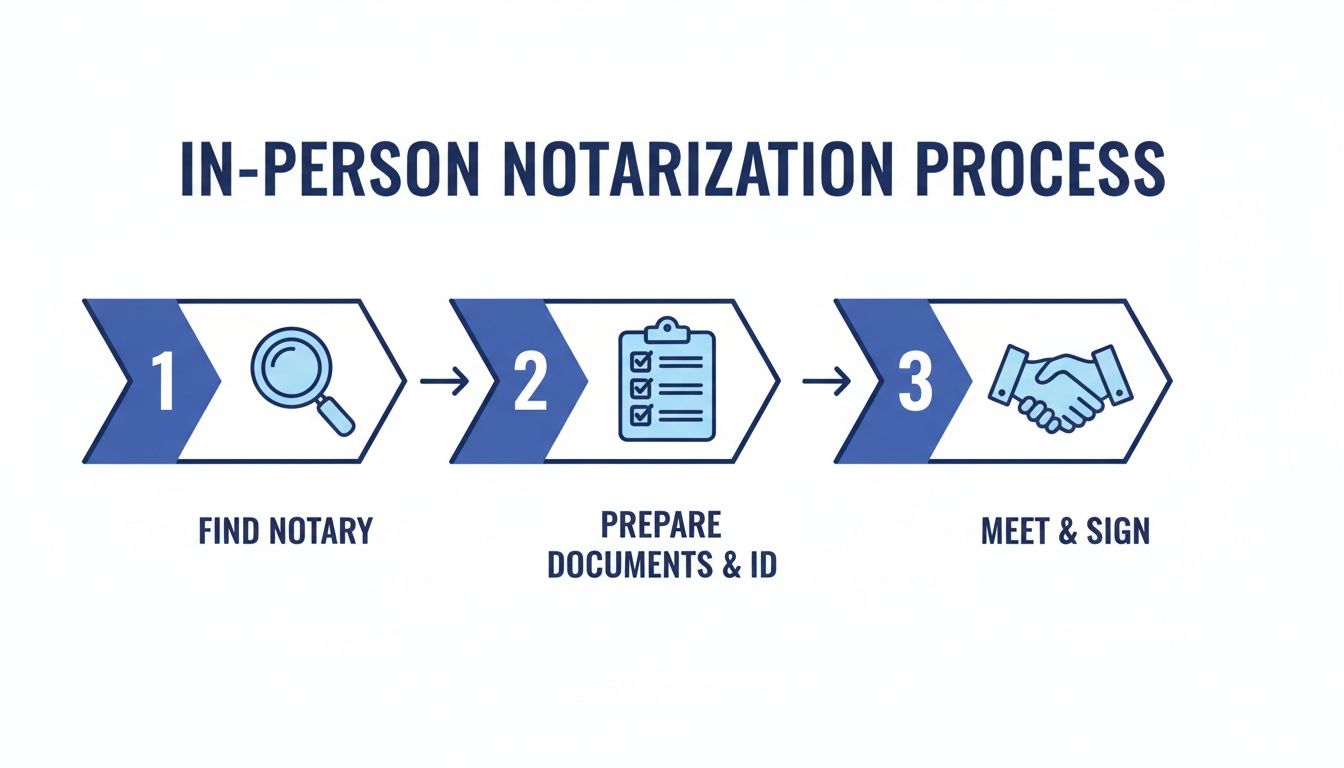
RON takes those separate actions—finding a notary, gathering your documents, and meeting up—and combines them into one efficient online workflow.
The Real-World Advantages of Going Remote
The benefits of using RON for your passport copy go way beyond just avoiding traffic. Speed is a huge one. A notarization that could take days to coordinate in person can often be wrapped up in just a few minutes online. That’s a lifesaver when you’re up against a tight deadline for a visa application or a real estate deal.
Accessibility is another game-changer. If you live overseas or have mobility issues, RON eliminates major hurdles. All you need is a reliable internet connection and your documents to connect with a commissioned U.S. notary from almost anywhere on the globe.
The best part? RON creates a complete, tamper-evident audit trail. The entire audio-video session is recorded and stored securely, which means you have an undisputed digital record of the notarial act—far more robust than a simple entry in a paper journal.
But Is It Legally Accepted?
That’s the million-dollar question, and the answer is a firm “yes.” In the United States, Remote Online Notarization is widely accepted thanks to interstate recognition laws. This means that a document properly notarized online by a commissioned notary in a state that permits RON (like Florida, Texas, or Virginia) is valid across the country.
Internationally, acceptance is growing fast. Many foreign embassies, universities, and banks now recognize remotely notarized documents because they understand the strong security protocols behind the process. Still, it’s always smart to double-check with the person or organization receiving your document to confirm they accept RON. If you’re new to the concept, learning more about what a remote online notary can do is a great way to get comfortable with the process.
Navigating the Maze of Legal Requirements
One of the biggest mistakes I see people make is assuming notarization is the same everywhere. It’s not. The rules for a passport copy notarization can swing wildly from one state to another, and they change again if the document is heading overseas. What works perfectly in Florida might get your application flat-out rejected in California.
Understanding these differences is the key to avoiding headaches and delays. You can’t just assume any notary can handle your request. The very first question to ask is whether a notary in that state is even allowed to certify a copy of a passport.
State Rules Aren’t One-Size-Fits-All
Some states are very clear-cut. In places like Michigan and Ohio, notaries are simply forbidden from certifying copies of any document. If you’re there, you’ll need a different strategy. The common solution is for you, the document holder, to sign an affidavit stating the copy is true and correct, and the notary just notarizes your signature on that statement. It’s a solid workaround, but you absolutely have to check if the receiving agency will accept it.
Then you have states with more nuanced rules. New York and Tennessee, for example, only let their notaries certify physical copies of electronic records. That means your actual, physical passport is off the table for this kind of notarization.
The California Workaround: Copy Certification by Document Custodian
California law is a great example of these local quirks. Notaries there cannot directly certify that your passport copy is authentic. Instead, the responsibility falls on you. You have to write and sign a sworn statement declaring the photocopy is a true, accurate reproduction of your original passport. The notary’s job is simply to notarize your signature on that affidavit, not to vouch for the copy itself. This method is legally sound and widely accepted, but you have to know to ask for it.
This “Document Custodian” approach perfectly illustrates why knowing the local landscape is so critical. It cleverly shifts the legal declaration from the notary to you while still providing the official verification that agencies need.
When Your Document Crosses Borders
If your notarized passport copy is for a foreign entity—a university, a bank, a government—a simple notarization probably won’t cut it. This is where you’ll hear the term “Apostille.”
Think of an Apostille as a second layer of verification. It’s a special certificate attached to your notarized document that confirms the notary’s signature and seal are legitimate. It’s recognized by all countries that are part of the 1961 Hague Convention, essentially telling a foreign government that the American notary who handled your document is the real deal.
Here’s a quick mental checklist:
- For use within the U.S.: A standard notarization is almost always enough.
- For use in a Hague Convention country: You’ll almost certainly need both a notarization and an Apostille.
- For use in a non-Hague country: You might be looking at a more involved process called “legalization” or “authentication,” which can involve multiple government offices.
Do yourself a huge favor and ask the requesting organization exactly what they need. A simple question like, “Do I need an Apostille for this?” can save you weeks of stress.
The Golden Rule: The Receiving Agency’s Rules Are All That Matter
At the end of the day, the only rules that truly count are the ones set by the company, embassy, or agency asking for your document. They have the final say.
For many official processes, like visas and consular services, a notarized copy of your passport’s biographical page is a standard requirement. Foreign embassies often want a certified copy because a notary’s stamp provides a quick, trusted confirmation that the copy “matches the original.” This is a crucial security check in workflows that process millions of documents annually, a reality reflected in reports on U.S. travel and consular activities. You can get a sense of this massive scale by reviewing data on international travel statistics.
Before you go anywhere, get direct answers to these questions from the receiving party:
- Will you accept a “Copy Certification by Document Custodian”? (This is vital if you’re in a state like California).
- Is a U.S. notarization enough, or do I also need to get an Apostille?
- Do you have specific wording you require in the notarial certificate?
Getting this information upfront is the single most effective thing you can do. It ensures your passport copy notarization is done right the first time, saving you from the frustration of having your documents rejected.
For any business in finance, law, or real estate, verifying someone’s identity is a critical, everyday task—not a one-time chore. Relying on one-off passport notarizations is a recipe for inefficiency. It’s slow, riddled with potential for human error, and simply doesn’t scale. The real trick is to build a secure and compliant system that works with your daily operations, not against them.
This is where a dedicated identity verification platform comes into play. When you move from cobbled-together solutions to an integrated system like BlueNotary’s Remote Online Notarization (RON) platform, you’re not just tweaking a process; you’re overhauling your entire approach to client onboarding and compliance. You trade a messy, fragmented workflow for a single, auditable pipeline for every identity check.
Weaving Verification into Your Onboarding Flow
The key is to make identity verification feel like a natural part of your client’s experience, not a clunky, frustrating hurdle. By using an API to integrate a RON platform, you can embed the entire notarization process directly into your own systems—whether that’s a client portal, a mobile app, or an internal dashboard. This keeps the experience professional, secure, and entirely under your brand.
This kind of integration delivers some serious wins:
- Move at the Speed of Business: Transactions that used to hang in limbo for days waiting for a physical notarization can now be wrapped up in minutes.
- Seriously Reduce Fraud Risk: RON isn’t just a video call. These platforms layer multiple security checks, like credential analysis and biometric verification, which are lightyears ahead of a quick glance at a physical ID.
- A Better Client Experience: Let’s be honest, nobody enjoys tracking down a notary. Offering a convenient, remote option for passport copy notarization makes a great impression and removes a major headache for your clients.
Centralizing this process also gives you a tamper-evident audit trail for every single verification. The entire audio-video session is recorded and stored, giving you undeniable proof that the notarial act took place. For any business dealing with strict KYC and AML regulations, that’s priceless.
What This Looks Like in the Real World
Picture an international law firm handling immigration cases. They’re onboarding hundreds of clients a year from all over the globe, and every single one needs to provide a verified passport copy.
Their old method was a logistical nightmare. They’d have to instruct clients to find a notary in their own country, get the copy notarized (hoping the standards were acceptable), and then ship the physical document internationally. It was slow, expensive, and carried a constant risk of documents getting lost or rejected.
Then, they integrated BlueNotary’s RON API directly into their client portal. The entire workflow changed overnight:
- The Invitation: A new client gets an email, clicks a link, and lands in their secure portal to start the identity verification.
- A Seamless Experience: Right there on the law firm’s website, the client is guided through uploading their passport and completing the necessary identity checks. They never have to leave the portal.
- Instant Notarization: The client is connected with a commissioned U.S. eNotary over a live video feed, completes the session in minutes, and immediately receives a digitally signed and sealed notarized copy of their passport.
- Automated Compliance: The final, secure document—along with the full video recording—is automatically saved to the client’s file in the firm’s case management system. It’s ready for submission without any manual intervention.
This integrated approach didn’t just cut their document processing time by over 90%; it created an ironclad, auditable record for every client, dramatically improving their compliance posture. The firm stopped worrying about the validity of foreign notarizations and started offering a consistent, modern experience to everyone, regardless of where they were in the world.
When streamlining identity verification, businesses also have to navigate the complex web of legal privacy considerations that come with handling sensitive documents like passports. Building an efficient workflow is only half the battle; ensuring it’s fully compliant with data protection laws is just as important.
Ultimately, adopting a modern verification stack is a strategic shift. You stop treating passport copy notarization as a series of administrative hurdles and start seeing it as an asset—one that strengthens security, makes clients happier, and gives your business a real competitive edge.
Common Notarization Mistakes to Avoid
Getting a notarized passport copy rejected is a frustrating experience that forces you to start all over again. A simple, avoidable mistake can lead to serious delays and extra costs. I’ve seen these common slip-ups derail people’s plans time and time again, but the good news is they are easy to sidestep once you know what to look for.
One of the most frequent reasons for rejection is a bad photocopy. A blurry, smudged, or incomplete copy of your passport’s biographic page is a non-starter. Any notary worth their salt will turn it away immediately. Your copy has to be a perfect, high-quality reproduction of the original document.
Another instant dealbreaker? An expired passport. A notary’s job is to verify your identity using a current, valid form of identification. An expired passport doesn’t meet that standard and can’t be used for a notarial act.
The Number One In-Person Mistake
I can’t stress this enough: the single biggest error people make with in-person notarizations is signing the document before meeting the notary. If the process requires an affidavit or a specific sworn statement like a “Copy Certification by Document Custodian,” you must sign it in the physical presence of the notary.
Signing it at home or even in the waiting room will invalidate the entire act. The notary has to personally witness you signing the document—that’s a fundamental part of the job.
The entire point of the notarization is for the notary to verify who you are and watch you willingly sign the document. If they don’t see the signature happen, they can’t legally complete their duty, and the notarization is worthless.
Navigating Remote Notarization Pitfalls
Remote Online Notarization (RON) is incredibly convenient, but it introduces a few technical hurdles. A choppy internet connection is the top culprit; if the video feed drops, the session has to be stopped and rescheduled. Poor lighting or a noisy environment can also interfere with the all-important identity verification steps.
Before you log into your RON session, do a quick tech check:
- A strong, stable internet connection is essential for a smooth video call.
- A quiet, well-lit room ensures the notary can clearly see you and your documents.
- Your original passport and any required secondary ID should be on hand and ready to show on camera.
Finally, remember that notary laws are always evolving. Regulatory changes can affect who can perform certain acts and how. For example, some recent legislative proposals are looking at expanding the notary’s role to include acting as passport acceptance agents, which could change verification workflows down the road. You can find more notary market statistics and changes to stay informed.
Common Questions About Notarizing Passport Copies
When it comes to notarizing a copy of your passport, a few questions always seem to pop up. Let’s clear the air and tackle them head-on so you can avoid common pitfalls and get it right the first time.
Can I Just Go to Any Notary?
This is a huge one, and the answer is a firm no. A notary’s authority to certify a copy is dictated entirely by their state’s laws, and the rules are all over the map.
For instance, notaries in states like Michigan and Ohio are simply not allowed to certify copies of any document. Period. Meanwhile, a place like California has a specific workaround called a “Copy Certification by Document Custodian.” In that scenario, you (the passport holder) have to personally write and sign a statement attesting that the copy is true and accurate, and the notary just notarizes your signature on that sworn statement. They aren’t certifying the copy itself.
Do I Really Need to Bring My Original Passport?
Yes, you absolutely must have your original, physical passport with you. The entire point of the exercise is for the notary to look at your original document and compare it directly to the photocopy to verify it’s a true and unaltered reproduction.
I can’t tell you how many times people show up with just a photocopy. It’s an instant dead end. The notary cannot and will not proceed without the original, valid passport in hand for comparison.
What’s This Going to Cost Me?
The price tag for notarizing a passport copy can vary quite a bit, depending on where you are and how you get it done.
If you go the traditional in-person route, the fee is set by the state and is usually pretty low—think $10 to $15 per notarized signature. Just remember that doesn’t account for any mobile service or travel fees the notary might charge.
For a Remote Online Notarization (RON) session, you’re looking at a different pricing model. Platforms typically charge a flat fee for the service, often somewhere between $25 and $50. It’s more, but you’re paying for the convenience of doing it from anywhere, the added security layers, and the technology itself. It’s always smart to confirm the total cost before you start.
Ready to skip the hassle and get your passport copy notarized in minutes? BlueNotary offers a secure, compliant, and user-friendly platform for all your Remote Online Notarization needs. Get started with BlueNotary today!