


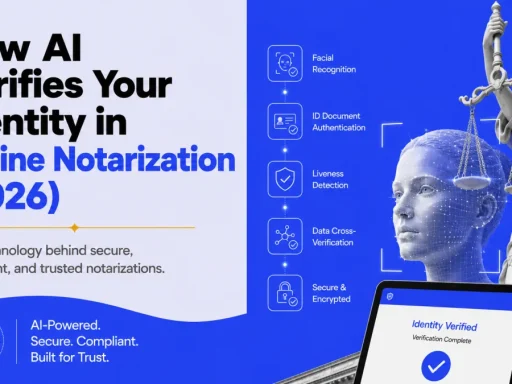
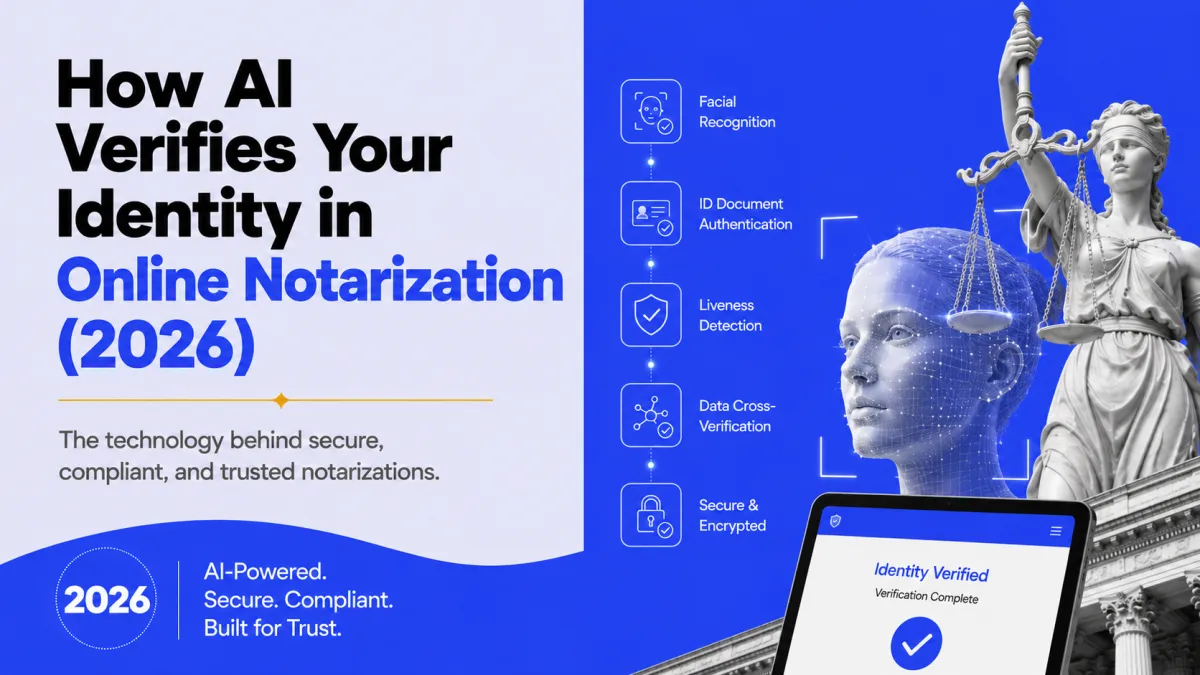

Quick answer: Online notarization verifies your identity with four AI-powered layers: credential analysis (scanning your ID’s security features), knowledge-based authentication (KBA), a biometric face match, and liveness detection. Together they confirm you’re a real, live person and help stop deepfakes and synthetic-identity fraud.
How does online notarization verify your identity?
Online notarization (remote online notarization, or RON) verifies identity through a stack of automated checks that run before the notary ever applies a seal. Instead of one person glancing at a card, the system layers several independent tests so a single weak point can’t let an impostor through. Most state RON laws actually require a certified identity-proofing process for this reason.
Here are the four layers at a glance:
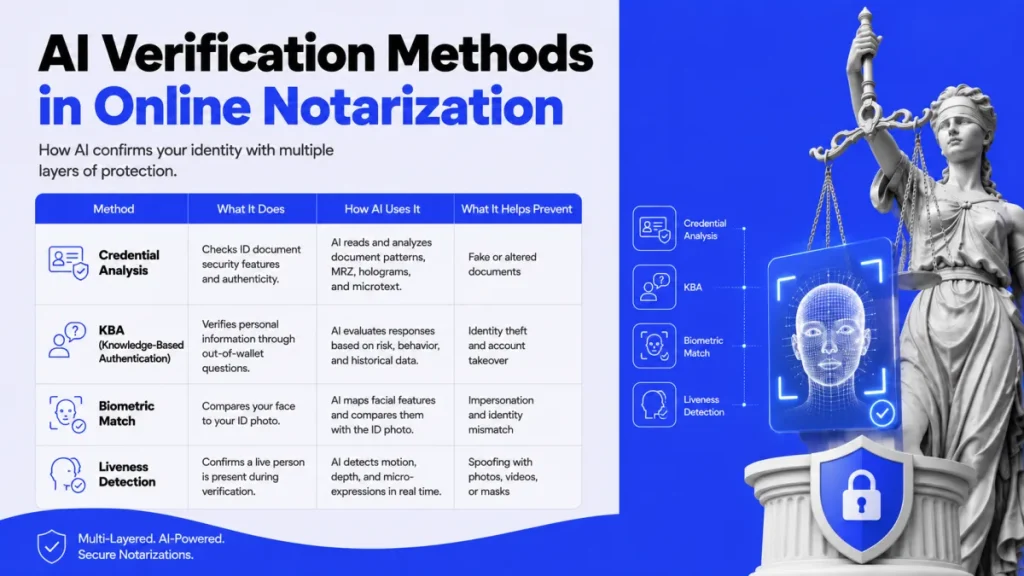
| Layer | What it checks | What it stops |
|---|---|---|
| Credential analysis | Your ID’s security features are genuine | Fake or altered IDs |
| Knowledge-based authentication (KBA) | You can answer questions only you should know | Stolen-ID use by someone else |
| Biometric face match | The live face matches the ID photo | Someone using your real ID |
| Liveness detection | A real, live person is present | Photos, video replays, and deepfakes |
Each layer is explained below, and then how they combine to defeat the two threats people worry about most in 2026, deepfakes and synthetic identities. For the full session flow, see how remote online notarization works.
Credential analysis: scanning your ID
Credential analysis is the first gate. You photograph your government ID, and software examines its security features, holograms, microprint, fonts, layouts, and barcode data, comparing them against known templates for that document type. Machine-learning models flag IDs that are forged, altered, or expired in seconds.
This is also why a physical ID is required, the software is built to read a real card’s features, which a screenshot or phone-wallet ID can’t present the same way. If your ID fails credential analysis, the session stops before it starts.
Knowledge-based authentication (KBA)
Knowledge-based authentication confirms you know what the real person would know. You answer about five questions drawn from public and commercial records, past addresses, vehicles, or accounts, within a short time limit, and you must pass to continue.
KBA matters because a stolen ID alone isn’t enough; an impostor would also have to answer your personal-history questions correctly under pressure. It’s not foolproof (data breaches exist), which is exactly why it’s only one of four layers. People without U.S. records may use an alternative path, covered in what you need to notarize.
Biometric face match and liveness detection
These two layers verify the person, not just the document.
- Biometric face match: You take a selfie, and facial-recognition software compares it to the photo on your ID to confirm they’re the same person. This stops someone from using your genuine ID with their own face.
- Liveness detection: This confirms a real, live human is on camera right now, not a printed photo, a recorded video, or an AI-generated face. Active liveness asks you to blink or turn your head; passive liveness analyzes texture, depth, and lighting cues invisible to the eye.
Liveness detection is the front line against deepfakes, which is why standards bodies like the FIDO Alliance now certify biometric systems for exactly this. The broader framework for identity assurance comes from NIST’s Digital Identity Guidelines (SP 800-63).
How these checks stop deepfakes and synthetic identity fraud
This is the question on everyone’s mind in 2026, so here’s the honest mechanism:
- Deepfakes (AI-generated faces or video) are countered mainly by liveness detection + biometric match. A deepfake can mimic a face, but passive liveness looks for the depth, texture, and micro-signals a synthetic feed lacks, and active prompts are hard for a pre-rendered fake to satisfy in real time.
- Synthetic identities (fake identities built from a mix of real and fabricated data) are countered by the combination of credential analysis and KBA: a fabricated ID tends to fail document checks, and a stitched-together identity struggles to answer deep historical questions consistently.
No single layer is enough, the defense is the stack. Federal regulators have flagged AI-assisted fraud as a rising threat, and the layered model is the response. For the threat side and red flags, your companion read is detecting notarization fraud.
The limits: where AI isn’t enough
Honest truth: identity verification is very strong, not perfect. Deepfake technology keeps improving, KBA data can be exposed in breaches, and no automated system catches everything. That’s why the commissioned notary remains in the loop, observing the live session, judging behavior, and refusing when something feels wrong. Technology raises the floor; human judgment guards the edge cases.
It’s also why rules differ, states set their own identity-proofing standards, so the exact checks can vary. Confirm your state’s requirements in the notarization requirements by state guide, and treat any platform promising “100% fraud-proof” with healthy skepticism.
Conclusion
When you notarize a document online, your identity isn’t taken on trust, it’s tested four ways: credential analysis proves your ID is real, KBA proves you know what only you should, a biometric match proves the face fits the ID, and liveness detection proves you’re a live person rather than a deepfake or replay. Layered together, those checks make online notarization a genuinely hard target for both deepfakes and synthetic identities. and a commissioned notary stays in the session as the human backstop for whatever the software might miss.
Want a notarization backed by that verification? Complete an identity-verified online notarization with a commissioned notary on BlueNotary in about 15 minutes, 24/7. Curious which IDs pass the checks? Start with what you need to notarize.
Frequently asked questions
How does online notarization verify identity?
It uses four layered checks before you sign, credential analysis of your ID, knowledge-based authentication questions, a biometric face match, and liveness detection, plus a live notary observing the session.
What is credential analysis in online notarization?
Credential analysis is automated software that scans your government ID’s security features, holograms, microprint, fonts, and barcode data, to confirm it’s genuine and unaltered before the session continues.
What is knowledge-based authentication (KBA)?
KBA is a set of about five timed questions drawn from public and commercial records that only the real person should be able to answer, confirming a stolen ID isn’t being used by someone else.
Can online notarization detect deepfakes?
Yes, primarily through liveness detection and biometric matching, which look for signals a real live person produces and an AI-generated face or replayed video cannot reliably reproduce in real time.
Can AI catch synthetic identity fraud?
The layered checks make it hard, a synthetic identity built from fake and real data tends to fail document credential analysis or stumble on deep knowledge-based questions, and the combination flags inconsistencies.
Is online notarization identity verification safe?
It’s strong but not flawless. Four layered AI checks plus a live notary make fraud difficult, though no system is perfect, so a human notary still judges and can refuse a suspicious session.