


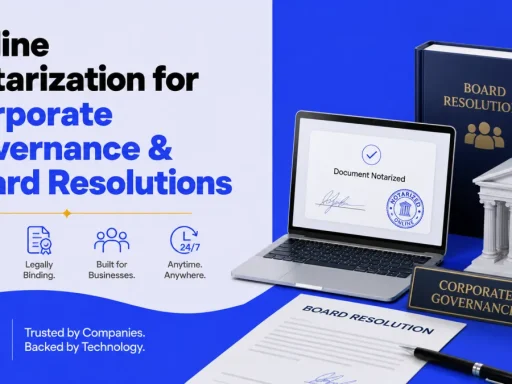


Quick answer: Most corporate governance documents, board resolutions, minutes, bylaws, don’t legally require notarization, since they’re internal. You notarize them when a third party demands it, a bank opening an account, a lender, a government filing, or a foreign authority. Officers can sign and notarize these online, even with board members in different locations.
Do board resolutions need to be notarized?
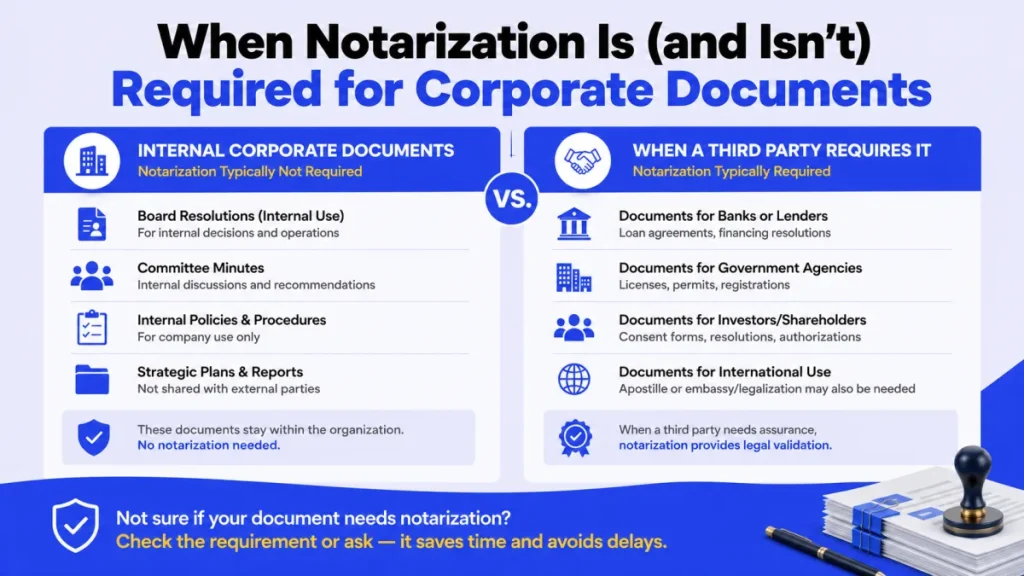
In most cases, no. A board resolution doesn’t legally need to be notarized. Resolutions, meeting minutes, and bylaws are internal governance records, they’re valid once properly adopted by the board, and no law requires a notary stamp to make them effective.
Notarization enters the picture when an outside party wants assurance that the document is genuine and that the person who signed it had the authority to act for the company. A bank opening a corporate account, a lender funding a loan, a county recording a deed signed by an officer, or a foreign government accepting a corporate document will often require a notarized resolution or certificate. So the real question isn’t “does my company need to notarize this?” — it’s “does the party receiving it require notarization?”
When corporate documents need notarization
Notarization is almost always demand-driven by a counterparty. The common triggers:
| Trigger | Why notarization is required |
|---|---|
| Banking (open account, authorize signers) | Banks want a notarized resolution proving who may act for the entity |
| Lending / financing | Lenders verify the signer’s authority and identity before funding |
| Real estate by an entity | A deed signed by an officer must be notarized to record |
| Government filings | Some state filings (e.g., articles of amendment) require notarized signatures |
| Cross-border / international deals | Foreign authorities often require notarization plus an apostille |
| Major contracts / M&A | Counterparties may require notarized authority documents |
If none of these apply, your internal resolution is usually fine as-is. When one does, confirm the exact format the counterparty wants, and check your state’s rules in the notarization requirements by state guide.
Which corporate documents commonly get notarized
When a third party asks, these are the entity documents most often notarized:
- Board / corporate resolutions: Authorizing a transaction, account, or signer
- Banking resolutions: Naming who can open accounts or borrow on the company’s behalf
- Secretary’s certificate: The corporate secretary certifying a resolution was duly adopted
- Certificate of incumbency: Confirming who currently holds which office and their signatures
- Operating agreement or amendment signatures: Where a bank or counterparty requests it (see LLC operating agreement amendments)
The notary isn’t validating your internal governance, they’re verifying the signature and identity (and sometimes authority) of the person signing.
How online notarization works for corporate governance
Online notarization is a natural fit for entities, because directors and officers are rarely in the same room. Here’s the flow:
- Confirm what the counterparty requires: Ask the bank, lender, or agency whether they accept remote online notarization and what document/format they need. This prevents a rejected signing.
- Prepare the document, unsigned: Finalize the resolution or certificate with the correct entity name, date, and signer titles. Don’t sign until the session.
- Upload and invite signers: A platform like BlueNotary lets you upload the document and bring multiple signers — officers or directors in different cities or states — into one session. See how remote online notarization works.
- Each signer verifies identity: Every signer completes credential analysis and knowledge-based authentication with a government photo ID.
- Sign on the live call: The notary watches each authorized officer sign, then applies the tamper-evident electronic seal and completes the certificate.
- Distribute the sealed document: Download and send the notarized resolution to the bank, lender, or counterparty and arrange an apostille if it’s headed abroad.
Authority verification: what the notary checks
A key nuance for corporate signings: the notary verifies who is signing, and a counterparty may also require proof that the signer is authorized to bind the entity. That’s why corporate packages often pair the signed document with a secretary’s certificate or certificate of incumbency confirming the officer’s role.
The notary’s job is identity and signature, not judging whether the board properly approved the action. So the company is responsible for ensuring the resolution was duly adopted and the signer genuinely holds authority. For complex governance or high-value transactions, have corporate counsel confirm the authority chain before notarizing.
Conclusion
Corporate governance documents live by their own rules: board resolutions, minutes, and bylaws are internal and rarely need a notary to be valid. Notarization becomes necessary when an outside party, a bank, lender, government office, or foreign authority, needs proof that the document is genuine and the signer had authority. When that happens, online notarization is the efficient path: your officers and directors can verify their identities and sign from wherever they are, in a single session, with a tamper-evident seal at the end.
Need a board resolution or secretary’s certificate notarized with signers in different locations? Notarize your corporate documents online with a commissioned notary on BlueNotary in about 15 minutes, 24/7. Multiple signers welcome. Not sure your document needs a notary at all? Start with what documents require notarization.
Frequently asked questions
Do board resolutions need to be notarized?
Usually not. Board resolutions are internal governance records and are valid once duly adopted. Notarization is only needed when a bank, lender, government office, or foreign authority specifically requires it.
Do corporate documents need to be notarized?
Most don’t on their own. Notarization is triggered by third-party requirements, banking, lending, certain government filings, or cross-border use, rather than by the document itself.
Why do banks require a notarized corporate resolution?
Banks want assurance that the resolution is genuine and that the person opening the account or borrowing has authority to act for the company, so they require a notarized resolution to verify identity and signature.
Can you notarize a board resolution online?
Yes. A board resolution can be notarized online, and multiple officers or directors in different locations can verify their identities and sign in a single remote session.
What is a secretary’s certificate or certificate of incumbency?
A secretary’s certificate confirms a resolution was duly adopted by the board, a certificate of incumbency confirms who holds which office and provides their signatures. Both are often notarized to prove authority.
Do corporate documents need an apostille for use abroad?
Often yes. Corporate resolutions and certificates used by foreign authorities usually must be notarized and then apostilled to be recognized internationally.