


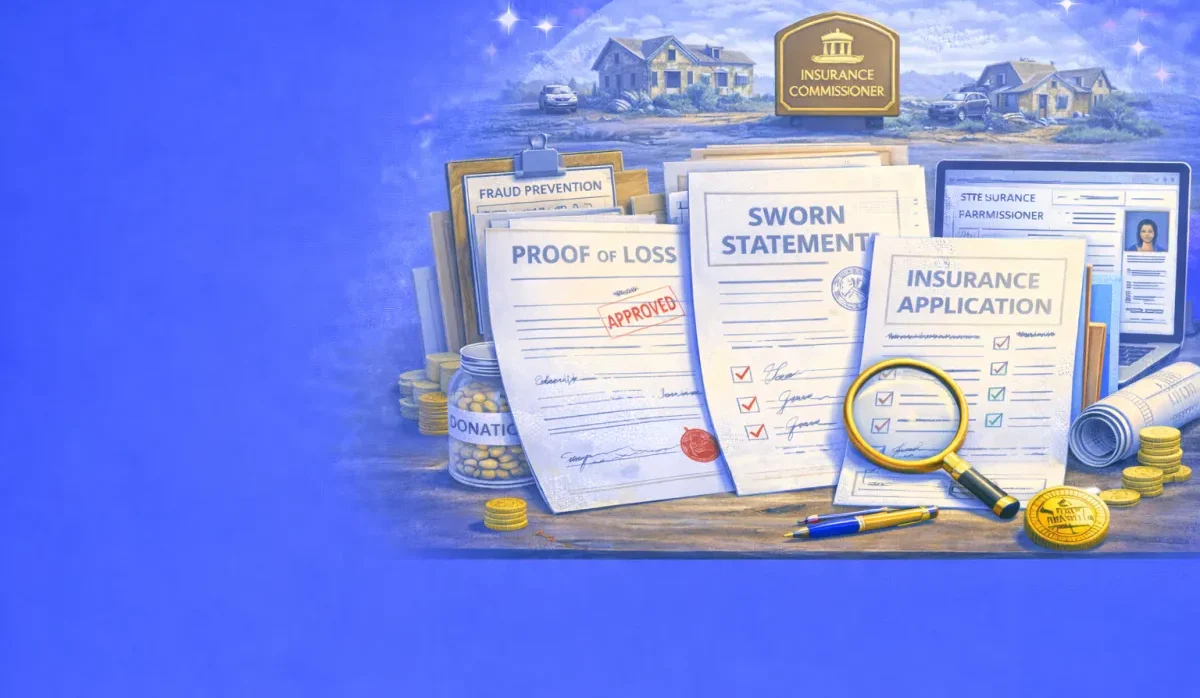

The insurance industry relies heavily on notarized documents. From proof of loss forms to agent appointments, proper notarization prevents fraud and ensures legal validity. Both insurance professionals and policyholders encounter notarization requirements regularly.
This guide covers essential insurance documents that require notarization. We’ll explore proof of loss forms, sworn statements, claims documentation, and licensing requirements. You’ll also learn about fraud prevention measures and state insurance commissioner guidelines.
Proof of Loss Forms: The Foundation of Claims
A proof of loss form is one of the most important insurance documents. This formal statement notifies the insurance carrier that damage occurred. It also requests payment under the policy terms. Most insurers require notarized proof of loss forms for significant claims.
What Is a Proof of Loss?
A proof of loss, sometimes called a “sworn statement in proof of loss,” details your claim. The document includes the date and cause of loss. It specifies the coverage amount and itemizes damaged or destroyed property. Additionally, it provides supporting documentation for your claimed expenses.
Insurance companies use this document to verify claims and prevent fraud. The sworn nature of the statement means you affirm everything is true. Making false statements on a proof of loss can result in claim denial. In serious cases, it may lead to criminal prosecution.
Notarization Requirements
Most insurance companies require notarized signatures on proof of loss forms. Without notarization, insurers may reject the document entirely. The notary witnesses your signature and confirms your identity. This process transforms the document into a sworn statement.
Some policies include specific language requiring notarization. Others simply require a signed, sworn statement. Always check your policy conditions to determine exact requirements. The “Duties After Loss” section typically outlines these obligations.
Federal flood insurance policies through NFIP have specific requirements. These policies require either notarized statements or declarations under penalty of perjury. A statement that lacks both may fail to meet policy requirements. Courts have ruled against policyholders who submitted incomplete documents.
Common Mistakes to Avoid
Several errors frequently cause proof of loss rejections. First, missing the filing deadline creates serious problems. Most policies require submission within 60 days. The clock typically starts when you suffer the loss or when the insurer requests the form.
Second, failing to include supporting documentation weakens your claim. Insurance companies need receipts, estimates, and inventories. They verify your claimed expenses against this evidence. Without proof, they cannot settle your claim properly.
Third, forgetting notarization invalidates the document. Even a perfectly prepared form will be rejected without the notary seal. Some policyholders assume electronic signatures are sufficient. However, most insurers specifically require traditional notarization.
Response Timeline
After you submit a notarized proof of loss, the insurer must respond. Response times vary by state regulation. For example, California requires insurers to respond within 90 days. The claims adjuster reviews your form and supporting documentation.
The adjuster may accept the claim or request additional information. Sometimes they send a reservation of rights letter. This indicates the claim remains under investigation. Eventually, the insurer will approve, partially approve, or deny your claim.
Sworn Statements and Examinations Under Oath
Insurance companies have additional tools to verify claims. Sworn statements and examinations under oath (EUOs) are common requirements. Both involve formal testimony that requires careful attention.
Understanding Examinations Under Oath
An examination under oath is a formal interview process. The insurance company’s representative questions you about your claim. A certified court reporter records everything. A notary administers the oath before questioning begins.
EUOs serve several purposes. They allow insurers to gather detailed information. They help verify the facts surrounding your loss. Additionally, they test your credibility as a witness. Insurance companies also use EUOs to screen for fraudulent claims.
Most property insurance policies include EUO provisions. These clauses typically appear in the conditions section. The policy gives the insurer the right to examine you under oath. Refusing to participate can result in claim denial.
Your Rights During an EUO
Various states have laws protecting policyholder rights during EUOs. In California, specific regulations govern the process. The insurer must hold the examination at a reasonable time and place. They must provide advance notice of your right to counsel.
You have the right to receive a transcript copy after the examination. The insurer must provide this within 10 business days of receiving it. You can make sworn corrections to ensure accuracy. Additionally, you may assert legal objections during the examination.
However, asserting objections has consequences. If your objections prevent the insurer from evaluating your claim, your rights may be affected. Courts traditionally take a hard line on policyholders who refuse to cooperate. Therefore, preparation and honest testimony are essential.
Preparing for an EUO
Preparation is crucial for a successful examination under oath. Review all facts about when the loss happened. Understand why it happened and the extent of your damages. Know the basis for every expense you claimed.
Consider retaining an attorney before the examination. A lawyer can help you prepare and protect your rights. They can advise you on questions you should not answer. However, attorneys typically cannot object or ask questions during the EUO itself.
Remember that testimony is recorded and sworn. Anything you say can be used later in legal proceedings. Therefore, answer honestly and accurately. Speculation and careless statements can damage your claim.
Insurance Agent and Producer Licensing
Insurance agents and producers must obtain proper licensing. Each state regulates insurance licensing through its department of insurance. Licensing requirements include applications, examinations, and ongoing compliance.
State Licensing Requirements
Insurance licensing is regulated entirely at the state level. Requirements vary significantly from state to state. Some states require pre-licensing education before taking examinations. Others allow candidates to take exams without formal coursework.
Most states license producers by line of authority. Common lines include property, casualty, life, health, and variable products. Some states offer all-lines adjuster licenses. These cover multiple insurance types under one license.
Currently, approximately 35 states require insurance adjuster licenses. The remaining states either don’t require licenses or have limited requirements. If you live in a non-licensing state, you can designate another state as your home state.
Notarization in Licensing Applications
Some states require notarized licensing applications. For example, Kentucky requires applicants to sign, date, and notarize certain forms. These include bond forms and assumption of liability documents.
Agent appointment forms may also require notarization. When an insurance company appoints you to sell its products, documentation is necessary. Some carriers require notarized appointment paperwork. This verifies your identity and authorization.
Surety bond requirements apply in many states. California requires a $2,000 bond for independent adjusters. The bond must be executed by a California-admitted surety. The principal must sign the bond, and notarization may be required.
Reciprocity and Multi-State Licensing
Many states offer reciprocal licensing arrangements. If you hold a license in your home state, other states may grant reciprocal licenses. Florida and Texas are popular designated home states. Their licenses provide access to many other states.
However, reciprocity is not universal. Some states require you to pass their specific examination. Others have additional requirements for non-resident licensees. Always verify current requirements with each state’s insurance department.
The National Insurance Producer Registry (NIPR) streamlines multi-state licensing. This electronic system processes applications and renewals. Most states participate in NIPR for efficiency.
Public Adjuster Requirements
Public adjusters work on behalf of policyholders, not insurance companies. They help claimants navigate the claims process. Most states require public adjuster licensing, though requirements vary considerably.
Licensing Variations by State
Public adjuster licensing requirements differ dramatically. Some states require licenses, examinations, and continuing education. Others have minimal or no requirements. A few states prohibit public adjusting entirely.
Alabama and Alaska do not license public adjusters. In these states, operating as a public adjuster may constitute practicing law. Arkansas prohibits public adjusters from adjusting claims. Consequently, only attorneys can perform this function there.
States like California, Florida, and Texas require comprehensive licensing. These states have examination requirements and continuing education. They also impose fee caps limiting what public adjusters can charge.
Bond and Insurance Requirements
Many states require public adjusters to post surety bonds. Bond amounts vary by state but typically range from $5,000 to $50,000. The bond protects consumers from adjuster misconduct.
Additionally, public adjusters often need errors and omissions insurance. This coverage protects against claims arising from professional mistakes. Some states mandate minimum coverage amounts. Others recommend but don’t require this protection.
Emergency and Catastrophe Licensing
Natural disasters create increased demand for adjusters. States often activate emergency licensing provisions after major events. These allow non-resident adjusters to work temporarily without full state licenses.
Hawaii activated such provisions after the Maui wildfires. The insurance commissioner authorized temporary assistance from non-resident adjusters. These emergency measures help handle claim volumes after catastrophes.
Registration requirements typically apply during emergencies. Adjusters must register with the state before beginning work. They must also comply with state regulations while working. Emergency authorizations have time limits and specific conditions.
Insurance Applications and Fraud Prevention
Insurance applications require accurate information. Misrepresentations on applications constitute fraud. Insurers use various methods to detect and prevent application fraud.
Application Requirements
Most insurance applications don’t require notarization. However, some high-value or specialized policies may require notarized applications. Commercial insurance and certain life insurance policies sometimes have this requirement.
Regardless of notarization, applications are legal documents. You must provide accurate information about your identity. You must truthfully disclose relevant facts about the risk being insured. Material misrepresentations can void your policy entirely.
Life insurance applications are particularly sensitive. The contestability period, typically one to two years, allows investigation. During this time, insurers can deny claims for misrepresentation. After the period ends, the incontestability clause provides more protection.
Fraud Prevention Measures
Insurance companies employ multiple fraud detection methods. Data analytics and machine learning identify suspicious patterns. Identity verification includes document scanning and biometric checks. Device fingerprinting prevents multiple fraudulent applications.
The Medical Information Bureau (MIB) shares data among insurers. This cooperative system detects red flags across companies. It prevents applicants from hiding information disclosed to previous insurers. The system helps maintain transparency in the application process.
Special Investigative Units (SIUs) investigate suspected fraud. These teams exist within most insurance companies. They use surveillance, interviews, and financial audits. California requires insurers to maintain SIUs under state law.
Notarization as a Fraud Deterrent
Notarization adds a verification layer to insurance documents. The notary confirms the signer’s identity. They witness the signature and verify willingness to sign. This process creates an auditable trail.
For claims documents, notarization provides significant protection. Forged signatures become easier to detect. False statements carry greater legal weight when notarized. Both insurers and policyholders benefit from this verification.
Remote online notarization platforms create additional security. They maintain detailed logs of each session. Video recordings document the entire process. These records support fraud investigations when needed.
State Insurance Commissioner Requirements
Each state has an insurance commissioner or director. This official oversees insurance regulation in the state. Commissioners enforce laws affecting insurers, agents, and policyholders.
Regulatory Authority
Insurance commissioners have broad regulatory powers. They approve policy forms and rate filings. They license insurance companies, agents, and adjusters. Additionally, they investigate complaints and enforce compliance.
Fair Claims Settlement Practices Regulations govern insurer conduct. These rules specify how insurers must handle claims. They establish timelines for responses and payments. Violations can result in penalties against insurance companies.
For example, California’s regulations require specific adjuster conduct. After major disasters, adjusters must read and understand CDI’s Annual Notice. They must follow the Guide for Adjusting Property Claims. Non-compliance can result in disciplinary action.
Filing Requirements
Insurers must file various documents with state regulators. These include policy forms, rates, and financial statements. Many filings require certified officer signatures. Some require notarization for verification.
Fraud Prevention Plans must be filed in many states. New York requires insurers to submit detailed anti-fraud plans. These plans describe SIU operations and fraud detection procedures. They must include provisions for employee training and public awareness.
Annual reports document SIU activities and fraud referrals. California requires approximately 1,100 insurers to file these reports. The SIU Compliance Review Program evaluates report accuracy and completeness. Non-compliance can trigger regulatory review.
Consumer Protection
State insurance departments protect consumers in several ways. They maintain complaint databases and investigate issues. They provide resources for understanding insurance rights. Additionally, they take action against fraudulent companies and agents.
Before purchasing insurance, verify company and agent licensing. Contact your state insurance department for confirmation. Report suspected fraud to the department or attorney general. These steps protect you and other consumers.
Claims Documentation Requirements
Proper documentation supports successful insurance claims. Different claim types require different evidence. Understanding requirements helps you prepare effectively.
Property Damage Claims
Property damage claims require extensive documentation. Photographs capture damage before repairs begin. Video recordings can show the extent of destruction. Written descriptions detail each damaged item.
Receipts and invoices prove ownership and value. Bank statements may show major purchases. Credit card records provide additional verification. Home inventory lists help document contents.
Repair estimates from licensed contractors support cost claims. Multiple estimates strengthen your position. Keep all correspondence with your insurer. Document phone calls with dates, times, and names.
Personal Injury Claims
Personal injury claims require medical documentation. Copies of medical bills prove treatment costs. Records of diagnostic tests support injury claims. Physical therapy receipts document rehabilitation expenses.
Police reports provide official incident documentation. Witness statements corroborate your account. Photographs of injuries show visible damage. Employment records prove lost wages.
The insurer may request a sworn statement in proof of loss. This document details your injuries and expenses. It requires accurate information about the incident. Notarization validates the sworn statement.
Life Insurance Claims
Life insurance claims require death certificates. The beneficiary submits claim forms with this documentation. The insurer verifies policy status and beneficiary designation. They also confirm the cause of death.
Complex claims may require additional documentation. Medical records from the insured’s final illness. Autopsy reports if applicable. Police reports for accidental deaths. These documents help verify the claim.
Beneficiary designation changes may require notarization. This prevents unauthorized changes to beneficiary information. Similarly, policy ownership transfers often need notarized signatures. These requirements protect all parties involved.
Remote Online Notarization for Insurance Documents
Remote Online Notarization (RON) offers convenience for insurance transactions. Approximately 47 states now permit RON for various documents. This technology streamlines the notarization process significantly.
Benefits for Insurance Transactions
RON provides several advantages for insurance matters. Policyholders can notarize documents from anywhere with internet access. This is especially valuable after disasters when travel is difficult. It also helps elderly or mobility-limited individuals.
For urgent situations, RON offers faster processing. Proof of loss forms can be notarized immediately after completion. Beneficiary changes can happen without scheduling delays. Claims processing accelerates with faster document execution.
Most RON platforms create comprehensive audit trails. They record identity verification data and timestamps. Video recordings document each session. These records support fraud investigations and dispute resolution.
Suitable Insurance Documents
Many insurance documents work well with RON. Proof of loss forms and sworn statements are common uses. Beneficiary designation forms benefit from remote notarization. Power of attorney documents for insurance matters also qualify.
Agent appointment forms can use RON where permitted. Settlement agreements and releases work well remotely. Policy applications requiring notarization benefit similarly. However, always verify state-specific requirements first.
Considerations and Limitations
Despite RON benefits, some limitations exist. Not all states permit RON for every document type. Some insurance companies may have specific notarization requirements. Always verify acceptability before using remote notarization.
State laws govern which documents can use RON. Some transactions may still require in-person notarization. Check with your insurance company about their policies. They can confirm whether RON documents will be accepted.
Best Practices for Insurance Document Notarization
Following best practices ensures smooth document processing. Proper preparation prevents delays and rejections. These guidelines apply to most insurance documents.
Before Notarization
Review the document completely before notarization. Understand what you’re signing and affirming. Verify all information is accurate and complete. Correct any errors before the notarization appointment.
Gather proper identification documents. Most notaries accept state-issued driver’s licenses or ID cards. Passports and military IDs are typically acceptable. The ID must be current and include your photograph.
Understand deadlines for submission. Proof of loss forms typically have 60-day deadlines. Missing deadlines can result in claim denial. Plan notarization appointments with time to spare.
During Notarization
Bring the unsigned document to your appointment. You must sign in the notary’s presence. Never pre-sign documents intended for notarization. Pre-signed documents cannot be properly notarized.
The notary will verify your identity against your ID. They will confirm you understand the document. They witness your signature and complete the notarial certificate. Finally, they apply their official seal.
Answer the notary’s questions honestly. They may ask if you’re signing voluntarily. They may confirm you understand the document’s contents. These questions ensure proper notarization.
After Notarization
Keep copies of all notarized documents. Store originals in a safe location. Submit documents to your insurer promptly. Retain proof of delivery for your records.
If using mail, consider certified mail with return receipt. This proves delivery and timing. Electronic submission may require specific formats. Follow your insurer’s instructions carefully.
Track response deadlines after submission. Note when you should expect a response. Follow up if you don’t hear back within the specified timeframe. Document all communications with your insurer.
Frequently Asked Questions
Do all proof of loss forms require notarization?
Most insurance companies require notarized proof of loss forms. However, requirements vary by policy and insurer. Check your policy’s “Duties After Loss” section for specific requirements. Some policies may accept declarations under penalty of perjury instead.
What happens if I don’t participate in an examination under oath?
Refusing to participate in an EUO can result in claim denial. Insurance policies typically require cooperation with investigations. Courts generally support insurers who deny claims for EUO non-compliance. Therefore, participation is strongly recommended.
Do insurance agents need notarized documents for licensing?
Requirements vary by state. Some states require notarized bond forms or applications. Others process licensing entirely electronically. Check with your state’s department of insurance for specific requirements.
Can I use remote online notarization for insurance claims documents?
Yes, in most states. Approximately 47 states permit RON for various documents. However, verify with your insurance company that they accept RON documents. Some insurers may have specific requirements.
What documents should I have notarized for a life insurance claim?
Death certificates are typically required but don’t need notarization themselves. Beneficiary claims forms may require notarization. Power of attorney documents for handling claims often need notarization. Check with the insurance company for specific requirements.
How do fraud prevention measures affect the claims process?
Fraud prevention measures may extend claim processing times. Your claim might be referred to the Special Investigative Unit for review. You may be asked for additional documentation or an examination under oath. Cooperate fully to expedite the process.
What is a Special Investigative Unit?
An SIU is a specialized team that investigates suspected insurance fraud. Most insurance companies maintain SIUs as required by state law. They investigate claims with suspicious indicators. Their goal is to protect insurers and policyholders from fraud.
How long do I have to submit a proof of loss form?
Most policies require submission within 60 days. The countdown typically starts when you suffer the loss. Some policies start the clock when the insurer requests the form. Check your specific policy language for exact requirements.
Conclusion:
Insurance documents require careful attention to notarization requirements. Proof of loss forms, sworn statements, and licensing applications often need notarized signatures. Understanding these requirements helps ensure smooth processing.
Fraud prevention measures protect both insurers and policyholders. Notarization adds a verification layer that deters fraudulent activity. Examinations under oath allow thorough claim investigation. These processes maintain industry integrity.
State insurance commissioners establish regulatory frameworks. They oversee licensing, claims handling, and fraud prevention. Compliance with their requirements is essential for insurance professionals. Policyholders benefit from these consumer protections.
Remote online notarization provides convenient options for insurance documents. This technology accelerates claims processing and improves accessibility. However, verify acceptance before using RON for specific transactions.
BlueNotary provides RON services for insurance documents. The platform connects users with licensed notaries for secure sessions. This is especially valuable when dealing with time-sensitive claims.
Proper documentation and cooperation lead to successful claims outcomes. Prepare thoroughly for notarization appointments. Participate honestly in any required examinations. Keep detailed records of all insurance-related communications.
By understanding insurance notarization requirements, you protect your interests. Whether you’re a policyholder filing a claim or an agent maintaining your license, proper documentation matters. Take the time to do it right.