

You found a place to rent. The landlord sends over a lease. It is several pages long, full of legal language you were not expecting, and you need to sign before the weekend. Before you do, you need to understand what you are actually agreeing to.
A lease agreement contract is a legally binding document between a landlord and a tenant that defines the terms of a rental arrangement. It covers rent amount, lease duration, security deposit, property rules, and each party’s responsibilities, and it becomes enforceable once both parties sign it.
This guide covers what a lease agreement contract includes, the types you will encounter, what makes one legally binding, and when you may need to get it notarized.
What Is a Lease Agreement Contract?
A lease agreement contract is a written, legally binding agreement between a property owner (the landlord) and the person renting that property (the tenant). It sets the rules of the rental relationship: how much rent is due, when it is due, how long the arrangement lasts, and what each party is responsible for during that time. Without a written lease, both sides rely on memory and good faith, which rarely holds up when a dispute arises.
Is a Lease Agreement the Same as a Contract?
Yes. A lease agreement is a specific type of contract. Like any contract, it requires an offer, acceptance, and an exchange of something valuable between both parties. In a lease, the tenant gets the right to occupy the property and the landlord receives rent. What distinguishes it from a general contract is that it governs the use of real property for a defined period of time.
Lease Agreement vs. Rental Agreement: What Is the Difference?
These two terms get used interchangeably, but they work differently in practice.
| Feature | Lease Agreement | Rental Agreement |
|---|---|---|
| Term length | Fixed (typically 6 to 12 months) | Month-to-month |
| Rent changes | Cannot change mid-term | Can adjust at renewal |
| Flexibility | Lower — penalties for early exit | Higher — 30-day notice to end |
| Best for | Long-term stability | Short stays or uncertain timelines |
A lease locks in the agreed terms for the full period. Neither party can raise the rent or change the rules mid-term without mutual consent. A rental agreement renews each month and gives both sides more room to adjust, but also more uncertainty.
What a Lease Agreement Contract Must Include
Not every lease looks the same, but every enforceable lease agreement contract needs to cover certain ground. Missing even one of these elements can leave you without legal footing if a dispute arises.
- Full legal names of all parties: List the landlord and every adult tenant by full legal name. This identifies exactly who the contract binds.
- Property address and description: Include the full street address and any unit number. Be specific enough that the property cannot be confused with another.
- Lease start and end date: State the exact term. Vague or open-ended language creates disputes before the first month is up.
- Monthly rent amount and due date: State the exact dollar amount and the date it is due each month, most commonly the 1st.
- Security deposit amount and return conditions: Specify how much the deposit is, where it will be held, and under what conditions it gets returned.
- Late fees and grace period: Define what happens when rent is paid late and how many days pass before a fee applies.
- Maintenance and repair responsibilities: Spell out who handles what. Landlords typically cover major systems; tenants handle routine upkeep.
- Rules on pets, smoking, and guests: Policies on these three topics prevent the majority of mid-lease conflicts.
- Early termination conditions: How either party can exit early, how much notice is required, and whether a penalty fee applies.
- Signatures of all parties: A lease is not legally binding until every person named in it has signed the document.
Optional but Recommended Clauses
Some provisions are not legally required but protect both sides when situations get complicated:
- Subletting rules, including whether the tenant is allowed to sublet and under what conditions
- Right-of-entry notice, specifying how much advance notice the landlord must give before entering the property
- Utility responsibilities, clarifying who pays for water, electricity, gas, and trash
- Renewal terms, stating whether the lease auto-renews or requires written notice to vacate
Including these upfront costs nothing. Leaving them out often costs both parties significantly when things go sideways.
Types of Lease Agreement Contracts
Lease agreements are not one-size-fits-all. The right type depends on how long the rental lasts, what kind of property is involved, and how much flexibility both parties need.
Fixed-Term Lease
A fixed-term lease runs for a specific period, most commonly 12 months, though 6-month and 24-month terms are common too. Once signed, the terms are locked. The landlord cannot raise rent and the tenant cannot walk away without consequence until the term ends.
This structure works well for landlords who want stable, predictable income and for tenants who want to commit to a location without worrying about rent increases or sudden displacement. The tradeoff is flexibility. If a tenant’s situation changes mid-term due to job loss, relocation, or a family emergency, breaking the lease typically triggers a penalty.
Month-to-Month Lease
A month-to-month lease renews automatically every 30 days until one party gives proper notice to end it. This gives both sides more flexibility but removes the predictability a fixed term provides.
Landlords can adjust rent at renewal with proper notice and can end the tenancy more quickly if needed. Tenants can exit without paying a break fee but face the possibility of rent increases or non-renewal on relatively short notice. Month-to-month arrangements suit short-term stays, transitional housing, and situations where neither side is ready to commit to a longer term.
Residential vs. Commercial Lease Agreements
Residential leases cover housing: apartments, houses, and condos. Commercial leases cover property used for business, including retail storefronts, office space, warehouses, and restaurants.
Commercial leases are generally more complex. They tend to run longer (three to ten years is common), allow more room for negotiation, and carry fewer consumer protections than residential leases. Tenants entering commercial leases are expected to understand and negotiate the terms themselves. Residential tenants have stronger statutory protections under state landlord-tenant laws, including limits on security deposits, required disclosures, and mandated notice periods.
What Makes a Lease Agreement Contract Legally Binding?
Signing a lease is only part of making it enforceable. For a lease agreement contract to hold up legally, it needs to satisfy four foundational requirements.
- Mutual assent: Both parties must agree to the same terms. A lease signed under pressure or based on misrepresentation can be challenged in court.
- Consideration: Something of value must be exchanged. The tenant receives housing and use of the property; the landlord receives rent. Without this exchange, there is no enforceable contract.
- Legal capacity: Both parties must be of legal age (18 in most states) and mentally competent to enter a binding agreement.
- Lawful subject matter: The lease cannot require anything illegal. A clause that violates fair housing laws may void that clause or the entire agreement, depending on the state.
The Statute of Frauds: Why Written Leases Matter
In most states, the Statute of Frauds requires any lease that runs longer than one year to be in writing in order to be enforceable in court. A verbal agreement for a two-year lease, no matter how clearly both parties recall it, typically cannot be enforced once a dispute arises.
For leases shorter than a year, verbal agreements can technically be valid in some states. But proving what was agreed to becomes nearly impossible without written documentation. Always get it in writing.
When All Parties Must Sign
A lease agreement is not legally binding until every party named in it signs the document. That means the landlord and all adult tenants. If a co-tenant moves in later and never signs the lease, their obligations under that agreement may be unenforceable if challenged.
How to Create and Execute a Lease Agreement Contract
Creating a lease agreement contract does not require a lawyer, but it does require attention to your state’s landlord-tenant laws. Here is how the process works from start to finish.
- Draft or download a state-compliant lease template: Use a template specific to your state. Laws on security deposits, notice periods, required disclosures, and notarization vary significantly between states.
- Fill in all required clauses and property-specific terms: Complete every field. Leave nothing blank. Vague or missing terms become the landlord’s liability in a dispute.
- Review the draft with all parties: Both the landlord and tenant should read the full lease before signing. Questions are far easier to resolve before signatures are on the page.
- Have all parties sign: The landlord and every adult tenant must sign. Electronic signatures are valid in most states under the federal ESIGN Act.
- Determine if notarization is required or beneficial: Check your state’s rules. Some situations legally require a notarized lease; others benefit from notarization even without a legal mandate.
- Store signed copies securely: Both parties should retain a fully signed copy. Digital backups are a smart precaution against loss or damage.
Does a Lease Agreement Contract Need to Be Notarized?
Most residential lease agreements do not legally require notarization to be valid and enforceable. If both parties sign a written lease, that document is generally binding. But notarization is not always optional, and even when it is, it can meaningfully strengthen the agreement.
When Notarization Is Required
The requirement depends on your state, the type of lease, and the term length.
| Situation | Notarization Status |
|---|---|
| Residential lease under 1 year (most states) | Not required |
| Residential lease over 1 year in Washington State | Required by law (RCW 59.18.210) |
| Commercial lease being recorded with the county | Generally required |
| Lease with a guarantor | Strongly recommended |
| Commercial lease in most other states | Varies; check state law |
Washington State is the most commonly cited example. Under RCW 59.18.210, a residential lease longer than one year must be in writing and have the landlord’s signature acknowledged by a notary public to be fully valid. Without notarization, Washington courts treat the lease as a month-to-month tenancy rather than voiding it entirely. Worth noting: Washington removed the notarization requirement for commercial leases in 2024 under SB 5840, though notarization is still required if the lease or a memorandum of it is being recorded with the county.
Why Notarize a Lease Even When It Is Not Required
Notarization adds a layer of legal protection that a basic signature cannot. Here is what it actually does for a lease agreement:
- It verifies the identity of everyone who signs, so neither party can later claim they did not sign or that someone signed without authorization
- It creates a tamper-evident record confirming the document was not altered after signing
- It signals good faith on both sides, which can deter bad-faith disputes before they reach a courtroom
- It makes the document easier to enforce if a dispute does reach that stage
For high-value properties, long-term leases, or commercial arrangements, notarizing the lease is one of the lowest-cost legal protections available to both parties.
How to Notarize a Lease Agreement Online
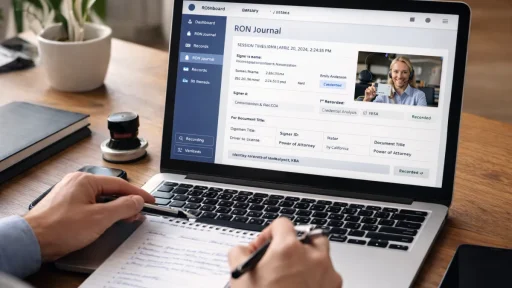
Getting a lease notarized no longer means scheduling an in-person appointment and coordinating calendars between landlord, tenant, and notary. Remote online notarization (RON) is now legal in more than 40 states and lets all parties complete the process over a secure video call.
Through BlueNotary, the process works in three steps:
- Upload your signed lease agreement: Submit the document to the platform securely.
- Verify your identity: Complete a quick ID check and knowledge-based authentication.
- Meet with a commissioned notary online: The notary witnesses your signature live over video and applies a legally valid digital notary seal.
The entire process typically takes under 15 minutes. You get a fully notarized lease without leaving your home or waiting for anyone’s schedule to open up.
Make Sure Your Lease Holds Up
A lease agreement contract is only as strong as the terms it contains and the way it is executed. Get the required elements right, understand your state’s signing and notarization rules, and make sure every party signs before keys or deposits change hands.
If your lease needs notarization, or if you want that added layer of legal protection even when it is not required, BlueNotary lets you complete the process online in minutes. No scheduling delays, no in-person coordination. Just a legally notarized lease, done.
Frequently Asked Questions
Is a lease agreement a legally binding contract?
Yes. A lease agreement is a legally binding contract as long as it meets the standard requirements: both parties must agree to the same terms, exchange something of value, have legal capacity to enter a contract, and the lease must cover a lawful subject matter. Once all parties sign, the document is enforceable.
What is the difference between a lease and a rental agreement?
A lease agreement locks in terms for a fixed period, typically 6 to 12 months. Neither party can change the rent or exit early without penalty during that time. A rental agreement runs month-to-month and renews automatically each month until either party gives proper notice to end it. Leases offer stability; rental agreements offer flexibility.
What happens if a lease agreement is not notarized when required?
The consequence depends on your state. In Washington State, a residential lease longer than one year that lacks proper notarization is treated as a month-to-month tenancy rather than being voided entirely. In other situations, an unnotarized lease that was legally required to be notarized may be unenforceable as written. Check your state’s rules before assuming notarization is optional.
Can I notarize a lease agreement online?
Yes. Remote online notarization (RON) is legal in more than 40 states and allows all parties to have a lease notarized over a secure video call with a commissioned notary. BlueNotary provides online notarization for lease agreements with no in-person appointment required.
How long is a standard lease agreement?
Most residential lease agreements run for 12 months. Shorter fixed terms of 3 or 6 months are available, as are longer terms of 24 months or more. Month-to-month leases have no fixed end date and continue until one party gives proper notice, which is typically 30 days in most states.
What should I do if my landlord refuses to sign the lease?
Do not move in or pay a security deposit until the lease is fully signed by all parties. An unsigned lease is not a binding contract. If a landlord is unwilling to put the agreed terms in writing and sign them, treat that as a significant red flag. Without signatures, you have no documented agreement and no legal protection if a dispute arises.
Can a lease agreement be changed after signing?
Yes, but only with the written consent of all parties. A change to a signed lease is documented through an addendum or amendment, and both the landlord and tenant must sign it for the change to be enforceable. A landlord cannot raise rent or alter conditions unilaterally during a fixed-term lease.
Does a commercial lease agreement need to be notarized?
It depends on the state and the specific circumstances. Washington State removed the notarization requirement for commercial leases in 2024, though it still applies if the lease is being recorded with the county. Requirements vary in other states. Commercial landlords and tenants frequently notarize their leases voluntarily because the terms are longer, the stakes are higher, and disputes are more costly to litigate without a strong paper trail.