


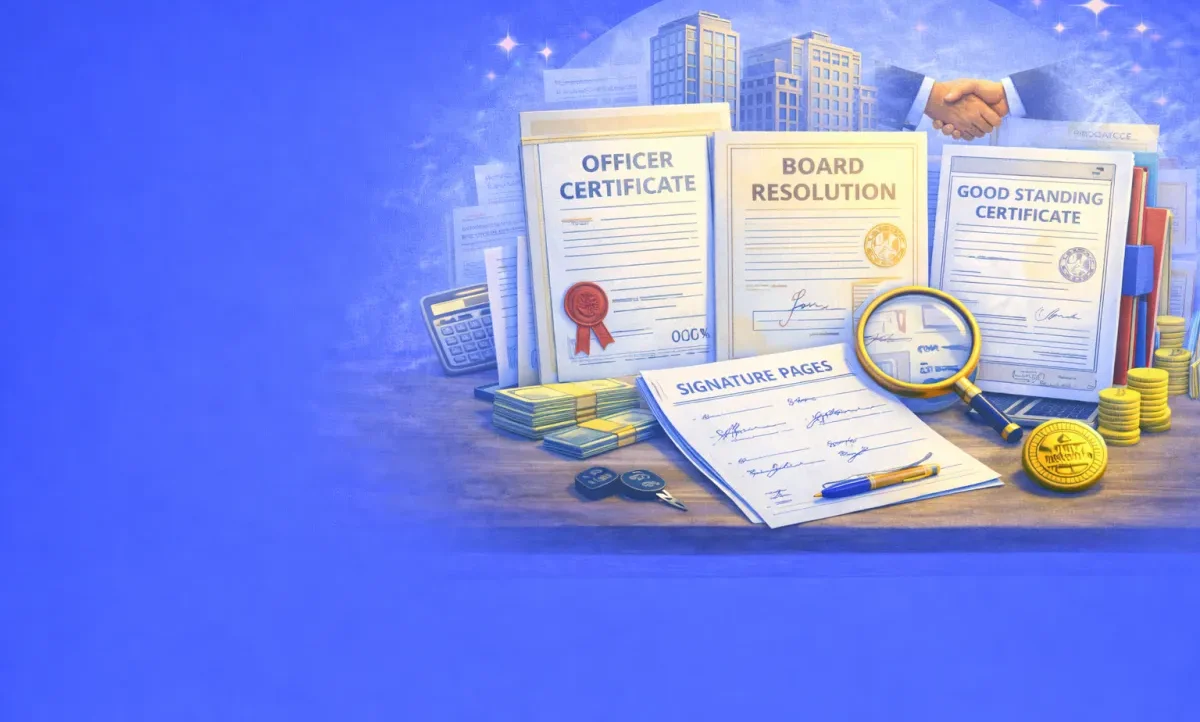

Mergers and acquisitions demand meticulous documentation. Every closing condition, every representation brought down to closing, every certification of authority must be precisely executed. Within this documentary framework, notarization serves a critical but often underappreciated function: establishing the authenticity of signatures, verifying the authority of signatories, and creating a reliable evidentiary record that survives the transaction itself.
For enterprise transactions—particularly those involving multiple entities, multiple jurisdictions, or cross-border elements—understanding when notarization is required, when it’s advisable even if not strictly required, and how to coordinate notarization across complex deal structures can mean the difference between a smooth closing and a last-minute scramble that delays funding and frustrates all parties.
This guide examines the key M&A documents where notarization plays a role, the strategic considerations for when to require notarized documents, and practical approaches to managing notarization across multi-entity, multi-jurisdictional transactions.
The Role of Notarization in M&A Documentation
Why Notarization Matters in Transactions
M&A transactions create binding obligations worth millions or billions of dollars. The parties need confidence that the individuals signing documents have authority to bind their respective entities and that signatures are genuine. Notarization provides several forms of assurance:
Identity verification: The notary confirms that the person signing is who they claim to be, typically through government-issued identification. This prevents fraud and establishes a clear record of who executed the document.
Acknowledgment of voluntary execution: The notary confirms that the signer appeared willingly and understood they were executing the document. This deters claims that signatures were forged or obtained under duress.
Evidentiary record: Notarized documents carry presumptive validity in legal proceedings. The notary’s seal and certificate create a record that can be verified if the authenticity of a document is later challenged.
International recognition: For cross-border transactions, notarization (often combined with apostille or consular legalization) enables documents to be recognized in foreign jurisdictions.
When Notarization Is Required vs. Advisable
Not all M&A documents require notarization under U.S. law. In fact, most private deal documents—including the acquisition agreement itself—typically do not require notarization to be enforceable. However, notarization may be:
Legally required for specific document types, such as documents affecting real property interests (deeds, mortgages, assignments of leases), certain powers of attorney, and documents to be filed with government agencies that mandate notarization.
Contractually required when the acquisition agreement or ancillary documents specify notarized certificates as closing conditions.
Advisable for evidentiary purposes when documents may need to be used in future legal proceedings, when signatories are difficult to locate post-closing, or when enhanced authentication provides additional comfort to parties.
Required for international use when documents will be used in foreign jurisdictions that require notarization followed by apostille or consular legalization.
Officer’s Certificates
Purpose and Function
An officer’s certificate is a closing document in which an authorized officer of a company certifies to the truth of certain matters as of the closing date. In M&A transactions, officer’s certificates typically serve to:
Bring down representations and warranties: The officer certifies that the representations and warranties made in the acquisition agreement remain true and correct as of closing, qualified to whatever standard the agreement specifies (e.g., “in all material respects” or subject to no “Material Adverse Effect”).
Confirm covenant compliance: The officer certifies that the company has performed all obligations required to be performed by it under the agreement prior to closing.
Satisfy closing conditions: The acquisition agreement typically makes delivery of the officer’s certificate a condition to the other party’s obligation to close.
Although typically two to four pages, the officer’s certificate often determines whether a buyer can refuse to close, whether lenders must fund, and what position each side takes if the deal is later contested.
Notarization Considerations
Under U.S. law, officer’s certificates in private M&A transactions rarely require notarization. The certificate’s legal effect comes from its status as a representation made in connection with the acquisition agreement, not from notarization.
However, notarization may be appropriate when:
Cross-border elements exist: Some foreign jurisdictions require notarization and apostille for closing documents to be recognized. If an officer’s certificate will be presented to foreign courts, regulators, or registries, notarization may be necessary.
Financing documentation requires it: Lender officer certificates delivered to financing sources may have specific notarization requirements, particularly for cross-border lending.
Enhanced evidentiary record is desired: In complex or contentious transactions, notarization creates an additional layer of authentication that may be valuable if disputes arise post-closing.
Execution Best Practices
Boards should authorize officers to sign closing certificates in their approving resolutions. The resolution should specifically identify which officers are authorized to execute closing documents, including officer’s certificates.
Typical signers are CEOs or CFOs—officers with appropriate knowledge and authority regarding the company’s representations, warranties, and covenant compliance. Secretary’s certificates (discussed below) should identify authorized officers and include specimen signatures for cross-reference.
Secretary’s Certificates
Purpose and Function
A secretary’s certificate (sometimes called a secretary’s closing certificate or corporate secretary certificate) serves a different function than the officer’s certificate. While the officer’s certificate addresses representations, warranties, and covenants, the secretary’s certificate verifies:
Organizational documents: The certificate attests that attached copies of the company’s certificate of incorporation, bylaws, or operating agreement are true, correct, and complete.
Board resolutions: The certificate confirms that attached resolutions authorizing the transaction were duly adopted and remain in full force and effect.
Officer incumbency: The certificate identifies the officers authorized to execute transaction documents and confirms their authority.
Good standing: The certificate often attaches certificates of good standing from the company’s state of formation and states where it is qualified to do business.
In essence, the secretary’s certificate provides a “corporate DNA test” proving the company is exactly who it says it is and that the individuals signing transaction documents have legitimate authority to bind the company.
Standard Contents
A comprehensive secretary’s certificate typically includes:
Certification of organizational documents: Statement that attached exhibits represent true and complete copies of the certificate of incorporation (including all amendments), bylaws or operating agreement, and any shareholder or member agreements relevant to the transaction.
Certification of resolutions: Statement that attached board (and if required, stockholder or member) resolutions authorizing the transaction were duly adopted in accordance with applicable law and the company’s organizational documents, have not been rescinded or modified, and remain in full force and effect.
Incumbency certification: A table listing the names, titles, and specimen signatures of all officers authorized to execute transaction documents on behalf of the company.
Good standing attachment: Certificates of good standing from the Secretary of State of the company’s state of formation and each state where the company is qualified to do business.
Secretary’s signature: The secretary (or assistant secretary or other authorized officer) signs the certificate, often with a second officer signing to confirm the secretary’s own incumbency.
Notarization Practices
Secretary’s certificates may be notarized to add an additional layer of authentication, though this is not universally required under U.S. law. Notarization is more common when:
Counterparties request it: Banks, lenders, and sophisticated buyers may require notarized secretary’s certificates as a condition to closing.
Cross-border transactions: Foreign jurisdictions may require notarization (and apostille) for secretary’s certificates to be recognized.
Corporate formalities are heightened: In transactions involving regulated entities, government contracts, or other contexts where formality matters, notarization demonstrates attention to corporate governance.
When notarization is required, the secretary signs in the presence of a notary who verifies the secretary’s identity and completes the notarial certificate.
Certificates of Incumbency
Purpose and Function
A certificate of incumbency (sometimes combined with the secretary’s certificate) specifically certifies the identity and authority of officers and directors authorized to act on behalf of the company. It’s routinely required by banks for opening accounts or obtaining loans, by investors in financing transactions, and by counterparties to significant contracts who need to verify that individuals signing on behalf of the corporation have legitimate authority.
In M&A transactions, certificates of incumbency are essential closing documents to verify corporate authority of signatories and confirm officer status for executing transaction documents.
Standard Contents
A certificate of incumbency typically includes:
Identification of officers and directors: Names, titles, and positions of current officers and directors.
Signature specimens: Sample signatures of each listed officer, allowing recipients to verify signatures on transaction documents.
Authority statement: Confirmation that listed individuals have authority to execute documents binding the company.
Supporting documentation: Exhibits may include bylaws or operating agreement provisions establishing officer authority, and board resolutions granting specific transaction authority.
Notarization Practices
Certificates of incumbency are frequently notarized to ensure authenticity and credibility, particularly when:
Financial institutions require it: Banks universally require certificates of incumbency to verify that corporate officers executing loan documents have proper authority to bind the borrowing entity.
Third parties will rely on the certificate: When the certificate will be presented to government agencies, courts, or other third parties, notarization adds credibility.
International use is anticipated: Foreign jurisdictions frequently require notarized incumbency certificates, sometimes with apostille.
When notarized, the corporate secretary or authorized officer signs the certificate before a notary who verifies identity and completes the notarial acknowledgment.
Good Standing Certificates
Purpose and Function
A certificate of good standing (also called a certificate of status, certificate of existence, or certificate of compliance depending on the state) is an official document issued by a state’s Secretary of State or equivalent office confirming that a business entity:
- Is properly registered with the state
- Has filed required annual reports
- Has paid required fees and taxes (in some states)
- Is authorized to conduct business in the state
In M&A due diligence, good standing certificates confirm that the target company exists, is active, and has maintained compliance with state registration requirements. Buyers, lenders, and investors universally request these certificates to verify the target’s legal status before engaging in major transactions.
What Good Standing Does and Does Not Confirm
It’s important to understand the limitations of good standing certificates:
What they confirm:
- The entity is registered with the state and exists in state records
- Entity has filed required reports with the Secretary of State
- Entity has paid fees required by the Secretary of State (and in some states, franchise taxes)
What they don’t confirm:
- Full compliance with all federal, state, and local tax obligations
- Compliance with industry-specific licensing requirements
- Compliance with employment, environmental, or other regulatory requirements
- The accuracy of information in filed documents
Some states, like Delaware and Tennessee, include certain tax information on Secretary of State certificates. In states like Illinois, the Department of Revenue can flag entities in Secretary of State records that are delinquent on taxes. But in states like New York and California, the Secretary of State certificate attests only to the entity’s existence—the company may still be delinquent on franchise taxes.
Timing and Validity
Good standing certificates do not have formal expiration dates, but they reflect status only as of the date issued. For M&A closings:
Freshness requirements: Most parties require certificates dated within 30 days of closing, though some require 60 or 90 days. The acquisition agreement should specify the required date range.
Bring-down considerations: Because status can change quickly, some transactions require a “bring-down” telephone or electronic verification from the Secretary of State’s office as close to closing as possible.
Multiple jurisdictions: Companies must obtain good standing certificates from their state of formation and each state where they are qualified to do business (foreign qualifications).
Obtaining Good Standing Certificates
Certificates can be obtained directly from the relevant Secretary of State office or through compliance service providers. Processing times and fees vary by state:
Online availability: Many states, including California and Colorado, offer instant online certificates of status.
Expedited processing: Most states offer expedited processing for additional fees. New York, for example, offers 24-hour processing for $25, same-day for $75, or two-hour processing for $150.
Service providers: Companies like CT Corporation, CSC, and InCorp handle certificate requests and can coordinate multi-state orders efficiently.
For M&A closings involving multiple entities across multiple states, coordinating good standing certificates early in the closing process prevents last-minute delays.
Board Resolutions
Purpose and Function
Board resolutions document the formal approval of corporate actions by the board of directors. In M&A transactions, board resolutions typically authorize:
- Approval of the transaction itself (merger, asset purchase, stock purchase)
- Execution of the acquisition agreement and ancillary documents
- Designation of officers authorized to execute documents and take actions to consummate the transaction
- Any amendments to organizational documents required by the transaction
- Related matters such as employment agreements, benefit plan amendments, or financing arrangements
For significant transactions, stockholder or member approval may also be required, documented through written consents or meeting minutes.
Documentation Requirements
Board resolutions should:
Identify the transaction specifically: Reference the acquisition agreement by name and date, the parties, and the basic transaction structure.
Authorize specific documents: List each agreement and document the board is approving, or use broader language authorizing “any and all documents necessary or appropriate to consummate the transaction.”
Designate authorized signers: Identify by name and title the officers authorized to execute transaction documents on behalf of the company.
Confirm proper adoption: Include recitals confirming that the meeting was properly called and a quorum was present, or (for written consents) that the requisite percentage of directors consented.
Notarization and Certification
Board resolutions themselves are typically not notarized. However, the secretary’s certificate that certifies the resolutions’ authenticity may be notarized.
When resolutions are attached as exhibits to a secretary’s certificate, the secretary certifies that:
- The attached resolutions are true and complete copies
- They were duly adopted in accordance with applicable law and the company’s organizational documents
- Have not been rescinded, amended, or modified
- They remain in full force and effect
This certification, rather than notarization of the resolutions themselves, provides authentication.
Signature Pages and Execution
Execution Fundamentals
Proper execution of M&A documents requires attention to several elements:
Authority: Only individuals with actual authority to bind the company should sign. Authority typically derives from board resolutions, organizational documents, or specific powers of attorney.
Signature blocks: Signature blocks should clearly identify the signing entity, the individual’s name, and their title. Format example:
ABC CORPORATION

By: ___________________________
    Jane Doe, Chief Executive Officer
Counterparts: Most acquisition agreements permit execution in counterparts, allowing each party to sign separate copies that together constitute a single agreement.
Dates: Signature pages should be dated, though the effective date of the agreement may differ from execution dates if documents are signed in escrow.
When Signature Pages Require Notarization
Notarization of signature pages is not required for most M&A agreements under U.S. law. However, notarization may be required or advisable for:
Documents affecting real property: Deeds, mortgages, assignments of leases, and similar documents typically require notarized signatures for recording.
Powers of attorney: Powers of attorney used in connection with the transaction often require notarization.
Documents for international use: If the acquisition agreement or ancillary documents will be used in foreign jurisdictions, notarization may be required for recognition.
Specific contract requirements: The agreement itself may require notarized signature pages as a condition to closing.
Coordinating Multi-Party Signatures
Complex transactions may require signatures from:
- Multiple entities (buyer, seller, target subsidiaries, guarantors)
- Multiple individuals (officers of each entity, stockholders, key employees)
- Parties in different locations (different states or countries)
- Representatives acting under power of attorney
Coordinating these signatures requires careful planning:
Signature packages: Prepare complete signature packages for each signer, including all documents requiring their signature and clear instructions.
Execution tracking: Use a closing checklist to track which documents have been signed, by whom, and when.
Pre-signing: For complex closings, parties may pre-sign documents to be held in escrow pending satisfaction of all closing conditions.
Remote execution: Remote online notarization enables signers in different locations to execute notarized documents without physical presence.
Managing Multi-Entity Transactions
Subsidiary and Affiliate Documentation
Many M&A transactions involve multiple related entities:
Target subsidiaries: If the buyer is acquiring a parent company, all material subsidiaries may need to deliver closing certificates, good standing certificates, and other documentation.
Seller affiliates: Affiliates providing services, licenses, or other support to the target may need to execute transition agreements or releases.
Buyer affiliates: Buyer subsidiaries may serve as the actual acquiring entity, requiring their own authorization documentation.
Guarantors: Parent companies or affiliates providing guarantees must execute guaranty agreements with proper authorization.
For each entity involved in the transaction, the closing checklist should identify:
- The Required organizational documents and certificates
- Required board or member authorizations
- Required officer’s and secretary’s certificates
- Any documents requiring that entity’s signature
- Notarization requirements for each document
Coordinating Across Entities
Multi-entity transactions require coordination to ensure:
Consistent authorization: Each entity’s resolutions should use consistent language and properly reference the transaction documents.
Consistent signatories: The same individual may be an officer of multiple entities. Ensure signature blocks correctly identify which entity they’re signing on behalf of in each instance.
Consistent timing: Good standing certificates, bring-down certificates, and other time-sensitive documents should be dated consistently and within required time frames.
Complete documentation: Each entity’s documentation package should be complete before closing. Missing documents from a single subsidiary can delay the entire transaction.
Cross-Border and Multi-Jurisdictional Considerations
Apostille Requirements
For documents to be used in countries that are parties to the Hague Apostille Convention, an apostille may be required:
What an apostille does: An apostille is a certificate issued by a designated authority (typically the Secretary of State in the U.S.) that authenticates the signature, seal, and capacity of the official who signed or notarized the document.
When apostilles are needed: When notarized documents, corporate certificates, or government-issued documents will be presented to authorities in a Hague Convention country.
What apostilles don’t do: Apostilles authenticate the notary’s signature and commission—not the content of the underlying document.
Process: The document must first be properly notarized by a notary commissioned in the state where the apostille will be issued. The notarized document is then submitted to the Secretary of State for apostille.
Non-Hague Convention Countries
For countries that are not parties to the Hague Convention, a more involved authentication and legalization process is required:
Authentication: The document is notarized, then certified by the county clerk (in some states), then authenticated by the Secretary of State, then authenticated by the U.S. Department of State.
Legalization: After U.S. authentication, the document must be legalized by the embassy or consulate of the destination country.
Timeline: This process can take weeks or months depending on embassy workload and requirements.
RON for International Documents
Remote online notarization can facilitate cross-border M&A documentation:
Geographic flexibility: Signers located in different countries can complete notarization without traveling to a physical notary location.
Apostille compatibility: Documents notarized through RON can typically receive apostilles, provided the RON complies with state law requirements.
Platform considerations: For cross-border transactions, select a RON platform like BlueNotary with experience handling international documents and understanding of apostille requirements.
Destination country acceptance: Before using RON for documents to be used abroad, verify that the destination country will accept electronically notarized documents.
Practical Considerations for M&A Closings
Pre-Closing Preparation
Effective notarization coordination begins well before closing:
Identify notarization requirements early: Review the acquisition agreement and closing checklist to identify all documents requiring notarization.
Determine signer locations: Identify where each signer will be located at closing. Plan for in-person or remote notarization accordingly.
Order good standing certificates early: Good standing certificates take time to obtain, especially from multiple states. Begin the ordering process as soon as the closing date is reasonably certain.
Prepare secretary’s certificates in advance: Draft secretary’s certificates early, leaving dates and specific closing references to be filled in at closing.
Coordinate with notary resources: Whether using in-person notaries, mobile notary services, or RON platforms, arrange for notarization services in advance.
Closing Day Execution
On closing day, notarization coordination requires:
Document control: Maintain clear control over which documents have been signed, notarized, and delivered.
Timing coordination: For simultaneous closings, coordinate notarization timing across parties and locations.
Verification: Before releasing closing documents, verify that all notarizations are properly completed with correct dates, signatures, and seals.
Copies: Obtain sufficient copies of notarized documents for all parties and for post-closing filings.
Post-Closing Considerations
After closing, notarized documents may need:
Recording: Real property documents must be recorded in the appropriate county recording offices.
Filing: Certain documents may need to be filed with state agencies or regulatory bodies.
Apostille: Documents needed for international use must be submitted for apostille or authentication.
Retention: Maintain all due diligence materials, including notarized documents, for at least seven years. These may be needed to support indemnification claims, defend against seller disputes, or respond to regulatory inquiries.
Frequently Asked Questions
Which M&A documents typically require notarization?
Under U.S. law, most M&A agreement documents—including the acquisition agreement itself—do not require notarization. Documents that commonly require notarization include real property documents (deeds, mortgages, assignments), powers of attorney, and documents to be used internationally. Secretary’s certificates and incumbency certificates are frequently notarized for enhanced authentication, even when not legally required.
Do officer’s certificates need to be notarized?
Officer’s certificates in domestic private M&A transactions rarely require notarization under U.S. law. However, notarization may be appropriate for cross-border transactions where foreign jurisdictions require it, when financing documentation has specific notarization requirements, or when enhanced evidentiary records are desired.
How current must good standing certificates be for closing?
Most acquisition agreements require good standing certificates dated within 30 days of closing, though some specify 60 or 90 days. The specific requirement should be stated in the closing conditions. Because status can change quickly, some parties also require telephone or electronic verification as close to closing as possible.
Can remote online notarization be used for M&A closing documents?
Yes, RON can be used for M&A closing documents in most states with permanent RON authorization (approximately 47 states plus DC as of early 2026). RON is particularly valuable for coordinating signers in multiple locations. Verify that RON-executed documents are acceptable for any required filings, recordings, or international use.
What’s the difference between apostille and authentication/legalization?
An apostille is a simplified certification for documents to be used in countries that are parties to the Hague Apostille Convention. For non-Hague countries, the longer authentication and legalization process is required, involving certification by the Secretary of State, authentication by the U.S. Department of State, and legalization by the destination country’s embassy or consulate.
Who typically signs officer’s and secretary’s certificates?
Officer’s certificates are typically signed by CEOs or CFOs—officers with knowledge of the company’s representations, warranties, and covenant compliance. Secretary’s certificates are signed by the corporate secretary or assistant secretary, often with a second officer signing to confirm the secretary’s own incumbency.
How do you coordinate notarization across multiple entities in a transaction?
Create a detailed closing checklist identifying all documents requiring notarization for each entity. Prepare signature packages for each signer with clear instructions. Coordinate notarization resources (in-person notaries, mobile services, or RON platforms) in advance. Track execution status for each entity to ensure complete documentation before closing.
What should be included in a secretary’s certificate for an M&A closing?
A comprehensive secretary’s certificate includes certification of organizational documents (certificate of incorporation, bylaws), certification of board resolutions authorizing the transaction, an incumbency table with officer names, titles, and specimen signatures, attached good standing certificates, and the secretary’s signature (often with a second officer confirming the secretary’s incumbency).