



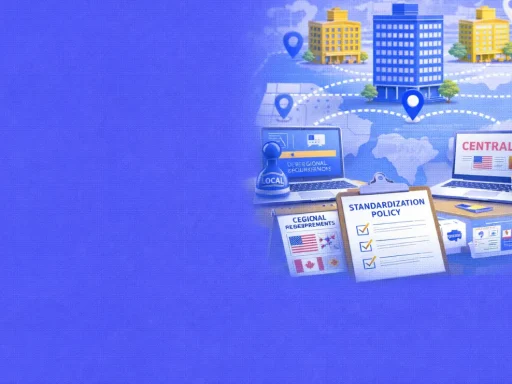


Your company has 12 offices across seven states. Each office handles its own notarizations. The Houston office uses a mobile notary service. The Chicago branch sends employees to a UPS store. Miami keeps a commissioned notary on staff. Denver uses a RON platform. And the New York office – nobody is quite sure what New York does.
The CFO asks a simple question: “How much did we spend on notarization last year?” Nobody can answer. There is no central tracking. No standard process. No way to know whether the Denver office’s RON platform meets the same compliance standards as the Miami office’s in-house notary. And when the Houston mobile notary botched a power of attorney last quarter, nobody in Denver learned from it.
This is the default state for most multi-location businesses. Notarization happens locally, without coordination, without standardization, and without visibility.
Why Multi-Location Strategy Matters
A single office can manage notarization casually. A dozen offices cannot. As locations multiply, so do the problems: inconsistent processes, duplicated costs, compliance gaps that hide in local workflows, and zero organizational learning between sites.
This guide covers how to choose between centralized and local notarization models, how to standardize processes across offices in different states, which regional requirements create the most friction, how to build a unified platform strategy, and how to measure performance across your entire operation.
Centralized vs. Local: Choosing Your Model
The first strategic decision is where notarization authority lives. Each model carries tradeoffs.
The Centralized Model
A centralized model routes all notarization through a single team, platform, or vendor. One office or department manages the RON platform account. Trained specialists handle every session. Documents flow in from all locations and return completed.
The strengths are obvious. One team means one process, one compliance standard, and one vendor relationship. Training concentrates in a small group that builds deep expertise. Audit trails live in a single system. Volume consolidation earns better pricing from vendors.
The weaknesses emerge with scale. A centralized team in Eastern time serves a West Coast office poorly after 2 PM. Time zone mismatches delay closings. Local offices lose control over scheduling. And if the central team is overwhelmed during peak periods, every location feels the bottleneck.
Centralization works best for companies with moderate notarization volume (under 500 per month total), offices in three or fewer time zones, and document types that do not require local knowledge (corporate resolutions, vendor agreements, HR documents).
The Local Model
A local model lets each office handle its own notarizations. Each location maintains its own notary — either an in-house commissioned employee or a local mobile notary relationship. The office controls scheduling, vendor selection, and process design.
Local models offer speed and flexibility. The office handles notarization on its own timeline. Staff can respond to urgent requests without routing through a central queue. Local notaries understand regional requirements firsthand.
The weaknesses compound across locations. Each office may use a different vendor, a different process, and a different compliance standard. Cost tracking requires collecting data from every site. Training is inconsistent. Audit trails scatter across multiple systems. And when one office discovers a better process, the insight rarely travels to the others.
Local models work best for companies with high urgency (same-day or same-hour notarization needs), offices spread across many time zones, and transaction types that require local expertise (real estate closings with county-specific requirements).
The Hybrid Model
Most multi-location businesses land here. A hybrid model centralizes the platform, the vendor relationship, and the compliance standards — but distributes execution to local teams.
Every office uses the same RON platform. Each closer follows the same process. Every session feeds the same audit trail. But each office schedules and runs its own sessions using locally trained staff. The central team sets standards, negotiates the vendor contract, monitors compliance, and reports on performance. Local teams execute.
This model captures the consistency of centralization with the speed of local execution. It requires more upfront design than either pure model. But for companies operating across multiple states with varying volumes per location, it produces the best balance of control and flexibility.
Standardizing Processes Across Locations
A platform alone does not create consistency. People follow processes. Without a standard operating procedure that every location follows, the same platform produces different outcomes at every office.
Build a Notarization Playbook
Create a single document that covers every step. It should define which document types require notarization and which do not. Should specify the approved platform and how to access it. It should walk through the session workflow from document upload to completed package retrieval. It should list the identity verification steps the closer must follow. And it should explain what to do when something goes wrong — a failed KBA, a dropped connection, or a signer who does not appear.
Distribute the playbook to every office. Train every closer on its contents. Update it when processes change. A playbook that exists but is not followed is worse than no playbook — it creates a false sense of standardization.
Standardize Document Templates
Each office should use the same document templates for common notarization needs. Corporate resolutions, powers of attorney, affidavits, and vendor agreements should all follow a single template with proper signature placement, notarial certificate positioning, and state-specific language.
Without standard templates, the Houston office produces documents with the signature block at the bottom of the last page (no room for the notary seal). The Chicago office uses a template with California acknowledgment language for an Illinois notarization. The Denver office builds templates correctly but never shares them.
Create a central template library. Store it where every office can access it. Lock editing permissions so local offices cannot modify templates without approval. Update the library when state requirements change.
Assign a Notarization Coordinator
Designate one person or small team to own notarization across the organization. This coordinator maintains the playbook and template library, manages the vendor relationship and platform configuration, monitors compliance across all locations, tracks volume and cost data, and distributes lessons learned when one office encounters a problem.
Without a coordinator, standardization erodes within months. Local offices drift back to their own habits. The playbook collects dust. Templates diverge. And the organization loses the visibility that a unified strategy is supposed to provide.
Navigating Regional Requirement Differences
Multi-location businesses face a challenge that single-office companies avoid: notarization laws differ by state. A process that works perfectly in Texas may fail in New York.
RON Authorization by State
As of 2025, 44 states plus the District of Columbia have permanent RON laws. The remaining states are in various stages of legislation. California has enacted RON legislation but will not implement it until 2030. Connecticut allows RON but excludes real estate transactions.
For a multi-location business, this means your RON strategy may not cover every office. An office in a state without full RON authorization needs a fallback — in-person notarization, mobile notary services, or IPEN (in-person electronic notarization). Map each office to its state’s RON status before designing your workflow.
Notary Physical Location Requirements
Some states require the RON notary to be physically located within the state during the session. Florida is one example. Others allow the notary to perform RON from any location as long as they hold the state’s commission.
This matters for centralized models. If your central notary team sits in Virginia but handles sessions for Florida signers, the team must include notaries commissioned in Florida who are physically located in Florida during those sessions. A Virginia notary cannot perform a RON session under Florida’s RON laws while sitting in Virginia — unless the session is conducted under Virginia’s laws, which have their own requirements.
Clarify the physical location rules for every state where you operate. Assign notaries accordingly.
Witness and Oath Requirements
States differ on whether RON sessions require witnesses, how many, and whether witnesses can appear remotely. Some states require witnesses for specific document types — wills, real estate deeds, or powers of attorney — but not for others.
Build a state-specific reference table that your closers consult before every session. The table should list each state’s witness requirements by document type. Update it quarterly as laws change. A closer in your Denver office handling a session for a signer in North Carolina needs to know North Carolina’s witness rules — not Colorado’s.
Recording Retention Periods
Recording retention ranges from 5 to 10 years by state. Florida mandates 10 years. Texas requires 5 years. Michigan requires 10 years after the last journal entry. Your organization must meet the longest retention period that applies to any session your team performs.
For a multi-location business operating across states with different retention rules, the simplest approach is defaulting to 10-year retention for all recordings. The marginal cost of extra storage is negligible compared to the risk of a missing recording during an examination.
What No Other Guide Covers: The Compliance Inheritance Problem
Every multi-location guide says “follow each state’s requirements.” None of them address the specific problem that creates the most compliance risk for distributed organizations: compliance inheritance.
How the Problem Develops
Your Denver office runs RON sessions under Colorado law. Your Houston office runs sessions under Texas law. Each office follows its own state’s rules correctly.
Then your Denver closer handles a session for a signer located in Texas. The closer applies Colorado’s requirements. The session completes without issues. Six months later, a Texas regulator reviews the transaction. The recording does not include the verbal identity confirmation protocol that Texas requires. The journal entry does not follow Texas formatting. The session met Colorado’s standards — but it was a Texas transaction.
The closer did nothing wrong by Colorado standards. But the transaction inherited Texas compliance obligations through the signer’s location and the document’s purpose. Your Denver office had no awareness that Texas rules applied.
How Compliance Inheritance Works
When a RON notary in State A performs a session for a signer in State B involving a document governed by State B’s laws, the transaction may need to satisfy requirements from both states. The notary follows their commissioning state’s RON procedures. But the document’s receiving institution — a county recorder, a title company, a bank — may apply the destination state’s standards when reviewing it.
A document that meets Virginia RON requirements may face rejection at a Florida county recorder’s office if it lacks Florida-specific elements. A New York bank may refuse to honor a notarization that does not meet New York’s internal review standards, even if the notarization was legally valid under the notary’s commissioning state.
How to Manage Compliance Inheritance
Build a cross-state compliance matrix. For every combination of notary state and signer state that your business handles, document the requirements from both sides. Identify where they conflict or where the destination state adds requirements beyond the notary’s home state.
Train your closers on this matrix. When a Denver closer handles a session for a Texas signer, the closer should know to apply both Colorado RON procedures and Texas recording standards. The platform should route the session to a notary whose commissioning state aligns with the transaction — or flag the cross-state combination for compliance review.
Run quarterly audits on cross-state transactions. Pull 10 to 15 sessions per quarter where the notary state differs from the signer state. Review each one against both states’ requirements. Fix gaps before a regulator finds them.
Building a Unified Platform Strategy
A single platform across all locations creates the consistency that multi-location businesses need. Choosing and deploying that platform requires planning.
Platform Selection for Multi-Location Use
Evaluate RON platforms against multi-location criteria specifically. The platform should support multiple user accounts with role-based permissions (closers, administrators, compliance reviewers). It should offer a centralized dashboard that shows activity across all locations. It should handle state-specific compliance automatically — applying the right rules for each session based on notary and signer location. And it should generate reports that break down volume, cost, and error rates by office.
Platforms built for single-office use often lack these features. A platform with no multi-user dashboard forces your coordinator to log into each office’s account separately. A platform with no state-specific automation puts compliance decisions on closers who may not know the rules.
Volume-Based Pricing Across Locations
Consolidating all locations onto one platform unlocks volume pricing. Instead of 12 offices each paying consumer rates, your organization negotiates one enterprise agreement based on total monthly volume.
Track each office’s volume before negotiation. Some offices may contribute 200 sessions per month while others contribute 10. The combined volume determines your pricing tier. Make sure your contract counts sessions from all locations toward a single volume threshold — not separate thresholds per office.
Rollout Sequencing
Do not deploy to all 12 offices at once. Start with two or three locations that have the highest volume, the most engaged closers, and the fewest state-specific complications. Let these pilot offices work through the integration, training, and process issues before expanding.
Use the pilot offices to refine your playbook, templates, and training materials. Their real-world experience makes the rollout smoother for every subsequent office. A lesson learned in Houston during week two saves Denver from the same mistake during week six.
Measuring Performance Across Locations
What gets measured gets managed. A multi-location notarization strategy needs metrics that compare performance across offices and reveal problems before they escalate.
Key Metrics to Track
Monitor these metrics monthly for each location: session volume (total notarizations per office), average session time (minutes from session start to completion), error rate (percentage of sessions requiring rework or correction), signer satisfaction (feedback scores or complaint counts), compliance adherence (percentage of sessions meeting all state requirements on first pass), and cost per session (total notarization spend divided by session count).
Compare each office against the organizational average. An office with double the error rate needs attention. An office with half the average session time may have best practices worth sharing.
Monthly Reporting
Publish a monthly notarization performance report. Distribute it to every office manager and the executive team. Highlight top-performing locations. Flag offices that fall below thresholds on key metrics. Include a section on lessons learned — process improvements, compliance updates, and solutions to problems that one office solved for everyone.
Regular reporting creates accountability. Offices that see their metrics alongside peers naturally push toward improvement.
Frequently Asked Questions
Should we use a centralized or local notarization model?
Most multi-location businesses benefit from a hybrid model. Centralize the platform, vendor relationship, compliance standards, and reporting. Distribute execution to local teams who schedule and run their own sessions. This captures consistency without sacrificing speed.
How do we handle offices in states without RON laws?
Provide a fallback for those offices — in-person notarization with a local mobile notary service or IPEN where available. Map each office to its state’s current RON status and plan accordingly. Monitor pending legislation so you can activate RON as new states authorize it.
What is compliance inheritance?
It occurs when a RON session conducted by a notary in one state must satisfy requirements from another state — typically the signer’s state or the state where the document will be used. Build a cross-state compliance matrix and train closers on which additional requirements apply for each state combination.
How do we standardize processes without slowing down local teams?
Create a notarization playbook with clear, step-by-step instructions. Build standard document templates. Deploy a single platform across all locations. Then let local teams execute within that framework at their own pace. Standardization sets the floor, not the ceiling.
Can we negotiate volume pricing across all locations?
Yes. Consolidate all locations onto one platform and negotiate a single enterprise agreement based on total organizational volume. Make sure the contract counts sessions from every office toward one volume threshold. Combined volume earns better per-session rates than each office negotiating separately.
How do we track notarization costs across the organization?
Use a single platform with centralized reporting. Track cost per session by office, including platform fees, notary fees, and any mobile notary expenses. Publish monthly reports that break down spending by location. Without centralized tracking, the CFO’s question — “How much did we spend?” — remains unanswerable.
How often should we audit cross-state transactions?
Quarterly. Pull 10 to 15 sessions per quarter where the notary’s state differs from the signer’s state. Review each session against both states’ requirements. Flag gaps and fix root causes before the next quarter’s audit.
What platform features matter most for multi-location use?
Multi-user accounts with role-based permissions, a centralized dashboard showing all-location activity, automatic state-specific compliance, per-location reporting, and volume-based pricing that aggregates across offices. Platforms lacking these features create the same fragmentation you are trying to eliminate.
Conclusion:
A business with one office can improvise its notarization process. A business with twelve cannot. Without a deliberate strategy, each office creates its own approach. Costs scatter. Compliance gaps hide. Lessons die in the office where they were learned.
The fix is not complicated. Choose a model — centralized, local, or hybrid. Pick one platform and deploy it everywhere. Write a playbook. Standardize templates. Assign a coordinator. Track metrics by location. Audit cross-state transactions quarterly. And build a compliance matrix that accounts for the requirements your closers inherit when they serve signers in other states.
The organizations that notarize across 12 offices without surprises are not the ones with the biggest budgets. They are the ones that built a system — and then made every office follow it.
For multi-location businesses building a unified notarization strategy, BlueNotary provides a RON platform with centralized management, multi-user dashboards, and the compliance automation to support distributed operations across states.