






So, you’re ready to start a notary business. It’s a fantastic venture, but it’s more than just getting a stamp and waiting for calls. Think of it as a four-stage process: getting your legal ducks in a row, setting up the actual business, getting your operations down pat, and finally, getting out there and finding clients.
This journey takes you from securing your state commission all the way to marketing your services to the right people.
Your Notary Business Startup Roadmap
From day one, you have a major decision to make. Are you going to be a traditional, on-the-go notary, or will you build a modern, tech-focused online business? This single choice will ripple through everything else you do—your business plan, how you market yourself, and even your long-term growth potential.
The two main paths are quite different, but they aren’t mutually exclusive. Let’s break down what each one looks like so you can figure out where you fit.
Choosing Your Service Model
First up is the classic Mobile Notary model. This is all about convenience and personal touch. You’re the one traveling to clients—at their homes, offices, coffee shops, you name it—to perform notarizations in person. This is perfect if you enjoy face-to-face interaction and want to build a reputation within your local community. You’ll need reliable transportation, a flexible schedule, and some good old-fashioned networking skills.
On the other hand, you have the Remote Online Notary (RON) model. This is where you leverage technology to serve clients from anywhere. As a RON, you use secure audio-video platforms to perform notarizations. This path is a great fit for the tech-savvy entrepreneur who wants to break free from geographical limits and attract a broader market, especially high-volume B2B clients like law firms and title companies that value speed and efficiency.
This flowchart maps out the two main routes you can take, highlighting the critical decisions at each stage.
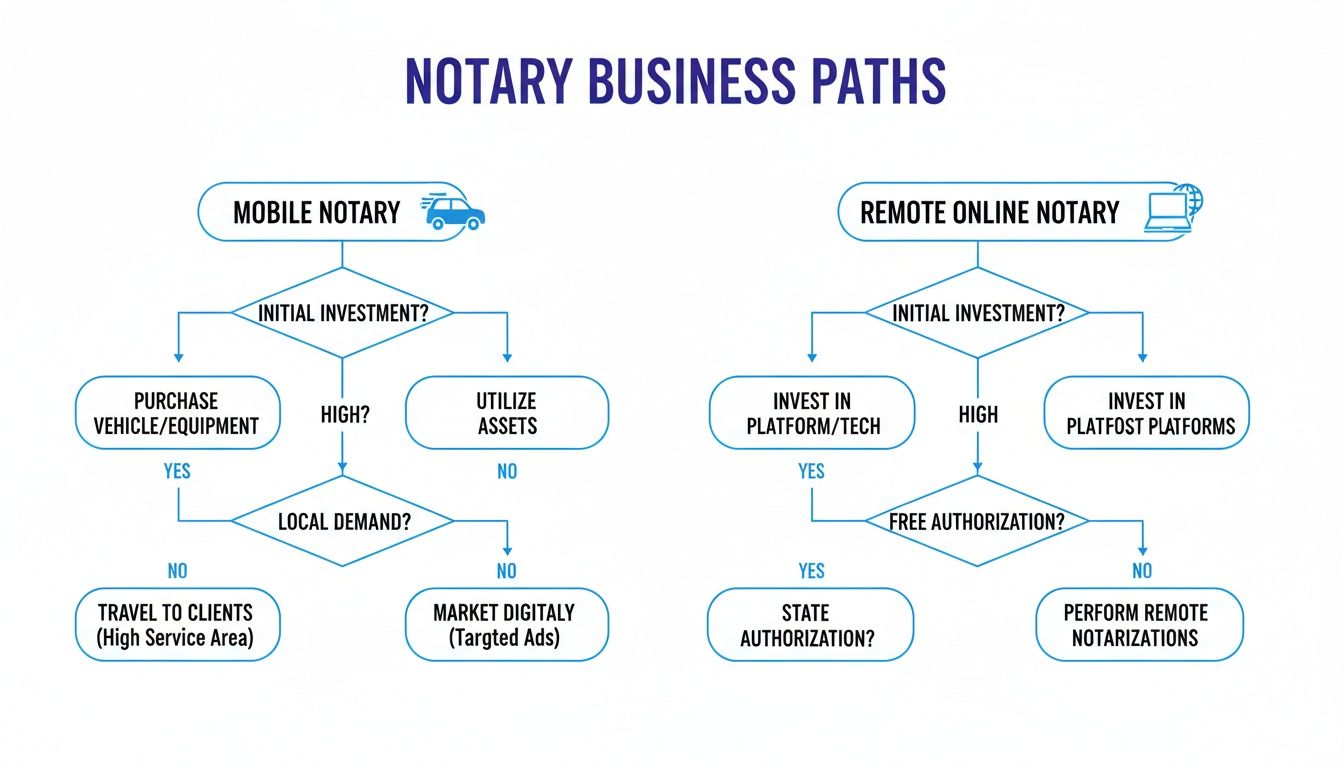
As you can see, your choice between mobile and remote services really shapes your initial investment, your potential market reach, and the kind of clients you’ll end up working with.
A Quick-Start Checklist for Aspiring Notaries
To get you started, here’s a checklist that summarizes the essential first steps for launching your notary business. Think of these as the non-negotiable groundwork you need to lay before you can start serving clients.
| Phase | Action Item | Key Consideration |
|---|---|---|
| Foundation | Verify State Requirements | Each state’s rules are different. Check your Secretary of State’s website for training, background checks, and application specifics. |
| Structure | Establish a Business Entity | Decide between a Sole Proprietorship or an LLC. An LLC is often recommended for liability protection. |
| Compliance | Secure Commission & Supplies | Pass your exam (if required), get commissioned, and then purchase your official notary seal and a journal. |
| Operations | Choose Your Service Model | Decide if you’ll be a Mobile Notary, a RON, or both. This impacts your tech needs and marketing strategy. |
Completing these foundational steps correctly from the beginning will save you a world of headaches down the road. It’s all about building a solid, compliant base for your future success.
That first phase is all about building a solid foundation. If you rush through the legal and administrative stuff, you’re just creating problems for your future self. Taking the time to really understand your state’s laws and set up your business properly is the smartest first investment you can make.
Getting Your Commission and Setting Up a Legit Business
Before you can even think about marketing or making money, you have to get the legal stuff right. This isn’t just paperwork; it’s the foundation of your entire business. Getting your notary commission and putting the right legal protections in place is the absolute first step. Everything else you do will be built on this.
Your journey begins with your state’s commissioning process. I can’t stress this enough: every state plays by a different set of rules. Your first move should be to head straight to your Secretary of State’s official website. That’s where you’ll find the real-deal info on applications, required training, background checks, and any exams you need to pass.

Nail Down Your State’s Specific Requirements
Some states, like California and New York, have pretty tough training and exam requirements. Others have a much more straightforward application process. You have to follow your state’s protocol precisely. Don’t listen to generic advice online—what gets you commissioned in Ohio will not work in Florida.
For instance, one state might require a six-hour course and a proctored exam, while another just needs a simple form and a check. The time this takes can vary wildly, too. For a better sense of what to expect, check out our guide on how long it takes to become a notary public.
Why You Absolutely Need a Bond and Insurance
Once you’ve met the state’s requirements, you’ll run into two critical financial tools: a surety bond and Errors & Omissions (E&O) insurance. People often mix them up, but they do completely different jobs.
- Surety Bond: This is a financial safety net for the public, not for you. Most states require you to buy a bond (usually for $5,000 to $25,000) to get your commission. If you make an error that costs a client money, the bond company pays them. But here’s the kicker: you have to pay the bond company back. It protects your clients from your mistakes.
- E&O Insurance: This policy is for you. If a client sues you over an alleged mistake, E&O insurance helps cover your legal fees, settlements, or judgments. It’s what protects your business and personal savings from a simple, honest error.
Think of it this way: The surety bond is like a security deposit you give the state to protect the public. E&O insurance is your personal liability shield, protecting your own bank account when things go sideways. Having both isn’t optional for a serious notary.
Adding Remote Online Notarization to Your Services
If you’re aiming to build a modern, scalable business, offering Remote Online Notarization (RON) is a no-brainer. But becoming a RON isn’t as simple as firing up a video call; it’s a separate authorization that builds on your traditional commission.
Most states that have approved RON have a specific checklist you’ll need to follow:
- You must already hold an active, traditional notary commission.
- You’ll likely need to complete extra training focused on RON technology and laws.
- You have to choose an approved RON platform, like BlueNotary, that meets your state’s security and record-keeping rules.
- Finally, you’ll submit a separate application or notice to your state, declaring your intent to perform RON and naming your chosen tech provider.
The demand for RON is exploding. Since 2019, more than 40 states have passed laws allowing it, making the U.S. the biggest market for these services, especially for things like mortgage closings. North America is set to dominate the e-notary market for the next decade, so getting authorized now is a smart strategic move.
As you grow, you might also look into different legal structures that provide more protection. It can be useful to learn about specialized business entities, and a good place to start is by understanding professional corporations in Canada, which offers a good overview of the concept.
Building Your Business Operations
Getting your notary commission is your ticket to the game, but a real business structure is what lets you win. Think of it this way: without a solid operational and financial framework, you’re just a freelancer with a stamp, and you’re leaving yourself open to a ton of legal risk. This is where you build the professional engine that will drive your notary business forward.
The first big decision on your plate is choosing a legal structure. This isn’t just paperwork—it directly affects how you’re taxed and, more importantly, your personal liability. Most notaries starting out land on one of two paths.
Choosing Your Legal Business Structure
A Sole Proprietorship is the path of least resistance. It’s fast, cheap, and simple to set up because you and your business are legally one and the same. But that simplicity is a double-edged sword. There’s no legal wall between your business and personal assets. If your business ever gets sued, your personal savings, your car, and even your house could be on the line.
That’s exactly why so many notaries form a Limited Liability Company (LLC). An LLC creates a legal barrier—a “corporate veil”—between your business and your personal life. If something goes wrong and a lawsuit happens, it’s the business’s assets at risk, not your personal finances. Yes, it takes a bit more paperwork and a few more fees to get an LLC going, but that protection is priceless. If you’re on the fence, we have a guide that breaks down exactly how to create an LLC and what it means for you.
By establishing an LLC, you’re not just setting up a business; you’re building a financial firewall. It’s a foundational step that separates your professional risks from your personal life, giving you peace of mind as you grow.
Getting Your Financial House in Order
Once you’ve picked your business entity, your very next move should be separating your money. Mixing personal and business funds is a classic rookie mistake. It’s a nightmare for accounting and can even destroy the liability protection your LLC is supposed to provide.
Here’s how to start clean and stay organized from day one:
- Open a Dedicated Business Bank Account: This is non-negotiable. Every dollar a client pays you goes into this account. Every business expense—supplies, insurance, marketing—comes out of it. This keeps your records squeaky clean for tax time.
- Pick an Accounting System: You don’t need to go overboard. Simple software like QuickBooks Self-Employed works great, but even a well-managed spreadsheet can do the trick early on. The goal is just to have a clear, real-time view of your income and expenses.
- Know Your Tax Obligations: When you’re the boss, you’re on the hook for self-employment taxes (that’s Social Security and Medicare) plus your regular income taxes. A smart habit is to immediately stash 25-30% of every payment into a separate savings account just for taxes. Trust me, you’ll thank yourself later when there’s no surprise tax bill.
Crafting a Smart Pricing Strategy
Your pricing is what will make or break your profitability. The state-mandated fees for the actual notarial act are often quite low. Your real money is made in the service fees you charge around that act—things like travel, printing, or the tech fee for a Remote Online Notarization (RON) session.
You’ll want to structure your pricing for different kinds of jobs. For instance:
- General Notary Work: For a simple one-document signing, you’d charge the state-allowed fee plus a mobile service fee that accounts for your travel time and distance.
- Loan Signing Packages: This is a huge income stream. As a Notary Signing Agent (NSA), you’re not just stamping one document; you’re guiding a borrower through an entire loan package. For that expertise and responsibility, you can charge a flat fee—often $100 to $250 per signing.
- Remote Online Notarization (RON): For virtual sessions, you can charge your state’s maximum per notarial act, plus a technology fee for facilitating the signing on a secure platform.
Don’t be afraid to offer service bundles. A law firm handling estate planning might love a package deal for notarizing a will, power of attorney, and healthcare directive all in one sitting. This gives your client great value and boosts your revenue per appointment—a win-win that makes your business smarter and more profitable.
Building Your Modern Notary Tech Stack
In today’s service world, technology is the ultimate advantage. For a notary business, your tech stack isn’t just about convenience; it’s the engine that powers your efficiency, expands your reach, and lets you offer more valuable services. A smart setup automates the tedious stuff, so you can focus on what actually makes you money: serving clients quickly and professionally.
This isn’t about chasing every new gadget. It’s about building a seamless system that handles everything from the first client call to the final, secure document storage.
Core Tools for Day-to-Day Operations
Before we get into the specialized notary platforms, let’s talk about the foundational software every service business needs. These tools are your virtual assistants, handling the administrative grind so you can perform more notarizations and build your client list.
A few key pieces of software can completely transform your workflow:
- Appointment Scheduling: Stop the endless email chains. Tools like Calendly or Acuity Scheduling let clients see your real-time availability and book a slot instantly. It looks professional and drastically cuts down on no-shows.
- Client Management & Invoicing: To run a real business, you need to track your money. Simple accounting software like QuickBooks or FreshBooks is perfect for managing income, logging expenses, and sending out polished invoices. This financial discipline is non-negotiable from day one.
- A Professional Online Presence: Your website is your digital storefront. Creating a polished site is a critical part of your tech stack, and you don’t need to be a coder to do it. You can explore the best AI website builders for your business to get a great-looking site up and running in no time.
Selecting Your Remote Online Notarization Platform
For any notary serious about growth, the most critical decision is choosing a Remote Online Notarization (RON) platform. This is the heart of your digital operation, especially if you want to land those lucrative B2B clients in real estate, finance, or law.
The right platform is so much more than a video chat tool—it’s your all-in-one security and compliance system.
Choosing your RON platform is like a contractor choosing their power tools. The right one makes complex jobs faster, safer, and more reliable. The wrong one creates constant headaches and puts your work—and your commission—at risk.
The demand for these services is exploding. One analysis projects the online notary software market will skyrocket from roughly $262 million in 2025 to over $655 million by 2035. That’s a clear signal of sustained demand for digital solutions. You can review the full market report to see the data for yourself.
Must-Have Features in a RON System
Not all platforms are built the same. As you evaluate your options, you’re looking for a solution that weaves several key security and compliance features into a single, straightforward workflow. These are the non-negotiables that protect you, your clients, and the integrity of every document you notarize.
I’ve learned that a solid RON platform is essential for a modern practice. Here’s a breakdown of the critical features you should be looking for.
Essential Features of a RON Platform
| Feature | Why It’s Critical | How BlueNotary Excels |
|---|---|---|
| Multi-Factor ID Verification | State laws require you to verify a signer’s identity with absolute certainty. This two-step process—analyzing a government ID and using Knowledge-Based Authentication (KBA)—is your first line of defense against fraud. | BlueNotary integrates both IDV and KBA seamlessly into the session startup, making it fast for the client and fully compliant for you. |
| Secure E-Signing & Tamper-Evident Seals | The platform must apply a secure digital signature and your notary seal. More importantly, the final document must be “tamper-evident,” meaning any change made after the fact instantly invalidates the seal. | Documents are sealed with a digital certificate that provides cryptographic proof of their integrity, giving all parties complete confidence. |
| Compliant Audio-Video Recording | Most states mandate that the entire RON session is recorded and securely stored, often for 5-10 years. This is your proof that the notarization was conducted properly. | BlueNotary handles the recording and secure, long-term cloud storage automatically, so you don’t have to worry about managing massive video files or meeting state retention laws. |
| A Detailed Audit Trail | This is your black box recorder. A comprehensive log captures every single action—from the moment the signer logs in to when the final document is downloaded. It’s your ultimate legal protection. | The platform generates an unchangeable, time-stamped log of every event. This audit trail is attached to the final document, creating an indisputable record of the transaction. |
Platforms like BlueNotary are designed from the ground up to handle these complex technical and compliance hurdles in one integrated process. When the tech just works, you can focus on providing a fantastic client experience, which is the cornerstone of any successful Remote Online Notarization business model.
Landing Your First High-Value Clients
So, you have your commission, your tech is ready to go, and you’re officially in business. That’s fantastic, but a commission and a laptop don’t pay the bills. The real work starts now: getting clients in the door.
To truly build a scalable business, you have to shift your mindset from chasing one-off signings to building a pipeline of high-volume, repeat business. This is how you move from a side hustle to a serious enterprise.

Let’s walk through how to build that client base, starting with your local community and then moving into the more lucrative B2B world.
Win Your Neighborhood First: Master Local Search
Your first clients will almost certainly come from your immediate area. These general notary jobs might seem small, but they’re your bread and butter when you’re starting out. They build your confidence, get cash flowing, and, most importantly, generate those all-important five-star reviews.
The single best tool for this is your Google Business Profile (GBP). It’s free, and it’s how people find a “notary near me.” A neglected profile is invisible; a well-tended one is a client-generating machine.
Here’s how to make your GBP pop:
- Fill Out Everything. Seriously, every single field. Hours, service area, phone number, website link—the works. Use crisp, professional photos of you (not just your logo).
- Become a Review Magnet. After every signing, make it a habit to politely ask for a review. Positive reviews are the lifeblood of a local service business and the #1 factor in showing up at the top of Google Maps.
- Speak Google’s Language. Weave keywords naturally into your business description. Think like a customer. What would they search for? “Mobile notary in [Your Town],” “notary public [Your County],” “remote online notary,” etc.
Your GBP should be paired with a simple, professional website. It doesn’t need to be fancy. A clean one-page site is often enough to show you’re a legitimate professional and give potential clients a place to see your rates and services.
Level Up: Target High-Volume B2B Partners
The real money and stability in the notary business lie in B2B relationships. Why? Because certain industries need documents notarized constantly, and they hate having to find someone new every time. Your goal is to become their go-to, on-call expert.
These clients aren’t just searching Google. You have to go find them. The top-tier B2B targets are:
- Title Companies & Mortgage Lenders: This is the heart of the loan signing world. They handle a steady stream of real estate closings and refinances, which are complex, high-paying assignments.
- Law Firms: Think estate planning, real estate, and family law attorneys. Wills, trusts, deeds, and powers of attorney all need a notary’s seal, making law firms a goldmine for repeat work.
- Healthcare Facilities: Hospitals, nursing homes, and assisted living centers frequently need notaries for patients signing powers of attorney or advanced healthcare directives.
Shifting your focus from chasing individual signings to building B2B relationships is the single most important pivot you can make. One title company can provide more consistent income than a hundred individual clients.
How to Get Your Foot in the Door
Once you know who you want to work with, how do you actually connect? Hint: it’s not by sending a hundred generic emails into the void. This is about professional networking and proving you can make their lives easier.
Your pitch isn’t just about your stamp. It’s about being the solution to their problems. They crave reliability, professionalism, and efficiency. That’s your value proposition.
Here’s a simple game plan that works:
- Do Your Homework. Identify a handful of local title companies or law firms. Go on LinkedIn or their website and find the name of the person who likely hires notaries—an escrow officer, paralegal, or office manager.
- Make a Personal Connection. In a post-COVID world, an old-school in-person drop-in with business cards can really stand out. If that’s not your style, a concise, well-crafted email or a personalized LinkedIn connection request is the next best thing.
- Showcase Your Strengths. Don’t just say you’re a notary. Mention your $100,000 E&O policy. Note that you’re a certified Notary Signing Agent. Emphasize that you are RON-capable. This last point is a huge differentiator—it tells them you’re tech-savvy and can handle anything they throw at you, no matter where their client is.
An initial email can be straightforward. Introduce yourself, list your key qualifications (NNA certified, RON-enabled), and explain that you specialize in providing both mobile and remote notarizations for their specific industry.
The key is persistence without being a pest. Follow up every few weeks to stay on their radar. Building these relationships takes time, but the payoff is a predictable, high-value stream of work that will become the backbone of your business.
Shifting from Side Hustle to Scalable Business
Alright, you’ve got the basics down. You’re handling signings, your commission is active, and the business is running. But how do you get beyond the one-off appointments and build something with real, long-term potential? It’s all about a mindset shift—thinking less like a notary and more like a CEO.
The goal is to stop trading time for money on a signing-by-signing basis and start building a predictable, profitable business engine. This is where you move from being just a generalist to a sought-after specialist. While taking every call that comes in pays the bills early on, the real money and growth lie in carving out a niche.

Find Your High-Value Niche
Instead of casting a wide net, it’s time to get strategic. Focusing on a specific, high-value sector makes your marketing laser-focused and positions you as the expert people seek out. You become the go-to pro for that exact type of work.
Here are a few of the most lucrative areas to consider:
- Real Estate Closings: This is the bread and butter for many high-earning notaries. Becoming a certified Notary Signing Agent (NSA) opens the door to working with lenders and title companies who pay a premium—often $100 to $250 per signing—for someone who can navigate a loan package without errors.
- Estate Planning: Lawyers who specialize in wills, trusts, and powers of attorney need reliable, detail-oriented notaries on speed dial. This work builds strong, recurring relationships with law firms that can feed you consistent business.
- Trust Delivery: This is a step above a simple notarization. As a Trust Delivery Agent, you’re responsible for overseeing the signing of an entire estate plan. It’s a high-responsibility role that commands a much higher fee.
Specialization is your escape route from the commodity trap. When you’re the local expert in loan signings or trust deliveries, you stop competing on price. You start competing on expertise, and that’s something clients will always pay more for.
Getting a Grip on Your Revenue and Profitability
To scale, you absolutely must know your numbers inside and out. This isn’t just about revenue; it’s about understanding the profitability of every service you offer.
A quick mobile signing for one document might seem like easy money because the overhead is low. But a complex loan signing, while taking more time and expertise, brings in a significantly higher fee. Your pricing needs to reflect this reality.
The most successful notary businesses blend different income streams. For instance, you might offer online notarizations for the general public at a transactional rate of $25 to $125 per session. At the same time, you could be servicing high-volume B2B clients, like title companies, on a hybrid model. This often involves a mix of per-signing fees plus a monthly subscription for platform access, locking in valuable, long-term partnerships. Digging into e-notary market pricing reports can give you a better sense of industry standards.
Expanding Your Operations: From Solo to Agency
Eventually, you’ll hit a ceiling on what you can personally handle. When you’ve maxed out your own calendar, the next logical step is to build an agency by bringing other commissioned notaries under your brand.
Yes, this adds new layers of complexity—scheduling, payroll, and quality control become your responsibility. But it’s the only way to achieve truly uncapped growth.
Building a multi-notary agency allows you to:
- Cover a larger geographic area with notaries strategically placed in different towns or counties.
- Say “yes” to more assignments, especially from high-volume clients who need broad coverage.
- Offer more specialized services by recruiting notaries who bring different skills to the table, like specific certifications or fluency in other languages.
Making that leap from a solo operator to a business owner is the final, critical piece of the puzzle. By zeroing in on high-margin niches, managing your finances with a sharp eye, and eventually building a team, you can transform your notary practice into a thriving, sustainable company.
Frequently Asked Questions
Diving into the notary world brings up a lot of questions, especially when you’re just getting your bearings. Here are some of the most common things people ask when they’re starting out.
What’s the Real Startup Cost?
Getting off the ground isn’t free, but it’s more accessible than many other businesses. You can generally expect to spend between $200 and $500 for the absolute must-haves, though this figure really depends on your state.
So, what does that money cover?
- State Fees: This is for your application and any required exams.
- Mandatory Training: The price for state-approved courses varies.
- Bond & Insurance: You’ll almost certainly need a surety bond, and Errors & Omissions (E&O) insurance is a smart move you shouldn’t skip.
- Basic Gear: We’re talking about your official notary seal (the stamp) and a journal to log all your acts.
Keep in mind, this initial budget doesn’t factor in things like setting up an LLC or the tech you’ll need if you plan to offer Remote Online Notarization (RON).
How Much Can I Actually Make?
This is the big question, and the answer is: it depends entirely on how you run your business. If you stick to general mobile notary work, you might pull in $30-$75 an appointment.
The real money is in specialization. Once you become a certified Notary Signing Agent (NSA) handling loan and real estate documents, those appointments can be worth $100-$250 each. The most successful notaries I know build strong relationships with B2B clients like law firms, lenders, and title companies—that’s where you find consistent, high-volume work.
Don’t think of your income in terms of state-set stamp fees. Your real value comes from the complete, convenient service you provide. Solve bigger problems for clients who need you often, and your bank account will show it.
Is It Hard to Learn Remote Online Notarization?
The thought of doing everything online can seem intimidating, but it’s easier than you think. Modern RON platforms are built to be intuitive. If you can handle a Zoom call and navigate a website, you have the core skills needed for a remote notarization.
The best systems, like BlueNotary, walk both you and the signer through the whole process—from verifying their ID to placing the final digital seal. The main challenge isn’t mastering the software; it’s navigating your state’s specific training and authorization requirements to get the green light to perform RONs in the first place.
Ready to build a modern, tech-forward practice? With BlueNotary, you get an all-in-one platform for secure Remote Online Notarization, e-signing, and identity verification, designed to help you serve high-value clients and grow your business. Get started on BlueNotary.