




When you’re dealing with paperwork, it’s not always obvious which documents need an official notary stamp and which don’t. A good rule of thumb is this: if the document involves a major financial transaction, grants legal power to someone, or marks a significant life event, it almost certainly needs to be notarized.
Think of notarization as a powerful anti-fraud tool. A state-certified Notary Public acts as an impartial third party to verify a signer’s identity, ensuring they are who they say they are and are signing the document knowingly and willingly. This adds a critical layer of trust and legal weight to your most important agreements.
Why Some Documents Need a Notary’s Stamp
At its heart, notarization is all about preventing fraud. The Notary Public is there to confirm a signer’s identity, a crucial step for any document carrying serious legal or financial implications where the risk of forgery or coercion is high.
Consider a real estate deed. Without a notary, what’s to stop someone from forging a signature and illegally transferring a property? The notary’s seal is the official proof that the legitimate owner signed the document, protecting all parties involved. That simple act turns a signature into a secure, legally recognized commitment.
Key Reasons for Notarization
The entire process comes down to a few fundamental protections:
- Identity Verification: The notary personally checks a signer’s government-issued ID to make sure no one is faking a signature.
- Willingness and Awareness: A notary confirms that the signer isn’t being forced into the agreement and understands what they’re signing.
- Record Keeping: Every notarization is logged in the notary’s official journal, creating a reliable paper trail that can be used as evidence if a dispute ever arises.
After verifying everything, the notary completes and attaches a special statement to your document called a notarial certificate. This block of text formally records the who, what, when, and where of the signing event. We dive deeper into this in our guide on what exactly is a notarial certificate.
To give you a better idea of what to look for, we’ve broken down the most common documents that need a notary into a few key categories.
Common Documents That Require Notarization by Category
This table provides a quick reference for the types of documents that most frequently need a notary’s seal, helping you easily spot when you might need one.
| Document Category | Examples of Documents | Primary Reason for Notarization |
|---|---|---|
| Real Estate | Property Deeds, Mortgage Documents, Loan Agreements | To prevent fraud in high-value property and financial transactions. |
| Legal | Affidavits, Powers of Attorney, Sworn Statements | To ensure statements are made under oath and legal authority is granted legitimately. |
| Financial | Loan Documents, Deeds of Trust, Certain Contracts | To verify identities and formalize agreements involving significant sums of money. |
| Personal | Wills, Trusts, Adoption Papers, Travel Consent for Minors | To formalize personal wishes and legally validate important family decisions. |
While the specific laws can differ from state to state, the core principle remains the same: notarization is for documents where authenticity is absolutely essential. Thankfully, with modern solutions like Remote Online Notarization (RON), this crucial security step is easier and more convenient than ever, letting you get your documents notarized securely from virtually anywhere.
2. Real Estate and Loan Document Notarization
When you get into the big leagues of transactions—think buying a home or securing a major loan—the stakes are incredibly high. These aren’t just casual agreements; they’re life-altering commitments. That’s why notarizing real estate and loan documents isn’t just a good idea; it’s an absolute necessity.

Think of a notary’s seal as the final, authoritative stamp that locks down the deal. It’s there to protect the integrity of the whole transaction, making sure every signature is legitimate and every person involved is shielded from fraud. Without that crucial step, the entire system of property ownership and lending would be built on shaky ground.
Why Notarization is Critical for Property Transactions
Of all the documents that cross a notary’s desk, property paperwork is one of the most common and critical. A poll from the National Notary Association found that real estate documents make up over 27.5% of all notarizations in the United States. That’s a huge slice of the pie, covering everything from the initial offer to the final closing.
The legal and financial weight of these documents is immense. A notarized deed, for instance, serves as undeniable public proof that a property was transferred correctly. It confirms the seller’s identity and their willing signature, which is exactly what the county recorder’s office needs to officially log the change of ownership.
Here are the heavy hitters in real estate that always require a notary:
- Property Deeds: Whether it’s a warranty, quitclaim, or grant deed, this is the document that legally moves ownership from one party to another. It must be notarized to be recorded and made official.
- Mortgage Documents (Deed of Trust): This is the agreement where you pledge your property as collateral for a loan. Lenders demand notarization to legally protect their stake in the property if you default.
- Closing Disclosures and Agreements: All the final paperwork you sign at closing—the documents spelling out every term, cost, and condition of the mortgage—has to be notarized to seal the deal.
Notarization in real estate is a powerful fraud deterrent. By verifying the identity and intent of every signer, the notary ensures a property can’t be sold or mortgaged without the true owner’s authenticated consent.
Locking Down Financial Agreements and Loans
It’s not just about property sales. Notarization is a bedrock of the entire lending industry. Banks, credit unions, and other financial institutions count on notaries to validate signatures on all sorts of legally binding financial papers. This protects the lender from phony loan applications and protects the borrower from someone trying to steal their identity.
For a lender, a notary’s seal is irrefutable proof that a specific person knowingly agreed to the terms of a loan. That verification is vital for enforcing the contract, especially if they ever have to take legal action to collect a debt.
Common Loan Documents That Need a Notary
The need for a notary’s stamp extends across a wide range of financial agreements:
- Promissory Notes: While not always mandatory, notarizing a promissory note for a large personal or business loan adds a serious layer of legal credibility.
- Loan Modification Agreements: If you’re changing the terms of an existing loan, the new agreement often needs to be notarized to make it official.
- Refinancing Paperwork: Just like your first mortgage, refinancing involves a brand-new set of loan documents that must be properly signed and notarized.
- HELOCs (Home Equity Lines of Credit): Because a HELOC uses your home as collateral, the paperwork is treated with the same level of security as a traditional mortgage.
As the world moves faster, so do transactions. The old, paper-heavy process of closing on a property can be made so much easier and more secure. To see how technology is making this happen, take a look at how a modern eClosing process can get deals done faster and with greater confidence.
Legal Documents: Where a Notary Seal is Non-Negotiable
Outside of big-ticket transactions, the legal system itself runs on notarized documents. It’s how justice is served and personal wishes are formally recognized. For many of these papers, a notary’s seal isn’t just a good idea—it’s the critical step that makes the document legally binding and credible.
Here, the notary acts as an official witness for the court. If notarizing a deed is like a “legal handshake” for a property deal, notarizing a legal document is like making a sworn promise in front of an impartial officer of the state. The notary’s job is to confirm that statements are made truthfully and legal authority is given freely, which protects the integrity of our judicial and personal planning systems.
Affidavits and Sworn Statements
One of a notary’s most fundamental duties is handling affidavits and sworn statements. An affidavit is pretty much just written testimony. Instead of speaking in a courtroom, a person (the “affiant”) writes down the facts and swears to their truthfulness before a notary.
The process is straightforward: the notary administers an oath, watches the person sign, and then adds their official seal. That simple act turns a plain piece of paper into a powerful statement that can be used as evidence. Without that seal, it’s just a claim. With it, the document carries the full weight of sworn testimony, and lying on it can lead to perjury charges.
You’ll find affidavits and sworn statements everywhere in legal, insurance, and immigration cases. Courts and government agencies won’t even look at them without a notary’s stamp because it’s the only way to be sure of the signer’s identity and that they understood the oath they were taking. You can find more details on how affidavits are used at USNotaryCenter.com.
Granting Authority with a Power of Attorney
A Power of Attorney (POA) is another document that is completely useless without a notary’s seal. This is the legal tool that lets you pick a trusted person—your “agent” or “attorney-in-fact”—to make critical decisions for you if you ever can’t make them for yourself.
The notary’s verification is what gives a POA its legal teeth. It’s proof that you, the “principal,” signed the document willingly and with a clear mind. This simple step shuts down any future arguments about fraud or coercion.
A Power of Attorney hands over immense control. Notarization is the key safeguard that proves this transfer of power was deliberate and legitimate, protecting vulnerable people from being taken advantage of.
There are a few different types of POAs, and every single one needs a notary to become active.
- Financial Power of Attorney: This lets your agent handle your money—paying bills, managing investments, or even selling property. It’s a vital part of planning for the future.
- Medical Power of Attorney: Also called a healthcare proxy, this lets your agent make medical decisions on your behalf if you’re incapacitated. It’s how you ensure your healthcare preferences are respected by someone you trust.
- Durable Power of Attorney: The word “durable” is what makes this so important. It means the document stays valid even if you become mentally incompetent, making it an incredibly powerful estate planning tool.
- Special Power of Attorney: This one is for specific, limited tasks. For example, you might use it to let someone sign the papers to sell your car while you’re traveling abroad.
In every case, the notary’s signature and seal act as the official “on” switch. Without it, banks, hospitals, and other institutions will reject the document, leaving your affairs in chaos and your wishes ignored. The notarization ensures that when your agent needs to step in, they can act with the full backing of the law.
Personal and Family Documents: More Than Just Paperwork
Notarization isn’t just for business deals and real estate closings. It plays a critical, and often very personal, role in protecting our families and securing our wishes for the future. For these kinds of documents, a notary’s seal is more than just a rubber stamp; it provides serious legal weight and, maybe more importantly, a whole lot of peace of mind. It’s the final step that solidifies your intentions into legally binding instructions.
Let’s face it, these documents often touch on some of life’s most sensitive and emotional moments. We’re talking about everything from planning your estate to making sure your kids are taken care of if you’re not around. Notarization acts as a key safeguard, confirming that you made these crucial decisions with a sound mind and without any pressure from others, which can stop family disputes before they even start.
Wills and Trusts: Protecting Your Legacy
When it comes to estate planning, wills and trusts are the heavy hitters. While the specific laws change from state to state, getting these documents notarized is almost always a smart move. A notary is crucial for creating what’s known as a “self-proving affidavit” for a will. Think of it as a separate statement that you and your witnesses sign right there in front of the notary.
Why bother? Because when a will has this affidavit attached, the court can usually accept it as valid without the hassle of tracking down the original witnesses to testify—a task that can be incredibly difficult years down the road. This one small action can make the probate process dramatically faster and easier, saving your family a ton of stress and money during a time that’s already tough enough.
Trusts, which are used to manage your assets both while you’re alive and after you’re gone, also benefit hugely from notarization. It officially verifies the identity of the person setting up the trust (the grantor). This adds a powerful layer of security against any future arguments that the document was a fake or signed under duress.
In estate planning, a notary’s seal is more than a formality—it’s a shield. It protects the integrity of your final wishes, ensuring your legacy is distributed exactly as you intended, without complication or conflict.
Keeping Kids Safe with Notarized Consents
When children are involved, you can’t be too careful. Notarized documents offer clear, undeniable proof of a parent’s permission, which is often a strict requirement for situations involving travel or medical decisions. These forms are designed to protect not only the children but also the adults who are looking after them.
Here are a few real-world examples where notarization is a must:
- Consent for a Minor to Travel: If a child is flying internationally with just one parent, a grandparent, or another guardian, most countries and airlines demand a notarized letter of consent from the parent who isn’t traveling. It’s a critical tool to help prevent international child abduction.
- Temporary Guardianship Agreement: This notarized paper gives a trusted friend or family member the authority to care for your child for a set amount of time. It allows them to make important calls, like enrolling your child in school or activities.
- Medical Consent Forms: A notarized medical consent form gives a caregiver—like a babysitter or grandparent—the legal green light to authorize medical treatment for your child in an emergency. Without one, doctors might have to delay life-saving care while they desperately try to get ahold of a parent.
Making Other Big Life Decisions Official
Beyond wills and documents for your kids, notarization brings legal clarity to other major personal agreements. These documents often lay out the terms of relationships and finances, and a notary’s seal ensures that everyone, including the legal system, takes them seriously.
Prenuptial agreements, for instance, are commonly notarized to prove that both people signed voluntarily and knew exactly what they were agreeing to. The same goes for adoption papers, where a notary confirms the identities and willing consent of the birth parents and adoptive parents in what is one of the most significant legal acts a person can undertake. In these deeply personal situations, notarization creates a clear, official record that stands up to scrutiny and protects everyone’s rights.
The Shift to Remote Online Notarization
Let’s be honest: finding a notary, scheduling a meeting, and physically signing a document has always been a bit of a hassle. It’s a process stuck in the past. But just like technology has completely changed how we bank and shop, it’s finally catching up to this essential legal service. The modern solution is Remote Online Notarization (RON), which takes the entire notarization act and moves it into a secure, online space.
Think of RON as a highly secure, legally binding video call with a commissioned Notary Public. Instead of sitting across a desk, you connect with the notary through a specialized online platform. This is far more than a simple Zoom call; it’s a sophisticated system built from the ground up for identity proofing, secure signing, and creating a legally sound, tamper-evident record of the entire event.
How Does Remote Online Notarization Work?
The entire RON process is layered with technology that often makes it more secure than a standard in-person meeting. It weaves together multi-factor authentication, high-tech ID analysis, and secure digital seals to create a rock-solid transaction. This jump forward makes notarization faster and more accessible for everyone, no matter where they are.
The workflow is straightforward and breaks down into three key steps:
- Advanced Identity Verification: Before the notarization even starts, the signer has to pass a rigorous identity check. This usually involves answering a few questions based on your personal credit history (knowledge-based authentication or KBA) and scanning your government-issued ID, which the system analyzes for authenticity.
- Live Audio-Video Session: Next, the signer connects with a commissioned remote notary in a live, recorded video meeting. The notary visually confirms the signer’s identity and makes sure they understand what they are signing and are doing so willingly—just like they would in person.
- Digital Signing and Sealing: The signer applies their electronic signature to the document. The notary then affixes their own digital seal and electronic signature. These are cryptographically locked to the document, creating a permanent, tamper-evident audit trail.
Remote Online Notarization doesn’t just replicate the in-person experience—it enhances it. With a complete audio-visual recording and a detailed digital audit log, RON provides a level of verification and evidence that traditional methods simply cannot match.
This infographic highlights some of the key family-related documents that are perfect for handling through a remote online notarization platform.
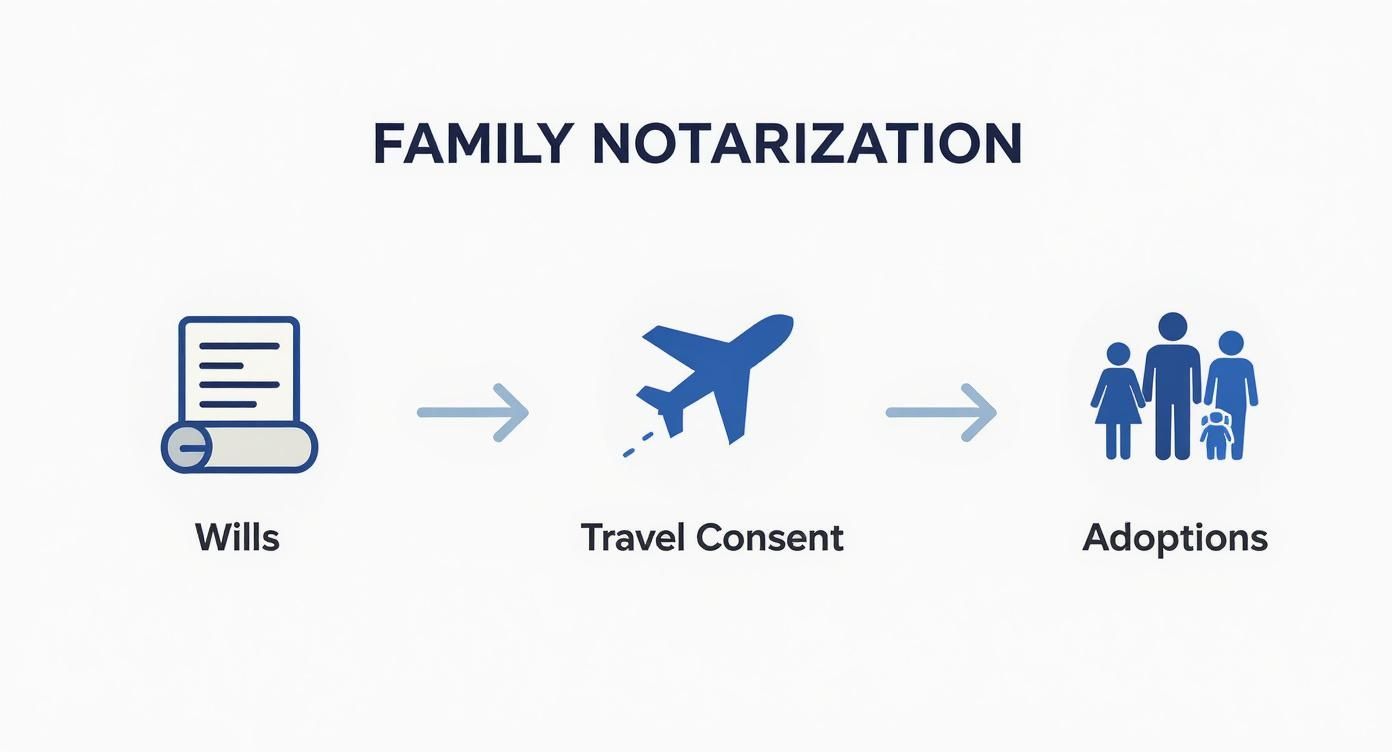
As you can see, critical life documents like wills, travel consent forms for minors, and adoption paperwork are ideal candidates for the security and simplicity of RON.
The Clear Advantages of Going Digital
The move toward RON is gaining steam for a simple reason: the benefits are huge and immediate. It solves the biggest headaches of the old paper-and-pen process—time, distance, and security. And for anyone still asking which documents require notarization, the good news is that almost any document that can be notarized in person can now be handled online.
The advantages are crystal clear:
- Unmatched Convenience: Get a document legally notarized from your home, office, or basically anywhere with an internet connection. This gets rid of travel, scheduling gymnastics, and geographical limits, which is a massive help for people with mobility challenges or for signers located in different states or even countries.
- Superior Security: RON platforms like BlueNotary use bank-grade security protocols. The combination of identity analytics, credential analysis, and a complete, unchangeable recording of the signing creates a process that is far more resistant to fraud than a quick glance at an ID in person.
- Remarkable Speed and Efficiency: The entire workflow, from uploading a document to getting back the final notarized version, can often be wrapped up in just a few minutes. That kind of speed is a true game-changer for time-sensitive deals in real estate, legal matters, and finance.
RON is now legally accepted across most of the United States, with a majority of states having passed laws to permanently authorize its use. To dig deeper into how it all works, you can check out our article on Remote Online Notarization The New Frontier. This powerful technology is well on its way to becoming the new standard for executing important documents.
How Businesses Use BlueNotary to Get Work Done Faster
Knowing which documents need a notary is one thing. Actually getting them notarized efficiently is a completely different ballgame, especially when you’re handling dozens or even hundreds of them.
Let’s be honest: the old way of doing things is a massive drag on business. You’re constantly dealing with shipping physical papers, trying to align schedules for people to meet in person, and then manually tracking everything. These bottlenecks don’t just slow things down; they can delay deals, miss legal deadlines, and frustrate everyone involved.
This is exactly why a dedicated digital platform like BlueNotary isn’t just a “nice-to-have” anymore—it’s essential. It was designed to eliminate these operational headaches by moving the entire process online, making it fast, secure, and far more organized.
A Single, Organized Hub for All Your Notarizations
One of the biggest black holes in the traditional process is simply keeping track of everything. Papers get misplaced, emails get buried, and nobody has a clear view of where a document is in the signing process. A digital platform solves this instantly.
BlueNotary gives you a central dashboard to manage it all. You can upload documents, send them out for notarization, and see the real-time status of every single one. Imagine a national mortgage lender juggling hundreds of loan packages. Instead of chaos, they have one clean interface showing what’s signed, what’s pending, and what’s complete.
The real power for a business is getting both speed and security in one package. You get an ironclad, auditable record of every single notarization, which keeps you compliant without slowing you down.
Compliance is baked right into the digital workflow. Every online notarization session is recorded, and a detailed audit trail is automatically created. This log captures everything from the moment a signer’s ID is verified to the application of the final digital seal. For anyone in finance, law, or real estate, this kind of bulletproof record-keeping is absolutely critical.
Plugging Notarization Directly into Your Workflow
To be truly efficient, notarization can’t be a siloed, manual step. It needs to plug right into the tools your team already relies on every day. That’s where API integrations come in.
Think of an API (Application Programming Interface) as a secure bridge that lets two different pieces of software talk to each other. With BlueNotary’s API, you can build remote online notarization directly into your company’s existing systems.
Here’s what that looks like in the real world:
- For a Law Firm: Imagine integrating BlueNotary with your case management software. A paralegal can launch a notarization session for an affidavit right from the client’s file. Once it’s done, the notarized document automatically saves itself back to the correct case. No downloading, no re-uploading, no confusion.
- For a Bank: A bank can embed the notarization step into its online loan portal. A customer can apply for a loan and get the final agreement notarized in a single, seamless session without ever leaving the bank’s website. It’s a massive improvement to the customer experience and radically shortens the time to close.
By connecting these systems, you eliminate mind-numbing manual work and the risk of human error. The whole process becomes faster and more accurate, freeing up your team to focus on what they do best instead of chasing signatures.
Answering Your Top Notarization Questions
Even with a solid grasp of the basics, a few common questions always pop up. Let’s tackle them head-on to clear up any lingering confusion about the notarization process.
Do I Have to Sign My Document in Front of the Notary?
Yes, this is non-negotiable. A huge part of a notary’s job is to witness you signing the document. You should never sign it beforehand.
The whole point is for the notary to see you sign—either physically or digitally—after they’ve confirmed your identity. This is how they certify that you are who you say you are and that you’re signing willingly. If you show up with a pre-signed document, you’ll have to start over with a fresh copy.
Can a Notary Actually Refuse to Notarize Something?
Absolutely. In fact, a notary must refuse if something feels wrong. This isn’t about being difficult; it’s a critical part of their role in preventing fraud.
A notary will likely turn you away if:
- You can’t provide a valid, government-issued photo ID.
- You seem confused, pressured, or not fully aware of what you’re signing.
- The document has blank spaces or looks incomplete, leaving it open to later tampering.
- The notary just has a gut feeling that something fraudulent is going on.
Their duty is to protect the integrity of the document, so they have to decline any notarization that raises red flags.
How Long Does a Notarization Last?
A notarization itself never expires. Think of the notary’s seal as a snapshot in time—it simply proves that your signature was verified on a specific date.
Key Takeaway: The notarization confirms the act of signing, but the document’s own terms decide how long it remains effective.
For instance, a temporary power of attorney or a travel consent form for a minor might only be valid for a few weeks or months. The notarization just validates the signature; the document itself dictates its own shelf life.
When you’re ready for a secure, modern, and incredibly convenient way to get your documents notarized, check out BlueNotary. Our platform connects you with certified remote online notaries in minutes, no matter where you are. Learn more and get started with BlueNotary today.