


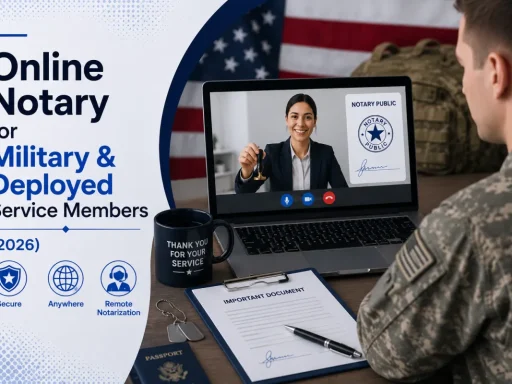
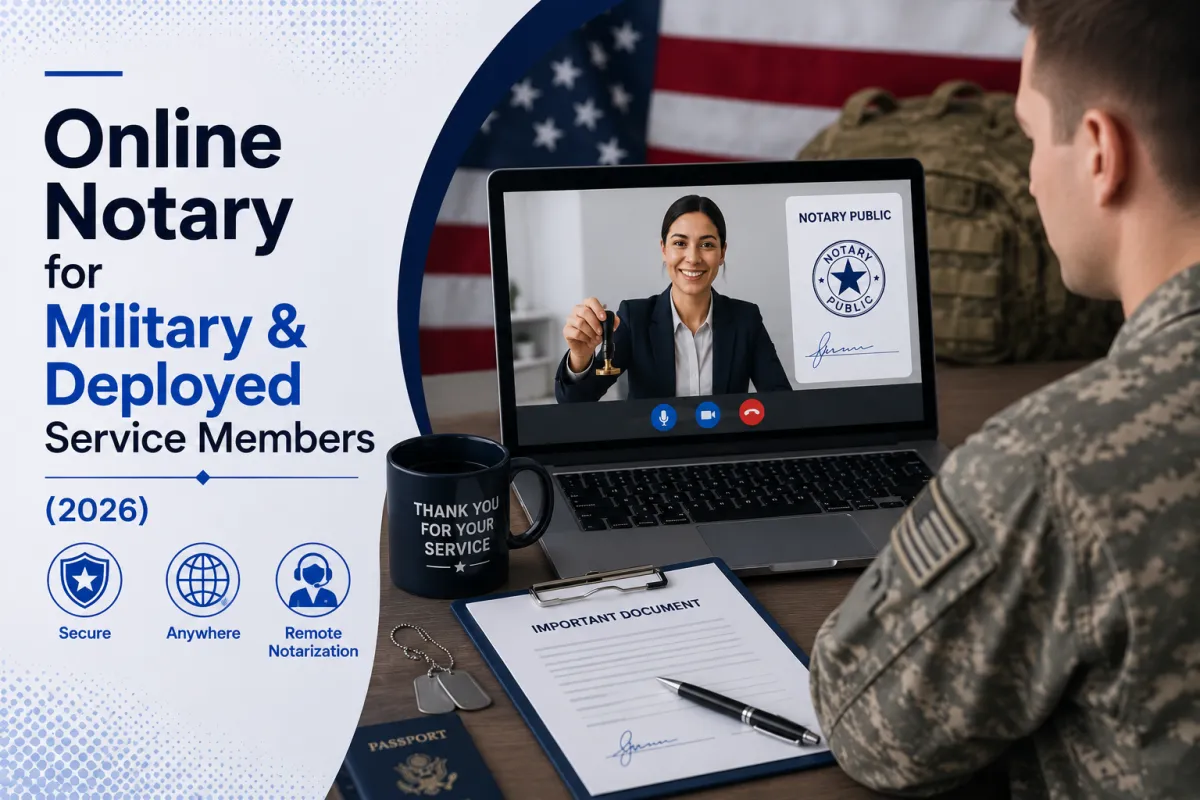

Quick answer: Military members can get documents notarized free at a base legal assistance (JAG) office under 10 U.S.C. § 1044a, valid worldwide, including overseas. When you can’t reach one, deployed remotely, after hours, or a spouse handling paperwork stateside, a commissioned online notary lets you notarize a POA, will, or affidavit over video from anywhere, 24/7.
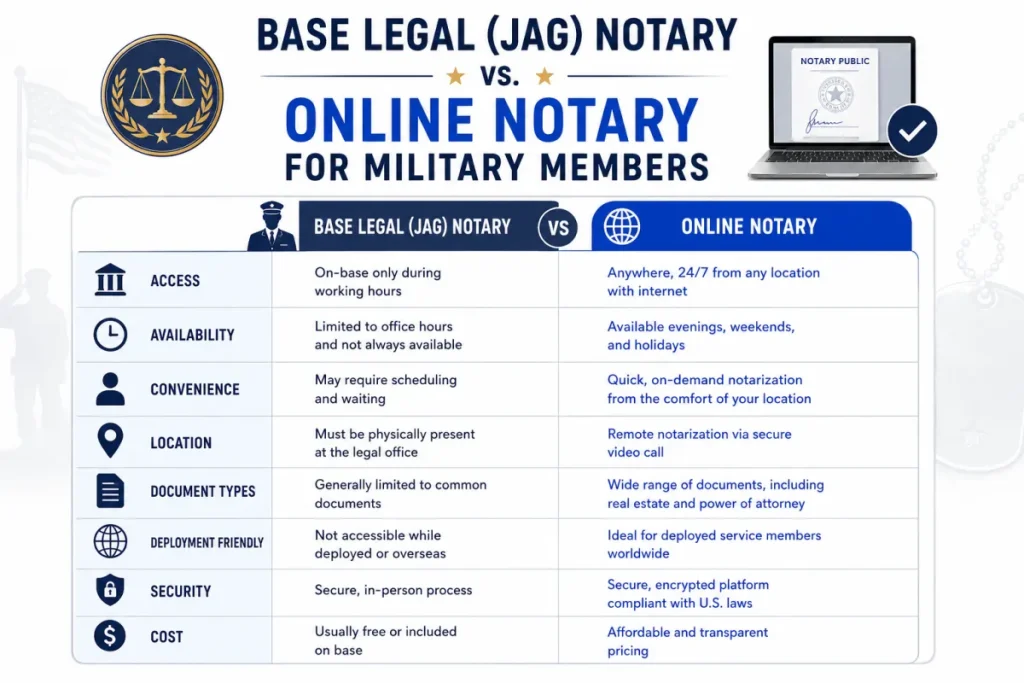
Notary options for military: free base legal vs. online
Service members actually have two solid paths to get a document notarized, and the right one depends on whether you can reach a base legal office:
| Base legal (JAG) notary | Online notary (RON) | |
|---|---|---|
| Cost | Free | Per-session fee (often ~$25) |
| Where | On base / installation | Anywhere with internet |
| Presence | In person | Live video |
| Who can use it | Members + eligible dependents | Anyone, including dependents stateside |
| Availability | Office hours, appointment | 24/7, on demand |
| Best for | When you can reach base legal | Deployed remotely, after hours, or no nearby office |
If you’re near an installation during business hours, base legal is free and ideal. The online route exists for the very common case where that isn’t possible, and it’s why an online notary is so useful for military families.
Who can notarize for military members?
Under 10 U.S.C. § 1044a, a specific group at military legal assistance offices can perform notarial acts for free, with the powers of both a notary public and a U.S. consul. That includes judge advocates, legal assistance attorneys, designated adjutants, and supervised civilian paralegals at those offices.
Two things make this authority powerful for the military community:
- It follows you worldwide, overseas postings and combat zones included, with no state commission required.
- No fee may be charged for a § 1044a notarial act.
It’s available to service members, dependents eligible for legal assistance, and people accompanying the armed forces overseas. You can read the statute itself at the Legal Information Institute’s 10 U.S.C. § 1044a, and most installations explain their hours through their Navy/branch JAG notary pages.
Common documents military members get notarized
Military life generates a predictable set of documents that often need notarization, especially around deployment and PCS moves:
- Power of attorney, so a spouse can manage finances, housing, or vehicles while you’re away. Notably, a military power of attorney is exempt from state form requirements and must be honored nationwide. See how to notarize a power of attorney.
- Wills and advance directives, common before a deployment.
- Family care plans, for single-parent or dual-military households.
- Affidavits and allotment or benefits forms, for pay, housing, or VA matters.
Whichever you need, have a valid military ID ready, it’s an accepted photo ID, as covered in what you need to notarize.
How a deployed service member notarizes online: step by step
- Confirm the receiving party accepts RON: Check whether the command, court, or agency that will use the document accepts remote online notarization. If a military notary is specifically required, use base legal instead.
- Fill out the document, but don’t sign yet: Complete the POA, affidavit, or form fully, the notary must watch you sign on the call.
- Create an account and upload the document: A platform like BlueNotary connects you with a commissioned online notary, usually within about 15 minutes, 24/7, useful across time zones.
- Verify your identity: Complete ID verification with your military ID or other government photo ID. Deployed members without U.S.-based records may need an alternative verification path, so check options first.
- Sign on the live video call: The notary confirms your identity and willingness, watches you sign, and applies the tamper-evident electronic seal.
- Download and send the notarized document: Save the sealed file and forward it to your spouse, command, or agency. For documents used abroad, review U.S. document requirements overseas.
When to use base legal vs. an online notary
Use base legal assistance whenever you can, it’s free, built for the military, and the safest choice for complex matters like wills or contested family issues. Reach for an online notary when base legal isn’t realistic: you’re deployed somewhere without a legal office, it’s outside business hours, you can’t get an appointment before a deadline, or a dependent stateside needs a document notarized without a base nearby.
Honest caveat: some military or VA processes may prefer a military notary or have specific handling rules, and a remotely notarized document is only useful if the receiving party accepts it. When the stakes are high or you’re unsure, confirm with your base legal office first, a notary verifies your signature, not your legal strategy.
Conclusion
Service members aren’t stuck when a document needs notarizing. Your base legal assistance office will do it free under 10 U.S.C. § 1044a, with authority that follows you worldwide, that’s the first choice whenever you can reach it. And when you can’t, deployed remotely, after hours, or with a spouse handling paperwork back home, an online notary lets you notarize a power of attorney, will, or affidavit over secure video from anywhere, on your schedule. Just confirm the receiving command or agency accepts the method before you sign.
Can’t get to base legal before your deadline? Notarize your POA, affidavit, or other document online with a commissioned notary on BlueNotary in about 15 minutes, 24/7, from any time zone. Not sure your document needs a notary or which ID to use? Start with what you need to notarize.
Frequently asked questions
Can military members get documents notarized for free?
Yes. Base legal assistance (JAG) offices notarize documents free under 10 U.S.C. § 1044a for service members and eligible dependents, and no fee may be charged for the service.
Can a deployed service member notarize a power of attorney?
Yes. A deployed member can use a base legal notary where available, or a commissioned online notary over video when they can’t reach one. A military power of attorney is recognized in every state.
Who can notarize for military members?
Under 10 U.S.C. § 1044a, judge advocates, legal assistance attorneys, designated adjutants, and supervised civilian paralegals at military legal offices can notarize, with worldwide authority and no fee.
Can you use an online notary while deployed overseas?
Yes, where the receiving party accepts remote online notarization and you can verify your identity. A U.S.-commissioned online notary can meet you over video from anywhere with internet.
Is a military notarization valid everywhere?
Yes. A notarial act under 10 U.S.C. § 1044a carries the powers of a notary public and a U.S. consul and is valid worldwide, and a military power of attorney must be honored in every state.
What documents do military members usually need notarized?
Commonly powers of attorney, wills, advance directives, family care plans, and affidavits or allotment and benefits forms, especially before a deployment or PCS move.