



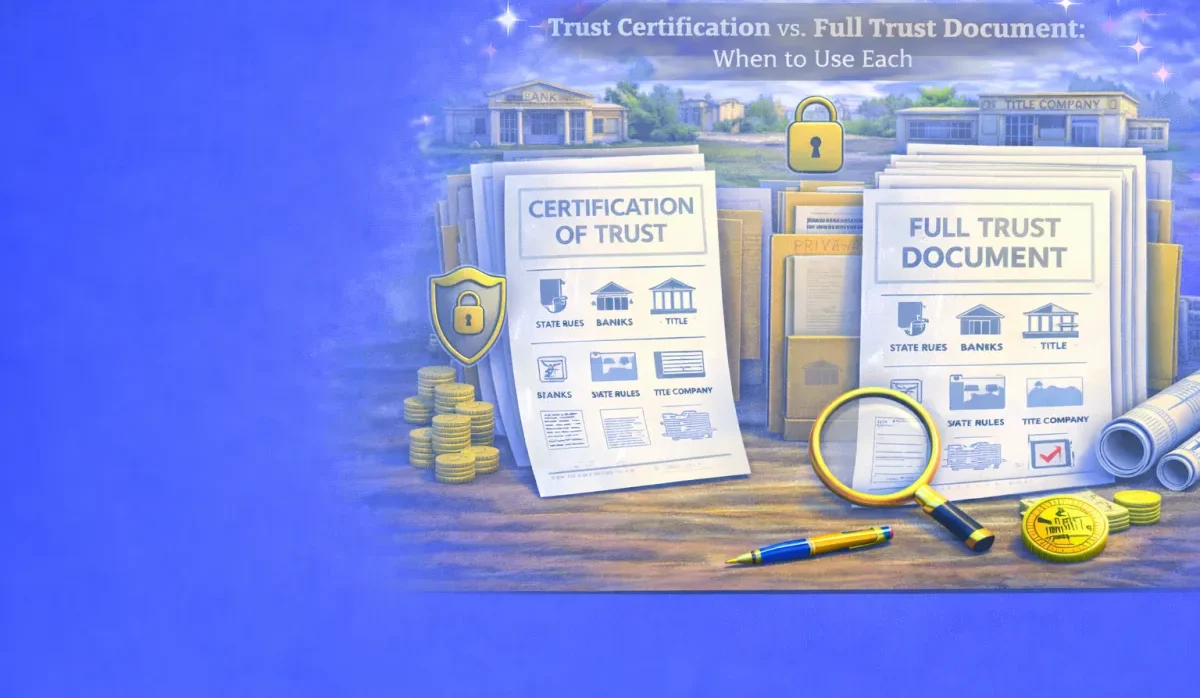

When you establish a living trust, you create a comprehensive document that contains detailed information about your assets, beneficiaries, and distribution instructions. Banks, title companies, and other institutions often need proof that the trust exists and that the trustee has authority to act. However, sharing the entire trust document exposes private family information that third parties do not need.
A certification of trust solves this problem by providing essential information without revealing sensitive details. Understanding when to use a certification versus when the full trust document is required helps trustees protect privacy while efficiently managing trust assets.
What Is a Certification of Trust?
A certification of trust, also called a certificate of trust, abstract of trust, or memorandum of trust, is a condensed document that summarizes key information about a trust without disclosing its private terms. The certification confirms the trust exists and verifies the trustee’s authority to act on behalf of the trust.
Think of the certification as an executive summary compared to the full trust agreement. The certification might be two to four pages, while the complete trust document could span 30 to 80 pages or more. The certification contains just enough information for third parties to verify the trustee’s authority and proceed with transactions.
Information Typically Included
A certification of trust generally contains the trust’s name, the date the trust was created, and the identity of the settlor who established the trust. It identifies the currently acting trustee or trustees and specifies whether the trust is revocable or irrevocable.
The certification describes the trustee’s powers relevant to the transaction, such as the authority to buy, sell, or encumber real property, or the power to open and manage financial accounts. It states how title to trust property should be taken and provides the trust’s taxpayer identification number.
If multiple trustees serve together, the certification specifies whether all trustees must sign or whether fewer than all may act. The document includes a statement that the trust has not been revoked, modified, or amended in any way that would make the certification’s representations incorrect.
Information Intentionally Omitted
The certification of trust deliberately excludes the dispositive provisions of the trust. These are the terms that specify who receives trust assets, under what conditions distributions occur, and how inheritances are structured. The names of beneficiaries and the details of their shares remain confidential.
The certification does not list specific trust assets or their values. It omits provisions about trustee compensation, removal procedures, and succession. Family circumstances, special conditions on inheritances, and charitable bequests stay private.
This selective disclosure allows the trustee to prove authority without revealing information that third parties have no legitimate need to know.
What Is the Full Trust Document?
The full trust document, often called the trust agreement, trust instrument, or declaration of trust, is the complete legal document that creates and governs the trust. It contains every provision, instruction, and condition the settlor established.
The trust agreement identifies all parties, including the settlor, trustees, successor trustees, and beneficiaries. It describes how assets should be managed during the settlor’s lifetime and distributed after death. It grants specific powers to the trustee and may impose limitations or conditions on those powers.
The document addresses contingencies such as what happens if a beneficiary predeceases the settlor, how minor beneficiaries’ shares should be held, and under what circumstances distributions may be accelerated or delayed. It may create subtrusts for specific purposes like education funding or special needs planning.
The trust agreement is the definitive source of the trustee’s authority and obligations. Any question about what the trustee can or cannot do must ultimately be answered by reference to the complete document.
Why Privacy Matters
Privacy is a primary reason people establish living trusts instead of relying solely on wills. Unlike wills, which become public record when filed for probate, trusts remain private documents. Only the trustee, beneficiaries, and those with legitimate legal interests typically have access to trust terms.
Protecting Sensitive Family Information
Trust documents often contain deeply personal information about family relationships and circumstances. The document might reveal that one child receives more than another, that conditions attach to a beneficiary’s inheritance, or that a family member has been disinherited entirely.
Provisions might address sensitive situations like a beneficiary’s struggles with addiction, a child’s special needs requiring lifetime care, or concerns about a beneficiary’s spouse. These private family matters should not be disclosed to bank clerks, escrow officers, or title company employees who have no need for such information.
Preventing Potential Exploitation
Detailed knowledge of trust assets and distribution plans could be misused. Unscrupulous individuals might target elderly beneficiaries knowing their expected inheritance. Family conflicts could escalate if distribution details become widely known before they take effect.
Protecting trust privacy also reduces the risk of fraud. The less information circulating about trust assets and terms, the harder it becomes for bad actors to impersonate trustees or manipulate beneficiaries.
Maintaining Dignity and Relationships
Settlors often prefer that beneficiaries not know precise distribution details until after death. Learning that a sibling will receive more or that conditions attach to one’s inheritance can damage family relationships during the settlor’s lifetime.
A certification of trust allows the trustee to conduct necessary business without prematurely revealing information that the settlor intended to keep confidential until the appropriate time.
What Third Parties Actually Need
Banks, title companies, lenders, and other institutions have legitimate reasons to request trust documentation. They need assurance that the trust is valid and that the person claiming to be trustee actually has authority to act. However, their needs are limited, and most can be satisfied without the full trust document.
Banks and Financial Institutions
When opening accounts or conducting transactions, banks need to verify that the trust exists, identify the authorized trustees, and confirm the trustees have power to manage financial accounts. They need the trust’s taxpayer identification number for reporting purposes.
Banks do not need to know who inherits trust assets after the settlor dies. They do not need information about beneficiary shares, distribution conditions, or provisions unrelated to account management. A certification of trust provides everything a bank legitimately requires.
Title Companies and Real Estate Transactions
Title companies need to verify that the trustee has authority to buy, sell, or encumber real property held in the trust. They must ensure the deed or mortgage will be valid and that no unauthorized person is signing documents.
The certification should specify trustee powers related to real estate transactions. If limitations exist, such as requiring multiple trustees’ consent for property sales, those limitations must be disclosed. However, the title company does not need to see beneficiary designations or distribution provisions.
For real estate transactions, the certification of trust may need to be recorded with the county recorder’s office. California Probate Code Section 18100.5 specifically authorizes recording the certification while keeping the full trust private.
Lenders and Mortgage Companies
Lenders financing property held in trust need assurance that the trust can legally borrow money and grant a security interest in trust property. They verify that the trustee signing loan documents has authority to do so.
A certification of trust combined with relevant excerpts showing borrowing powers typically satisfies lender requirements. Lenders reviewing entire trust documents must spend time and money examining provisions irrelevant to the loan, creating inefficiency for everyone.
Brokerage Firms and Investment Companies
Investment accounts held in trust require verification of trustee authority to buy, sell, and manage securities. Brokerage firms need to know who can give trading instructions and access account information.
Like banks, brokerage firms need basic trust information and evidence of trustee powers, not detailed distribution provisions or beneficiary information unrelated to account management.
State Laws Governing Trust Certifications
Most states have enacted statutes specifically authorizing trust certifications and protecting third parties who rely on them. These laws encourage institutions to accept certifications rather than demanding full trust documents.
The Uniform Trust Code Approach
The Uniform Trust Code, adopted in whole or substantial part by most states, includes Section 1013 addressing certifications of trust. This section establishes what information a certification may contain and provides protections for both trustees and third parties.
Under the UTC framework, a certification of trust may include the trust’s existence and execution date, the identity of the settlor and trustees, whether the trust is revocable or irrevocable, the authority of co-trustees to act, the trust’s taxpayer identification number, and the manner of taking title to trust property.
Critically, the UTC provides that a certification need not contain the dispositive terms of the trust. Third parties cannot demand these private provisions as a condition of dealing with the trustee.
States adopting the UTC include Massachusetts, Missouri, North Carolina, Oregon, Tennessee, Utah, and many others. While specific provisions may vary, the core principle remains consistent: certifications protect privacy while giving third parties adequate assurance.
California Probate Code Section 18100.5
California provides robust statutory protection for trust certifications. Under Probate Code Section 18100.5, a trustee may present a certification of trust to any person in lieu of providing a copy of the trust instrument to establish the trust’s existence or terms.
The California statute specifies that the certification may include the trust’s existence and execution date, the identity of settlors and trustees, trustee powers, revocability, signature authority when multiple trustees serve, the trust’s tax identification number, the manner of taking title, and legal descriptions of real property held in the trust.
The certification must state that the trust has not been revoked, modified, or amended in ways that would make the certification incorrect. It must be signed by all currently acting trustees as an acknowledged declaration.
California law explicitly provides that the certification need not contain dispositive provisions. A person whose interest may be affected by the certification may require excerpts showing trustee designation and powers related to the pending transaction, but cannot demand the entire trust document.
Texas Property Code Section 114.086
Texas law authorizes certifications of trust under Property Code Section 114.086. The certification must contain the trust’s existence and execution date, trustee identity, one or more trustee powers, revocability status, co-trustee signature authority, and the manner of taking title to trust property.
The certification must state that the trust has not been revoked, amended, or modified in ways making the certification incorrect. Texas law protects third parties who rely on certifications without actual knowledge that the representations are incorrect.
Florida Statutes Section 736.1017
Florida’s certification of trust provisions appear in Section 736.1017 of the Florida Statutes. The certification must be signed by the trustee and either notarized or include a penalty of perjury clause.
Florida law allows third parties to require excerpts from the trust instrument showing trustee designation and powers related to the pending transaction. However, third parties cannot demand the entire trust document when a valid certification is provided.
Other State Variations
While most states follow similar frameworks, specific requirements vary. Some states require notarization of the certification. Others specify particular language or format. Some impose penalties on third parties who refuse valid certifications without good faith justification.
Trustees should ensure their certification complies with the requirements of their state of residence and, for real estate transactions, the state where the property is located. An estate planning attorney can prepare certifications that meet applicable state requirements.
How Banks and Title Companies Differ
While state laws generally require acceptance of valid certifications, institutional practices vary. Understanding these differences helps trustees navigate transactions more smoothly.
Bank Practices
Banks have legitimate needs to verify trust authority, but individual bank employees may not understand certification of trust laws. A frontline employee might request the full trust simply because that is what they have always done or because they are unfamiliar with alternatives.
Many banks have their own certification of trust forms. If a bank offers its form, using it often streamlines the process. The bank’s form is designed to capture exactly what that institution requires, reducing back-and-forth requests for additional information.
When a bank employee insists on the full trust document, trustees can politely explain that state law authorizes use of a certification and that the bank is not entitled to dispositive provisions. Providing a copy of the relevant statute often resolves the issue.
Some banks have internal policies requiring full trust review for certain transaction types, particularly large transactions or those involving lending. These policies may conflict with state law protections. If a bank refuses a valid certification, the trustee may need to escalate to a supervisor, provide the statutory citation, or consult an attorney.
Title Company Practices
Title companies examine documents to ensure real estate transactions are valid and that title insurance can be issued. They need confirmation that the trustee has authority to convey or encumber real property.
Most title companies regularly work with trust certifications and understand their purpose. They typically accept certifications that meet state requirements and include provisions relevant to real estate transactions.
However, title companies may request excerpts from the trust document showing specific real estate powers, particularly for unusual transactions or when the certification language seems ambiguous. This request is permitted under most state certification statutes.
For real estate sales, the certification may need to be recorded with the county recorder. Title companies can advise whether recording is required and ensure the certification meets recording requirements such as proper notarization and formatting.
Lender Requirements
Mortgage lenders often have the most detailed documentation requirements. They may request not just a certification but specific excerpts showing the trustee’s borrowing authority, power to grant security interests, and ability to sign loan documents.
Lenders are cautioned by state laws not to demand the entire trust instrument when a certification and relevant excerpts suffice. Under many state statutes, a lender demanding the full trust document without good faith justification may be liable for damages.
In practice, providing a certification plus five to ten pages of relevant excerpts typically satisfies lender requirements without exposing the entire 50 or 70-page trust document.
When to Use a Certification of Trust
A certification of trust is appropriate for most routine transactions where third parties need verification of trustee authority. The certification efficiently provides necessary information while protecting privacy.
Opening Financial Accounts
When opening bank accounts, brokerage accounts, or other financial accounts in the trust’s name, a certification of trust is typically sufficient. The financial institution needs to verify the trust exists, identify authorized signers, and obtain tax identification information.
Buying or Selling Real Estate
Real estate transactions involving trust property regularly use certifications of trust. Title companies accept certifications showing trustee authority to convey or acquire real property. The certification may be recorded to establish the trustee’s authority in the public record.
Refinancing Property
When refinancing property held in trust, lenders need confirmation of the trustee’s borrowing authority. A certification combined with excerpts showing relevant powers typically satisfies lender requirements.
Transferring Assets into the Trust
When funding a trust by transferring assets from individual ownership to trust ownership, the receiving institutions need verification of the trust and trustee. Certifications facilitate these transfers efficiently.
Managing Investment Accounts
Ongoing management of investment accounts, including buying and selling securities, changing allocations, and taking distributions, relies on the trustee’s established authority. Initial account setup with a certification typically covers subsequent transactions.
Dealing with Insurance Companies
Changing beneficiary designations, obtaining policies on trust-owned assets, or making insurance claims may require proof of trustee authority. Certifications provide this proof without revealing trust distribution provisions.
When the Full Trust Document Is Required
Despite the availability of certifications, some situations require the complete trust document. Trustees should understand these circumstances and be prepared to provide the full document when truly necessary.
Creating or Amending the Trust
The attorney drafting the trust or preparing amendments needs the complete document. Amendments must reference and integrate with existing provisions, requiring full knowledge of the trust’s terms.
Legal Disputes and Litigation
If disputes arise about trust administration, interpretation, or validity, courts require the complete trust document. Litigation involving beneficiary rights, trustee removal, or breach of fiduciary duty necessarily examines the trust’s actual provisions.
Tax Matters and IRS Requirements
Certain tax matters may require disclosure of trust provisions. The IRS may request trust documents when examining trust tax returns or investigating potential issues. Estate tax returns may need to include trust provisions affecting estate tax calculations.
Trustee Succession
When a successor trustee takes over, they need the complete trust document to understand their duties, powers, and limitations. The full document explains distribution provisions, beneficiary rights, and administrative requirements that the successor must follow.
Court Proceedings
Probate court proceedings, trust accountings, and petitions for instructions require the complete trust document. Courts cannot rule on trust matters without examining the actual terms.
Complex Transactions Requiring Specific Powers
Some unusual transactions may require verification of specific powers not typically included in certifications. If a certification does not address a particular power and the third party legitimately needs confirmation, providing relevant excerpts or the full document may be necessary.
Notarization Requirements
Most states require or strongly encourage notarization of trust certifications. Notarization adds a layer of authenticity that third parties find reassuring.
State Requirements
California requires the certification to be in the form of an acknowledged declaration signed by all currently acting trustees. Tennessee requires the certification to be signed by trustees with signatory authority and attested by a notary public. Most UTC states permit third parties to require that the certification be acknowledged or guaranteed.
Even when not strictly required by statute, most banks, title companies, and other institutions request notarized certifications. The notarization verifies the trustee’s identity and confirms voluntary signing.
Recording Requirements
If the certification of trust will be recorded with a county recorder’s office, notarization is typically mandatory. Recording requirements follow the same standards as other recorded documents, including proper acknowledgment, legible notary seal, and compliant formatting.
BlueNotary provides convenient notarization services for trust certifications and other estate planning documents. Remote online notarization allows trustees to complete the notarization process efficiently without scheduling in-person appointments.
Updating Certifications
Certifications should be updated when trust terms change in ways affecting the certification’s representations. Successor trustee appointments, amendments affecting trustee powers, and changes from revocable to irrevocable status all warrant new certifications.
Some institutions request certifications no older than one or two years to ensure current accuracy. Keeping certifications updated prevents delays when transactions arise.
What to Do When Third Parties Demand the Full Trust
Despite statutory protections, trustees occasionally encounter institutions that demand the complete trust document. Understanding your rights and options helps resolve these situations.
Know Your State’s Law
Review your state’s certification of trust statute to understand what information you must provide and what protections apply. Most statutes explicitly state that certifications need not contain dispositive provisions and that third parties cannot demand them.
Provide the Statutory Citation
When an institution demands the full trust, provide a copy of the relevant state statute. Many institutional employees simply do not know the law permits certifications. Showing them the statute often resolves the issue immediately.
Escalate to Supervisors
Frontline employees may lack authority to accept a certification when their training or checklist says to request the full trust. Ask to speak with a supervisor or the institution’s legal department. Higher-level personnel are more likely to understand the legal framework.
Offer Relevant Excerpts
Most state statutes permit third parties to request excerpts showing trustee designation and the powers relevant to the pending transaction. Offering to provide these excerpts often satisfies legitimate concerns while protecting dispositive provisions.
Document the Refusal
If an institution refuses a valid certification without good faith justification, document the refusal in writing. Under many state statutes, an institution that wrongfully demands the full trust may be liable for damages caused by the delay or refusal.
Consult an Attorney
If an impasse develops, consult the attorney who prepared your trust. They can communicate with the institution, explain the applicable law, and help resolve the dispute. In some cases, a letter from an attorney citing potential liability resolves resistance quickly.
Consider Alternative Institutions
If an institution persistently refuses valid certifications despite clear legal authority, consider taking your business elsewhere. Many institutions routinely accept certifications; you need not remain with one that creates unnecessary obstacles.
Creating an Effective Certification of Trust
A well-drafted certification of trust anticipates third-party needs while protecting privacy. Working with an experienced estate planning attorney ensures the certification meets legal requirements and serves its intended purpose.
Match the Certification to the Trust
The certification must accurately reflect the trust’s current status. If the trust has been amended, the certification should reflect those amendments. If successor trustees have taken over, the certification should identify them.
Certifications based on outdated trust information create problems when third parties rely on inaccurate representations. Keep certifications current with any trust changes.
Include Relevant Powers
The certification should include powers relevant to anticipated transactions. If the trust owns real estate, include real estate powers. If the trustee will manage financial accounts, include account management powers.
Generic certifications may work for simple transactions but may prove inadequate for complex matters. Tailoring the certification to likely uses prevents requests for additional documentation later.
Use Statutory Forms When Available
Some states provide statutory forms for trust certifications. California’s Probate Code Section 18100.5 establishes specific requirements. Using a form that clearly complies with state law reduces the chance of rejection.
Prepare Multiple Copies
Trust administration often requires presenting certifications to multiple institutions. Prepare several originally signed and notarized copies. Having copies readily available prevents delays when transactions arise.
Protecting the Full Trust Document
While certifications handle most situations, trustees must still protect the complete trust document and know when disclosure is appropriate.
Secure Storage
Keep the original trust document in a secure location such as a safe deposit box, fireproof safe, or attorney’s office. Provide copies only to those with legitimate needs, such as successor trustees, co-trustees, and legal counsel.
Limited Distribution
Beneficiaries generally have rights to trust information, but the scope varies by state and trust terms. Provide information as required by law or the trust instrument, but avoid unnecessary distribution of the complete document.
Confidentiality Agreements
In some situations, trustees may require recipients to sign confidentiality agreements before receiving trust documents. This provides additional protection when disclosure is necessary but the trustee wants to limit further distribution.
Frequently Asked Questions
Is a certification of trust the same as the trust document?
No. A certification of trust is a summary document that provides essential information about the trust without revealing private terms like beneficiary designations and distribution provisions. The full trust document contains all terms and provisions governing the trust.
Do I need a certification of trust for every trust?
While not legally required, certifications are highly recommended for any trust that owns assets requiring third-party verification. Without a certification, you would need to provide the full trust document for every transaction, exposing private information unnecessarily.
Can a bank refuse my certification of trust?
Most state laws require third parties to accept valid certifications that meet statutory requirements. If a bank refuses without good faith justification, the bank may be liable for damages caused by the refusal. Providing the relevant statute often resolves resistance.
Does a certification of trust need to be notarized?
Most states require or strongly encourage notarization. Even when not strictly required, most institutions expect notarized certifications. For recorded certifications, notarization is mandatory.
How often should I update my certification of trust?
Update the certification whenever trust terms change in ways affecting its representations, such as trustee changes, amendments to trustee powers, or changes in revocability. Some institutions request certifications no older than one to two years.
Can title companies see my full trust document?
Title companies typically accept certifications of trust for real estate transactions. They may request excerpts showing specific real estate powers but generally cannot demand the complete document with all dispositive provisions.
What if my trust has been amended?
The certification must reflect the trust’s current status, including any amendments. If amendments changed information that appears in the certification, prepare a new certification incorporating those changes.
Who can sign a certification of trust?
Generally, all currently acting trustees must sign the certification. The certification itself typically states that it is being signed by all currently acting trustees, so all trustees’ signatures are required.
Conclusion:
Trust certifications provide an elegant solution to a common problem: how to verify trustee authority without exposing private family information. By summarizing essential trust details while omitting sensitive provisions, certifications protect privacy while facilitating necessary transactions.
State laws strongly support the use of certifications. The Uniform Trust Code, California Probate Code, Texas Property Code, Florida Statutes, and similar laws in other states authorize certifications and protect third parties who rely on them. These laws also protect trustees from demands for unnecessary disclosure.
Understanding when certifications suffice and when full trust documents are required helps trustees navigate various situations efficiently. Routine financial transactions, real estate dealings, and asset transfers typically require only certifications. Legal disputes, tax matters, and trust amendments require the complete document.
When third parties demand more than certifications provide, trustees should know their rights, provide statutory citations, offer relevant excerpts, and escalate appropriately. The law protects trustees who assert their right to privacy.
Working with an experienced estate planning attorney ensures certifications meet state requirements and serve their intended purpose. Keeping certifications current, properly notarized, and readily available streamlines trust administration while maintaining the privacy that trusts are designed to provide.