





When you need a document made official, the first question that pops into your head is probably, “Who can actually do this for me?” The short answer is a state-commissioned Notary Public. Think of them as an official, impartial witness appointed by the government to serve as a frontline defense against fraud.
Understanding Who Is Authorized for Notary Services
At its core, a notarization is all about trust and verification. The authorized professional acts as a neutral third party, their primary job being to confirm that you are who you say you are and that you’re signing the document of your own free will. They are the gatekeepers ensuring the integrity of important transactions.
It’s a lot like having a referee at a game. Their role isn’t to pick a side but to make sure everyone plays by the rules so the final score is legitimate. While the title “Notary Public” is the most common one you’ll hear, the people holding that authority can operate in a few different ways.

Key Notarization Providers
The days of having to hunt down a notary at your local bank or shipping center are fading. Today, the field has expanded, giving you more options than ever. Here’s a quick breakdown of who you’re likely to encounter:
- Traditional Notary Public: This is the classic role you’re probably most familiar with. These notaries are commissioned by their state and perform their duties in person. You have to physically appear before them, show a valid ID, and sign on the dotted line.
- Attorney Notaries: In many states, licensed attorneys automatically have the authority to notarize documents. It’s a natural extension of their professional duties, making it convenient to handle notarizations during legal matters like real estate closings, wills, or power of attorney setups.
- Remote Online Notaries (RONs): This is the modern evolution of the role. A specially trained and commissioned notary can perform the entire act online using secure audio-visual technology. You can be anywhere in the world, and the RON verifies your identity using sophisticated digital tools before witnessing your electronic signature.
To give you a clearer picture, here’s a simple table summarizing who does what.
Quick Guide to Authorized Notarization Providers
| Provider Type | Primary Role | Common Use Case |
|---|---|---|
| Traditional Notary Public | In-person identity verification and witnessing of physical signatures. | Signing a car title, local affidavits, or standard legal forms at a bank or office. |
| Attorney Notary | Notarizing documents as part of broader legal services for clients. | Finalizing real estate transactions, executing wills, or creating trusts. |
| Remote Online Notary (RON) | Digital identity verification and witnessing of electronic signatures via secure video. | Closing on a mortgage from a different state, notarizing business contracts with international partners. |
This table helps illustrate how different professionals fit into the notarization process, whether you’re handling a local task or a complex international agreement.
No matter how they perform the act—in-person or online—every single authorized individual must hold an active commission from a state government. This commission is their license to operate, proving they’ve met their state’s training and background check requirements.
The shift toward digital options has been massive. As of 2025, well over 30 states have passed laws to permanently allow remote online notarization. This has fueled a 40% increase in RON-certified notaries between 2020 and 2025 alone, with the total number now exceeding 150,000.
This trend is a game-changer, offering incredible flexibility. If you want to dive deeper, you can explore the full research on the online notary service market to see just how quickly things are evolving.
The Path to Becoming a Commissioned Notary
Becoming a commissioned Notary Public isn’t as simple as just buying a stamp; it’s a formal process built on a foundation of public trust. Every state has its own playbook, but the general journey involves a few key milestones designed to make sure every candidate is qualified to serve as an impartial witness for the public. Think of it less like a sprint and more like an official qualification course, with checkpoints all along the way to verify an applicant’s integrity and knowledge.
The first hurdle is meeting the basic eligibility criteria. These are the non-negotiables you have to clear before you can even think about filling out an application.
- Age Requirement: You almost always need to be at least 18 years old.
- Residency: Generally, you must be a legal resident of the state where you’re applying for your commission.
- Criminal Record: A clean background is essential. Since the role demands a high ethical standard, most states will bar anyone convicted of a felony or certain misdemeanors from becoming a notary.
The Commissioning Process Step by Step
Once you’ve ticked off the eligibility boxes, the real application process kicks off. It’s a multi-step journey that ensures only properly prepared and vetted individuals get that official commission. While the fine print varies by state, the core steps are pretty consistent.
- Submit an Application: This is the official form that gathers your personal information. It’s your formal request to the state’s commissioning authority, which is usually the Secretary of State’s office.
- Pass a State Exam: Many states require you to pass an exam testing your knowledge of notary laws, ethical duties, and correct procedures. It’s their way of making sure you know the rules of the road before they hand you the keys.
- Secure a Surety Bond: A surety bond is basically an insurance policy that protects the public from financial loss if a notary makes a mistake or engages in misconduct. The required bond amount can be anywhere from $500 to over $25,000, depending on what your state mandates.
- Take an Oath of Office: This is a formal, sworn promise to faithfully and impartially perform your duties as a Notary Public. It’s a serious step that solidifies your commitment to serving the public with integrity.
The National Notary Association provides a great visual overview of the general steps involved.
This guide reinforces that the path involves a formal application, bonding, and official filing to ensure every notary is properly vetted. The timeline can differ, and you can get a better feel for it by checking out our guide on how long it takes to become a Notary Public.
A notary commission isn’t a lifetime appointment. It’s a term-limited public office, typically lasting four to five years, after which the notary has to go through a renewal process to continue serving.
Once you successfully navigate all these steps, you’ll receive your official notary commission certificate and your seal. This is the state’s green light—its official declaration that you are a trusted public servant, empowered to perform notarial acts.
Understanding Who Cannot Perform a Notarization
Knowing who can notarize a document is crucial, but it’s just half the story. Just as important are the hard-and-fast rules about who can’t. The entire notarization process hinges on the notary being a neutral, unbiased witness. Certain situations immediately disqualify someone from acting in that role.
The foundational idea here is something called a disqualifying interest. Simply put, a notary can’t have any skin in the game. They can’t stand to gain—personally or financially—from the document they’re stamping.
Imagine a referee officiating a game where their own kid is the star player. The conflict of interest is blatant, and it undermines the entire match. A notary’s impartiality has to be just as unwavering.
The Rule of Impartiality
This isn’t just a friendly suggestion; it’s a core legal and ethical mandate in every single state. A notary’s judgment can’t be clouded by personal involvement. Breaking this rule is serious business, often resulting in the loss of their commission and even legal trouble.
So, when is a notary automatically out? Here are the most common deal-breakers:
- Notarizing Their Own Signature: This is the most basic rule. A notary can never notarize their own signature. The whole point is to have an impartial third party, and you can’t be that for yourself. It’s a non-starter.
- Being a Beneficiary: If the notary is named in the document to receive something of value—like in a will, trust, or property deed—they’re disqualified. You can’t authenticate a document that puts money or assets in your own pocket.
- Family Members: State laws can differ on the specifics, but it’s almost always forbidden or strongly advised against for a notary to handle documents for immediate family (think spouse, parent, or child). Even where it’s not strictly illegal, it casts a shadow of doubt that could get the document challenged down the road.
A notary’s first duty is to the public, not to the signers. Their loyalty is to the integrity of the notarial act itself, ensuring it’s done without a hint of bias or personal gain.
This obsession with secure, impartial verification is what’s pushing big changes in the field. It’s no surprise that the e-notary software market has exploded, crossing USD 261.99 million globally in 2025. This growth is all about finding reliable, efficient digital tools that maintain those strict impartiality standards online. If you’re curious about the technology behind this shift, you can discover more insights about the e-notary market.
Comparing In-Person and Remote Online Notarization
Not long ago, getting a document notarized meant one thing: a trip to a notary’s office. Today, you have two very different paths to choose from—the traditional, in-person method and the increasingly popular digital alternative. While both get the job done, how they work couldn’t be more distinct.
Think of it this way: traditional notarization is like visiting a bank branch. You have to physically go there, show your ID to the teller, and sign paper documents right in front of them. It’s a method that has worked for centuries, built on face-to-face interaction and ink on paper.
Remote Online Notarization (RON), on the other hand, is like using your bank’s secure mobile app. You can be anywhere in the world, connecting with a commissioned notary through a live video call on your computer or phone. This isn’t just a simple video chat; it’s a sophisticated process that uses technology to make notarization more secure and incredibly convenient.
The Technology and Security Divide
The real game-changer between these two methods comes down to how they verify your identity and keep records. Each has its own tools and protocols designed to protect the integrity of the notarization.
- Identity Verification: In a traditional notarization, the notary eyeballs your driver’s license or passport. With RON, the process is far more rigorous. You’ll typically upload a photo of your ID, which is then analyzed by specialized software, and then answer a series of “knowledge-based authentication” (KBA) questions that only you would know.
- Record-Keeping: A traditional notary makes an entry in a physical journal. RON platforms, however, record the entire audio-visual session. This creates a secure, tamper-evident digital file that serves as an unshakeable record of the entire transaction from start to finish.
No matter the method, the core rules of impartiality remain the same. A notary must be a neutral witness.
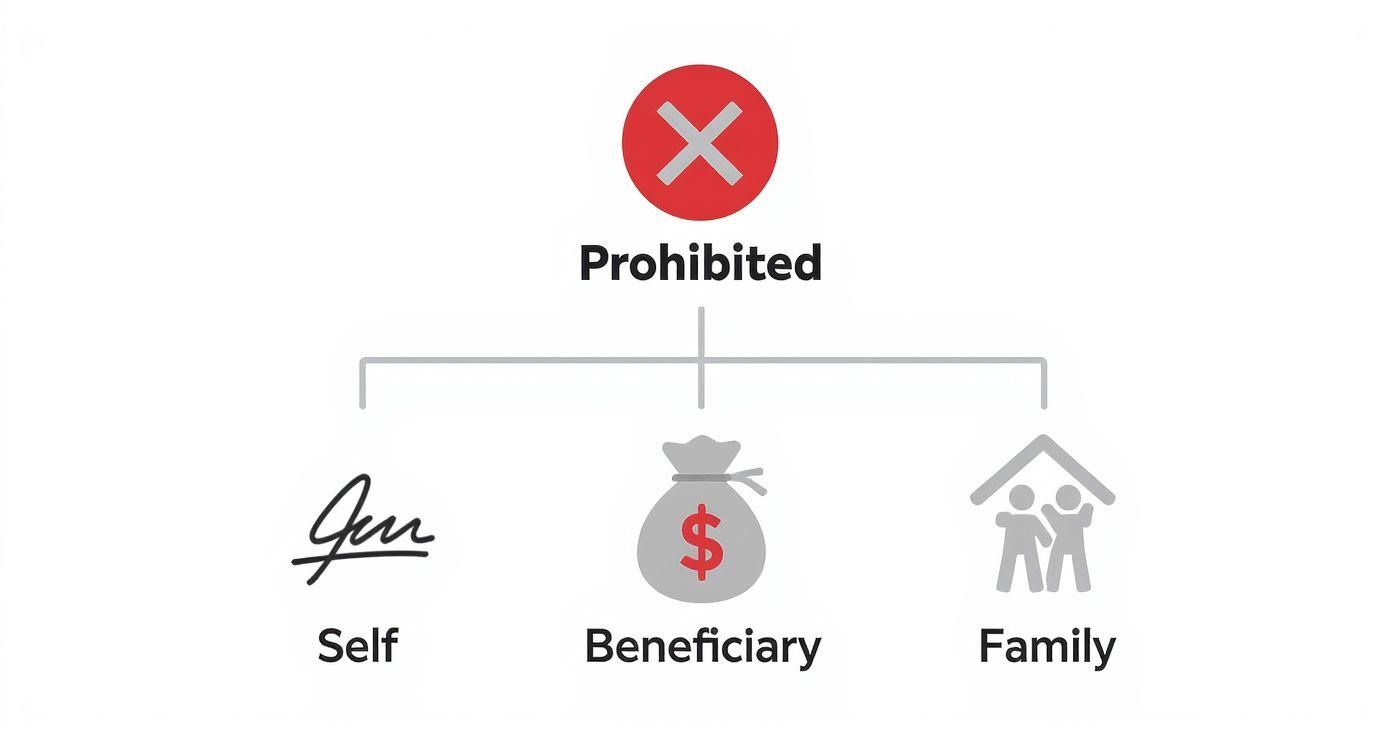
As this shows, notaries are strictly forbidden from handling documents where they have a personal stake—whether for themselves, their family members, or anyone who stands to benefit from the transaction. This is a bedrock principle of notarial law.
Feature Comparison In-Person vs Remote Online Notarization
To help you see the differences side-by-side, let’s break down how each method stacks up across key features. The best choice often depends on your specific needs for speed, security, and convenience.
| Feature | In-Person Notarization (IPEN) | Remote Online Notarization (RON) |
|---|---|---|
| Location | Signer and notary must be in the same physical location. | Signer and notary can be in different locations, even different states or countries. |
| Identity Verification | Visual inspection of a physical government-issued ID. | Multi-factor authentication (ID analysis, KBA questions, live visual confirmation). |
| Document Format | Physical paper documents signed with wet ink. | Digital documents signed electronically. |
| Record-Keeping | Manual entry in a physical journal. | Secure, tamper-evident audio-visual recording of the entire session plus a digital journal. |
| Scheduling & Availability | Limited by business hours and travel time. | Often available 24/7, with instant or on-demand sessions possible. |
| Audit Trail | Limited to the journal entry. | Comprehensive digital audit trail tracking every action taken during the session. |
| Security | Relies on the notary’s physical security and judgment. | Enhanced by encryption, secure storage, and advanced identity verification technologies. |
While in-person notarization remains a viable option, the enhanced security features and unparalleled convenience of RON are making it the go-to choice for businesses and individuals who value efficiency and a robust digital record.
Choosing the Right Method For Your Needs
So, which one is right for you? If you’re dealing with a simple, local transaction and have easy access to a notary, the traditional route might be perfectly fine.
But for urgent matters, signers in different states, or documents that demand an ironclad audit trail, RON is clearly the superior option. The market reflects this shift. The global mobile notary market, which includes a significant RON component, was valued at USD 0.5 billion in 2025. It’s expected to surge to USD 2.6 billion by 2035, growing at an incredible 18.4% CAGR.
The core difference isn’t just about location; it’s about the technology that underpins the entire process. RON doesn’t just replicate the in-person experience online—it enhances it with layers of digital security and a comprehensive electronic audit trail that a physical journal cannot match.
For a deeper dive into how this all works, exploring remote online notarization as the new frontier is a great next step. You’ll see exactly why this technology is quickly becoming the standard for modern business and legal transactions.
How to Confidently Verify a Notary’s Credentials
Trust is the currency of notarization. Before you let anyone put their official stamp on your document, you need to be sure they’re the real deal. After all, a legitimate notary is a commissioned public official, and verifying their status isn’t just a good idea—it’s your best protection against fraud.
Think of it as a quick background check that ensures the entire transaction is valid and legally sound. Fortunately, you don’t have to just take their word for it. Every state gives the public a way to check a notary’s credentials, giving you the peace of mind to move forward.
Simple Steps to Verify a Notary
Whether you’re sitting across from a notary at a desk or connecting with them online, a few simple checks can confirm their authority in minutes. These steps are your first line of defense against someone with an expired commission or, worse, a complete imposter. The process is a lot like how remote platforms handle signer identity, using official sources to confirm legitimacy.
Here are three easy ways to do it:
- Ask to See Their Commission Certificate. Every commissioned notary has an official certificate issued by the state. This is their license to operate, and it includes their full name, commission number, and the dates their commission is valid. Don’t be shy about asking to see it.
- Inspect the Notary Seal. The notary’s seal or stamp is packed with critical details. Look for their name exactly as it appears on their commission, their commission number, and the expiration date. If that date has passed, any notarization they perform is completely invalid.
- Use Your State’s Online Database. This is the most surefire method. Almost every state maintains a public, searchable online database of all its commissioned notaries. Just head to your Secretary of State’s website and look for a link like “Notary Search” or “Verify a Notary.”
By entering the notary’s name or commission number, you can instantly see if their commission is active, expired, or has been revoked. This digital lookup is the ultimate source of truth.
This simple check ensures the person you’re working with is a legitimate public servant. For businesses, platforms like BlueNotary bake this verification right into their system, confirming every notary’s credentials before they can even join the network. This focus on security is a core part of the process, and you can learn more about the tough standards for digital identity verification that protect everyone involved.
Taking a moment to verify is a small step that safeguards the integrity of your most important documents.
Finding the Right Notary Solution for Your Business
For a lot of businesses, notarizations aren’t just a once-in-a-while task. They’re woven into the fabric of daily operations, affecting everything from critical contracts to routine compliance paperwork. Getting this workflow right is non-negotiable. The first big fork in the road is deciding whether to handle it in-house or partner with a specialized service.
At first glance, having an employee become a commissioned notary seems like the simplest solution. You get instant, on-site access whenever a document needs a stamp. But this path has hidden complexities and costs, from training and bonding fees to the headache of managing commission renewals. It also creates a huge bottleneck—if your one notary is sick, on vacation, or swamped, your entire process can grind to a halt.
How to Scale Your Notarization Workflow
This is where turning to a third-party service, especially a modern digital platform, really makes sense. Instead of depending on a single person, you tap into a whole network of qualified professionals, building a more resilient and scalable system. Platforms offering Remote Online Notarization (RON), like BlueNotary, are a game-changer here, turning a logistical nightmare into a real business advantage.
A centralized RON solution is a perfect fit for companies with remote employees, clients spread across the country, or just a high volume of documents to get through. The impact is both significant and immediate:
- Unmatched Speed and Efficiency: Forget waiting days for a signed document to come back in the mail. With RON, turnaround can shrink to just a few minutes. Deals close faster when you don’t have to wrestle with schedules and travel.
- A Higher Standard of Security: Every RON session is recorded, creating a tamper-evident audio-visual record. This digital trail offers a layer of security and undeniable proof that a traditional paper journal simply can’t compete with.
- Total Accessibility and Convenience: Your team and your clients can connect with a notary from anywhere with an internet connection, at almost any time. That kind of flexibility is essential for serving a wide customer base and keeping business moving forward.
By bringing a RON solution into your workflow, you’re doing more than just finding someone to stamp documents. You’re fundamentally upgrading your operational engine. Notarization transforms from a manual, time-consuming task into a streamlined, secure, and incredibly efficient digital process.
This modern approach ensures your notarization needs fuel business growth instead of slowing it down. You get the speed and security required to stay competitive.
Common Questions About Notary Services
Even with the basics covered, you’ll likely run into some specific questions when you’re in the thick of getting a document notarized. Let’s clear up the confusion around some of the most common situations you might face.
Can a Notary Refuse to Notarize a Document?
Absolutely. In fact, a notary isn’t just allowed to refuse—they’re required to under certain circumstances. Think of them as the front line of fraud prevention, not just a rubber stamp service.
A notary must say no if the signer doesn’t have proper ID, seems unsure about what they’re signing, or looks like they’re being pressured. They’ll also hit the brakes if the document has blank spaces or if the notary has a personal stake in the transaction (like being named in a will they’re notarizing). This isn’t them being difficult; it’s them doing their job to protect everyone involved.
Does Notarization Make a Document Legally Binding?
This is probably one of the biggest myths out there. A notary’s seal does not magically make a document legally binding. The legal weight of a document comes from its actual content and whether it follows the laws for that specific type of agreement (like a contract or a deed).
So what’s the point? The notary’s job is strictly to confirm who signed the document and to ensure they did it willingly. That verification is a critical piece of the puzzle, and often required for a document to hold up in court, but it’s the signature verification—not the document’s terms—that the notary is attesting to.
Can a Notary from One State Notarize for Another?
This is a “yes, but” situation that’s important to understand. A notary’s power is tied to the state that gave them their commission. A notary commissioned in California can only perform notarizations while they are physically in California. Simple as that.
But here’s the key part: thanks to the U.S. Constitution, a document that’s been properly notarized in one state is typically accepted as valid across all other states. This is where remote online notarization really shines. A remote notary in Virginia can legally notarize a document for a signer located in another country, as long as the notary themselves is physically in Virginia during the online session. This makes cross-border business a whole lot easier.
Ready to stop chasing down notaries and streamline your workflow? BlueNotary provides a secure, on-demand platform for businesses and individuals who need remote online notarization done right. Get your documents notarized online in minutes.