





You’ve almost certainly run into Knowledge-Based Authentication, or KBA, even if you didn’t know it by name. It’s a way of proving you are who you say you are by answering questions that, in theory, only you know the answers to.
Think of it like a digital bouncer quizzing you on your personal history—like the color of your first car or a street you used to live on—instead of checking a physical ID.
Decoding Knowledge Based Authentication
At its heart, KBA works on a simple principle: you confirm your identity by recalling secret, personal information. As services moved online, this became a go-to method for securing accounts without needing physical tokens or in-person checks. It’s a key piece of the much larger security puzzle that covers Authentication, Authorization, and Account Management.
But not all KBA is created equal. The process comes in two main flavors, each with its own set of pros and cons.
To get a quick handle on these concepts, the table below breaks down the fundamentals.
Quick Overview of KBA Concepts
| Concept | Brief Explanation | Example |
|---|---|---|
| Static KBA | You choose security questions and provide answers that are saved for later verification. | “What was your mother’s maiden name?” or “What was the name of your first pet?” |
| Dynamic KBA | Questions are generated in real-time from third-party data sources like credit bureaus. | “Which of these addresses have you been associated with?” with multiple-choice options. |
| “Out-of-Wallet” | A term for questions whose answers aren’t found in your wallet if it were stolen. | Questions about past mortgage payments or loan amounts. |
This table gives you a bird’s-eye view, but let’s dig into what makes these two approaches so different in practice.
Static KBA: The Pre-Set Questions
This is the classic KBA you’ve seen a thousand times when setting up a new online account. The website asks you to pick a few questions from a list and type in your answers, which are then stored for future logins or password resets.
Familiar examples include:
- What was your mother’s maiden name?
- What city were you born in?
- What was the name of your first pet?
The problem? While simple, this method has a major security flaw. In the age of social media, the answers to these questions are often surprisingly easy to find, making them a weak defense against a determined fraudster.
Dynamic KBA: The On-The-Fly Quiz
Dynamic KBA is a whole different ballgame. It’s a far more sophisticated and secure approach. Instead of relying on answers you provided, it generates multiple-choice questions on the spot by pulling from massive, trusted databases like public records and credit bureaus.
A dynamic KBA system might ask: “Which of the following streets have you previously lived on?” or “Which of these amounts corresponds to your last mortgage payment?”
These are often called “out-of-wallet” questions because a thief couldn’t answer them just by stealing your wallet. The information is too specific and obscure for anyone but the real you to know instantly.
This unpredictable, real-time questioning makes dynamic KBA a cornerstone of modern identity verification systems, especially for high-stakes transactions. It’s this very unpredictability that provides a powerful layer of defense against today’s increasingly clever fraud attempts.
Understanding Static vs. Dynamic KBA
Knowledge-based authentication isn’t a single tool; it comes in two distinct flavors: static and dynamic. Both methods use personal information to prove you are who you say you are, but how they do it—and how secure they are—couldn’t be more different. Getting this distinction right is crucial for building a verification process that actually works.
Think of it like this: static KBA is like having a single, permanent key to your house. It’s simple, but if someone copies it, they have access forever. Dynamic KBA, on the other hand, is like getting a new, unique security code sent to you every time you approach the door. One is fixed and vulnerable, while the other is unpredictable and far more secure.
Static KBA: The Familiar Security Question
We’ve all run into static KBA. It’s the classic security question you set up when creating an account online, usually as a backup for when you forget your password.
The system asks you to pick from a list and provide answers it can store forever.
Common static questions look like this:
- What was the make and model of your first car?
- In what city were your parents married?
- What was your high school mascot?
You answer these once, and they stay the same—or “static”—in that company’s system. When you need to recover your account, the platform just asks the same question, expecting the exact same answer you gave months or years ago.
The problem? Static KBA is incredibly fragile. In an age where we share so much online and data breaches are common, the answers to these questions are often surprisingly easy to find. A determined fraudster can often piece together what they need with a few targeted searches.
It’s a known headache for businesses, too. A huge chunk of customer support tickets at large companies are from users who’ve forgotten their own static KBA answers. This clogs up support lines and creates a frustrating experience for everyone.
At its core, static KBA is the digital version of leaving a spare key under the welcome mat. It’s convenient for you, but it’s just as convenient for anyone who knows where to look.
Dynamic KBA: The Real-Time Identity Quiz
Dynamic KBA is a whole different ballgame. Instead of relying on answers you provided, it generates a pop quiz about you in real-time, pulling questions from massive third-party databases. These sources include public records, credit histories, and other commercial data you’ve never shared with the specific website you’re on.
This creates what we call “out-of-wallet” questions—things an imposter couldn’t possibly know just by stealing your wallet or hacking your email. The questions are almost always multiple-choice to keep things simple for the real user while tripping up the fraudster.
For instance, a dynamic KBA system might ask:
- Which of the following addresses have you been associated with in the last five years?
- From which of these banks did you take out an auto loan?
- Your previous mortgage payment was in which of the following ranges?
The system cleverly mixes the correct answer with several other plausible-but-wrong options. For an imposter, it’s a nearly impossible guessing game. But for you, the right answer usually jumps right out.
The real power of dynamic KBA is its unpredictability. The questions are generated on the spot and drawn from data sources a criminal just won’t have access to. Someone who stole your password in a data breach won’t have a clue about a home loan you took out a decade ago.
This makes dynamic KBA an incredibly strong tool for high-stakes situations like opening a bank account, applying for a loan, or getting a document notarized online. It offers a much higher level of confidence that the person on the other end of the screen is the real deal.
How KBA Helps Businesses Meet Regulatory Demands
In high-stakes industries like finance, law, and real estate, verifying someone’s identity isn’t just a good idea—it’s the law. Failing to properly vet customers can lead to massive fines and a damaged reputation. This is where knowledge-based authentication comes in, serving as a critical tool for navigating these strict regulatory waters.
Think of KBA as the documented proof that a business did its homework. When a bank needs to confirm a new customer’s identity online or a title company needs to validate a signer for a remote closing, KBA provides a clear, auditable trail. It shows the organization took a concrete step to ensure the person was who they claimed to be.
KBA’s Role in KYC and AML
Two of the biggest regulatory hurdles are Know Your Customer (KYC) and Anti-Money Laundering (AML). These rules require businesses, especially financial ones, to make a real effort to verify the identity and assess the risk of their clients. The whole point is to shut down identity theft, financial fraud, and the funding of illegal activities.
Dynamic KBA is a perfect fit for these mandates. Here’s how it helps:
- Creates a Clear Audit Trail: Every KBA session is logged—the questions asked, the answers given, and the final result. This creates a solid record you can show regulators to prove you followed the rules.
- Enables Remote Identity Verification: It allows businesses to onboard customers from anywhere without an in-person visit, which is a must-have for any digital operation.
- Adds a Layer of Diligence: By asking those “out-of-wallet” questions, dynamic KBA proves the verification process went deeper than just glancing at a driver’s license.
For example, when someone successfully passes a dynamic KBA quiz to open a new bank account, the institution gets a timestamped record. This record proves it took that extra step to validate the person’s identity against trusted, third-party data sources. That kind of proof is gold during a compliance audit.
KBA in High-Trust Transactions
The need for solid identity verification is only getting bigger, thanks to more sophisticated online fraud and expanding regulations. The global identity verification market is booming as a result. The U.S. market alone, valued at around USD 2.9 billion in 2024, is expected to climb to USD 8.9 billion by 2033, growing at a rate of 13.2% each year. This growth is fueled by strict rules like KYC and AML that demand reliable authentication. You can discover more insights about this growing market to see just how critical this has become.
This trend is especially obvious in specialized fields like law and real estate.
In the world of Remote Online Notarization (RON), KBA isn’t just a nice-to-have; it’s a legal requirement. Many state laws governing RON explicitly mandate that a notary must use KBA to identify a signer they don’t know personally.
On a platform like BlueNotary, here’s how it works in practice: before a document can be legally notarized online, the signer has to pass a dynamic KBA quiz. This step legally confirms their identity from a distance, making the entire notarization valid and enforceable. Without it, the transaction would be dead in the water in many states.
At the end of the day, using KBA is more than just a security upgrade; it’s a smart business move. It allows companies to operate smoothly in a regulated digital world, build trust with their customers, and confidently prove their compliance when the auditors show up.
KBA vs Other Authentication Methods
Knowledge-based authentication doesn’t exist in a bubble. In a world full of fingerprint scanners, facial recognition, and one-time passcodes, figuring out where KBA fits is crucial for building a solid security strategy. Each method has its own distinct strengths and weaknesses, so a direct comparison is the only way to pick the right tool for the job.
While KBA is all about what you know, other methods rely on who you are (biometrics) or what you have (your phone for a passcode). This basic difference changes everything, from how easy it is for a user to get through to how vulnerable the system is to certain types of fraud. Since no single method is perfect, a layered approach often works best.
When you’re weighing your options, compliance is a huge factor. KBA is a direct way to meet critical regulatory requirements, which isn’t always the case for other methods.
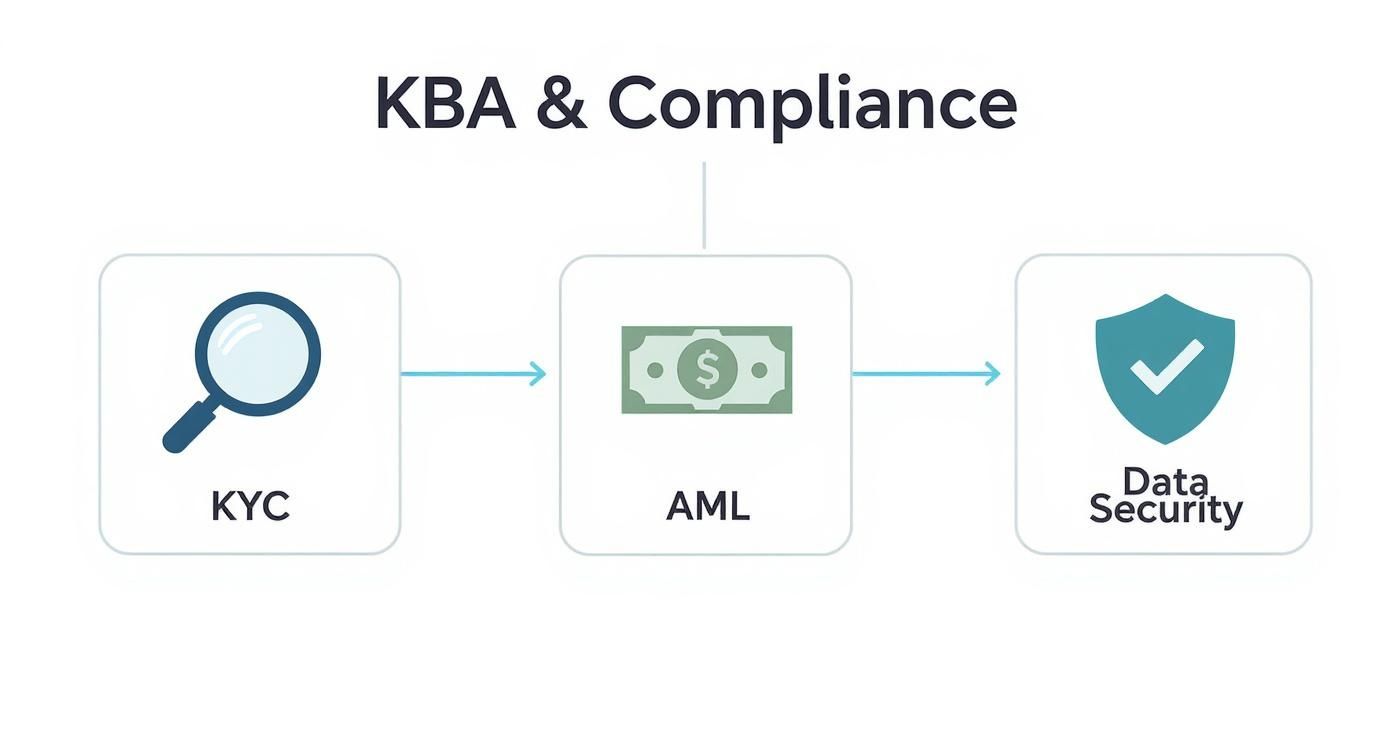
This flow shows how KBA directly helps with KYC and AML checks, which in turn strengthens overall data security. It’s a foundational piece of the compliance puzzle.
KBA vs Biometrics
Biometric authentication uses your unique physical traits—like a fingerprint, your face, or even the way you type—to prove you are who you say you are. At first glance, it seems unbreakable. After all, a fraudster can’t just steal your fingerprint. This makes biometrics a seriously strong security layer.
But biometrics aren’t flawless. High-quality fakes can sometimes fool scanners, and the idea of companies collecting and storing our biometric data brings up some major privacy questions. There’s a whole conversation around https://bluenotaryonline.com/biometrics-whats-the-buzz-online-notary-public/ that digs into this balance. KBA, on the other hand, avoids the need to store that kind of sensitive personal data.
KBA vs One-Time Passcodes
One-Time Passcodes (OTPs), usually sent to your phone via text or an app, work by proving you have a specific device in your possession. They’re simple for users to understand and offer a good security bump over using just a password.
The biggest issue with OTPs is their vulnerability to attacks like SIM swapping. This is where a scammer convinces a mobile carrier to switch a victim’s phone number to a new SIM card. Once they control the number, they can intercept any OTPs sent to it. Dynamic KBA sidesteps this problem entirely by asking questions that have nothing to do with your phone.
KBA vs Document Verification
Document verification requires a user to scan or photograph a government-issued ID, like a driver’s license or passport. Special software then checks the document’s authenticity and often compares the ID photo to a live selfie of the user.
This method offers a very high level of identity assurance, but it can create a clunky user experience. It forces the user to find their physical ID and navigate a multi-step process. KBA is usually much faster and less invasive, which makes it a better choice for situations where speed is important.
The real power of knowledge-based authentication today isn’t as a standalone defense. It shines as a vital part of a multi-factor authentication (MFA) strategy. When you combine KBA (what you know) with another factor like an OTP (what you have) or a fingerprint scan (who you are), you build layers of security that are much, much harder for criminals to break through.
When looking at these options, it’s also useful to see how different authentication and password policies are designed to incorporate these methods. A side-by-side comparison can make the differences crystal clear.
KBA vs Other Authentication Methods
Here’s a quick breakdown of how these different identity verification methods stack up against each other based on security, user experience, and typical weaknesses.
| Authentication Method | Security Level | User Convenience | Common Weakness |
|---|---|---|---|
| Dynamic KBA | Moderate-High | High | Thin data files for some users |
| Biometrics | High | Very High | Spoofing and privacy concerns |
| One-Time Passcodes | Moderate | High | SIM swapping and phishing attacks |
| Document Verification | Very High | Moderate | User friction and process time |
In the end, the right choice always comes down to the specific use case, what the regulations require, and the kind of experience you want to create for your users. KBA continues to be a flexible and essential tool in the security toolkit, especially when it’s integrated smartly with other modern defenses.
Real-World Applications of KBA
The theory behind knowledge-based authentication is one thing, but where does the rubber meet the road? Its real value comes to life when you see it solving tangible problems in high-stakes industries. KBA isn’t just an abstract security measure; it’s a practical tool that makes secure digital transactions possible every day.
Think about opening a bank account online or signing mortgage documents from your kitchen table. In these moments, KBA acts as a crucial gatekeeper, striking a balance between airtight identity verification and the seamless digital experience we all expect. Let’s dig into how it’s being used in finance, real estate, and healthcare.
The market numbers back this up. The mobile user authentication market was valued at USD 4.44 billion in 2025 and is on track to hit USD 9.04 billion by 2029. That explosive growth shows just how vital KBA has become in sectors where compliance is king. If you’re curious, you can read the full research about these market trends to see the bigger picture.
Securing Online Bank Account Opening
Let’s say someone wants to open a new savings account online. Banks are on the hook to verify that person’s identity under strict Know Your Customer (KYC) rules, which are designed to stop fraud and money laundering. But how do you do that when you can’t see the person face-to-face?
This is a perfect job for dynamic KBA. During the online application, the system can hit the applicant with a quick, personalized quiz.
- Example Question: “Which of the following lenders have you had a mortgage with in the past?”
- Another Example: “Your vehicle, a Toyota Camry, is associated with which of the following insurance providers?”
These aren’t random questions. They’re pulled in real-time from trusted data sources like credit bureaus and public records. A genuine applicant would know the answers instantly, but a fraudster working with a stolen name and social security number would be stopped cold. This process also creates a clear, auditable trail proving the bank did its due diligence.
Validating Identity in Real Estate Transactions
The real estate world has gone digital in a big way, especially with the rise of Remote Online Notarization (RON). Imagine a home buyer in Florida signing documents for a property in Texas. The notary has a legal duty to verify their identity, even from hundreds of miles away.
This is where platforms like BlueNotary step in, integrating KBA directly into the workflow. In many states, it’s a required step. Before the virtual notarization can even start, the signer must pass a dynamic KBA challenge.
This identity verification step is often a legal requirement stipulated by state RON laws. Successfully passing the KBA quiz is what gives the remote notarization its legal standing, ensuring the transaction is valid and secure.
The system might ask about a previous address or a past loan amount, confirming the signer is who they say they are beyond just showing a driver’s license to a webcam. This application of KBA is critical for maintaining the integrity of property deals and making secure, convenient cross-state transactions a reality.
Protecting Patient Data in Healthcare
In healthcare, patient privacy isn’t just a good idea—it’s the law, thanks to regulations like the Health Insurance Portability and Accountability Act (HIPAA). When a patient needs to access their medical records or lab results through an online portal, the provider has to be absolutely sure who is logging in.
KBA adds a much-needed layer of security here. For instance, if a patient forgets their password, asking a simple static question like “What is your mother’s maiden name?” just doesn’t cut it anymore for protecting such sensitive information.
Instead, a dynamic KBA system can confirm their identity before letting them reset their password. This approach effectively blocks unauthorized access to protected health information (PHI), helping healthcare organizations stay compliant with HIPAA while still giving patients secure and easy access to their own data.
Implementing KBA Securely and Effectively
Putting KBA to work is about more than just flipping a switch. It takes a careful, strategic approach to boost security without alienating legitimate users. Get it wrong, and you can inadvertently open up security holes or frustrate customers so much they simply leave.
The goal is a process that’s tough on fraudsters but feels seamless to the people you’re actually trying to serve.
The most important decision you can make right from the start is to exclusively use dynamic KBA. Static KBA, with its fixed questions and answers, is a relic from a different era. In a world where data breaches are common, it’s just too easy to crack. Dynamic questions, pulled on-the-fly from secure data sources, offer a far stronger guarantee of someone’s identity.
Core Best Practices for KBA Deployment
To build a KBA system that’s both strong and sensible, you need to focus on a few key pillars. First, never let KBA stand alone. It should always be one layer in a multi-factor authentication (MFA) strategy. Think of it like a deadbolt on a door that already has a lock—combining KBA with other methods makes your security exponentially tougher to break.
Here are the non-negotiables for a solid KBA setup:
- Diversify Your Data Sources: Don’t pull all your questions from one database. By using multiple, independent sources, you make it incredibly difficult for a fraudster to find all the answers, even if one source gets compromised.
- Implement Strict Lockout Policies: You have to stop brute-force attacks in their tracks. This means automatically locking a user out after a small number of wrong answers, typically three to five attempts.
- Set Session Timeouts: An active KBA session shouldn’t stay open forever. If there’s no activity for a few minutes, the session should automatically expire. This prevents someone from walking away from a computer and leaving an open door for an imposter.
These technical guardrails are your foundation. But security is also about people.
A common pitfall in KBA implementation is creating a poor user experience. Studies show that up to 30% of users who fail a KBA challenge will abandon the process entirely. This highlights the need for a system that is as intuitive as it is secure.
Designing a User-Friendly Experience
A fortress-like security system doesn’t do much good if your customers can’t get past the front gate. The design of the user interface (UI) and the clarity of the questions themselves are critical to making KBA work. The questions need to be straightforward and unambiguous, so the right person can answer them without a second thought.
Even more importantly, you need a backup plan. What happens when a legitimate user fails the quiz? It could be due to a simple data error or a “thin file” with not enough information to generate questions. Instead of hitting a brick wall, they should be guided to another way to verify their identity, like uploading a photo ID for manual review.
For businesses that handle high-stakes transactions, a holistic approach to secure session verification isn’t just a good idea—it’s an absolute must.
Your Top Questions About Knowledge-Based Authentication, Answered
When you dig into the world of identity verification, a few common questions about K-B-A always pop up. Let’s clear the air and get you some straight answers on how it works, where it shines, and where it falls short.
Getting these details right is the key to using KBA effectively.
Is KBA Still Secure in an Age of Massive Data Breaches?
This is the big question, and the answer really comes down to which type of KBA we’re talking about.
Think of static KBA—the kind that asks for your mother’s maiden name or your first pet’s name. It’s incredibly vulnerable. After years of data breaches exposing billions of personal records, the answers to these common questions are all over the dark web, making this method pretty insecure on its own.
On the other hand, dynamic KBA is a different beast entirely. It pulls together multiple-choice questions in real-time from massive, disconnected data sources like your credit history or public records. A fraudster would have an incredibly tough time gathering all the right answers—like the exact amount of your last car payment or a previous street you lived on—from a single hacked database.
How Is KBA Different From the Security Questions I Set Up Myself?
Those “regular” security questions you’re thinking of are a classic example of static KBA. You choose the questions and provide the answers yourself when you open an account, and that service just stores them for later.
Dynamic KBA flips that model on its head. The questions are created on the spot, using information you never gave to that particular website or service.
This is why they’re often called “out-of-wallet” questions. The idea is that a thief who just stole your wallet wouldn’t be able to answer them. They’re digging into your financial or personal history, asking about old loans or past addresses, which makes the answers much, much harder to guess. That unpredictability is its biggest strength.
Does KBA Work for Everyone?
Honestly, no. Knowledge-based authentication isn’t a silver bullet and can be a real headache for certain people. The main roadblock is what’s known in the industry as a “thin file.”
A thin file just means someone doesn’t have a deep credit or public records history for the system to pull questions from.
This often affects a few specific groups:
- Young adults who are just starting to build a credit history.
- Recent immigrants who are new to the U.S. financial system.
- People who have made a conscious choice to live without credit.
For anyone in these situations, a system that only relies on KBA can be a dead end, locking out perfectly legitimate users. The best systems are flexible, offering an alternative path like document verification to make sure everyone can prove who they are.
At BlueNotary, we build robust identity verification methods like KBA directly into a smooth workflow for remote online notarization and e-signing. Our platform is built to handle strict compliance needs while making sure the experience is simple and secure for your most important transactions. See how we can help you secure your legal and financial documents.