


Quick answer: Remote ink-signed notarization (RIN) lets you appear before a notary over live video, sign the document in wet ink on paper, and then mail the signed paper to the notary, who completes the notarization. Unlike RON (fully electronic) or IPEN (in-person, electronic), RIN combines a remote video appearance with a physical, ink-signed document.
What is RIN (remote ink-signed notarization)?
Remote ink-signed notarization (RIN), sometimes called remote ink notarization, is a method where the signer and notary meet over live audio-video, but the signer signs a paper document in wet ink during (or right after) the call, then physically sends that signed document to the notary. The notary then applies a traditional wet-ink notarization to the paper original.
It’s a hybrid, the appearance is remote (like RON), but the document and signatures stay on paper (like traditional notarization). That combination makes RIN distinct from the two more common electronic methods, which we’ll compare below. If you’re weighing your options, start with how remote online notarization works.
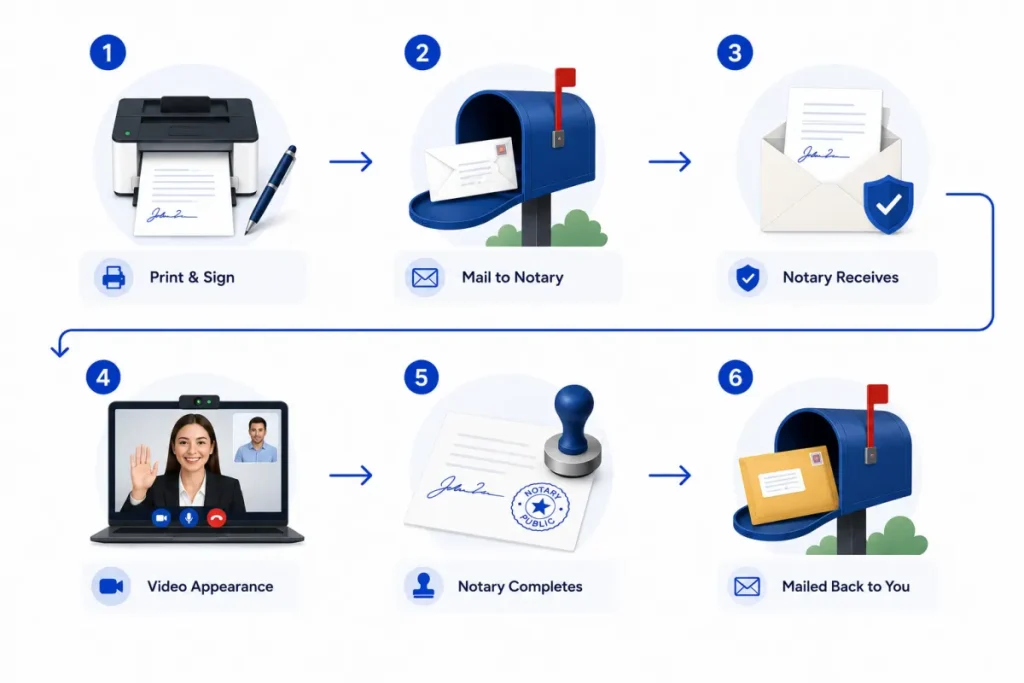
How RIN works: step by step
The RIN process typically goes like this:
- Connect over live video: You appear before the notary on an audio-video call, and the notary verifies your identity.
- Sign the paper document in wet ink: While the notary watches on video, you sign the physical document by hand.
- Mail the signed original to the notary: You ship the wet-ink signed paper to the notary.
- The notary completes the notarization: Once they receive it, the notary adds their wet-ink signature and seal and returns the finished document.
The key trait: there’s a shipping step, because the notary must handle the physical paper to complete the act.
RON vs. IPEN vs. RIN
Here’s the clean comparison of the three modern methods:
| RON | IPEN | RIN | |
|---|---|---|---|
| Appearance | Remote (video) | In person | Remote (video) |
| Signature | Electronic | Electronic | Wet ink (paper) |
| Notary seal | Electronic | Electronic | Wet ink |
| Output | Electronic file | Electronic file | Paper original |
| Speed | Fastest (minutes) | Fast | Slower (mailing) |
| Common in 2026 | Widely used | Common | Limited/legacy |
The one-line takeaway, RON is fully digital, IPEN is in-person-digital, and RIN is remote-but-paper. You can read more about the in-person electronic option on the IPEN page.
When is RIN used, and is it still allowed?
RIN rose to prominence during the COVID-19 era, when many states temporarily allowed a remote appearance but hadn’t yet authorized full electronic RON. It let people notarize without meeting in person, using familiar paper.
Today, with RON legal in 49 states and DC, RIN is far less common and only specifically authorized in some states (often as a temporary or narrow option). You might still encounter it when:
- A state or recipient requires a wet-ink paper original, or
- A signer or notary prefers paper but can’t meet in person.
Because availability varies, confirm whether RIN is permitted in your state via the notarization requirements by state guide, and whether your document type can use it.
RIN’s drawbacks (and why RON mostly replaced it)
RIN solved a real problem, but it has clear downsides compared to RON:
- It’s slower: The mailing step adds days versus RON’s minutes.
- It’s less convenient: You need to print, sign, and ship a physical document.
- More points of failure: Lost mail, delays, or errors on the paper can restart the process.
- No electronic: Audit trail on the document itself the way RON provides.
As full RON became widely authorized and accepted, most signers and businesses shifted to it for the speed and the tamper-evident electronic record. RIN largely remains a legacy or niche option for cases that specifically need paper.
Conclusion
Remote ink-signed notarization (RIN) is the method that bridges old and new: you appear over video like a modern remote notarization, but you sign on paper in wet ink and mail it to the notary like a traditional one, ending with a paper original. It’s distinct from RON (fully electronic) and IPEN (in-person, electronic), and it was most useful as a COVID-era stopgap in states without RON. Today it’s limited and less common, since full RON is faster and produces a tamper-evident electronic record, but RIN can still fit when a wet-ink paper original is required.
For most people, you don’t need the mailing detour, notarize online, fully digital, with a commissioned notary on BlueNotary in about 15 minutes, 24/7. Not sure which method your document or state requires? Start with the notarization requirements by state guide.
Frequently asked questions
What is remote ink-signed notarization (RIN)?
RIN is a method where you appear before a notary over live video, sign the document in wet ink on paper, and mail the signed original to the notary, who completes the notarization with a wet-ink seal.
How is RIN different from RON?
RON is fully electronic, you e-sign and the notary applies an electronic seal, producing a digital document. RIN uses a remote video appearance but a wet-ink paper signature that’s mailed to the notary.
How is RIN different from IPEN?
IPEN is in-person electronic notarization, you’re physically present and sign electronically. RIN is remote (video) but uses a paper, wet-ink signature instead of electronic signing.
Is remote ink notarization still allowed?
In some states, yes, but it’s far less common now that full RON is legal in 49 states and DC. Availability varies, so confirm whether your state specifically authorizes RIN.
When would you use RIN?
Mainly when a state or recipient requires a wet-ink paper original, or when paper is preferred but an in-person meeting isn’t possible. Otherwise, RON is usually faster and easier.
Does RIN produce a paper or electronic document?
A paper original. RIN ends with a physically signed, wet-ink notarized document, unlike RON and IPEN, which produce electronic files.