




Absolutely. Electronic signatures are legally binding, but only if they check a few specific boxes set by law. Think of landmark laws like the U.S. ESIGN Act and the EU’s eIDAS Regulation as the bedrock—they give digital signatures the same muscle as their handwritten, ink-on-paper cousins. Getting these rules right is crucial if you want your digital agreements to stand up in court.
Are Electronic Signatures Legally Binding
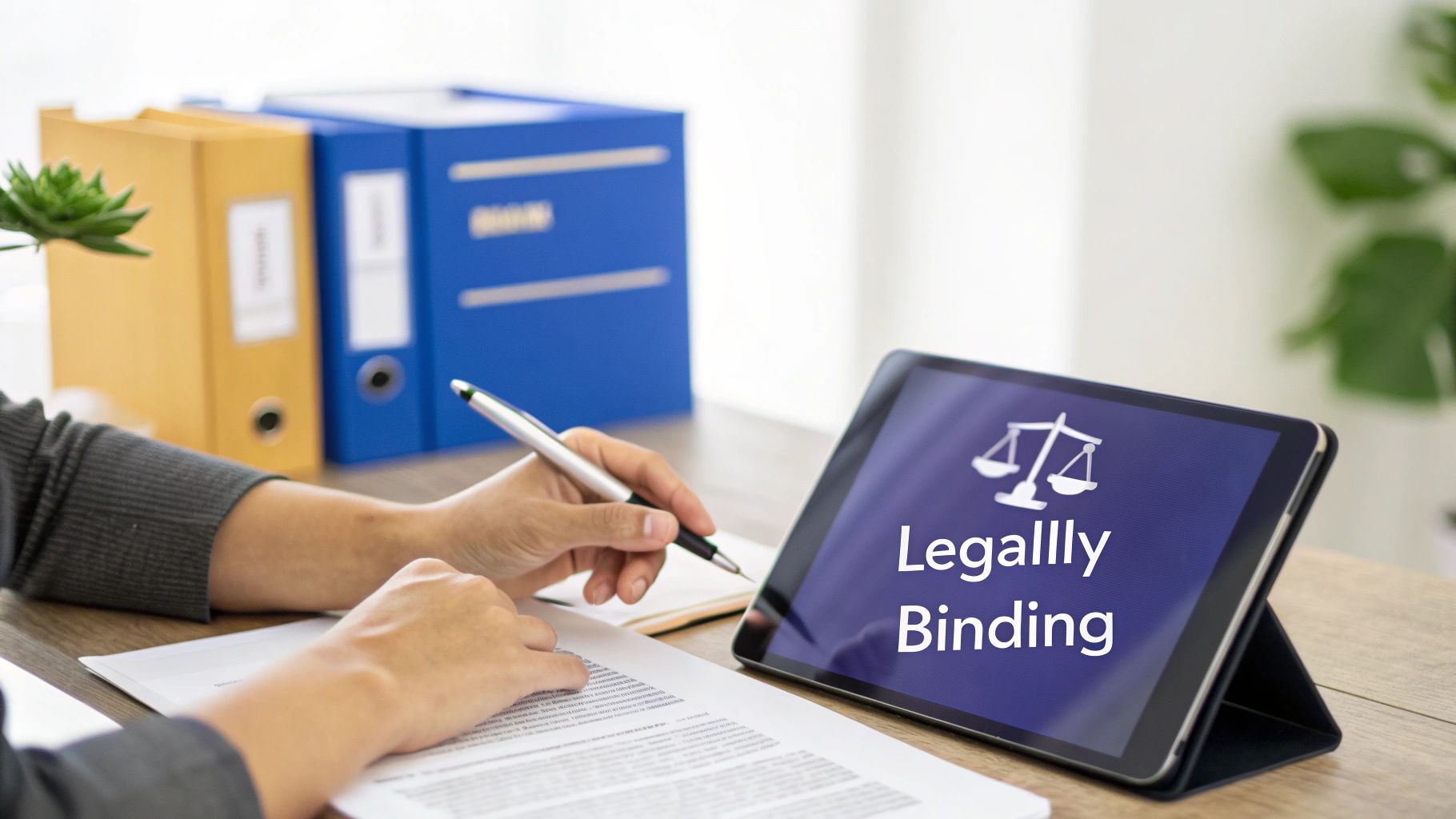
The short answer is a definitive yes. In the United States, electronic signatures have held the same legal standing as traditional “wet ink” signatures since the ESIGN Act was passed way back in 2000. This was a game-changer, allowing business to finally move away from paper-shuffling and embrace more efficient digital processes.
This isn’t just a fleeting trend; it’s now standard practice. Projections show that by 2025, over 80% of contracts worldwide will be handled digitally. That’s a massive shift, and it’s all built on the trust that these legal frameworks provide.
The Legal Foundation for Digital Agreements
The laws that govern electronic signatures act as a universal rulebook for a digital handshake. They ensure that when someone clicks “I Agree” or types their name into a box, that action is recognized as a genuine, binding commitment. The real focus of these laws isn’t on how you sign, but on proving the intent behind the signature.
For a closer look at the principles that make digital consent valid and keep you compliant, it’s worth digging into the core electronic signature legal requirements. These are the pillars that support every solid digital agreement.
The best way to think about this legal framework is that it’s technology-neutral. It doesn’t care if you use a mouse, a stylus, or your fingertip. It cares about the process and intent, which means the rules stay solid even as technology changes.
This legal recognition is precisely what makes it possible to create an electronic signature online and have it mean something. It all comes down to a few core ideas that make the signature valid and defensible.
To simplify, here’s a quick breakdown of what makes an e-signature legally sound.
Key Legal Requirements for a Valid E-Signature at a Glance
This table summarizes the core pillars that grant an electronic signature its legal standing, based on major U.S. laws.
| Legal Requirement | What It Means in Practice |
|---|---|
| Intent to Sign | The person signing must clearly show they mean to sign. This can be as simple as clicking a button labeled “Accept” or drawing their signature. |
| Consent to Do Business Electronically | All parties involved must agree to use electronic records and signatures for the transaction. You can’t force someone to sign digitally. |
| Clear Association with the Record | The signature must be logically connected to the document. The system has to show that this specific signature applies to this specific document. |
| Record Retention | The final, signed document must be stored securely and be available for all parties to view or download. It has to be an accurate, unchangeable copy. |
Getting these four elements right is the key to creating a digital agreement that is just as enforceable as a piece of paper signed with a pen.
Understanding The Pillars of US E-Signature Law
To really get a handle on what makes an electronic signature legally sound in the United States, you need to know about two key pieces of legislation: the ESIGN Act and the Uniform Electronic Transactions Act (UETA). Don’t let the names intimidate you. Think of them less as dense legal texts and more as the blueprints that allow business to happen securely in our digital age.
So, how do they work together? It’s pretty simple. The ESIGN Act is the federal law that ensures an electronic signature is just as valid as a wet ink one, no matter where you are in the country. UETA is a state-level framework that most states have adopted to create similar rules. They’re two sides of the same coin, creating a predictable legal landscape for everyone.
What’s great is that this legal structure is intentionally “technology-neutral.” The law doesn’t care if you use one e-signature platform or another. Instead, it focuses on the process and the intent behind the signature. This smart approach allows the law to keep up with new technology while sticking to its core principles.
The Four Core Requirements for a Binding E-Signature
For an electronic signature to hold up in court under ESIGN and UETA, it needs to meet four basic conditions. These aren’t technical jargon; they’re common-sense checks to prove a real agreement was made. I like to think of them as the four legs of a table—remove one, and the whole thing wobbles.
- Intent to Sign: The person signing has to show they actually meant to sign. This is the digital equivalent of picking up a pen and putting it to paper. Something as simple as clicking a button labeled “I Agree” or drawing your name with a stylus is enough to show intent. The crucial part is that the action was a deliberate choice to finalize the agreement.
- Consent to Do Business Electronically: This one is huge. All parties have to agree to conduct the transaction using electronic records and signatures. You can’t just spring a digital contract on someone who wants a paper copy. That’s why you almost always see a consent clause at the very beginning of the process, asking you to agree to do things electronically before you even get to the document.
This consent clause is a critical first step. It establishes the “digital handshake” where both parties acknowledge and accept the electronic format, ensuring no one can later claim they were unaware the agreement was being finalized online.
- Association of Signature with the Record: The system has to prove that a specific signature belongs to a specific document. The signature can’t just be floating out in cyberspace; it needs to be logically and securely connected to the contract it’s on. E-signature platforms handle this by creating a tamper-evident seal that binds the signature to the document’s data.
- Record Retention: The final, signed document must be stored accurately and be available to everyone involved. Every party should be able to look at, download, or print a copy of the executed agreement. This creates a verifiable and unchangeable record of the deal for future reference, just like filing away a signed paper contract in a cabinet.
Making Legal Concepts Practical
These four pillars are the bedrock of electronic signature legal requirements. When a platform like BlueNotary guides you through a signing, it’s actually baking these principles right into its workflow.
The audit trail is a perfect example of how this works in the real world. It meticulously records every single action—from the moment the document is viewed to the final click to sign—and links it all to the signer’s verified identity. This trail becomes rock-solid evidence of intent, consent, and the signature’s connection to the document, creating a legally defensible record that checks every box.
Navigating Global E-Signature Legal Requirements
When your business crosses borders, your contracts do too. That means you can’t just assume an electronic signature that works in one country is valid in another. Understanding the global landscape for e-signatures isn’t just a good idea—it’s absolutely essential for making sure your international agreements will actually hold up.
While the United States generally takes a flexible, “technology-neutral” stance, many other parts of the world have built more rigid, structured systems. The European Union is the most prominent example, and its approach is quite different from what we’re used to in the U.S.
The EU’s Tiered Approach To E-Signatures
The best way to think about the EU’s eIDAS Regulation is like different levels of security clearance for a sensitive building. Each level gives you more access but demands stricter proof of your identity, which in turn provides greater legal certainty.
- Simple Electronic Signature (SES): This is your basic keycard. It covers everyday actions like typing your name at the end of an email or clicking an “I Agree” button. It’s legally recognized, but it offers the least assurance.
- Advanced Electronic Signature (AES): Think of this as a keycard that also needs a unique PIN. An AES has to be uniquely linked to the signer, capable of identifying them, and created using a method that the signer keeps under their sole control. It also has to be linked to the document in such a way that you can tell if anything’s been changed after signing.
- Qualified Electronic Signature (QES): This is the highest level of security, like passing through a multi-factor biometric scanner. A QES is a type of advanced signature created with a special secure device and backed by a qualified certificate from a government-approved provider. Here’s the most important part: across all EU member states, a QES has the exact same legal weight as a traditional handwritten signature.
This tiered system gives everyone clarity but also puts the responsibility on businesses to pick the right signature for the job. A simple sales quote might be fine with an SES, but a high-value international merger agreement will almost certainly demand the security of a QES.
How Other Major Economies Handle E-Signatures
Moving beyond the EU and U.S., you’ll find other major economies have carved out their own legal frameworks, often borrowing ideas from both models.
- Canada: The Personal Information Protection and Electronic Documents Act (PIPEDA) is Canada’s federal law, and it functions a lot like the ESIGN Act in the U.S. It provides a flexible, technology-neutral foundation for e-signatures.
- Australia: Down under, the Electronic Transactions Act of 1999 makes e-signatures legally binding, as long as all parties consent to their use and the signing method can reliably identify the person and show they approved the document.
- India: The Information Technology Act of 2000 gives legal recognition to electronic signatures, but it comes with some important exceptions. Certain high-stakes documents, like a power of attorney or real estate contracts, must still be signed by hand.
The diagram below helps visualize the foundational laws in the United States, showing how federal and state-level rules work together to support e-signature validity.
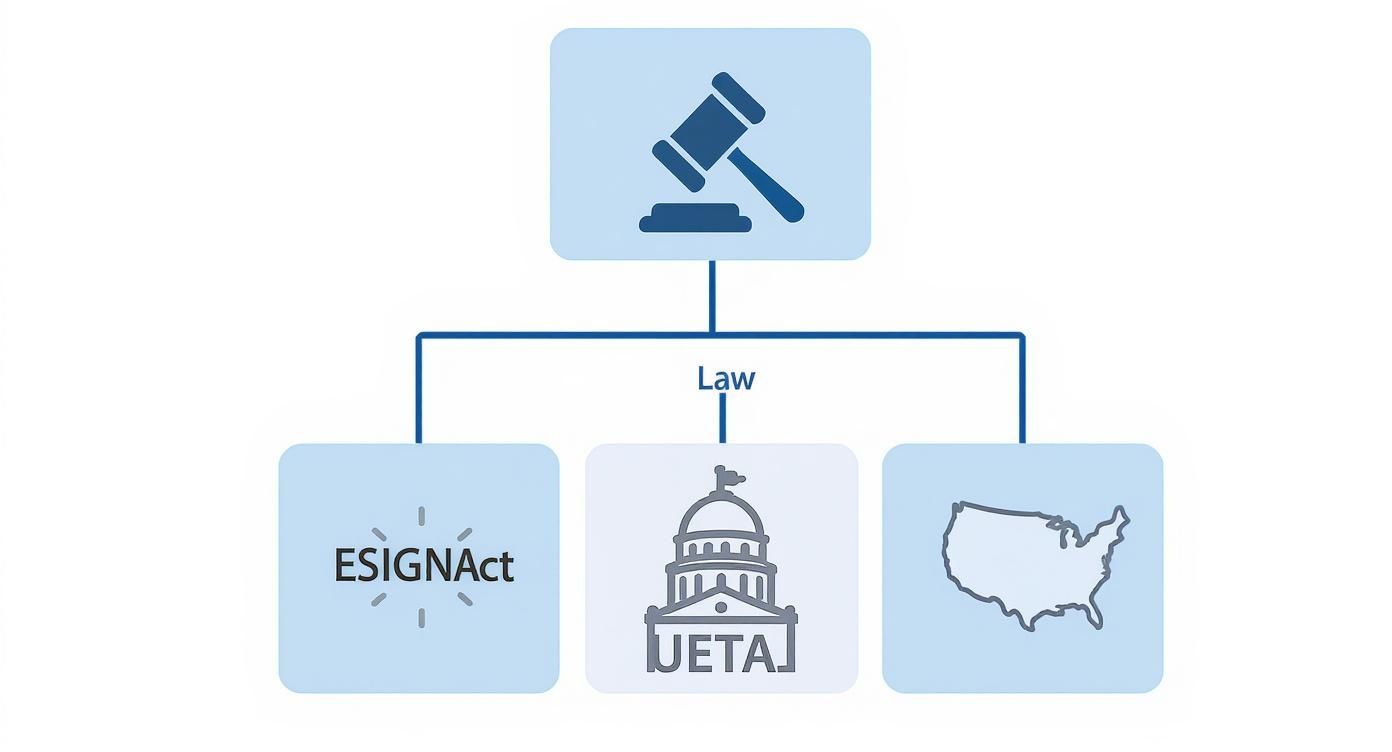
This hierarchy shows the federal ESIGN Act setting a national baseline, while the state-adopted UETA creates consistency. Together, they form a solid legal foundation for digital business across the country.
For any business involved with international legal documents, understanding these differences is a big deal. For example, if you have a document that needs to be officially certified for use in another country, you might run into a process called an apostille. To find out which countries accept this specific type of authentication, you can check out our comprehensive Hague Apostille country list.
Taking the time to navigate these global e-signature requirements ensures your cross-border agreements are not just fast and convenient, but fully compliant and legally sound.
How to Prove a Signature Is Authentic: Identity Verification & Audit Trails
A signature’s legal weight doesn’t come from the mark itself—it comes from proving who made that mark. For an electronic signature to be legally sound, you have to show that the person who signed is exactly who they claim to be. This is where identity verification and audit trails come in; they are the absolute bedrock of a legally defensible e-signature.
Think of an audit trail as the digital equivalent of a detective’s case file for the entire signing event. It’s a complete, time-stamped record that logs every single action taken from start to finish. This digital paper trail makes the entire process transparent and verifiable, giving you the hard evidence needed to stand up to any legal challenge down the road.
The Unbreakable Story of an Audit Trail
A flimsy e-signature process just captures the bare minimum, leaving you exposed if someone later disputes the signature. A robust audit trail, on the other hand, tells a complete, court-admissible story.
A strong audit trail will capture details like:
- Document Timeline: Every key event, including when the document was created, sent, viewed, and ultimately signed by each individual.
- Signer Footprints: The signer’s name, email address, and the IP address they used.
- Authentication Details: A clear record of how each signer’s identity was confirmed before they were allowed to sign.
- Every Action: Each click, page view, and signature placement is logged with a precise timestamp.
This level of detail makes it incredibly difficult for a signer to credibly deny their involvement. In legal terms, this is called non-repudiation.
The whole point of an audit trail isn’t just to get a signature on a page. It’s to build an unbroken chain of evidence that proves intent, consent, and identity beyond a reasonable doubt, effectively locking down the agreement against future disputes.
This chain of evidence is what gives a modern e-signature its legal power. It turns a simple click into a legally binding act.
Identity Verification: The Linchpin of Authenticity
While the audit trail tells you what happened, identity verification proves who did it. Just sending a link to an email address is often not enough, especially for important or high-value documents. To create a signature that holds up under scrutiny, you need stronger methods.
Different situations call for different levels of security. Here’s a rundown of common methods, from basic to highly secure:
- Email Verification: The simplest approach. A unique signing link is sent to a specific email. This works well for low-risk agreements.
- Access Codes: A one-time password (OTP) is sent to the signer’s phone via SMS. This adds a second factor, confirming they have access to their phone.
- Knowledge-Based Authentication (KBA): This is a bigger step up. The system asks the signer questions based on their personal credit and public records history—things only they should know. You see this a lot in finance and real estate.
- ID Verification: This is the gold standard. The signer has to upload a photo of their government-issued ID (like a driver’s license), which is then analyzed by sophisticated tech to confirm it’s legitimate.
Platforms that offer a menu of these options give businesses the flexibility to match the security level to the risk of the transaction. You can learn more about how these different levels of identity verification for online signatures help secure your agreements.
By pairing a rigorous identity check with a detailed audit trail, you create a signature built on a foundation of undeniable proof, satisfying the core legal requirements for authenticity.
Going Beyond the Basics: Industry-Specific and Notary Requirements
While big laws like the ESIGN Act laid the groundwork for e-signatures, they really just set the minimum standard. For anyone working in a highly regulated field, just meeting the general electronic signature legal requirements is only the first step on a much longer journey.
Think of it this way: the ESIGN Act is like the national building code for a house. It ensures the basic structure is sound. But if you’re building in a hurricane zone—say, finance or healthcare—you need to add storm shutters, reinforced concrete, and impact-resistant windows. Those extra layers of protection are what industry-specific rules are all about.
These regulations aren’t just red tape; they exist to protect incredibly sensitive information and demand a higher level of accountability where the stakes are massive. Getting this wrong can invalidate critical documents, trigger steep fines, and expose your entire organization to serious legal trouble.
Navigating the Rules in Healthcare and Finance
In fields where personal health or financial data is on the line, basic security just won’t cut it. Two of the biggest regulatory frameworks to watch out for are HIPAA in healthcare and a slew of rules from bodies like FINRA in the financial world.
- Healthcare (HIPAA): The Health Insurance Portability and Accountability Act (HIPAA) mandates bulletproof safeguards for Protected Health Information (PHI). If you’re using an e-signature solution for patient consent forms, it can’t just be legally binding. It needs powerful access controls, encryption, and airtight audit trails to prove no unauthorized person ever saw that data.
- Finance (FINRA/SEC): Financial services firms are under a microscope. Regulators require them to maintain secure, auditable, and tamper-evident records. Any electronic signature on a client agreement has to be captured and stored in a way that creates an unchangeable history, often for many years, just in case auditors come knocking.
For these industries, it’s not just about getting a signature. It’s about having a full, provable record of who signed, precisely when they signed, and that the document has been locked down and untouched ever since.
The New Frontier: Remote Online Notarization
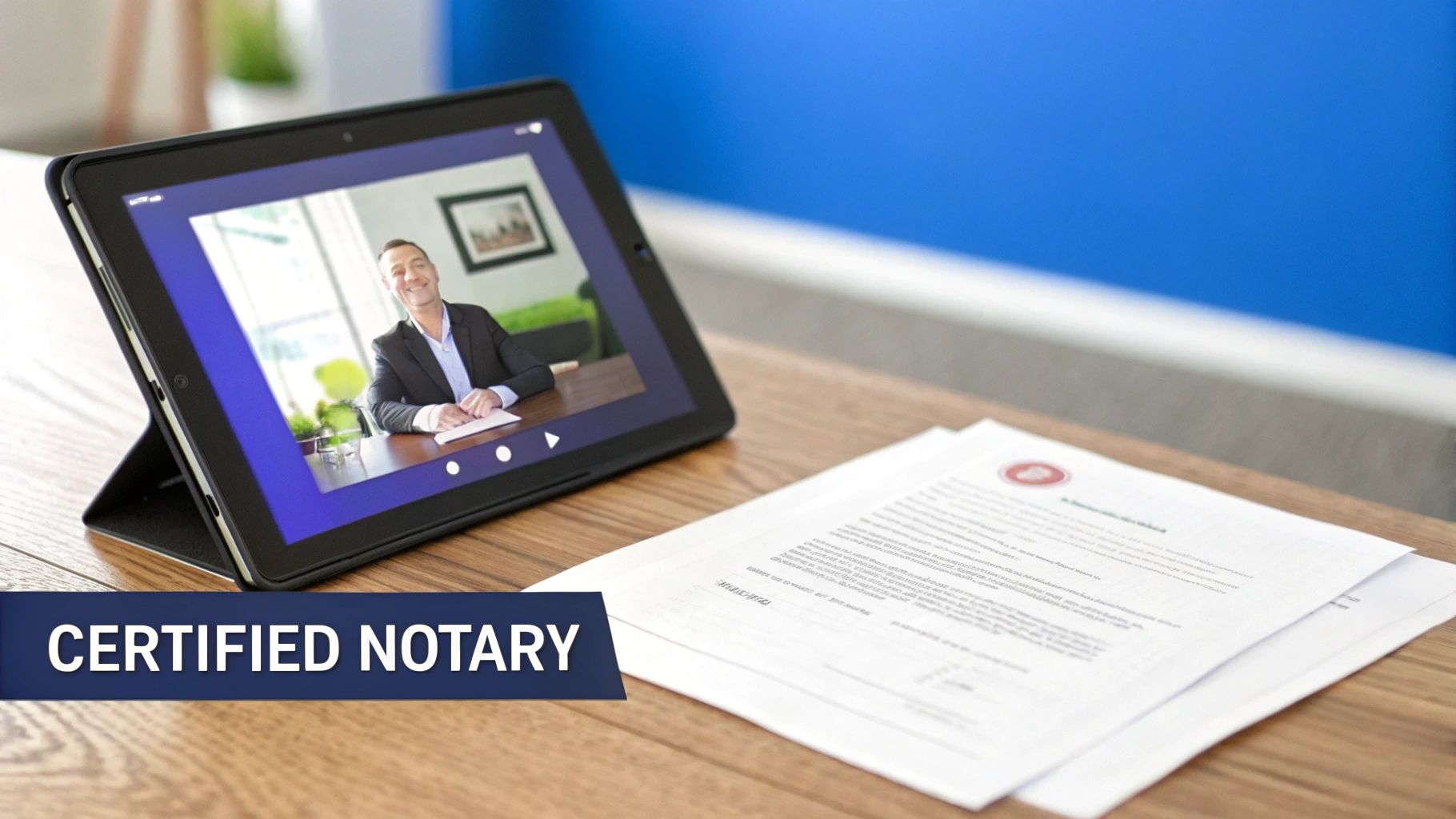
The most specialized use of e-signature technology today is hands-down Remote Online Notarization (RON). A notary’s job has always been to deter fraud by verifying a signer’s identity in person. RON takes this centuries-old process and brings it online, but it’s far more complex than just adding a digital stamp.
A simple e-signature doesn’t come close to what’s required for a notarized document. RON platforms, like BlueNotary, operate under very specific state laws that outline a much more rigorous ceremony.
Remote Online Notarization isn’t just an electronic signature with a notary stamp attached. It is a complete, legally defined ceremony that combines live audio-visual technology with multi-factor identity verification and a secure, tamper-evident digital seal.
This detailed legal framework is designed to provide an even higher level of trust than a standard e-signature, which is why RON is quickly becoming indispensable in real estate, law, and estate planning—fields where document integrity is everything. The legal world’s adoption is especially telling: data predicts that 78% of U.S. law firms will have integrated e-signature tools by 2025 as they move away from cumbersome paper-based systems. You can explore more statistics on e-signature adoption in the legal field.
So, what does a compliant RON session actually involve? It’s a multi-step process.
- Identity Verification: The notary doesn’t just take the signer’s word for it. The process often involves Knowledge-Based Authentication (KBA)—those “out of wallet” questions about past addresses or loans—plus a sophisticated analysis of a government-issued photo ID.
- Live Audio-Visual Session: The signer and the notary must meet face-to-face in real-time over a secure, two-way video connection.
- Secure Journaling and Recording: The entire event, including the video feed, is recorded and stored securely for a period mandated by state law. This creates an indisputable audit trail.
This meticulous approach ensures that professionals in the most demanding fields can execute their most important documents with total confidence, knowing they’ve met every legal standard on the books.
Common Questions About E-Signature Legality
Jumping into electronic signatures can feel a bit like learning a new language. You know it’s powerful, but the details can be fuzzy. Let’s clear up some of the most common questions people have about electronic signature legal requirements so you can move forward with confidence.
What’s the Difference Between an Electronic and a Digital Signature?
It’s easy to see why people use these terms interchangeably, but they aren’t the same thing. Think of it this way: an electronic signature is like signing for a package on a courier’s tablet, while a digital signature is like getting a document notarized inside a bank vault.
An electronic signature is the broad, catch-all legal term. The ESIGN Act defines it as any electronic sound, symbol, or process that shows you intend to sign something. That could be your typed name, a signature you draw with your mouse, or even just clicking an “I Agree” button. It’s all about showing intent.
A digital signature is a specific, highly secure type of electronic signature. It’s not just about what you see; it’s about the technology working behind the scenes. This method uses sophisticated encryption to create a unique, tamper-evident “fingerprint” on the document. This fingerprint does two critical things: it proves who signed it and locks the document down so you can tell if it’s been altered one bit since signing.
How Do You Prove an E-Signature Is Authentic in Court?
This is where the rubber meets the road, legally speaking. Proving an e-signature is real all comes down to the audit trail. A good e-signature platform doesn’t just capture a signature; it records the entire story of the signing event.
This digital paper trail is your key piece of evidence. A solid audit trail will meticulously document every step, including:
- The signer’s IP address
- Precise timestamps for every single action (when it was viewed, when it was signed)
- The exact methods used to verify the signer’s identity
All of this data gets compiled into a court-admissible certificate of completion. It’s an unbroken chain of evidence that makes it incredibly difficult for someone to later claim, “That wasn’t me,” or “That’s not what I agreed to.”
In a legal dispute, the strength of your e-signature is a direct reflection of its audit trail. A flimsy trail creates doubt. A comprehensive one presents irrefutable proof of intent, identity, and integrity.
That’s why simply scanning a “wet” signature and pasting it into a document just doesn’t cut it. It lacks the verifiable data that makes a true e-signature legally sound.
Are E-Signatures Valid Across Different States or Countries?
Great question. Domestically, within the United States, the answer is a resounding yes. Thanks to the federal ESIGN Act and the near-universal adoption of the Uniform Electronic Transactions Act (UETA) at the state level, a compliant electronic signature is legally binding and enforceable from California to New York. This creates a stable legal foundation for business across the country.
Once you go international, things get a bit more complicated. Every country has its own set of rules. For instance, an agreement between a U.S. company and a partner in the European Union needs to respect both the ESIGN Act and the EU’s eIDAS Regulation. The best practice for cross-border deals is to use a platform built for global compliance and to explicitly state in the contract which country’s laws will govern the agreement.
Are There Documents That Still Can’t Be Electronically Signed?
Yes, there are still a few holdouts. Even with the widespread acceptance of e-signatures, some documents are considered so significant that the law insists on an old-fashioned “wet-ink” signature. These exceptions are carved out to ensure there’s absolutely no question about the signer’s understanding and intent.
The most common exclusions are:
- Wills, codicils, and testamentary trusts
- Family law documents, such as papers for divorce or adoption
- Official court orders and certain legal notices
- Notices about utility cancellations or major product recalls
These specific carve-outs protect people in life-altering situations. The list can vary slightly from one jurisdiction to another, so it’s always smart to double-check the relevant state and federal laws for your specific document.
Ready to move your agreements from paper to a fully compliant digital workflow? BlueNotary offers a secure platform with robust identity verification, detailed audit trails, and the industry-specific compliance features you need. Explore how BlueNotary can secure your documents today.