


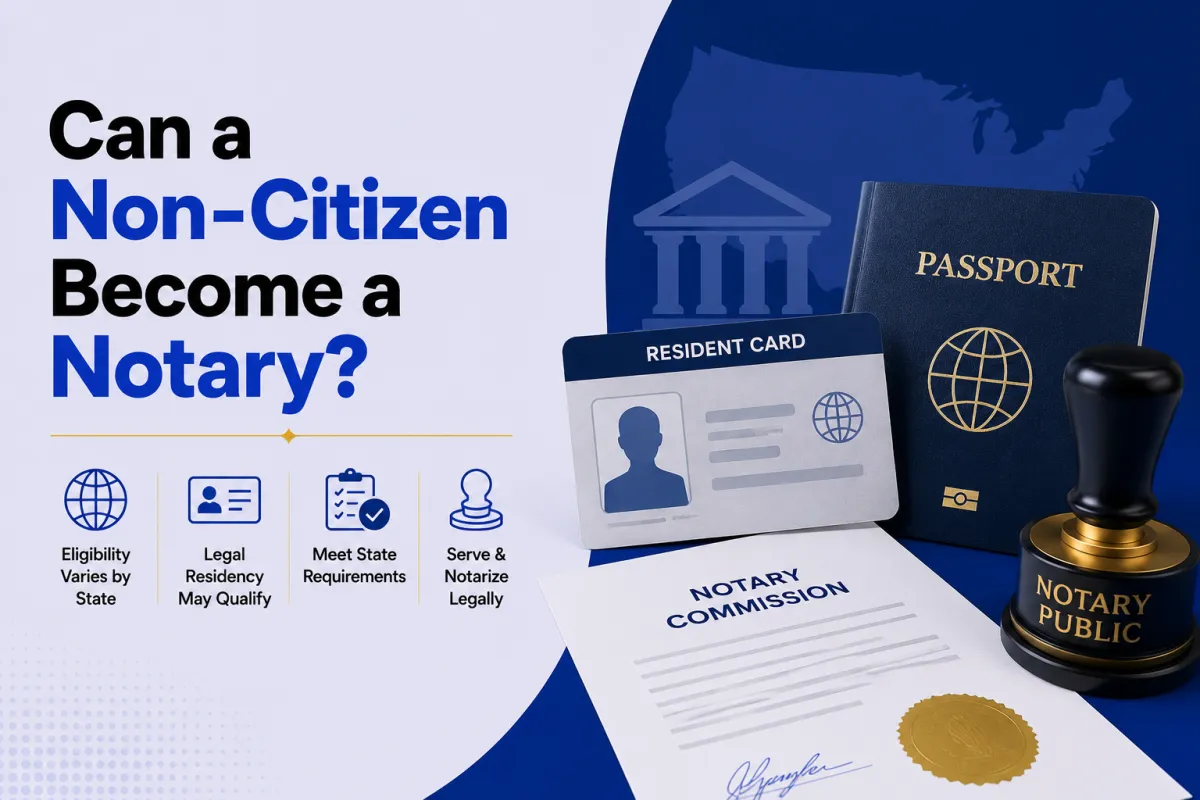

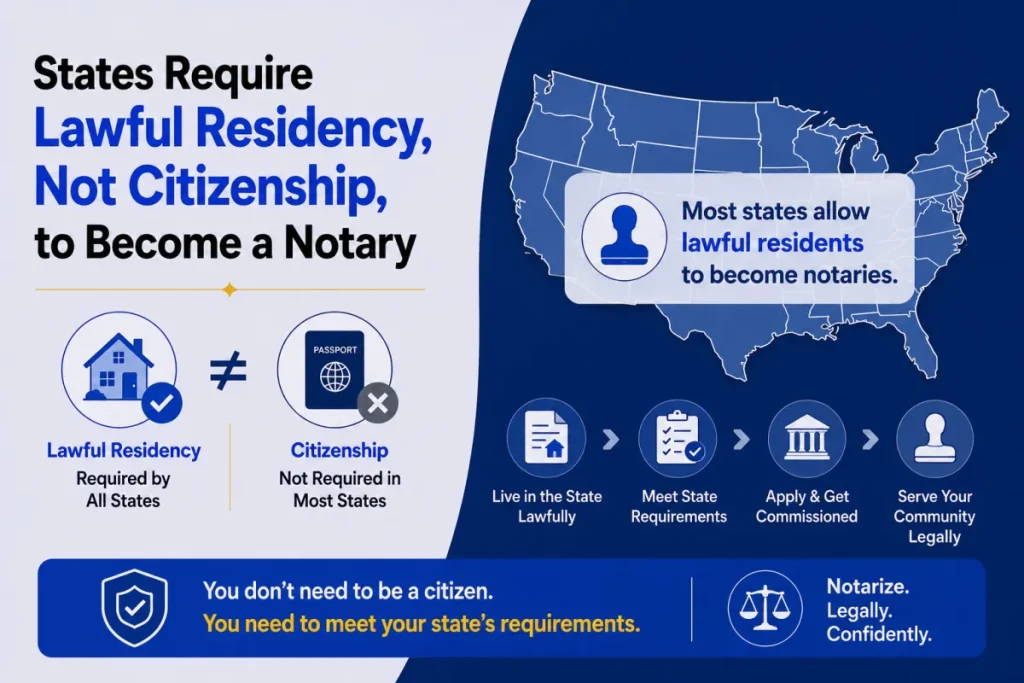
Quick answer: Yes, in most states a non-citizen can become a notary. States require lawful U.S. residency, not U.S. citizenship, because the Supreme Court struck down citizenship requirements for notaries in Bernal v. Fainter (1984). A legal permanent resident who meets the other state requirements can typically qualify; undocumented individuals cannot.
Can a non-citizen become a notary?
Yes, in the large majority of states. A common misconception is that you must be a U.S. citizen to hold a notary commission — but that’s not the standard. States generally require you to be a lawful U.S. resident (and a resident of, or employed in, the state), not a citizen. So a legal permanent resident. A green card holder, who meets the other requirements can typically become a notary.
The reason this rule is so consistent isn’t an accident; it comes from a Supreme Court decision that made citizenship requirements for notaries unconstitutional. That’s the next section. If your goal is to eventually offer online services, see how to become an online notary after you’re commissioned.
Why states can’t require U.S. citizenship
The legal anchor is Bernal v. Fainter (1984), in which the U.S. Supreme Court struck down Texas’s requirement that notaries be U.S. citizens as a violation of the Equal Protection Clause. The Court held that being a notary is largely a ministerial function, verifying signatures and administering oaths, not a role reserved for citizens.
Because of that decision, states generally cannot deny a notary commission solely on the basis that an applicant is a non-citizen. Instead, they require lawful residency. You can read the case at Justia (Bernal v. Fainter, 467 U.S. 216). It’s why “you must be a citizen” is outdated advice.
What you actually need: notary eligibility requirements
Citizenship aside, every state has its own checklist. The common requirements are:
- Be at least 18 years old.
- Be a legal resident of (or employed in) the state where you’re applying, and a lawful U.S. resident.
- Read and write English.
- No disqualifying criminal record, many states bar applicants with certain felony convictions.
- Complete the application process, which may include a training course, an exam, a background check, and a surety bond, depending on the state.
Notice that “U.S. citizen” isn’t on the standard list. The residency and character requirements are what matter, and they apply to citizens and non-citizens alike. Confirm your state’s exact steps via the notarization requirements by state guide.
Green card holders yes, undocumented no
The dividing line is lawful residency, not citizenship:
- Legal permanent residents (green card holders): Eligible in most states, assuming they meet the age, residency, English, and character requirements.
- Some visa holders / DACA recipients: It depends on the state’s definition of “resident”, a few states are stricter, so check locally.
- Undocumented individuals: Not eligible, because notary applicants must be lawfully present and a legal resident.
So “non-citizen” and “ineligible” are not the same thing, lawful permanent residents are a large, eligible group.
It still varies by state, check yours
Eligibility is set state by state, so the details differ. A handful of states have particular residency definitions or additional steps, and the acceptable proof of lawful residency can vary. Before you apply:
- Read your state’s official notary eligibility page (usually the Secretary of State).
- Confirm the residency proof they accept.
- Check character/criminal-record rules, which differ widely.
When in doubt, your state’s commissioning authority, not a third-party site, is the final word.
Conclusion
If you’re a non-citizen wondering whether you can become a notary, the answer in most of the country is yes. States require lawful U.S. residency, not citizenship, and the Supreme Court’s Bernal v. Fainter decision is why they can’t demand citizenship in the first place. A legal permanent resident who is at least 18, resides in (or works in) the state, reads and writes English, and passes the character and application requirements can generally qualify — while undocumented individuals cannot, since lawful residency is required. As always, the specifics are state-set, so verify your state’s exact rules before applying.
Already commissioned, or planning to be? Once you hold a notary commission, you can start offering remote online notarizations, see how to become an online notary, or learn how remote online notarization works on BlueNotary.
Frequently asked questions
Can a non-citizen become a notary?
Yes, in most states. States require lawful U.S. residency rather than citizenship, so a legal permanent resident who meets the other requirements can typically become a notary.
Do you have to be a U.S. citizen to be a notary?
No. Most states do not require citizenship. The Supreme Court struck down citizenship requirements for notaries in Bernal v. Fainter (1984), so states require lawful residency instead.
Can a green card holder become a notary?
Yes, in most states. A legal permanent resident can become a notary if they meet the age, residency, English, and character requirements that apply to everyone.
What are the requirements to become a notary?
Typically being at least 18, a legal resident of the state, able to read and write English, without a disqualifying criminal record, and completing the state’s application, which may include a course, exam, and bond.
Can an undocumented immigrant be a notary?
No. Notary applicants must be lawfully present and legal residents, so undocumented individuals are not eligible to become notaries.
Which states let permanent residents be notaries?
Most states do. Because citizenship generally can’t be required, legal permanent residents are eligible in the large majority of states, though residency definitions vary, so check your state.