


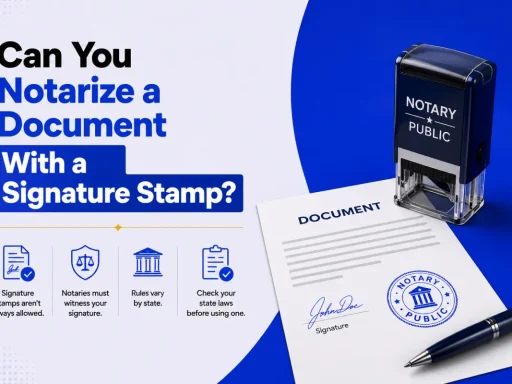
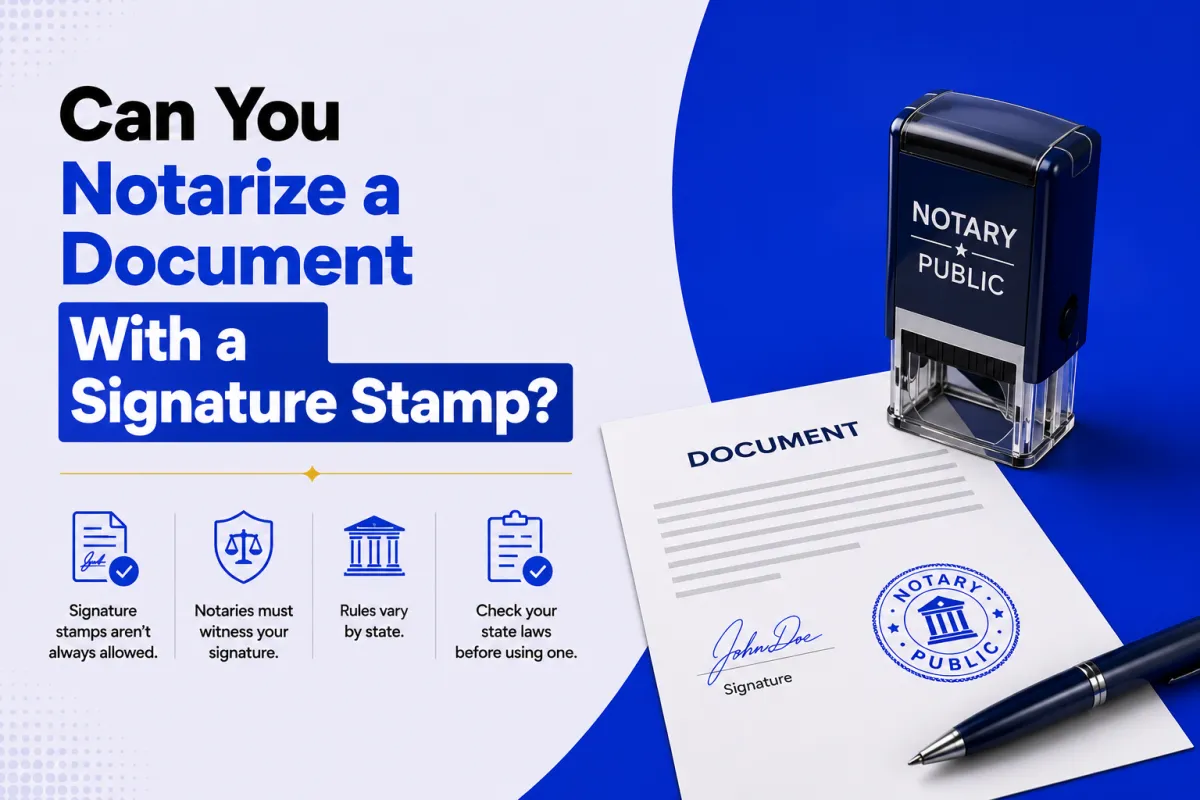

Quick answer: No, you generally can’t notarize a document signed with a signature stamp or facsimile signature. A notary must witness the signer make their signature personally, and a pre-made stamp isn’t a signing act the notary can verify. If a signer physically can’t sign, legitimate alternatives exist, like a signature by mark (an X) or a directed signature but those aren’t the same as a stamp.
Can you notarize a document with a signature stamp?
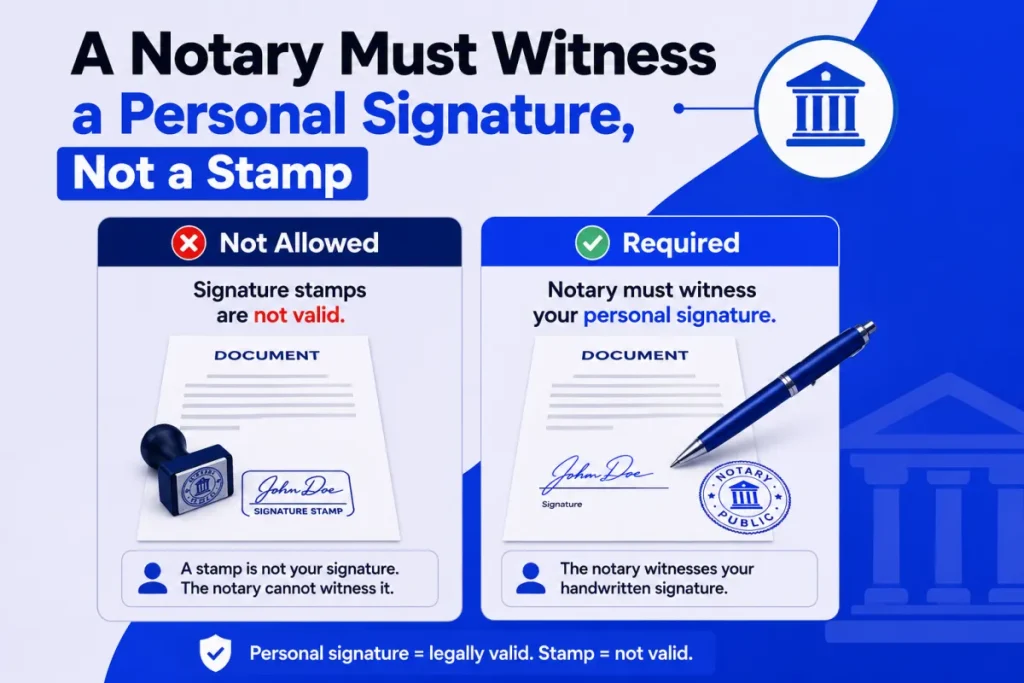
No. A signature stamp, a rubber stamp or facsimile of someone’s signature can’t be used to notarize a document. Notarization exists to confirm that a specific person personally signed, and the notary attests to witnessing (or the signer acknowledging) that act. A stamp applied by pressing it onto paper isn’t a personal signing the notary can verify, so it fails the core requirement.
The same goes for autopen or other automatic-signing devices. What the notary needs is the signer’s own act either signing in front of them, or personally acknowledging a signature as theirs. A pre-made mark doesn’t meet that bar. The identity-and-signing requirement is the heart of the process; see what you need to notarize.
Why a signature stamp doesn’t work
A notary’s job is to deter fraud by confirming the right person signed willingly and knowingly. A signature stamp undermines every part of that:
- Anyone could apply it: A stamp doesn’t prove the actual person signed, someone else could press it.
- There’s no personal act to witness: The notary can’t attest to a signing that’s really just a stamp impression.
- It defeats the fraud protection: The whole point of notarization would be lost. This is the same impartiality-and-verification principle behind notarization fraud red flags.
So even if you routinely use a signature stamp for convenience, on business documents, for example, it won’t fly for a notarized signature.
If you can’t sign: the signature by mark
The stamp question often comes up because the signer physically can’t sign, due to injury, illness, or disability. For that, the law provides a real accommodation: the signature by mark.
The signer makes a mark (commonly an “X”) instead of a full signature, in the notary’s presence. States typically require:
- The mark is made in front of the notary, and
- One or two witnesses observe it, and often
- The notary or a witness prints the signer’s name near the mark.
A signature by mark is a legitimate, verifiable act, unlike a stamp, so it’s the correct route when someone can’t produce a handwritten signature.
Directed signatures: signing at the signer’s request
Some states allow another option when a signer can’t sign at all: a directed signature (also called signing by proxy). Here, another person signs the signer’s name, but only:
- At the signer’s explicit direction,
- In the presence of the signer and the notary, and
- Following the state’s specific procedure (often with witnesses and a note in the notarial record).
This is very different from a signature stamp, it’s a live, directed, witnessed act, not a pre-made impression. Because the rules are strict and vary, confirm your state’s procedure in the notarization requirements by state guide before relying on it.
What about the notary’s own signature?
The rule cuts both ways, a notary must sign each notarization by hand, a wet-ink signature, or a proper electronic signature in online notarization, not a facsimile or signature stamp. A notary using a rubber-stamp signature on the notarial certificate would invalidate the act.
Note that an electronic signature in remote online notarization is not a “stamp”, it’s the person (signer or notary) applying their signature live during the session, which is exactly the personal act the law requires.
Conclusion
You can’t notarize a document signed with a signature stamp or facsimile, notarization depends on the notary witnessing a personal signing act, and a stamp isn’t one. If the reason you’re asking is that you can’t physically sign, the law has you covered with legitimate accommodations: a signature by mark (an X made in front of the notary with witnesses) or, where allowed, a directed signature by another person at your direction. Both are real, verifiable acts. And remember that a notary’s own signature must be handwritten or electronically applied too, never stamped.
Need to sign and notarize without the hassle? Notarize online with a commissioned notary on BlueNotary in about 15 minutes, 24/7. You sign live on video, which is fully valid. Not sure what your document or situation requires? Start with what you need to notarize.
Frequently asked questions
Can you notarize a document signed with a signature stamp?
No. A signature stamp or facsimile can’t be used for notarization because the notary must witness the signer personally sign. A pre-made stamp isn’t a signing act the notary can verify.
Can a notary accept a facsimile signature?
No. A facsimile or auto-applied signature doesn’t prove the person personally signed, so a notary can’t attest to it. The signer must sign in the notary’s presence or personally acknowledge the signature.
Why can’t you use a signature stamp for notarization?
Because anyone could apply a stamp, there’s no personal signing act to witness, and it defeats the fraud protection notarization is meant to provide. The notary must confirm the actual person signed willingly.
What if you can’t physically sign a document?
You can use a signature by mark, an X made in the notary’s presence, usually with witnesses who observe it and print your name near the mark. It’s a legitimate, verifiable alternative to signing.
Can someone sign a notarized document for you?
In some states, yes, through a directed signature, another person signs at your explicit direction, in your and the notary’s presence, following the state’s procedure. It’s different from a signature stamp.
Can a notary use a signature stamp for their own signature?
No. A notary must sign each notarization by hand or with a proper electronic signature. A facsimile or stamped notary signature would invalidate the notarial act.