


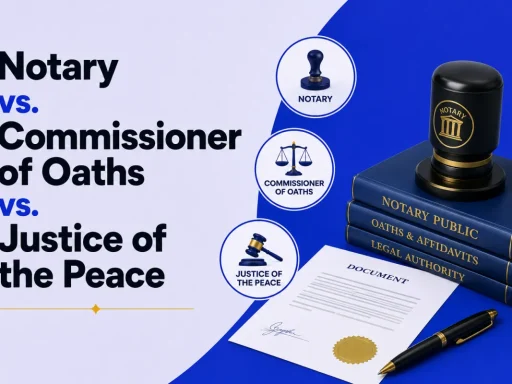
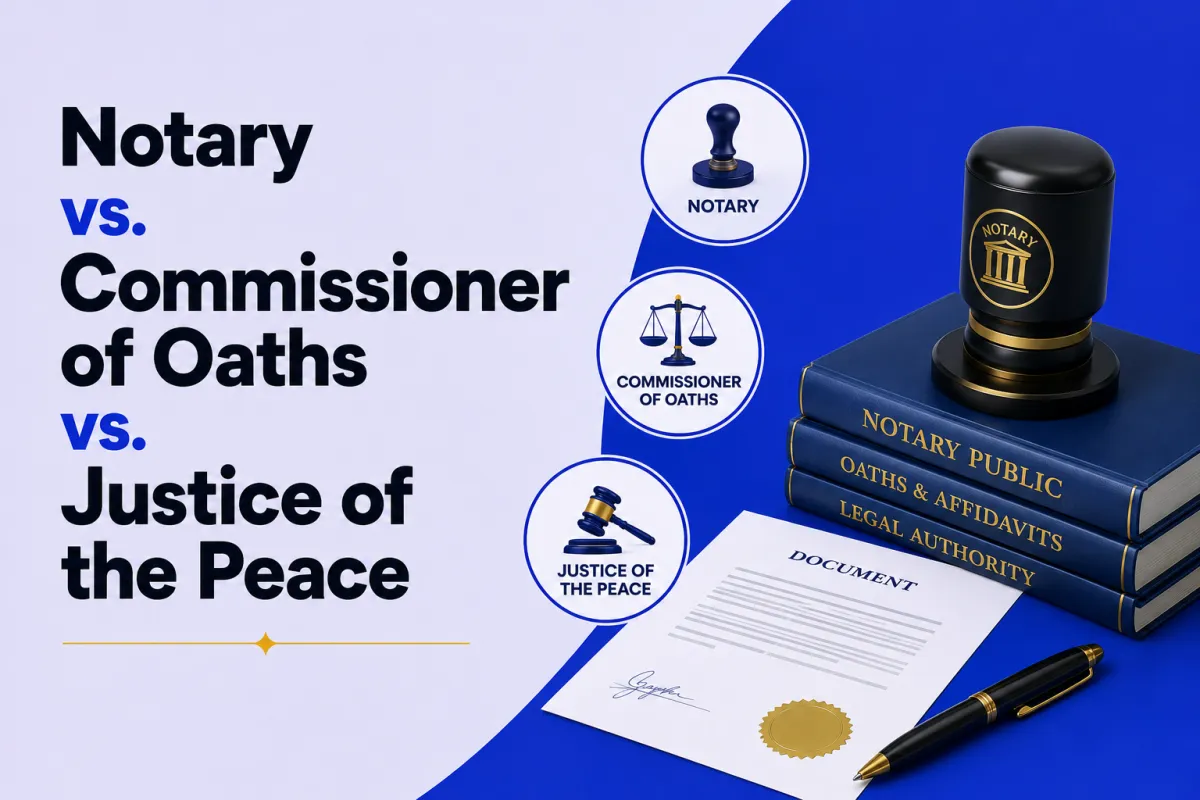

Quick answer: They sound alike but do different jobs. A notary public authenticates signatures and documents with an official seal, recognized for legal and international use. A commissioner of oaths only administers oaths and witnesses affidavits, mainly in Canada and the UK. A justice of the peace is a judicial officer (in Commonwealth countries, also witnesses and certifies documents). In the U.S., you almost always need a notary.
What does a notary public do?
A notary public is a state-appointed official whose core job is to verify a signer’s identity and witness signatures, deterring fraud. Notaries also administer oaths and affirmations (for affidavits and jurats) and, in many states, certify copies of certain documents. Their work carries an official seal and a notarial certificate, which is what makes a notarized document trusted by banks, courts, and with an apostille, foreign governments.
Crucially, a notary is not a lawyer and can’t give legal advice, they authenticate, they don’t advise. In the U.S., when someone says a document “needs to be notarized,” this is the role they mean. You can do it in person or through online notarization, and the range of documents is broad, see what documents require notarization.
What does a commissioner of oaths do?
A commissioner of oaths (or “commissioner for oaths”) is a role found mainly in Canada, the UK, and other Commonwealth countries. Their authority is narrower than a notary’s: they can administer oaths and affirmations and witness the signing of affidavits and statutory declarations — and that’s largely it.
What they generally cannot do is certify true copies of documents or authenticate documents for international use — those are a notary public’s job in those countries. So a commissioner of oaths is the right choice for a domestic sworn statement, but not for a document going abroad. This is why people in Canada/UK are sometimes sent to a commissioner for one task and a notary for another.
What does a justice of the peace do?
The justice of the peace (JP) role varies the most by country:
- In Commonwealth countries (Australia, Canada, UK): A JP often witnesses documents, certifies copies, and administers oaths, essentially a free, everyday document-witnessing service similar to a commissioner of oaths, sometimes broader.
- In the United States: A JP is generally a minor judicial officer who may perform marriages and handle small-claims or low-level court matters, not a routine document-authentication role.
So whether a JP can help with your document depends heavily on where you are. In the U.S., don’t expect a JP to be your go-to for notarizing paperwork.
Which one do you need?
Match the role to your task and location:
- You’re in the U.S. and a document needs notarizing → a notary public (in person or online).
- You’re in Canada/UK and need a sworn affidavit or statutory declaration → a commissioner of oaths (or a notary/JP).
- You need a certified copy or a document for international use → a notary public (plus an apostille for abroad).
- You need a marriage officiated (U.S.) → a justice of the peace may qualify, depending on the state.
When in doubt, ask the party requesting the document exactly which official they require, the title matters, and using the wrong one means a redo.
Conclusion
The three roles get confused because they overlap in casual language, but they’re distinct. A notary public is the broad, seal-bearing authority who authenticates signatures and documents and is recognized internationally, the role you need for almost anything in the U.S. A commissioner of oaths is a narrower Commonwealth role limited to oaths and affidavits, and a justice of the peace is a judicial officer whose document powers depend entirely on the country. The safest approach is to identify your task and jurisdiction, then confirm the exact title the receiving party wants.
If you’re in the U.S. and need a document notarized, you need a notary, and you can connect with a commissioned online notary on BlueNotary in about 15 minutes, 24/7. Not sure your document needs a notary at all? Start with what documents require notarization.
Frequently asked questions
What’s the difference between a notary and a commissioner of oaths?
A notary authenticates signatures and documents with an official seal and is recognized internationally. A commissioner of oaths only administers oaths and witnesses affidavits, mainly in Canada and the UK, and usually can’t certify copies.
Is a commissioner of oaths the same as a notary public?
No. A commissioner of oaths has narrower authority, oaths and affidavits only. A notary public can also certify copies (in many places) and authenticate documents for international use, which a commissioner generally cannot.
What does a justice of the peace do?
It varies by country. In Commonwealth nations a JP often witnesses and certifies documents and administers oaths. In the U.S., a JP is usually a minor judicial officer who may perform marriages and handle small court matters.
Can a commissioner of oaths certify a copy?
Usually not. Certifying true copies is generally a notary public’s role. A commissioner of oaths is limited to administering oaths and witnessing affidavits and statutory declarations.
Do I need a notary or a commissioner of oaths?
In the U.S., you need a notary public. In Canada or the UK, a commissioner of oaths handles domestic sworn statements, but a notary is needed for certified copies or documents used internationally.
Is a notary public recognized internationally?
Yes, especially when paired with an apostille for use in Hague Convention countries. A commissioner of oaths generally is not recognized for international documents.