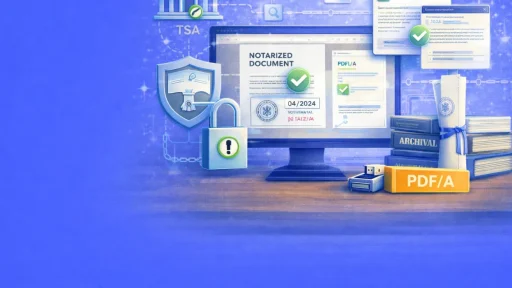






The notary seal has authenticated documents for centuries. That familiar round or rectangular imprint, pressed into paper with ink or embossed into the page itself, signals that a qualified official has verified identities and witnessed signatures. But as documents have migrated from paper to pixels, the notary stamp has undergone its own transformation.
Electronic notary stamps now appear on PDFs and digital documents, serving the same authentication function as their physical counterparts. Understanding how these digital seals work, where they carry legal weight, and when traditional stamps remain necessary helps businesses and individuals navigate modern notarization confidently.
The Foundation of Legal Equivalence
Two landmark federal laws establish that electronic signatures and records carry the same legal weight as paper-based alternatives. The Electronic Signatures in Global and National Commerce Act (ESIGN), enacted in 2000, declares that signatures and records cannot be denied legal effect solely because they are electronic. The Uniform Electronic Transactions Act (UETA), adopted by 47 states, provides the same assurance at the state level.
Section 11 of UETA specifically addresses notarization. When a law requires a signature or record to be notarized, acknowledged, or made under oath, that requirement is satisfied if the electronic signature of the notary, together with all other required information, is attached to or logically associated with the record. This language effectively removes traditional stamp and seal requirements when proper electronic equivalents are used.
These laws establish that electronic notary stamps are not merely tolerated substitutes for physical stamps. They are legally equivalent alternatives that fulfill the same authentication function through digital means.
How Physical Stamps Work
Traditional notary stamps come in two primary forms: rubber ink stamps and embossers. Each creates a different type of impression on paper.
Rubber Ink Stamps
Rubber stamps press inked images onto paper. The stamp contains the notary’s identifying information in reverse, and when pressed against an ink pad and then paper, it transfers that information as a visible mark. Most states require black or blue ink that produces clear, photographically reproducible impressions.
Ink stamps offer several practical advantages. They create highly legible impressions that photocopy and scan clearly. They require minimal pressure to apply and work on various paper weights. Modern self-inking stamps contain internal ink reservoirs that automatically re-ink the stamp face between uses.
Embossers
Embossers create raised impressions by pressing paper between two dies. The resulting impression has no ink but appears as a raised pattern visible when held at an angle or felt by touch. Embossers provide tamper evidence because the raised impression is difficult to replicate without the original tool.
However, embossed seals present challenges in the digital age. The raised impression may not photocopy or scan legibly, leading to rejected documents. Many states now require embossers to be used alongside ink stamps rather than alone, or recommend applying ink over the embossed impression to ensure legibility in copies.
State Specifications for Physical Stamps
Each state prescribes specific requirements for notary stamps. These typically include shape and size limitations, required text elements, and sometimes ink color restrictions.
Common required elements include the notary’s name exactly as it appears on their commission, the words “Notary Public,” the state name, and the commission expiration date. Some states additionally require a commission number, county of commission, or specific phrases like “My commission expires on.”
Shape requirements vary significantly. Many states permit circular stamps up to two inches in diameter or rectangular stamps not exceeding one inch by two and a half inches. Some states, like Arkansas, mandate rectangular stamps and prohibit embossers entirely. Others, like Louisiana, consider the notary’s signature itself to be their seal, making physical stamps optional for paper notarizations.
The serrated or milled edge border appears in many state requirements. This decorative edge helps distinguish authentic notary stamps from generic rubber stamps and adds a visual element that is difficult to reproduce casually.
How Electronic Stamps Work
Electronic notary stamps are digital images that serve the same identification function as physical stamps. However, the technology underlying them provides additional security features that physical stamps cannot match.
The Visual Component
At its simplest level, an electronic stamp is a high-resolution image file containing the same information required on a physical stamp. This image is typically created at 300 DPI (dots per inch) or higher to ensure clarity when displayed on screen or printed. Common file formats include PNG (often with transparent backgrounds for placement over existing document content), JPEG, PDF, and TIFF.
The visual appearance mirrors physical stamp requirements. A Texas electronic seal, for example, must contain the notary’s name, the words “Notary Public, State of Texas,” the commission expiration date, and the notary identification number, all within a circular form not exceeding two inches in diameter with a serrated edge border.
Many RON platforms and state registration portals specify acceptable image formats and dimensions. Texas accepts BMP, JPEG, PNG, and TIF formats for electronic seal uploads. Some platforms recommend dimensions of 400×200 or 400×400 pixels with transparent backgrounds to accommodate placement on documents with colored backgrounds.
The Cryptographic Component
The visual image alone provides only visual authentication. The true security of electronic notarization comes from the digital certificate that accompanies it.
A digital certificate is an encrypted file based on Public Key Infrastructure (PKI) technology. When the notary applies their electronic seal to a document, the digital certificate creates a cryptographic hash of the document’s contents and signs it with the notary’s private key. This signature binds the notary’s identity to that specific document at that specific moment.
If anyone modifies the document after the digital certificate is applied, the cryptographic signature becomes invalid. PDF readers and other software can detect this invalidity and display a warning that the document has been altered. This tamper-evident property provides security that physical stamps simply cannot achieve.
Embedding in PDFs
When a notary electronically notarizes a PDF document, several elements are embedded. The visual stamp image appears at the designated location, typically near the notary’s electronic signature on the notarial certificate. The digital certificate attaches to or logically associates with the document, creating the tamper-evident seal.
Modern PDF readers can display information about the digital signature by clicking on the signature area. This reveals details including when the document was signed, the identity of the signer as verified by the certificate authority that issued the digital certificate, and whether the document has been modified since signing.
The embedded metadata includes timestamps that record exactly when the notarization occurred. Unlike physical stamps where the date must be written separately and could theoretically be falsified, electronic timestamps are cryptographically bound to the notarization event.
State Requirements for Electronic Seals
States that authorize electronic notarization specify requirements for electronic seals, often in addition to their existing requirements for physical stamps.
Registration Requirements
Most states require notaries who wish to perform electronic notarizations to register separately for that capability. This registration typically involves submitting an electronic seal image and digital certificate information to the commissioning authority.
Texas requires online notary applicants to upload their electronic seal image to the Secretary of State’s online notary application system. The seal must meet all traditional format requirements while also being submitted in an acceptable digital format.
Pennsylvania requires that the electronic certificate contain the same identifying information required on a physical stamp, ensuring legal validity and transparency whether the notarization is performed on paper or electronically.
Content Equivalence
A consistent principle across states is that electronic seals must contain the same information required on physical seals. The electronic medium does not reduce the informational requirements; it merely changes the format.
If a state requires commission numbers on physical stamps, it requires commission numbers on electronic seals. If a state mandates specific phrases like “Commonwealth of Pennsylvania,” that phrase must appear on both physical and electronic seals. This equivalence ensures that anyone examining a notarized document, whether physical or electronic, can obtain the same identifying information about the notary who performed the act.
Digital Certificate Requirements
States increasingly specify technical standards for digital certificates used in electronic notarization. Common requirements include X.509 compliance, PKI technology from a recognized certificate authority, and the capability to render document changes evident after the certificate is applied.
Some states leave certificate vendor selection to the notary while requiring the vendor to meet specified standards. Others maintain lists of approved technology providers. The technical complexity of these requirements has led many notaries to work through RON platforms that handle certificate management as part of their service.
Security Comparison
Physical and electronic stamps offer different security characteristics. Understanding these differences helps evaluate which format better serves particular needs.
Physical Stamp Security
Physical stamps provide security through custody control. The stamp is a tangible object that the notary must physically possess to use. State laws uniformly prohibit allowing anyone else to use a notary’s stamp and require notaries to maintain sole custody of their stamping devices.
However, physical stamps are vulnerable to loss or theft. A stolen stamp could be used fraudulently until the notary discovers the theft and reports it. The impressions themselves can potentially be reproduced through high-quality printing or stamp fabrication, though doing so constitutes a crime.
The security of physical notarization also depends on the difficulty of altering paper documents after notarization. While not impossible, physically altering a signed and stamped document leaves evidence that trained examiners can detect.
Electronic Stamp Security
Electronic stamps secured by digital certificates provide cryptographic tamper evidence. Any modification to the document after the digital signature is applied invalidates the signature. This protection is immediate and automatic, requiring no special examination to detect.
The digital certificate binds the notary’s identity to the act through cryptographic means verified by certificate authorities. This creates an authentication chain that is mathematically verifiable rather than relying on visual comparison of seal impressions.
However, electronic security depends on protecting the notary’s private key. If an attacker gains access to the private key, they could potentially create fraudulent signatures. This is why RON platforms and digital certificate providers implement strong authentication requirements and why states prohibit notaries from sharing their credentials.
Audit Trail Differences
Physical notarization creates a limited audit trail. The notary’s journal records details about each act, but this record is maintained separately from the notarized document itself. Years later, connecting a specific document to its journal entry may require effort.
Electronic notarization creates comprehensive embedded audit trails. The notarization event is recorded within the document itself through metadata and potentially through separate audit records maintained by the RON platform. Video recordings of RON sessions provide additional evidence of how the notarization was performed.
When Physical Stamps Remain Required
Despite legal equivalence, certain situations continue to require physical stamps and wet ink signatures.
Documents Excluded from Electronic Transaction Laws
Both ESIGN and UETA exclude specific document categories from electronic execution. These exclusions include wills and testamentary trusts, family law documents such as adoption and divorce papers, court orders, and certain notices related to utility termination, foreclosure, or insurance cancellation.
Documents in these categories typically require traditional notarization with physical stamps even when electronic alternatives might otherwise be available. The exclusions reflect legislative judgment that the formality of paper-based execution serves important purposes for these high-stakes documents.
Recording Office Requirements
Real property documents must typically be recorded with county recording offices. While many recording offices now accept electronically notarized documents, not all do. The acceptance varies by county, and document submitters must verify that their local recording office can process electronic documents before relying on electronic notarization.
Some recording offices accept electronic documents but require specific formatting, security features, or submission methods. Others remain paper-only and require physically notarized documents. This fragmented landscape means that real estate professionals must understand their local requirements.
International Use and Apostilles
Documents intended for use in foreign countries often require apostille certification, which authenticates the notary’s authority for recognition under the Hague Apostille Convention. The apostille process has traditionally required physical documents with original signatures and seals.
Progress toward electronic apostilles is underway. As of 2024, seven U.S. states (Montana, Utah, Rhode Island, Connecticut, Maryland, Minnesota, and Washington) offer digital apostille services. However, only Florida, Kentucky, Michigan, and Texas currently apostille documents that were notarized electronically.
For the remaining states and most international contexts, electronically notarized documents cannot currently receive apostilles. Individuals needing apostilled documents must often obtain traditional paper notarization, even if electronic notarization would otherwise be acceptable domestically.
Some foreign authorities remain unfamiliar with or skeptical of electronic notarization regardless of apostille status. When documents will be submitted to foreign governments, banks, or courts, verifying acceptance of electronic notarization before proceeding avoids potential rejection.
Industry and Institutional Preferences
Certain industries maintain wet signature requirements despite legal authorization of electronic alternatives. Government agencies at various levels may require physical signatures for specific document types. Banks and financial institutions sometimes require wet signatures for high-value transactions or complex instruments.
These requirements often stem from regulatory frameworks, risk management policies, or system limitations rather than legal necessity. They may change over time as organizations update their practices, but document signers must work within current institutional requirements.
Image Quality and Reproduction
Whether physical or electronic, notary stamps must produce clear, legible images that can be reproduced accurately.
Photocopy and Scan Requirements
State laws commonly require that notary stamps be capable of photographic reproduction. This requirement predates digital scanning but applies equally to modern scanning practices. A stamp impression that cannot be read when the document is photocopied or scanned fails to serve its authentication purpose.
Black ink typically reproduces most clearly. Some states prohibit certain ink colors (Tennessee prohibits black ink in favor of colors that appear black when photocopied, creating visual distinctiveness while maintaining reproducibility). Blue ink is widely accepted and offers some protection against confusion with photocopied documents.
Resolution and Format for Electronic Seals
Electronic seals should be created at sufficient resolution to appear clear when displayed at various sizes and when printed. The commonly recommended 300 DPI standard ensures legibility across most use cases.
File format choice affects how the seal appears when placed on documents. PNG files with transparent backgrounds allow the seal to overlay existing document content without creating white rectangles. JPEG files with white backgrounds work well when placed in designated clear areas but may obscure underlying text if positioned incorrectly.
Placement Best Practices
Whether physical or electronic, stamps should be placed prominently on the notarial certificate near the notary’s signature. Placement should not obscure other document content, signatures, or text that might be important to the document’s meaning.
Electronic platforms typically provide designated seal placement areas within the notarial certificate template, ensuring appropriate positioning. Physical stamps require the notary to select appropriate placement manually, avoiding signatures, printed text, and document edges.
Transitioning Between Formats
Notaries often work with both physical and electronic documents, requiring them to maintain both stamp types and understand when each applies.
Maintaining Both Stamps
A notary authorized for both traditional and electronic notarization typically maintains both a physical rubber stamp (and potentially an embosser) and an electronic seal image with associated digital certificate. The physical tools remain in the notary’s exclusive custody, while the electronic credentials are secured through platform login protections and certificate passwords.
When a commission expires or information changes, both physical and electronic stamps must be updated. Physical stamps should be destroyed or defaced to prevent misuse. Electronic seals should be replaced in all systems where they are registered.
In-Person Electronic Notarization
In-person electronic notarization (IPEN) involves the signer appearing physically before the notary while signing an electronic document. The notary applies their electronic seal and digital certificate to the electronic document rather than using a physical stamp on paper.
IPEN combines the identity verification benefits of in-person appearance with the security and efficiency benefits of electronic document handling. The document never exists on paper, avoiding scanning or printing steps while maintaining the notary’s direct observation of the signing.
Converting Between Formats
Once a document is notarized, its format should not change. A physically notarized paper document should remain in paper form; scanning it creates a copy, not a notarized electronic document. Similarly, printing an electronically notarized document creates a paper copy that loses the embedded digital certificate protections.
If a document must exist in a different format than originally notarized, re-notarization in the desired format is the proper approach rather than format conversion of an existing notarization.
Common Questions About Stamp Equivalence
Can I Use Either Type Interchangeably?
Within a single notarial act, you use one or the other, not both. For paper documents, use physical stamps. For electronic documents, use electronic seals. The document format determines the stamp format.
Across different transactions, you can use whichever format suits the situation, subject to any document-specific requirements that mandate a particular format.
Are Electronic Seals Accepted Everywhere?
Electronic seals are legally valid for most domestic purposes under ESIGN and UETA. However, specific recipients, recording offices, or foreign authorities may not accept them. Always verify acceptance with the receiving party before completing electronic notarization for critical documents.
What If Someone Questions the Validity?
Electronic notarizations can be verified by examining the digital certificate in a PDF reader. The certificate displays the notary’s identity, the timestamp, and whether the document has been modified. Physical notarizations can be verified by checking the notary’s commission status with the commissioning authority and comparing journal records.
Do Electronic Seals Expire?
Electronic seal images remain valid as long as the underlying commission remains valid. However, digital certificates typically have shorter validity periods (often one to three years) and must be renewed separately from the commission itself.
Can Electronic Notarizations Be Apostilled?
Currently, only Florida, Kentucky, Michigan, and Texas apostille electronically notarized documents. For documents needing apostilles in other states, traditional paper notarization is required.
What Happens If My Electronic Seal Is Compromised?
Report the compromise immediately to your commissioning authority and any platforms where the seal is registered. The digital certificate should be revoked, preventing its further use. You will need to obtain a new digital certificate and potentially a new electronic seal image.
Frequently Asked Questions
Are electronic notary stamps legally equivalent to physical stamps?
Yes. Federal laws (ESIGN) and state laws (UETA) establish that electronic signatures and seals have the same legal effect as their paper counterparts. The electronic seal, combined with a digital certificate, satisfies notarization requirements just as a physical stamp does.
What information must an electronic seal contain?
Electronic seals must contain the same information required on physical seals in your state. This typically includes your name as commissioned, the words “Notary Public,” the state name, and your commission expiration date. Some states also require commission numbers or specific phrases.
What file format should I use for my electronic seal?
PNG format with a transparent background is most versatile, allowing placement over documents with colored backgrounds. JPEG, PDF, and TIFF formats are also widely accepted. Check your state’s requirements and your RON platform’s specifications for accepted formats.
Can I use my electronic seal for paper documents?
No. Electronic seals apply to electronic documents. Paper documents require physical stamps. The document format determines which seal type to use.
Will foreign countries accept electronically notarized documents?
Acceptance varies. Some countries and authorities accept electronic notarization; others do not. Documents requiring apostilles present particular challenges, as only four U.S. states currently apostille electronically notarized documents. Always verify acceptance before relying on electronic notarization for international use.
What provides security for electronic seals?
Digital certificates using Public Key Infrastructure (PKI) technology provide cryptographic security. The certificate creates a tamper-evident seal that invalidates if the document is modified. This provides stronger tamper detection than physical stamps, which rely on the difficulty of altering paper documents.
Do I need separate seals for RON and in-person electronic notarization?
Typically, the same electronic seal works for both remote and in-person electronic notarization. However, some states require separate registrations or authorizations for remote notarization capabilities. Check your state’s specific requirements.
How long should I keep my electronic seal records?
Maintain records according to your state’s retention requirements, typically matching the journal retention period (often seven to ten years). Keep records of when seals were created, registered, and replaced or destroyed.
Conclusion:
Electronic notary stamps represent the natural evolution of notarial practice into the digital age. They fulfill the same authentication function as physical stamps while adding cryptographic security features that paper-based alternatives cannot match.
Legal equivalence is well established. Federal and state laws confirm that electronic seals satisfy notarization requirements when properly applied with appropriate digital certificates. The visual seal image provides familiar identification, while the underlying digital certificate ensures document integrity.
Understanding when each format applies, recognizing the situations where physical stamps remain necessary, and maintaining proper credentials for both paper and electronic notarization prepares notaries and document signers for the current hybrid landscape.
For electronic notarization with legally compliant seals and robust digital certificates, BlueNotary provides the technology infrastructure that ensures your electronic stamps meet all state requirements.