




Biometric authentication is a way of confirming you are who you say you are by using your unique biological traits. Think of it less like a password you know or a key you have, and more like a confirmation of who you are. Your face, your fingerprint, your voice—these become the keys to your digital life.
Your Body Is the Ultimate Password
Forget trying to remember another long, complicated password that you’ll probably forget anyway. That whole system is what biometric authentication is here to fix. Instead of typing in a secret code that a hacker could guess or steal, this technology simply analyzes a part of you that is completely unique.
It’s a lot like a friend recognizing your face in a crowd. It’s instant, natural, and incredibly personal.
This is a massive leap forward for digital security. For years, passwords have been the weakest link in the chain, leading to countless data breaches. They get lost, stolen, or reused on too many websites. Biometrics tackle this problem head-on by tying your identity directly to you. It’s a key that can’t be misplaced, forgotten, or easily copied.
What Makes Biometrics Different?
The real power of biometrics comes from these unique, measurable characteristics. A password or a security fob is something external that can be compromised. Your biometric data, on the other hand, is an intrinsic part of you. This makes it far tougher for anyone else to gain access.
Here’s what sets it apart:
- Uniqueness: Every person’s fingerprint, iris pattern, and facial structure is distinct. This makes it incredibly difficult for someone to impersonate you.
- Convenience: Let’s be honest, unlocking your phone with your face is just faster and easier than typing a passcode every single time.
- Security: Modern systems often include liveness detection, which makes sure it’s a real person in front of the camera and not just a picture. This adds a powerful layer of fraud prevention.
By verifying identity based on who you are, biometric authentication fundamentally changes the security equation. It moves authentication from a knowledge-based challenge to an identity-based confirmation, making digital interactions safer and simpler for everyone involved.
As we dive deeper, it’s clear why understanding the role of biometrics in remote online notarization is so important, especially in regulated fields. There are some fantastic resources out there detailing the rise of biometric technology in cybersecurity that are worth a read.
Next, we’ll walk through the main types of biometrics, see how they actually work, and look at their growing importance in industries like legaltech.
How Biometric Authentication Actually Works
So, how does this technology go from a scan of your face to unlocking your phone? It might seem like magic, but it’s actually a very logical, three-step process designed to create a secure digital blueprint of your unique traits. This process turns a part of you into a key that only you can use.
Think of it like getting a high-tech key made for a futuristic lock. First, a locksmith needs to take precise measurements. Then, they create a key based on a complex digital formula of those measurements—not a simple photo of the lock. Finally, every time you use the key, it has to match that original formula perfectly.
Biometric systems follow a similar path, moving through three distinct stages: enrollment, storage, and matching.
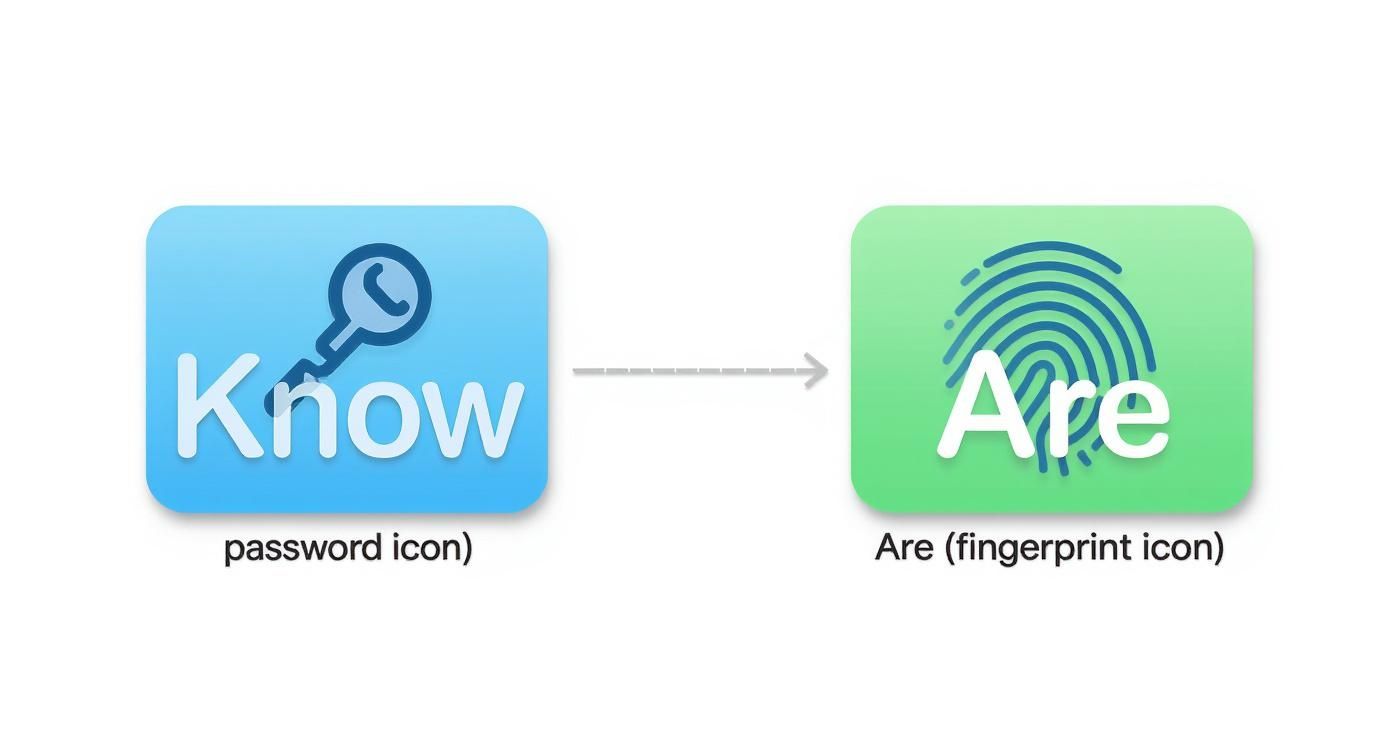
This image really gets to the heart of the matter. We’re moving beyond something you know (like a password) to something you fundamentally are (like your fingerprint). This is the core evolution that gives biometrics its power.
Stage 1: The Enrollment Process
Enrollment is your first handshake with the system. It’s when the technology captures your biometric data for the very first time. Think about setting up Face ID on a new phone—that’s the enrollment phase. The device has you look at the camera from different angles to gather all the data points it needs.
But it’s not just taking a selfie. The system’s sensors are busy mapping out the unique geometry of your face, measuring things like the distance between your eyes, the exact shape of your nose, and dozens of other features that are unique to you. If it’s a fingerprint, it’s mapping every last ridge and valley.
The whole point is to capture a high-quality, comprehensive sample. This becomes the master reference for every future authentication attempt.
Stage 2: Secure Storage and Template Creation
This is where the real security magic happens, and it’s a critical piece of the puzzle. The system does not store an actual picture of your face or an image of your fingerprint. If it did, it would be a huge privacy risk. Imagine a hacker getting their hands on a database of faces.
Instead, the system converts your biometric data into something else entirely: a secure digital format called a biometric template.
- Conversion: The unique data points from that first scan are fed into a complex algorithm.
- Encryption: This algorithm crunches the data, turning it into a string of numbers and characters—an encrypted, mathematical representation of your features.
- Irreversibility: This template is a one-way street. It’s virtually impossible to reverse-engineer the template to get back to the original image of your face or fingerprint.
This encrypted template is then tucked away securely, often right on your device in a protected zone like a Secure Enclave. This local, decentralized approach is a cornerstone of modern identity verification methods because it means your sensitive biometric data rarely has to leave your personal device.
Stage 3: Matching and Verification
The final stage is the one you do every day. When you glance at your phone to unlock it, you’re kicking off the matching process. In that split second, the device performs a brand new, live scan of your face.
It then uses the same algorithm from the enrollment stage to instantly convert this new scan into a temporary template. The system’s only job now is to compare this new template to the original one stored on your device.
If the two templates are a match within a very high degree of statistical probability, you’re in. If not, access is denied. This entire comparison happens in milliseconds, making the experience feel instant.
But wait, what’s to stop someone from just holding up a photo of you? That’s where a crucial security layer called liveness detection comes into play. Good systems use advanced tools like infrared sensors and 3D mapping to check for signs of a real person—things like subtle movements, blinking, or the actual depth of a face. This shuts down attempts to fool the system with static images or videos, ensuring the person being verified is right there, in the flesh.
Exploring the Types of Biometric Authentication
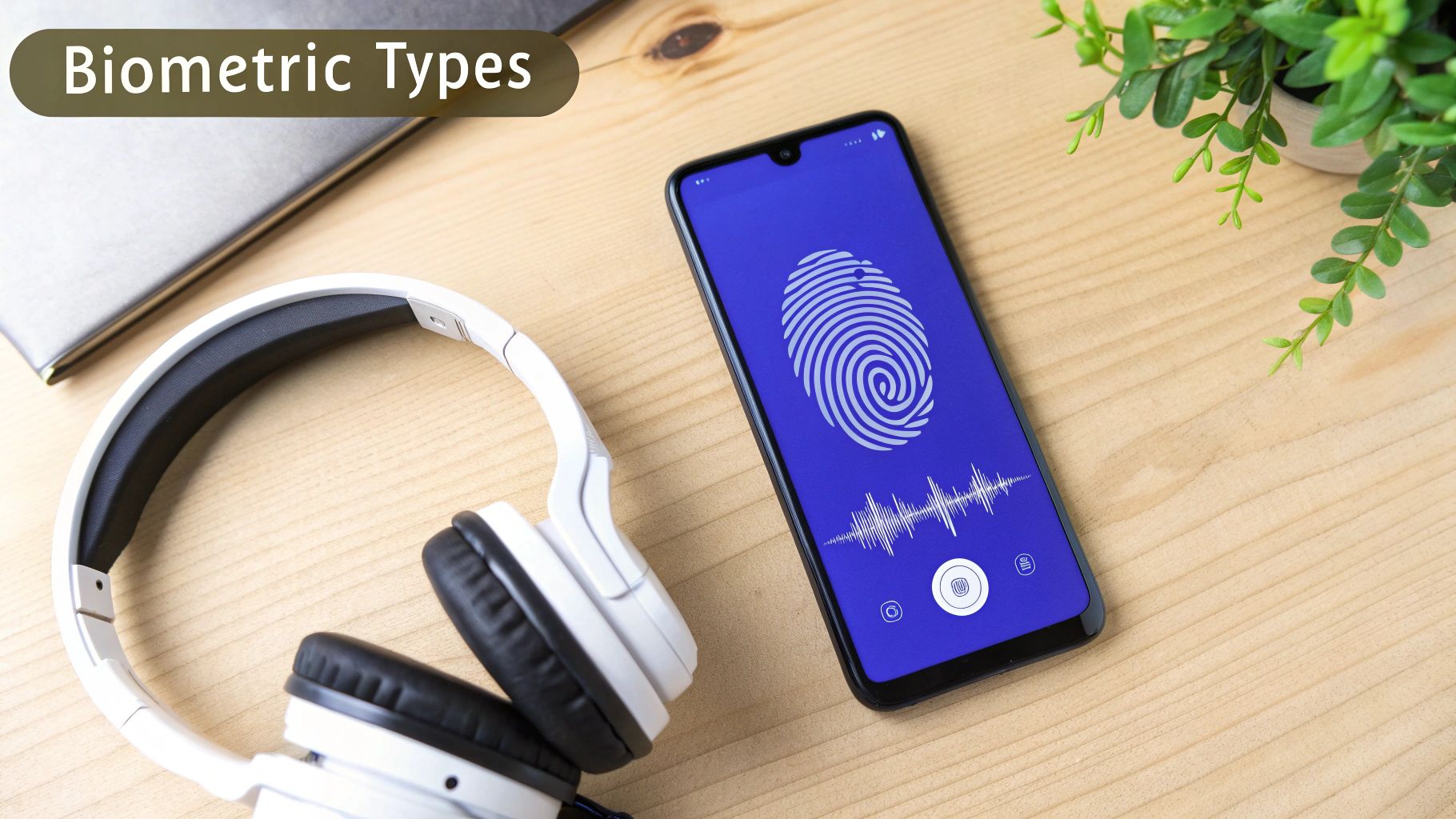
While the core process of enrollment and matching stays the same, the world of biometrics is incredibly diverse. The technology can tap into a huge range of unique human traits to confirm who you are. Each method, or modality, strikes a different balance between security, convenience, and accuracy.
Think of it like the keys on your keychain. You have a simple house key that’s easy to use but offers basic security. You might also have a complex, high-security key for a safe deposit box—it’s less convenient but far more robust. Biometric methods work the same way; some are perfect for unlocking your phone, while others are built to secure a multi-million dollar transaction.
Let’s break down the most common types you’ll run into.
Fingerprint Scanning: The Timeless Classic
Fingerprint scanning is what most people picture when they hear “biometrics.” It’s been used in forensics for over a century and became a household name when it landed on our smartphones.
The technology captures the unique patterns of ridges and valleys on your fingertip. Modern scanners might be optical (taking a detailed photo), capacitive (using electrical current to map the print), or even ultrasonic (using sound waves to build a 3D model).
- What it Measures: The unique whorls, loops, and arches that make up your fingerprint.
- Common Use Cases: Unlocking phones and laptops, clocking in at work, and authorizing payments.
- Key Advantage: It’s highly accurate and people are already comfortable using it, making it a reliable workhorse for everyday security.
Thanks to its long history and proven reliability, fingerprint authentication is still a cornerstone of the biometrics market.
Facial Recognition: The New Standard
Facial recognition has quickly become the go-to for seamless, hands-free authentication. From Apple’s Face ID to the identity checks you complete for online services, this tech is now everywhere.
It works by mapping the unique geometry of a person’s face. A camera captures your image, and smart algorithms measure dozens of “nodal points”—things like the distance between your eyes, the width of your nose, and the shape of your jawline. These measurements create a digital signature that’s uniquely yours.
The best facial recognition systems don’t just stop at mapping. They add liveness detection, which analyzes 3D depth and subtle movements to make sure it’s seeing a real, live person—not just a photo or a video. This is a critical defense against someone trying to fool the system.
This technology’s rapid rise is a testament to how easy it is for people to use. It’s a huge driver in the biometric market’s growth, which was valued at roughly USD 53.22 billion in 2025 and is expected to hit USD 95.14 billion by 2030. You can dig deeper into the numbers with these recent industry reports.
Voice Recognition: Your Voice Is Your Passphrase
Voice recognition, also called voiceprint analysis, identifies you based on the unique qualities of your speech. It’s not just about what you say, but how you say it.
The system analyzes over 100 different physical and behavioral voice traits. This includes the pitch, tone, and rhythm of your speech, plus the physical shape of your vocal tract, which affects how you produce sound. This combination makes a voiceprint nearly impossible for someone else to replicate.
- What it Measures: Acoustic patterns and unique physiological traits of your voice.
- Common Use Cases: Securing phone banking, talking to smart home devices, and verifying identities in call centers.
- Key Advantage: It’s a fantastic hands-free and remote option, especially when visual biometrics aren’t practical.
Iris and Retina Scanning: The High-Security Option
Often seen in spy movies and real-world high-security zones, iris and retina scanning are two of the most accurate biometric methods out there.
Iris scanning uses a camera with a gentle infrared light to map the complex, random patterns in the colored part of your eye (the iris). These patterns are one-of-a-kind and don’t change over your lifetime.
Retina scanning is a bit different; it maps the unique pattern of blood vessels at the very back of your eye. While incredibly accurate, it requires you to get very close to the scanner, which can feel a bit more invasive.
These ultra-secure methods are powerful, but the specialized hardware and higher costs have kept them from becoming mainstream consumer technologies. They’re typically reserved for places like border control checkpoints and military installations.
Behavioral Biometrics: How You Act Is Who You Are
This last category is a fascinating and growing field that shifts the focus from what you are to what you do. Behavioral biometrics authenticates your identity by analyzing the unique patterns in your actions.
This method often works quietly in the background, providing continuous authentication without you even noticing. It builds a profile based on your personal habits.
Some common examples include:
- Keystroke Dynamics: The rhythm and speed at which you type.
- Gait Analysis: Your unique walking pattern.
- Mouse Movement: How you typically move and click your mouse.
This approach is brilliant for fraud detection. A bank’s system might notice that someone logged into your account is suddenly typing and moving the mouse completely differently than you normally would. This could flag the session as a potential account takeover, adding a dynamic and intelligent layer of security.
Comparing Biometric Authentication Methods
Each biometric modality offers a distinct mix of pros and cons. Choosing the right one often depends on balancing the need for airtight security with user-friendliness.
The table below breaks down the most common methods, comparing them on key factors like accuracy, convenience, and how well they stand up to “spoofing” attacks (like using a fake fingerprint or a photo).
| Modality | Accuracy Level | Convenience | Security Against Spoofing |
|---|---|---|---|
| Fingerprint | High | High | Good (improving with liveness) |
| Facial Recognition | Very High | Very High | Excellent (with liveness detection) |
| Voice Recognition | Good | High | Good |
| Iris Scanning | Extremely High | Medium | Excellent |
| Behavioral | Medium-High | Very High | Good (detects anomalies) |
As you can see, there’s no single “best” option. High-security methods like iris scanning trade some convenience for near-flawless accuracy, while facial and fingerprint recognition offer a great all-around balance for everyday use.
Balancing Unbreakable Security with Personal Privacy
Bringing biometric authentication into the mix opens up a fascinating conversation—one that’s all about walking the fine line between rock-solid security and protecting our most personal data. On the one hand, this technology offers a powerful shield against the kind of cyber threats we’ve been battling for decades.
Think about it: when your face or fingerprint is the key, the risk of phishing scams and stolen passwords just plummets. Hackers can’t steal a password you don’t use. This move doesn’t just beef up security; it also creates a wonderfully smooth experience for everyone. No more forgotten passwords or frustrating reset loops—just quick, intuitive access.
But that brings up a perfectly valid and crucial question: what happens to this deeply personal data? If a password gets stolen, you can just change it. You can’t exactly get a new fingerprint. This very real concern sits at the heart of the biometrics debate and has pushed the industry to develop incredibly sophisticated ways to protect our privacy.
Protecting Your Digital Blueprint
The good news is that modern biometric systems are built from the ground up with these privacy risks in mind. Reputable solutions go to incredible lengths to ensure your biometric data is never stored in a way that could be easily compromised. It’s not about storing a picture of your face; it’s about safeguarding its mathematical representation.
Here are the core principles that keep your information safe:
- Template Encryption: As we’ve discussed, your biometric data is converted into an encrypted digital template. This is a one-way street, making it virtually impossible for anyone to reverse-engineer that template back into your original fingerprint or facial scan.
- Decentralized Storage: Many systems, especially on devices like your smartphone, store this encrypted template directly on a secure, isolated chip. Your biometric data never leaves your personal control, which dramatically cuts down the risk of a massive data breach.
By keeping the encrypted template on the user’s device, the system avoids creating a central “honeypot” of sensitive biometric data that would be an irresistible target for attackers. This decentralized model is a cornerstone of modern privacy-by-design architecture.
When building out a biometric system, it’s absolutely vital to strike a balance between security and personal privacy. Frameworks like the SOC 2 Trust Services Criteria provide a great roadmap for maintaining user trust and data integrity.
Biometrics in a Regulated World
Regulators have definitely taken notice of the immense trust and security that biometrics bring to the table. In fact, for many high-stakes industries, it’s fast becoming a required part of the process for staying compliant and stamping out fraud. This technology provides a level of identity assurance that passwords and simple ID checks just can’t touch.
The global market tells the same story. The biometric authentication and identification market, valued at USD 6.57 billion in 2024, is expected to skyrocket to USD 26.38 billion by 2033. That’s a compound annual growth rate of 16.7%. This explosive growth is largely fueled by its adoption in regulated sectors. To dig deeper into what’s driving this expansion, you can find more insights about the biometric identification market forecast on straitsresearch.com.
Key regulatory frameworks now lean heavily on biometric verification to build a foundation of trust in digital transactions.
How Compliance Frameworks Rely on Biometrics
Several key regulations now effectively demand biometric-level identity proofing to operate securely and legally.
- Know Your Customer (KYC) and Anti-Money Laundering (AML): Financial institutions are on the hook to verify who their clients are to prevent money laundering and other financial crimes. Biometric verification—matching a live selfie to a government-issued ID—has become the gold standard for remote onboarding, making sure the person opening an account is exactly who they say they are.
- Remote Online Notarization (RON): State-level RON laws have very strict rules for verifying identity before notarizing documents online. These regulations often demand multi-factor authentication, which frequently includes a biometric element like facial recognition to bind the signer’s identity to a legal document with an incredibly high degree of certainty.
In these situations, biometric authentication isn’t just a nice-to-have feature anymore. It’s a foundational requirement for building trust, meeting legal obligations, and securing our digital economy.
Putting Biometrics to Work in Regulated Industries
The theory behind biometrics is fascinating, but its real value shines when the stakes are high. In regulated industries like finance and legal services, you can’t just take someone’s word for it. You have to prove who they are, and that proof needs to hold up under scrutiny.
This is where understanding what is biometric authentication becomes a business necessity, not just a technical curiosity. It’s the technology that provides verifiable, auditable proof of identity, making it possible to execute legally binding documents from anywhere in the world. For industries built on trust, biometrics have become the digital handshake that secures the entire transaction.
A Walkthrough of Remote Online Notarization
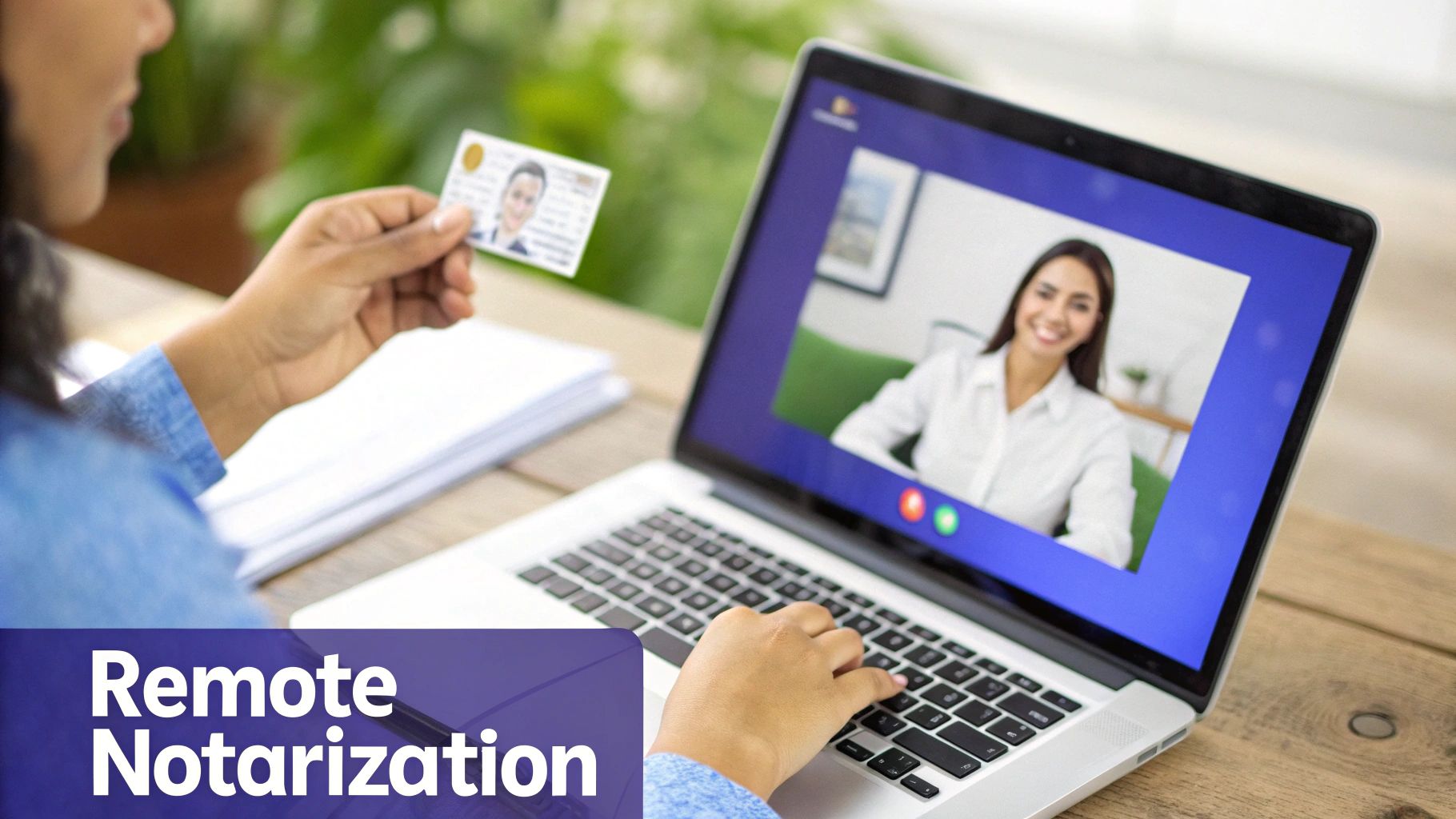
Let’s ground this in a real-world example: Remote Online Notarization (RON). Before a notary can legally stamp a digital document, they must be absolutely certain of the signer’s identity, often following very specific state laws. Biometrics make this remote verification process not just possible, but airtight.
Here’s how a platform like BlueNotary builds this trust step-by-step:
- Document and Signer Setup: It all starts when someone needs a document notarized. They upload their file and get ready for the identity verification flow.
- ID Document Capture: First, the system prompts the signer to take a clear photo of the front and back of their government-issued ID, like a driver’s license. Powerful software instantly scans the ID for security features—holograms, microprint, and more—while pulling key information like the name and photo.
- The Biometric Selfie and Liveness Check: This is where the magic happens. The signer is asked to take a live selfie. But this isn’t your average photo. The system runs a liveness detection check, often asking the person to turn their head slightly. This simple action proves they are a real, live person in front of the camera, not just a photo or a deepfake video.
- Facial Recognition Matching: Next, the system’s algorithm gets to work. It performs a detailed facial recognition scan, comparing the “live” selfie to the photo it extracted from the government ID. By analyzing dozens of unique facial points, it calculates a match score with incredible accuracy.
- Verification and Notarization: Once the biometric match is confirmed (and often after passing a secondary check like Knowledge-Based Authentication), the signer is connected to a live notary via video call. The notary, now confident in the signer’s verified identity, can finalize the notarization.
This multi-layered process, with biometrics at its core, creates an unshakeable, auditable link between the signer’s identity and the notarized document. It’s this high level of assurance that gives digital transactions the same legal weight as those signed in person.
Why This Matters for High-Stakes Industries
This workflow shows that biometric authentication is about more than just security; it’s about building the digital trust needed for our most sensitive operations. For businesses in the legal and financial worlds, this means fewer hurdles and less risk. To see this in action, you can learn more about how to reduce fraud risk with a biometric-first approach.
Ultimately, biometrics solve the single biggest challenge of remote business: proving identity with certainty. This capability makes complex legal processes not only safer but also far more accessible for everyone, no matter where they are.
How to Choose the Right Biometric Solution
Picking a biometric authentication partner is about much more than just buying software. It’s a critical decision that directly affects your security posture, customer experience, and even your legal and regulatory standing. The market is crowded, so you need a solid framework to cut through the noise and find a solution that fits your actual needs.
The right system should feel like a natural extension of your existing platform, delivering the identity assurance you require without creating friction for your users.
Start with the Core Metrics
First things first, let’s talk about performance. Don’t get distracted by vague marketing claims of “high accuracy.” You need to dig deeper and ask for hard numbers on two specific metrics:
- False Acceptance Rate (FAR): This is the big one for security. It tells you how often the system might mistakenly let an unauthorized person through. A low FAR is absolutely essential.
- False Rejection Rate (FRR): This metric is all about user experience. It measures how often a legitimate, authorized user gets incorrectly blocked. A high FRR means frustrated customers and a flooded support desk.
The best systems find the sweet spot, keeping security iron-clad while ensuring legitimate users can get in without a hassle.
Evaluate the Technical Guts
Beyond the basic accuracy stats, the technology under the hood is what determines if a solution will hold up in the real world. A feature you absolutely must insist on is liveness detection. This is what stops a fraudster from fooling the system with a simple photograph or a video of the user.
Make sure any vendor you consider can prove they use sophisticated active or passive liveness checks to confirm a real person is present during the scan.
Another crucial point is how easily the system integrates with what you already have. Look for a vendor with a well-documented API (Application Programming Interface). This is what will allow your developers to weave the biometric checks smoothly into your own applications, creating a seamless experience for your users instead of a clunky, disjointed one.
Choosing a vendor isn’t just a technical decision—it’s a strategic one. The provider should act as a partner who understands your industry’s specific compliance needs, whether that’s for KYC, AML, or state-specific RON regulations.
Look to the Future: Scalability and Compliance
Finally, you need to think about the long haul. As your business grows, your biometric solution has to grow with it. Can it handle a much higher volume of verifications down the road without slowing down or becoming less reliable?
Equally important is compliance. The vendor must demonstrate adherence to major data privacy regulations like GDPR and CCPA. Getting this wrong can lead to serious legal and financial trouble.
The market for these advanced biometric technologies is booming and is projected to hit nearly USD 118.65 billion by 2030. This explosive growth is a direct response to rising security threats, which makes picking a robust, scalable, and compliant partner more critical than ever. You can read more about this trend in the next-gen biometric authentication market report on grandviewresearch.com.
Frequently Asked Questions About Biometric Authentication
It’s one thing to understand the concept of biometric authentication, but another to see how it works in the real world. Let’s tackle some of the most common questions that pop up when people start thinking about using their face or fingerprint as a key.
Which Is More Secure: Face or Fingerprint Recognition?
This is the classic question, and the answer isn’t as simple as one being universally “better.” Both are incredibly secure, but modern facial recognition often gets a slight nod for one key reason: sophisticated liveness detection.
The best systems don’t just see a 2D picture of you; they use 3D mapping and even infrared sensors to confirm you’re a real, live person in front of the camera. This makes them extremely tough to trick with a simple photo or video.
Fingerprint scanners are no slouch, of course. While basic optical scanners can sometimes be fooled by a high-resolution replica, the newer ultrasonic scanners are changing the game. By creating a detailed 3D map of your fingerprint’s ridges and valleys, they’re quickly closing any perceived security gap.
What Happens If My Biometric Data Is Stolen?
This is probably the biggest concern most people have, and for good reason. The good news is that modern systems are built from the ground up to prevent this. Your biometric data is almost never stored as a raw image of your face or fingerprint.
Instead, the system converts it into an encrypted string of numbers—a biometric template.
Think of it like a one-way street. The software can create the template from your fingerprint, but it’s impossible to reverse-engineer that template back into your actual fingerprint image.
To add another layer of security, this encrypted template is usually stored right on your device in a secure enclave, a kind of digital vault. It never has to travel across the internet where it might be vulnerable.
Can Law Enforcement Access My Biometric Information?
The rules here are still being written and can get complicated, changing from one country or state to the next. Generally, getting a company to hand over user data requires a proper legal process, like a warrant.
The more immediate question is usually about accessing your personal device. Depending on where you are, authorities might be able to compel you to unlock a phone with your face or finger. It’s a gray area where technology and digital privacy law are still catching up with each other, and it remains a hot topic in courtrooms around the globe.
Ready to implement secure, compliant identity verification for your business? The BlueNotary platform integrates biometric authentication to provide the highest level of assurance for remote online notarization and legally binding e-signatures. Learn more about our platform.