






Thinking about becoming a notary public? It’s a role that goes way beyond simply stamping a document. You’re stepping into a position of trust, acting as an impartial witness to help prevent fraud and ensure that major life transactions are handled with integrity. It’s a serious responsibility, but a rewarding one.
This guide will walk you through exactly what it takes, breaking down the entire process from start to finish.
The first thing to understand is that your journey is defined by your state’s laws. While the core duties of a notary are pretty consistent across the country, the how can vary dramatically. In the U.S., you’ll generally need to be a legal resident, at least 18 years old, and free of any felony convictions.
From there, it gets specific. Some states, like California, have a mandatory exam. Others don’t. The length of your commission can also differ, typically ranging from 4 to 10 years.
The Four Pillars of Your Journey
Getting your notary commission really comes down to successfully navigating four key areas. Think of them as the pillars supporting your entire practice. Get these right, and you’ll be on solid ground.
- Meeting Eligibility Rules: This is your starting line. Every state has a checklist of non-negotiable requirements covering age, residency, and your background. You have to tick every box before you can even think about applying.
- Completing Required Training: Many states require you to complete an approved education course. This isn’t just a formality; it’s where you learn the laws, ethics, and procedures that will guide every notarization you perform. It builds the foundation for your confidence and competence.
- Passing the State Exam: If your state requires an exam, this is your chance to prove you know your stuff. It’s a critical checkpoint designed to ensure you’re ready for the responsibilities of the role.
- Securing Your Official Commission: This is the final leg of the race. It involves submitting your application, paying the necessary fees, taking your oath of office, and getting your essential tools of the trade—your official notary seal and a record-keeping journal.
A common question I hear is, “How long does all of this take?” The answer really depends on your state’s specific process. For a detailed breakdown, check out our guide on how long it takes to become a notary public.
The world of notarization has changed so much. It’s no longer just about in-person appointments. With the rise of Remote Online Notarization (RON), you can now serve clients from all over, right from your computer. This guide will set you up for success in both the traditional and the modern notary world.
Let’s quickly map out what this process looks like from a bird’s-eye view.
The Notary Commission Journey at a Glance
This table summarizes the main stages you’ll go through to become a fully commissioned Notary Public.
| Stage | What It Involves | Typical Timeframe |
|---|---|---|
| Eligibility & Training | Verifying you meet state criteria and completing any mandatory education courses. | 1-3 weeks |
| Application & Exam | Submitting your state application, background check, and passing the exam (if required). | 2-6 weeks |
| Bonding & Supplies | Securing a surety bond, errors & omissions insurance, and ordering your seal and journal. | 1-2 weeks |
| Commissioning | Receiving your official commission certificate and taking your oath of office. | 1-4 weeks |
Keep in mind, these timeframes are estimates. Your state’s efficiency and your own pace will ultimately determine your specific timeline. Now, let’s dive into the details of each step.
Navigating Your State’s Notary Requirements
The first thing you absolutely must understand is that becoming a notary is a state-level affair. While the job is similar everywhere, the journey to get your commission is completely dictated by where you live. This isn’t a “one-size-fits-all” deal; the rules for a notary in Texas can be wildly different from those in Oregon.
Your state’s Secretary of State office (or a similar agency) literally writes the rulebook. They set the qualifications, design the application, and decide if you need to pass an exam. Think of them as the gatekeepers to your notary commission.
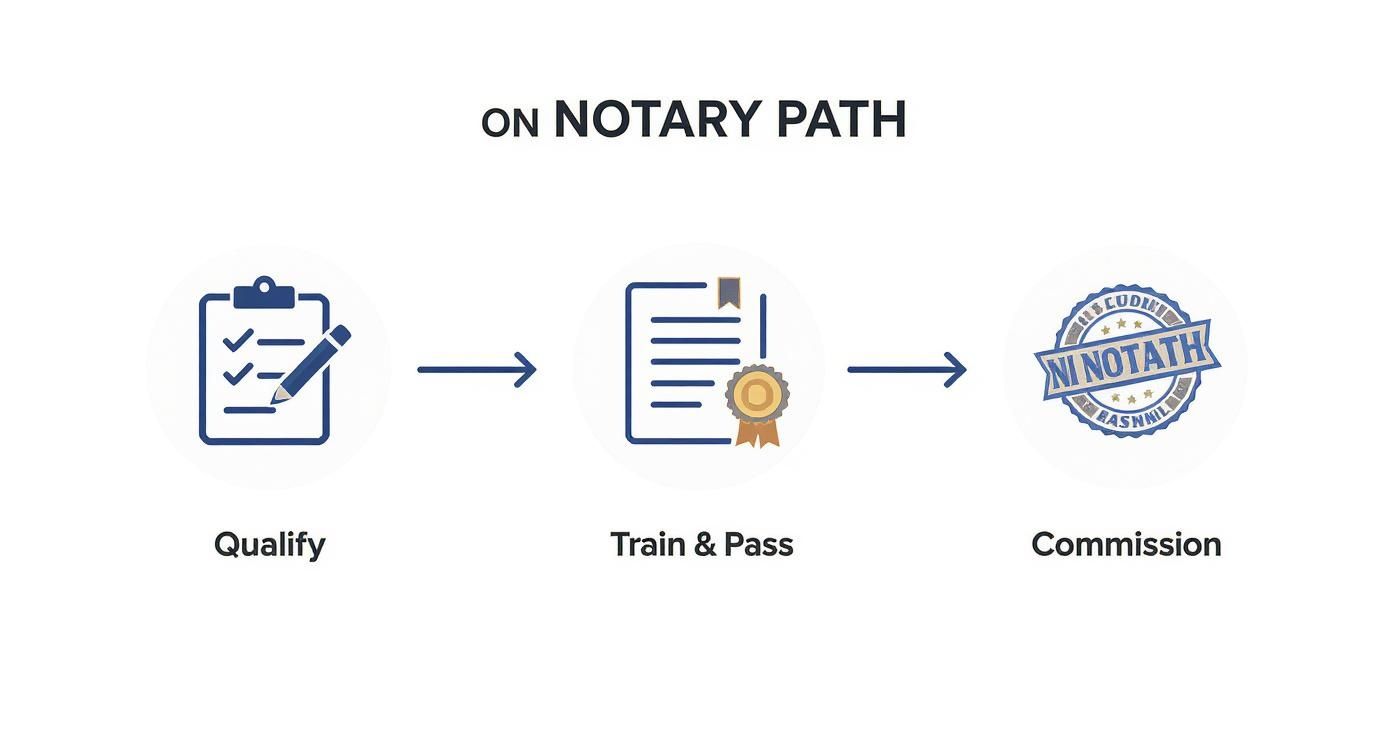
This path isn’t complicated, but you have to follow the steps in order. It all starts with making sure you’re even eligible to apply.
Decoding Eligibility and Background Checks
Before you spend a dime or fill out a single form, you have to clear the first hurdle: meeting your state’s basic eligibility rules. These are non-negotiable requirements designed to make sure notaries are upstanding members of the community.
Most states agree on a few core qualifications:
- Age: You almost always have to be at least 18 years old.
- Residency: You’ll need to be a legal resident of the state you’re applying in. Some states make an exception if you work primarily in that state, even if you live across the border.
- Criminal History: A clean record is crucial. States generally bar anyone with a felony conviction, especially if it involves fraud or dishonesty.
The background check is a serious step. In Ohio, for example, every new and renewing applicant (unless you’re an attorney) has to go through a Bureau of Criminal Investigation (BCI) check. Those results can take 4 to 6 weeks and are only good for six months, so you really have to time your application right.
The Application Process Unpacked
Once you know you’re eligible, it’s time to tackle the official application. This is where you need to be meticulous. One tiny mistake—a typo, a missed signature, an old address—can get your application kicked back, forcing you to start all over again.
First, you need the right form. Your best bet is to go directly to the source: your state’s commissioning authority. We’ve put together a handy list of Secretary of State websites to help you find the correct portal for your state.
Pro Tip: Download the application before you start filling it out. Read every single question and instruction. Make a checklist of all the other documents you’ll need—like proof of residency or your bond paperwork—so you can gather everything at once.
Getting the application right means making sure every detail is perfect and matches your government-issued ID. State officials are trained to spot discrepancies, and mismatched information is a huge red flag.
Conquering Training and State Exams
This is where you’ll see the biggest differences from one state to another. Some states, like Virginia, have a surprisingly straightforward process where you can apply directly without any mandatory training or exam.
Then you have states like California, which are on the complete opposite end of the spectrum. California has a reputation for its tough, mandatory training course and a proctored exam that you absolutely have to pass. You’ll be tested on everything from specific state laws to proper notarial procedures.
If your state does require training, make sure you sign up for a state-approved course. Don’t waste your money on a generic program that won’t count. These courses are designed to teach you the essentials:
- How to properly identify signers and spot potential fraud.
- The difference between notarial acts like acknowledgments and jurats, and how to fill out the certificates.
- The right way to maintain a notary journal or record book.
- How to avoid the unauthorized practice of law—a major trap many new notaries fall into.
When it comes to the exam, preparation is everything. Actually study the material; don’t just skim it. Use practice tests, memorize key terms, and focus on understanding why the rules exist. Passing on your first try saves you time, money, and a lot of headaches, getting you that much closer to your official commission.
Getting Commissioned and Geared Up
So, your application got the green light. That’s a huge step! But hold on, you’re not quite ready to start notarizing just yet. There are a few crucial final steps to lock in your commission and get the right tools for the job. This part is all about protecting the public, protecting yourself, and gathering the physical items you’ll use every day.
You’ll need to secure your notary bond, think seriously about insurance, order a state-compliant seal and journal, and then officially file everything to make it official. Each piece is a non-negotiable part of operating as a legitimate, professional notary.

Notary Bonds vs. Insurance: What’s the Difference?
Before you perform a single notarial act, nearly every state will require you to get a surety bond. Think of it as a form of financial assurance for the public. You’re basically posting a guarantee that you’ll do your job correctly and follow the letter of the law.
Here’s where many new notaries get tripped up: the bond doesn’t protect you. It protects your clients. If you make a critical error that costs a signer money, the bonding company covers the damages up to your bond limit. The catch? They’ll almost certainly come to you for reimbursement.
A notary bond exists to protect the public from financial harm caused by a notary’s error. It is not personal insurance for the notary.
That’s where Errors & Omissions (E&O) insurance comes in. While usually optional, I consider it essential. E&O insurance is what actually protects you. If you’re sued for an unintentional mistake, this policy helps cover your legal fees, settlements, and other court-related costs that could otherwise be a financial nightmare.
Even the most detail-oriented person can have an off day. E&O insurance is that vital safety net that protects your personal assets when an honest mistake happens.
Your Official Seal and Journal: The Tools of the Trade
With your bond and insurance squared away, it’s time for the fun part: getting your gear. Your notary seal and a record book (your journal) aren’t just fancy accessories; they are legal instruments that have to meet your state’s requirements down to the millimeter.
Your notary seal or stamp is your official mark. It has to include specific info like your name and commission number, all formatted exactly as your state law dictates. Don’t just order from any website. Make sure you use a reputable vendor who knows your state’s rules inside and out, or you risk getting a seal that gets rejected.
A well-kept notary journal is arguably your most powerful tool and your best defense if a notarization is ever questioned. This is your detailed log of every single act you perform. State laws specify the minimum you must record, but a complete entry usually includes:
- Date and time of the act
- Type of notarization (e.g., acknowledgment, jurat)
- A brief description of the document being signed
- The signer’s name, signature, and address
- How you identified the signer (e.g., driver’s license number)
Making a thorough journal entry a non-negotiable habit from day one will save you countless headaches down the road.
Making It Official: The Oath and Filing
This is the final hurdle. To activate your commission, you have to take an Oath of Office. It’s a formal, sworn promise that you will perform your duties faithfully and uphold the law. You’ll typically do this at your county clerk’s office in front of another official or notary.
After taking the oath, you’ll file your bond and commission paperwork with that same office. This is the moment it all becomes real—your name is officially recorded, and you are now a commissioned notary public in your jurisdiction. Congratulations, you’re ready for your first client
Embracing Remote Online Notarization
Your traditional notary commission is a powerful credential, but it’s really just the beginning of what’s possible in today’s market. If you’re looking for the single biggest opportunity for growth, it’s undeniably in Remote Online Notarization (RON). This technology lets you perform notarizations for clients anywhere in the world using secure audio-video platforms.
Think of it this way: as a traditional notary, your client base is limited to who you can physically meet. With RON, your potential market explodes. Suddenly, you’re connected to signers who need documents notarized from across the country or even while living abroad. This isn’t just a fleeting trend; it’s a fundamental shift in how notarial services are delivered.
The rise of RON has completely changed the game. The sector is valued at around $2 billion globally and is projected to grow annually at over a 15% CAGR until at least 2033, with the U.S. leading the way. You can read the full research about online notary services to see just how massive this shift is.
Becoming a RON-Certified Notary
It’s crucial to understand that your traditional notary commission doesn’t automatically give you the green light to perform remote notarizations. Becoming a RON is a separate process with its own set of requirements, almost like getting an advanced certification for your existing commission.
Most states that have authorized RON will require you to:
- Hold an active, traditional notary public commission. This is non-negotiable. You have to be a commissioned notary in good standing before you can even think about applying for RON.
- Complete state-approved RON training. This isn’t your basic notary course. It’s specialized education covering the unique laws, technology standards, and procedures for online notarizations.
- Pass a separate exam (if required). Some states want to ensure you know their RON-specific statutes inside and out, so they’ll test you on them.
- Partner with an approved RON technology provider. This is a big one. States mandate that you use a secure, compliant platform for all remote sessions.
That last point is key. You can’t just hop on a standard video chat app. RON platforms are built from the ground up with security in mind, including features like multi-factor authentication, robust identity proofing, and tamper-evident digital seals to protect the integrity of the notarization. For a deeper look at the tech, check out our article on remote online notarization as the new frontier.
The Tech and Tools You Will Need
Making the jump to RON means adopting a new, completely digital toolkit. Forget the physical stamp and paper journal—a remote online notary relies on specific digital tools to do the job securely and legally.
Becoming a RON means embracing technology as a core part of your practice. It’s about combining your notarial expertise with the right digital tools to provide a secure and convenient service that meets modern demands.
Your digital toolkit will have a few essential components:
- A Digital Certificate: This is your electronic credential, proving you are who you say you are—a commissioned notary. It’s used to apply your digital signature to documents, creating an unbreakable, verifiable link between you and the notarization.
- An Electronic Seal: Think of this as the digital version of your physical stamp. It contains all the same required information (your name, commission number, state) but in a digital format that gets securely attached to the electronic document.
- An Electronic Journal: Just like your trusty paper logbook, the electronic journal is where you record every single RON session. The best part? Approved RON platforms often have this built right in, automatically capturing key details like signer information and the audio-video recording of the session.
Finding Clients with RON Platforms
One of the most exciting parts of becoming a remote online notary is the access you gain to a much wider pool of clients. This is where platforms like BlueNotary become absolutely essential. Instead of just relying on local word-of-mouth, you can tap into a nationwide stream of people and businesses actively looking for remote notarization.
These platforms do the heavy lifting for you—the marketing, the scheduling, and providing the secure tech—so you can focus on what you do best: performing notarizations. By joining a reputable RON platform, you can fill your schedule with appointments from title companies, law firms, and everyday people who need documents notarized quickly and conveniently, creating a truly future-proof notary business.
Building Your Notary Business and Finding Clients
Earning your notary commission isn’t just the end of the application process—it’s the beginning of your business journey. That certificate is a license to operate. Now, the real work begins: deciding what kind of services you’ll offer and how you’ll find the people who need them.
Whether you’re aiming for a profitable side hustle or a full-time career, you’re now a service provider ready to meet the needs of your community.

General Notary Work vs. Notary Signing Agent
While the core duty of a notary is always the same, you can specialize. Most new notaries cut their teeth on general work, handling single documents for the public—think affidavits, powers of attorney, or vehicle titles. This is the bread and butter of most mobile notary businesses.
A Notary Signing Agent (NSA), on the other hand, is a specialist who focuses on real estate transactions. NSAs are trained to navigate the thick stack of documents involved in a loan signing. Because the stakes are so much higher, the fees are, too.
To make that leap, your state commission isn’t enough. You’ll need to get specialized training and pass a background check from a trusted organization. This certification tells lenders and title companies you know their process inside and out and won’t make costly mistakes.
Tapping into the High Demand for Mobile Notaries
Convenience is king, and that has created a massive opportunity for mobile notaries who travel directly to their clients. This service is a lifesaver for busy professionals, elderly clients, or anyone who can’t get to an office during the typical 9-to-5.
The numbers back this up. The global mobile notary public market was valued at about $0.5 billion in 2025 and is on track to hit an incredible $2.6 billion by 2035. That’s a compound annual growth rate of 18.4%. The biggest drivers are large enterprises in banking, insurance, and real estate, which made up 64.1% of the market’s revenue in 2025. You can discover more insights about the mobile notary market growth to understand just how big this opportunity is.
Being a successful mobile notary isn’t just about showing up with your stamp. It’s about professionalism, punctuality, and providing a seamless, stress-free experience for your clients wherever they are.
Actionable Marketing Tips to Find Your First Clients
Getting your name out there is everything, but you don’t need a huge marketing budget to get started. Focus your energy on these practical strategies that actually work.
- Network with Key Industries: Don’t just wait for the phone to ring. Introduce yourself to people who constantly need notaries—think law firms, real estate agencies, title companies, and even local hospitals. A simple visit with a business card can lead to a steady stream of referrals.
- Build a Simple Online Presence: Get yourself listed on professional directories. A basic website or even a well-managed social media page acts as your digital storefront, making it easy for people to find you and see that you’re a legitimate professional.
- Encourage Word-of-Mouth Referrals: After you’ve done a great job, don’t be shy. Politely ask your happy clients to pass your name along to friends or colleagues. A personal recommendation is the most powerful marketing tool you have.
You’ll also need to figure out your pricing. See what other notaries in your area are charging, but remember that your state might set maximum fees for specific notarial acts. For mobile services, it’s standard to charge your notarization fee plus a separate travel fee.
Delivering Service That Creates Repeat Business
The real secret to a sustainable notary business isn’t just finding clients—it’s keeping them. Exceptional service is what turns a one-time signing into a loyal customer who sends more business your way.
Here are a few ways to lock in that five-star experience every time:
- Communicate Clearly: When someone books you, confirm the time, location, and exactly what they need to have ready, like a valid ID. A quick confirmation text or email shows you’re on top of things.
- Be Prepared and Punctual: Show up on time with all your supplies: your seal, your journal, and a few extra notarial certificates just in case. Being prepared shows confidence and respect for your client’s schedule.
- Guide, Don’t Advise: Your role is to be a confident, impartial witness. Walk the signer through the notarization process, but never, ever offer legal advice. That’s a line you can’t cross.
By focusing on these fundamentals, you’ll build a reputation for being reliable and professional. That reputation is the foundation of a notary business that will grow for years to come.
Got Questions? Here’s What Aspiring Notaries Often Ask
As you start looking into becoming a notary, you’re bound to have a few questions pop up. It’s totally normal. Getting these sorted out early on helps you map out your budget, your timeline, and what to expect. Let’s tackle some of the most common questions I hear from people just starting out.
What’s the Real Cost to Become a Notary Public?
The bottom line is that your total startup cost will land somewhere between $100 and $500, but this number really depends on your state. It’s not one big fee, but a series of smaller ones that you’ll pay along the way.
Here’s a quick breakdown of where that money goes:
- State Application Fee: This is the non-negotiable fee for processing your application, usually running $40 to $100.
- Mandatory Training: If your state requires a training course, this will likely be one of your biggest expenses.
- Exam Fees: Some states require you to pass an exam, and there’s typically a fee to take it.
- Surety Bond: You’ll almost certainly need a surety bond. The price varies based on the required coverage amount and your personal credit, but it’s a must-have.
- Your Notary Kit: You can’t perform notarizations without your official seal (or stamp) and a record book, often called a journal. Make sure they meet your state’s exact rules.
And remember, that’s just for the basic commission. If you decide to add Errors & Omissions insurance for extra protection or get certified as a Notary Signing Agent for real estate work, those are separate investments.
How Long Does It Take to Get Your Notary Commission?
This is a classic “it depends” situation. The whole process can take anywhere from a couple of weeks to a few months. Your state’s bureaucracy and its list of requirements are the two biggest variables.
For states with a straightforward application, you could be commissioned in as little as 2 to 4 weeks. But if your state makes you take a course, pass an exam, and undergo a detailed background check, you should plan on it taking 2 or even 3 months. You really have to account for the time it takes to complete the training, find an exam date, and then wait for the state to process everything.
Can I Be a Notary in Multiple States at Once?
Straight answer? Almost always no. Your notary commission is tied to your state of residence or, in some cases, where you work. It’s not like a driver’s license that works everywhere; it’s only valid within the borders of the state that granted it to you.
If you pack up and move, you have to start from scratch. That means officially resigning your commission in your old state and then going through the full application process in your new one, meeting all of its unique requirements.
The Big Picture: Think of your commission as a local license. It gives you authority only within the state that issued it, and it doesn’t travel with you.
What Are the Rookie Mistakes I Should Avoid?
Every new notary makes a few mistakes—it’s part of the learning curve. But knowing the common slip-ups can help you sidestep them from day one.
One of the most serious errors is cutting corners on identity verification. You are the gatekeeper, and confirming who is in front of you is your most important job. Another classic fumble is messing up the notarial certificate—people either leave blanks or use the wrong wording for the notarial act they performed. And please, don’t forget to log every single act in your journal. It’s your best line of defense if a notarization is ever questioned.
But the biggest trap of all? Giving legal advice. Your role is to witness signatures and verify identity, not to explain the document or tell someone what to do. That’s considered the unauthorized practice of law, and it’s a fast track to losing your commission. Stick to what you’re authorized to do, and you’ll build a solid, trustworthy reputation.
Ready to navigate the world of modern notarization with confidence? At BlueNotary, we provide the secure platform and tools you need to succeed as a Remote Online Notary. Join a network of professionals and connect with clients nationwide. Get started with BlueNotary today.