


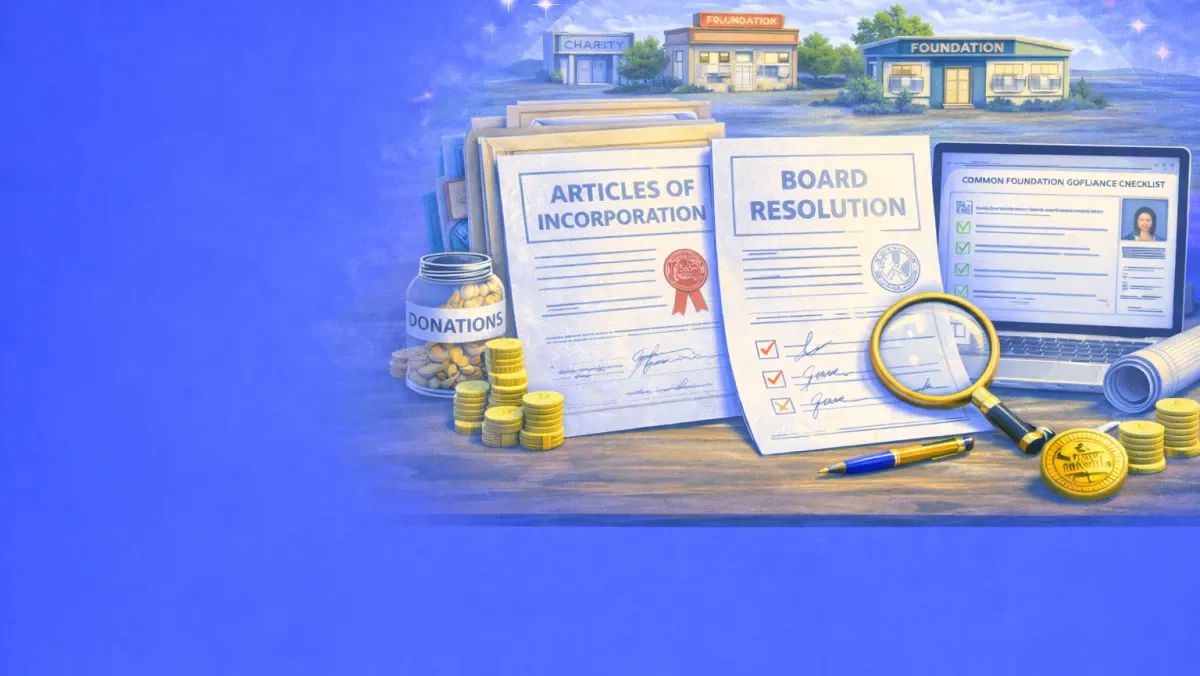

Running a 501(c)(3) nonprofit organization requires proper documentation at every stage. From formation to grant applications, nonprofits face unique paperwork requirements. Many of these documents need notarization to establish legal validity. Understanding these requirements helps your organization stay compliant and access funding opportunities.
This guide covers the essential documents nonprofits need. We’ll explore articles of incorporation, board resolutions, grant certifications, and foundation compliance requirements. You’ll learn which documents require notarization and how to handle each properly.
Articles of Incorporation: The Foundation of Your Nonprofit
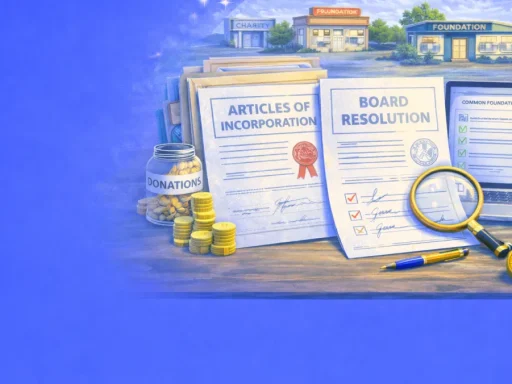
Articles of incorporation create your nonprofit as a legal entity. This document establishes your organization’s existence at the state level. It also sets the stage for federal tax-exempt recognition under Section 501(c)(3) of the Internal Revenue Code.
State Filing Requirements
Each state has its own process for nonprofit incorporation. Generally, you must file articles of incorporation with the Secretary of State’s office. Filing fees typically range from $25 to $400 depending on the state. Processing time usually takes two to four weeks.
However, state and IRS requirements differ significantly. Your state only collects minimum information to create the entity. The IRS requires additional language for tax-exempt status. Therefore, your articles must satisfy both sets of requirements.
IRS-Required Provisions
The IRS requires specific language in your articles of incorporation. Without these provisions, your Form 1023 application will face delays or rejection. Here are the essential clauses you must include.
First, you need a purpose clause. This statement must limit your organization to exempt purposes. For example: “This organization is organized exclusively for charitable and educational purposes within the meaning of Section 501(c)(3) of the Internal Revenue Code.”
Second, you need a dissolution clause. This provision ensures assets go to charitable purposes if your nonprofit closes. The clause should state that assets will be distributed to another 501(c)(3) organization or government entity.
Third, you should include a prohibited activities clause. This limits lobbying and political campaign activities. Additionally, you must state that no part of net earnings will benefit private individuals.
Notarization Requirements for Articles
Notarization requirements for articles of incorporation vary by state. Some states require notarized signatures from incorporators. Others accept unnotarized signatures filed electronically.
For instance, Georgia does not require notarization for articles of incorporation. The incorporator simply signs and indicates their capacity. In contrast, some states require a notary to verify the incorporator’s identity and signature.
Before filing, check your state’s specific requirements. Many states now accept electronic filing with typed signatures. Consequently, traditional notarization may not be necessary for initial incorporation. However, amendments or restated articles may have different requirements.
Board Resolutions: Documenting Organizational Decisions
Board resolutions formally document decisions made by your nonprofit’s board of directors. Every official decision should be properly documented through a resolution. These documents keep your records in compliance and demonstrate good governance.
Types of Board Resolutions
Nonprofits typically need several categories of board resolutions. Each serves a specific governance purpose.
Organizational resolutions establish your nonprofit’s structure. The initial board meeting should include resolutions to adopt bylaws, elect officers, and pursue federal tax exemption. The meeting minutes must show unanimous affirmation by initial board members.
Banking resolutions authorize specific individuals to manage accounts. Banks require this document before opening nonprofit accounts. The resolution specifies who can sign checks, make deposits, and conduct transactions. Most banks will not discuss accounts without seeing this resolution.
Grant authorization resolutions approve pursuit of specific funding. Some funders require board authorization before accepting applications. The resolution demonstrates organizational commitment to proposed projects.
Contract approval resolutions authorize major agreements. For example, signing leases, hiring executives, or entering service contracts. These resolutions protect board members from personal liability.
Amendment resolutions change organizational documents. Updating bylaws or articles of incorporation requires formal board action. These resolutions must be filed with appropriate state agencies.
Elements of a Valid Resolution
A proper board resolution contains several key elements. First, it should include the organization’s full legal name. Second, it should reference the meeting date and location. Third, it should clearly state what the board is authorizing.
The resolution should use formal language. It typically begins with “WHEREAS” clauses explaining the background. Then “RESOLVED” clauses state the specific actions authorized. For example: “RESOLVED, that the Board of Directors authorizes the Executive Director to open a checking account.”
Finally, the resolution needs proper signatures. The board secretary typically signs to certify the resolution’s adoption. Some resolutions may require additional signatures from officers or board members.
When Resolutions Require Notarization
Most internal board resolutions do not require notarization. However, certain situations call for notarized signatures. Banks often require notarized banking resolutions before opening accounts. This verifies the identities of authorized signers.
Similarly, real estate transactions typically require notarized resolutions. When your nonprofit purchases or sells property, the title company needs proof of authorization. A notarized resolution demonstrates that proper individuals signed the deed.
Grant applications sometimes require notarized authorizations. Government funders may request notarized certifications. Private foundations occasionally require notarized grant agreements. Always review funder requirements before submitting applications.
Conflict of Interest Policies: Protecting Organizational Integrity
A conflict of interest policy is essential for nonprofit governance. The IRS Form 990 asks whether your organization has a written policy. Additionally, the form asks how you manage conflicts and determine if board members have conflicting interests.
IRS Requirements
The IRS strongly encourages all charities to adopt conflict of interest policies. The policy should require directors and staff to act in the organization’s best interests. It must include procedures for determining whether conflicts exist. Furthermore, it should prescribe actions when conflicts are identified.
Form 990 specifically asks three questions about conflicts. First, does your organization have a written policy? Second, do officers, directors, and key employees disclose interests annually? Third, does the organization monitor and enforce compliance?
State Law Requirements
Some states mandate conflict of interest policies by law. For example, New York’s Nonprofit Revitalization Act requires all nonprofits to have such a policy. The law also provides guidance for drafting the policy.
New York law requires that directors, officers, and key employees act in the nonprofit’s best interest. Additionally, boards must adopt a process for annual conflict disclosure. Minnesota similarly requires full disclosure and specific voting procedures when conflicts arise.
Policy Components
A comprehensive conflict of interest policy includes several sections. The definition section explains what constitutes a financial interest. This covers direct and indirect benefits, including family relationships and business affiliations.
The disclosure section requires interested persons to reveal conflicts. Board members must disclose all material facts to the governing body. The policy should include an annual disclosure form that each board member signs.
The procedures section explains how to handle identified conflicts. The interested person should leave the meeting during deliberation and voting. Remaining board members then determine whether a conflict exists and how to proceed.
Finally, the policy should address violations. Failure to disclose conflicts may result in disciplinary action. The board has discretion to determine appropriate consequences, including removal.
Documentation Requirements
Proper documentation protects your organization. Board meeting minutes should record when members disclose conflicts. Minutes should also document how the conflict was managed.
Annual disclosure statements should be signed by all board members. Many organizations require notarized disclosure forms for additional verification. The board secretary should maintain these records with corporate documents.
Grant Application Requirements: Certifications and Assurances
Grant applications involve multiple compliance requirements. Government and private funders require various certifications. Understanding these requirements helps you submit complete applications.
Federal Grant Certifications
Federal grants require specific certifications through grants.gov. When the authorized representative signs an application, they certify several things. First, they certify the accuracy and completeness of all statements. Second, they agree to comply with award terms and conditions.
The Drug-Free Workplace certification is required for all federal grants. By signing the application, your representative certifies compliance with the Drug-Free Workplace Act.
Lobbying certifications are required for grants over $100,000. You must certify that no federal funds will pay for influencing federal decisions. If your organization did use funds for lobbying, you must file a disclosure form.
Civil rights compliance certifications are also required. Your representative certifies that programs will operate without discrimination. This covers race, color, national origin, sex, disability, and age.
Pre-Award Assurances
Pre-award standard assurances originated in the 1970s. They became part of the Standard Form 424 application for Federal Assistance. These assurances confirm your organization will comply with applicable laws and regulations.
Standard assurances cover many topics. They include compliance with federal civil rights laws, debarment and suspension rules, and lobbying restrictions. They also cover environmental protection, drug-free workplace, and trafficking in persons requirements.
With implementation of the Uniform Guidance (2 CFR 200), post-award assurances also became formalized. Now federal agencies can require continuing certifications throughout the grant period.
Private Foundation Requirements
Private foundations have their own grant requirements. When a foundation awards a grant to a public charity, it typically requires a signed grant agreement. This agreement includes several standard terms.
The grantee must certify continued 501(c)(3) status. The agreement requires immediate notification if the IRS proposes to revoke tax-exempt status. Additionally, the grantee certifies no agreement exists directing funds toward lobbying activities.
Grant agreements typically require periodic reporting. Progress reports describe how funds were used. Financial reports document expenditures in detail. Final reports cover the entire grant period.
Expenditure Responsibility Grants
When private foundations make grants to organizations other than public charities, they must exercise expenditure responsibility. This includes grants to 501(c)(4) organizations, foreign organizations, and other private foundations.
Expenditure responsibility has five elements. First, the foundation must conduct a pre-grant inquiry. Second, the grantor and grantee must sign a written agreement with specific IRS-required terms. Third, the grantee must maintain grant funds in a separate account.
Fourth, the grantee must provide written reports at least annually. These reports cover how funds were used and compliance with grant terms. Fifth, the foundation must properly report expenditure responsibility grants to the IRS on Form 990-PF.
For grants to foreign organizations, an affidavit or opinion of counsel may be required. This affirms that under foreign law, the agreement imposes appropriate restrictions on fund usage.
Notarization in Grant Applications
Some grant applications require notarized documents. For example, California requires a notarized Signature Verification Page for certain franchise tax board filings. Government grants may require notarized assurances and certifications.
Additionally, documents submitted with grant applications sometimes need notarization. These may include affidavits of organization status, board authorization resolutions, and signature authority documents. Always review application requirements carefully.
State Charitable Registration: Fundraising Compliance
Before soliciting donations, most nonprofits must register with state agencies. Currently, approximately 40 states plus Washington, DC require charitable solicitation registration. Failure to register can result in penalties and damage your organization’s reputation.
Registration Requirements
State laws generally require registration before soliciting residents for contributions. Registration involves submitting paperwork to the state charities bureau. This is usually managed by the state attorney general or secretary of state.
Currently, 36 to 40 states broadly require charitable solicitation registration and renewal. The following states do not currently require registration: Delaware, Idaho, Indiana, Iowa, Montana, Nebraska, South Dakota, Utah, Vermont, and Wyoming. Additionally, Arizona and Texas have very limited requirements.
Registration requirements typically include filing fees, organizational information, and financial disclosures. Initial filing fees range from $10 to $500 depending on the state. Most states require annual or biannual renewal filings.
Multi-State Considerations
If your nonprofit solicits nationwide, you may need multiple state registrations. This includes direct mail, phone calls, emails, and online fundraising. A “Donate” button on your website can trigger registration requirements.
Applying for grants also constitutes charitable solicitation in most states. Therefore, if you apply for a foundation grant in a registration state, you must be registered there. This catches many nonprofits by surprise.
The Unified Registration Statement (URS) attempted to standardize multi-state registration. Some states accepted this form to simplify the process. However, many states still require their own specific forms.
Documents Required for Registration
Charitable registration typically requires several supporting documents. Most states require your IRS determination letter confirming 501(c)(3) status. You’ll also need articles of incorporation, bylaws, and recent financial statements.
Many states require IRS Form 990 from the most recent filing year. States may also require lists of officers and directors with addresses. Additionally, some states require signed statements from board officers.
Some registration documents require notarization. Officers may need to sign notarized statements affirming information accuracy. Financial statements may require notarized certifications from accountants or board treasurers.
Ongoing Compliance
Registration is not a one-time event. Most states require annual renewal filings. These renewals update organizational information and include recent financial data.
Late filings result in penalties and fees. In some cases, failure to renew can lead to revocation of tax-exempt status. Therefore, create a calendar tracking all renewal deadlines.
If you stop soliciting in a state, you may need to formally un-register. Failure to do so can result in continued late filing penalties. Check each state’s requirements for withdrawing registration.
Essential Organizational Documents Checklist
Beyond the documents discussed above, nonprofits need several other foundational documents. These create the governance framework for your organization.
Bylaws
Bylaws establish rules for your nonprofit’s internal operations. They govern board composition, officer roles, meeting procedures, and voting requirements. Unlike articles of incorporation, bylaws typically don’t require state filing.
However, bylaws must align with your articles of incorporation. They should also reflect IRS requirements for 501(c)(3) organizations. Banks often request bylaws when opening nonprofit accounts.
Bylaw amendments require board action and proper documentation. Some organizations require notarized certifications when bylaws change. The board secretary should maintain current bylaws with organizational records.
Meeting Minutes
Every nonprofit must maintain minutes of board and committee meetings. These create a legal record of organizational decisions. Minutes document votes taken and compliance with fiduciary duties.
Minutes should reflect when board members disclose conflicts of interest. They should also document how conflicts were managed. Proper minutes demonstrate that directors fulfilled their duties of care, loyalty, and obedience.
California law specifically requires nonprofits to maintain minutes in written form or electronic format. The secretary typically drafts minutes under board supervision. Committee meeting minutes are usually prepared by the committee chair or secretary.
IRS Determination Letter
Your IRS determination letter confirms tax-exempt status. This document is essential for many purposes. Donors need it to claim tax deductions. Grant funders require it with applications. Banks may request it when opening accounts.
Keep your determination letter accessible in organizational records. Many funders require a copy with every grant application. Losing this document requires requesting a replacement from the IRS, which takes time.
EIN Documentation
Your Employer Identification Number (EIN) is your organization’s tax ID. Banks require the EIN to open accounts. Grant applications request this number. All tax filings use the EIN.
Keep documentation of your EIN assignment with organizational records. This is typically Form SS-4 or the IRS confirmation letter. The EIN never changes, even if organizational information changes.
Remote Online Notarization for Nonprofit Documents
Remote Online Notarization (RON) offers convenience for nonprofit document execution. Approximately 47 states now permit RON for various documents. This technology eliminates the need for in-person notary appointments.
Benefits for Nonprofits
RON provides several advantages for nonprofit organizations. Board members can sign documents from anywhere. This is particularly helpful when directors live in different states or countries.
Additionally, RON creates a secure digital record. Sessions are typically recorded for verification. Digital audit trails document exactly when and how documents were signed. This provides strong evidence of proper execution.
For organizations with geographically dispersed leadership, RON eliminates scheduling challenges. Board members don’t need to gather physically for notarized signatures. This speeds up document execution and reduces costs.
Documents Suitable for RON
Many nonprofit documents can be notarized through RON. Banking resolutions, grant certifications, and conflict of interest disclosures work well with remote notarization. Real estate documents and contract authorizations can also use RON.
However, some documents have specific requirements. Always verify that your state permits RON for the particular document type. Some transactions may require in-person notarization despite general RON availability.
Best Practices for RON
When using RON, ensure all signers have proper identification. State-issued driver’s licenses, ID cards, and passports are typically accepted. Signers need a computer or device with camera and microphone capabilities.
Coordinate timing with all required signers in advance. Establish who will initiate the notarization session. Have documents prepared and reviewed before the session begins.
After notarization, store documents securely. Maintain both digital and physical copies in organizational records. The notarized version becomes the official document for legal and compliance purposes.
Document Retention Requirements
Nonprofits must maintain documents for specified periods. Retention requirements come from federal and state laws. Proper record-keeping demonstrates compliance and supports organizational continuity.
Permanent Records
Some documents should be kept permanently. These include articles of incorporation, bylaws, and amendments. Keep all IRS determination letters and correspondence about tax-exempt status. Maintain board meeting minutes indefinitely.
Additionally, keep all real property records permanently. This includes deeds, mortgages, and title documents. Employment contracts and retirement plan documents also require permanent retention.
Grant Records
Federal grant regulations require specific retention periods. Generally, maintain records for three years after submitting the final expenditure report. However, if litigation or audit is pending, keep records until resolution.
Private foundation grant agreements should be kept for at least seven years. Some organizations retain grant files for ten years or longer. Include all correspondence, reports, and financial documentation.
Tax and Financial Records
Keep IRS Form 990 returns for at least seven years. Maintain supporting documentation for the same period. This includes donation records, expense receipts, and bank statements.
State tax filings follow similar retention requirements. However, check your state’s specific requirements. Some states require longer retention periods than federal rules.
Signature and Authorization Records
Board resolutions and authorization documents need proper retention. Keep banking resolutions for as long as accounts remain open. Retain signature cards and authorization changes similarly.
Conflict of interest disclosure forms should be kept for at least seven years. Some organizations maintain these permanently as evidence of ongoing compliance. Annual certifications document good governance practices.
Frequently Asked Questions
Do articles of incorporation need to be notarized?
Requirements vary by state. Some states require notarized signatures from incorporators. Others accept unnotarized signatures or electronic filings. Check your state’s Secretary of State website for specific requirements. Even if your state doesn’t require notarization, amendments or restated articles may have different rules.
What board resolutions require notarization?
Most internal board resolutions don’t require notarization. However, banking resolutions often need notarized signatures. Real estate transactions typically require notarized authorization. Grant applications may also request notarized certifications. Review each situation’s specific requirements.
How often should conflict of interest disclosures be signed?
Board members should sign annual conflict of interest disclosure statements. Some organizations require signatures at the start of each term. If circumstances change mid-year, updated disclosures should be provided within 30 days. Keep all signed disclosures with organizational records.
What documents are needed for charitable solicitation registration?
Requirements vary by state but typically include: IRS determination letter, articles of incorporation, bylaws, IRS Form 990, list of officers and directors, and financial statements. Some states require notarized statements from officers. Registration fees and specific forms also vary.
Can remote online notarization be used for nonprofit documents?
Yes, approximately 47 states permit RON for various documents. This includes board resolutions, grant certifications, and other organizational documents. However, verify your state permits RON for the specific document type. Some transactions may still require in-person notarization.
What certifications are required for federal grant applications?
Federal grants require several certifications. These include drug-free workplace, lobbying, and civil rights compliance certifications. Standard assurances confirm compliance with applicable laws. The authorized representative provides these certifications by signing the application.
How long should nonprofits keep grant records?
Federal regulations require three years after submitting the final expenditure report. However, keep records longer if litigation or audit is pending. Private foundation grant records should be kept at least seven years. Many organizations maintain grant files for ten years.
What happens if a nonprofit fails to register for charitable solicitation?
Penalties vary by state but can be significant. You may face fines, cease and desist orders, or revocation of fundraising authorization. In extreme cases, tax-exempt status could be affected. Additionally, failure to register damages donor trust and organizational reputation.
Conclusion:
Nonprofit document management requires attention to detail and ongoing compliance. From articles of incorporation to grant certifications, each document serves an important purpose. Proper documentation protects your organization, board members, and mission.
Understanding notarization requirements helps you execute documents properly. Some documents require notarized signatures while others do not. Remote online notarization provides convenient options for geographically dispersed boards.
Grant applications involve multiple certifications and assurances. Government funders require specific compliance certifications. Private foundations have their own grant agreement requirements. Meeting these requirements positions your organization for funding success.
Charitable registration enables legitimate fundraising activities. Most states require registration before soliciting donations. Ongoing compliance involves annual renewals and updated filings.
Finally, maintain proper records for required retention periods. Permanent records, grant documentation, and authorization documents all need organized storage. Good record-keeping demonstrates organizational integrity and supports future compliance reviews.
BlueNotary provides RON services that help nonprofits execute documents efficiently. Our platform connects organizations with licensed notaries for secure remote sessions. This is especially valuable for board resolutions requiring multiple signatures.