


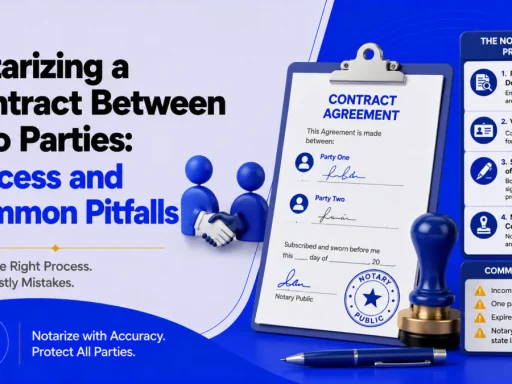
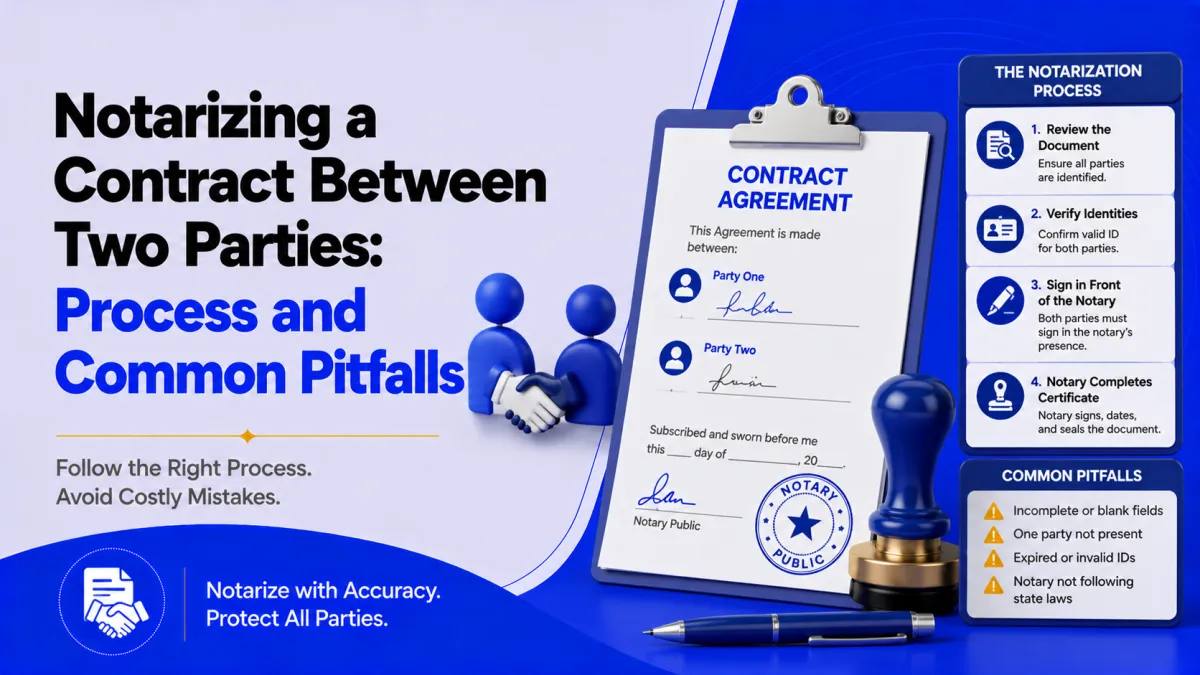

Quick answer: To notarize a contract between two parties, both signers appear before the same notary with valid photo ID, the notary confirms each person’s identity and willingness, watches or takes acknowledgment of their signatures, and completes a notarial certificate with a seal. Most contracts don’t legally require notarization, a properly signed contract is already binding but notarizing it deters fraud and makes it far stronger evidence if the deal is ever disputed.
You and the other party have an agreement drawn up, and someone said “get it notarized.” Before you book a notary, it helps to know what notarizing a contract actually does and, just as important, what it doesn’t. The act of notarizing a contract between two parties confirms who signed and that they signed willingly; it doesn’t bless the terms or rescue a flawed deal.
This guide walks the full two-signer process, shows when notarization is genuinely required, and lays out the pitfalls that quietly invalidate a notarization so your contract holds up if it’s ever challenged.
What “notarizing a contract between two parties” actually means
Notarizing a contract between two parties is the process where a notary public verifies the identity of each signer, confirms they are signing willingly, witnesses or takes acknowledgment of their signatures, and certifies the act with a notarial certificate and seal. The notary is a neutral, impartial witness to the signing event not a reviewer of whether the contract is fair, complete, or enforceable.
That distinction matters because the contents and legal effect of the document are the parties’ responsibility, not the notary’s. If you want the deeper background on what a notarized act certifies, BlueNotary’s complete guide to notary certification breaks it down.
Do you even need to notarize your contract?
For most agreements, no. A contract becomes legally binding when it has a clear offer, acceptance, consideration (something of value exchanged), and parties with the capacity to agree, see Cornell Law School’s definition of a contract. A notary stamp authenticates none of those elements. As FindLaw notes, business and personal contracts are typically enforceable without notarization or witnesses.
That said, some documents do require it, and a handful of contracts benefit from it even when optional:
| Situation | Notarization | Why |
|---|---|---|
| Real estate deeds, mortgages | Required (most states) | Needed to record with the county and to be valid |
| Leases longer than one year | Often required | Recordability and statute-of-frauds reasons |
| Wills, trusts, powers of attorney | Often required / recommended | State formalities; varies — see state rules |
| Contracts used abroad | Required (often + apostille) | Foreign acceptance and authentication |
| Private loans, partnerships, sales, settlements | Optional | Deters fraud; strong evidence if disputed |
For estate documents specifically, see BlueNotary’s guide to notarizing a will by state; for residential agreements, the notarized letter for an apartment explainer is a useful companion.
Why notarize anyway? Credibility, not validity
Even when it’s optional, notarizing a two-party contract has real value: it deters fraud by confirming each signer’s identity, and it makes the document far stronger evidence. If one party later claims “that’s not my signature” or “I never agreed,” a notarized record shows they appeared, were identified, and signed willingly. That evidentiary weight is why notarized documents carry credibility in a dispute, the same reason a sworn statement does, as covered in can an affidavit be used as evidence in court.
What it can’t do: it can’t make an unenforceable contract enforceable, and it can’t fix missing terms. Notarization is a layer of trust on top of a valid contract not a substitute for one.
Step-by-step: how to notarize a two-party contract
Here’s the full process when two signers are involved.
- Finalize the contract completely, no blanks:- Fill in every term, amount, and date before the appointment. A notary will (and should) decline a document with blank spaces or missing pages, which is one of the most common reasons a signing gets turned away. BlueNotary covers this in its common notarization mistakes guide.
- Confirm which notarial certificate the document needs:- Look for an acknowledgment or jurat block. If the contract just needs to confirm who signed, that’s an acknowledgment. If a signer must swear the contents are true, that’s a jurat (more below).
- Gather valid photo ID for every signer:- Each party needs their own unexpired, government-issued photo ID, a driver’s license, state ID, or passport. The name on the ID should match the name on the contract.
- Get all signing parties in front of the same notary:- Both parties should appear together in person or in the same online session. Do not pre-sign at home; the notary must witness or take acknowledgment of each signature.
- Find a qualified, neutral notary:- Use a bank, shipping store, mobile notary, or an online notary. The notary must have no personal stake in the contract. BlueNotary’s guide to places to find a notary near you lists options.
- The notary verifies identity and willingness:- They check each ID, confirm each signer understands they’re signing voluntarily (not under coercion), and that nothing appears incomplete.
- Each party signs as directed, and the notary completes the certificate:- For an acknowledgment, each signer acknowledges the signature; for a jurat, each takes an oath and signs in the notary’s presence. The notary fills in the certificate including the venue line (state and county) signs, and applies the seal.
- Keep the fully notarized original:- Store the original safely and give each party a copy. If you need verified duplicates later, see what a certified copy is.
Acknowledgment vs. jurat: pick the right certificate
This is where notarizations most often go wrong, so it’s worth its own table. The two certificates do different jobs:
| Acknowledgment | Jurat | |
|---|---|---|
| What the signer is doing | Confirming they signed the document | Swearing the contents are true |
| Must the notary watch the signing? | Not necessarily | Yes — sign in front of the notary |
| Is an oath required? | No | Yes |
| Typical use for contracts | Most common | When truthfulness must be sworn |
| What it proves | Who signed | The signer swore the content |
For most two-party contracts, an acknowledgment is correct. Choosing a jurat when an acknowledgment is needed or skipping the oath on a jurat can invalidate the notarization, per the National Notary Association. When unsure, ask the receiving party (court, agency, lender) which certificate they require.
Common pitfalls that void a notarization
Even a valid contract can have a defective notarization. These are the errors that most often cause rejection — or liability:
- The wrong certificate type:- Acknowledgment vs. jurat is the single most common mistake. Match the certificate to what the document and receiving party require.
- An incomplete document:- Blank spaces or missing pages mean the notary must decline. Finalize first.
- Signing before the appointment:- For a jurat especially, signing in advance invalidates the act, the notary must witness it.
- A missing party or mismatched ID:- Both signers must be present and identifiable; an expired ID or a name that doesn’t match stops the signing.
- A missing or wrong venue line:- The certificate must state the correct state and county where the act occurred.
- Using a notary with a stake in the deal:- A notary who is a party to the contract or stands to benefit from it generally cannot notarize it. Use a neutral notary.
- Assuming the stamp makes it binding:- It doesn’t. Make sure the contract itself is complete and valid; the seal only certifies the signing.
A real example: Dana and a business partner signed a partnership agreement, but Dana signed her copy the night before to “save time.” At the appointment the notary couldn’t complete the jurat, because Dana hadn’t signed in the notary’s presence, they had to reprint and re-sign. A two-minute shortcut cost the whole appointment.
Can you notarize a contract online?
Yes. With remote online notarization, both parties can join the same secure video session from different locations, verify their identities, and have the notary complete the certificate electronically, useful when signers aren’t in the same city. The same rules apply: complete document, valid ID, correct certificate, all parties present in the session. If a deal involves extra signers or witnesses, check BlueNotary’s overview of witness requirements for online notarization first.
The bottom line
Notarizing a contract between two parties is straightforward once you know what it’s for: both signers appear with valid ID, the notary confirms identity and willingness, the right certificate is completed, and the seal is applied. Just keep the two truths in view, most contracts are already binding without it, and the notarization only holds up if you avoid the common pitfalls (wrong certificate, incomplete document, signing early, a missing party). Finalize the document, get everyone in front of a neutral notary, and your agreement gains a durable layer of proof. To notarize your contract from anywhere with both parties in one secure session — visit BlueNotary to get started.
Need a two-party contract notarized without coordinating travel? Open a session on BlueNotary and connect both signers with a commissioned online notary in minutes, verify IDs, sign on camera, and download the notarized contract the same day. First time? Read how to use an online notary service to know what each party should have ready.
Frequently Asked Questions
Does a contract have to be notarized to be legal?
Usually no. A contract is legally binding when it has a valid offer, acceptance, consideration, and capable parties, notarization isn’t required for most agreements. Some documents, like real estate deeds and leases over a year, are exceptions that do require it.
Do both parties need to be present to notarize a contract?
Each party whose signature is being notarized must appear before the notary with valid ID. They don’t have to use the same notary, but every signer must personally appear for their own signature, a notary can’t notarize a signature for someone who isn’t present.
Does notarizing a contract make it legally binding?
No. Notarization verifies the identity of the signers and that they signed willingly; it doesn’t validate the contract’s terms or make an unenforceable agreement enforceable. It adds credibility and strong evidence, not legal validity.
What’s the difference between an acknowledgment and a jurat?
An acknowledgment confirms that the signer signed the document and proves who signed. A jurat requires the signer to swear the contents are true and to sign in the notary’s presence after taking an oath. Most contracts use an acknowledgment.
What do you need to bring to notarize a contract?
The complete, unsigned document with no blanks, valid unexpired government-issued photo ID for each signer, and all signing parties. If the document has a specific notarial certificate, make sure it’s the right one for your purpose.
Can a notary notarize a contract they are a party to?
Generally no. A notary who is a party to the contract or has a financial or beneficial interest in it cannot notarize it, because they must remain neutral. Use an impartial notary with no stake in the agreement.
Can you notarize a contract online?
Yes. Remote online notarization lets both parties join a secure video session, verify their identities, and have the notary complete the certificate electronically, convenient when signers are in different locations.
What kinds of contracts must be notarized?
Commonly, real estate deeds and mortgages, leases longer than one year, many estate-planning documents and powers of attorney, and contracts intended for use abroad. Requirements vary by state, so confirm with the receiving party or an attorney.