


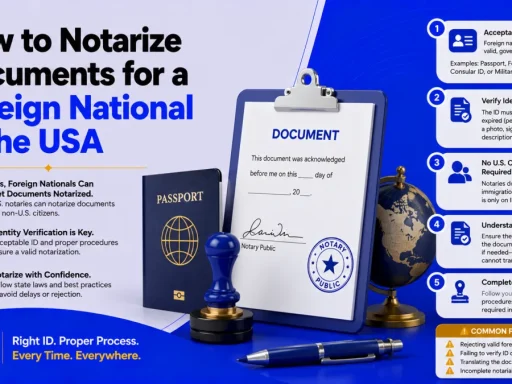
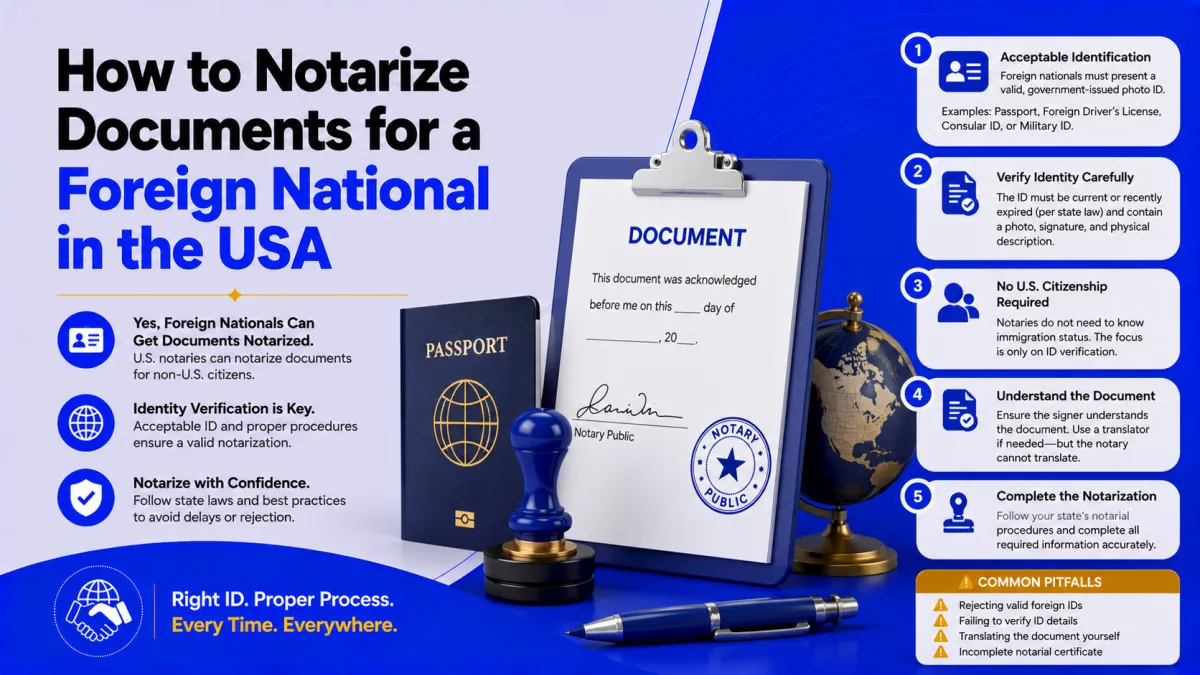

Quick answer: A U.S. notary can notarize documents for a foreign national, citizenship and immigration status don’t matter. What matters is three things: the signer presents satisfactory ID (often a foreign passport, subject to your state’s rules), the notary can communicate directly with the signer in a shared language, and the signer understands what they’re signing. For online notarization, a foreign national without a Social Security number usually can’t pass standard KBA, so a biometric/passport-based check or a credible witness is used instead. Documents headed abroad often also need an apostille.
A foreign student needs a power of attorney for a property sale back home; a visiting investor needs an affidavit; a work-visa holder needs a document for their consulate. In each case the question is the same: can a U.S. notary handle it? Yes. To notarize documents for a foreign national, the notary follows the same core rules as for any signer, the only differences sit in three places: which ID is acceptable, whether the notary and signer share a language, and whether the document will be used overseas.
This guide walks the full process and tackles those three friction points directly, for both in-person and online notarization.
Can a notary notarize for a foreign national? Yes, here’s what governs it
A notary’s job is to verify the identity and willingness of the person signing not their nationality. Immigration or citizenship status has no bearing on whether a document can be notarized. A foreign national signs, is identified, and is notarized exactly like a citizen.
What actually governs the notarization is a short checklist: satisfactory identification, the signer’s physical or virtual presence, the notary’s ability to communicate directly with the signer, and the signer’s understanding that they are signing voluntarily. If all four are met, the notary proceeds. For the foundation of what a notarized act certifies, see BlueNotary’s complete guide to notary certification.
Step-by-step: notarizing for a foreign national
Here’s the process from start to finish.
- Confirm the document is complete:- No blank spaces, no missing pages, a notary must decline an incomplete document. (See common notarization mistakes.)
- Establish a shared language with the signer:- The notary must communicate directly with the signer. If they can’t, the notarization can’t proceed in most states (more below).
- Verify identity with acceptable ID:- Usually a foreign passport but check what your state requires (next section).
- Confirm willingness and understanding:- The signer must appear to understand the document and be signing voluntarily, free of coercion.
- Identify the correct notarial certificate:- Acknowledgment or jurat, depending on the document and the receiving authority’s requirement.
- Witness the signature and complete the certificate:- The signer signs; the notary fills in the certificate (in English), including the venue, and applies the seal.
- Handle cross-border steps if needed:- If the document will be used in another country, plan for an apostille or authentication (final section).
Hurdle 1: which ID can a foreign national use?
This is where most notarizations for foreign nationals slow down. The professional standard, per the National Notary Association, is to accept a government-issued ID bearing the holder’s photograph, signature, and physical description which a foreign passport typically satisfies. But state law varies, so confirm yours:
| State approach | Examples | What it means |
|---|---|---|
| Accepts a properly stamped foreign passport (USCIS stamp) | Florida, Georgia, Nebraska, Tennessee | The passport generally needs an entry/USCIS stamp |
| Accepts a foreign passport without specifying a stamp | Iowa, Mississippi, Montana, North Dakota, Oregon, South Carolina, Utah, West Virginia | A valid foreign passport may be enough |
| Extra specifics required | California, Tennessee | Must include a serial/ID number plus photo, physical description, and signature |
Lists are illustrative, not exhaustive, and rules change. Always confirm with your state, BlueNotary’s guide to who regulates notaries by state shows where. A practical caution: if a passport’s identifying details are written only in a language the notary can’t read and there’s no English within the document, the notary generally shouldn’t rely on it. When no acceptable ID exists at all, many states allow a credible identifying witness regardless of the signer’s citizenship covered in witness requirements for online notarization.
Hurdle 2: the language barrier rule
This trips up well-meaning notaries constantly. The notary must be able to communicate directly with the signer in a language they both understand. Two hard limits follow:
- A notary cannot translate, summarize, or explain the document’s contents. Doing so is the unauthorized practice of law (UPL). The notary verifies the signing, not the meaning of the text.
- Many states prohibit using an interpreter to bridge the gap during a notarial act; some permit it. Where interpreters aren’t allowed, the answer is to refer the signer to a notary who speaks their language.
The Oregon Secretary of State’s guidance on notarizing non-English documents illustrates how seriously states treat this. The overriding rule: never proceed if you doubt the signer understands the document. If in doubt, refuse.
Note the difference between communicating with the signer and reading the document: a notary may notarize a signature on a foreign-language document they can’t read as long as they can communicate directly with the signer and complete an English certificate but they still cannot interpret what the document says.
Hurdle 3: online notarization without a Social Security number
Online notarization is ideal for foreign nationals, especially those who’ve already left the U.S. but there’s a catch. Standard remote online notarization uses knowledge-based authentication (KBA), a quiz built from U.S. credit and public records. A foreign national without a Social Security number or U.S. credit history usually can’t pass it. The workarounds:
| Method | How it verifies identity | Good for |
|---|---|---|
| Standard KBA | Quiz from U.S. credit/public records | Signers with a U.S. credit footprint |
| Biometric / passport-based | Facial match + foreign passport analysis | Foreign nationals without an SSN (Florida permits biometric in lieu of KBA) |
| Credible witness | A person who knows the signer vouches for them | Signers who can’t pass KBA or lack ID |
| Notary’s personal knowledge | Notary already knows the signer | Pre-existing relationships |
The practical path for most foreign nationals is a platform and state that allow biometric/passport verification or a credible witness. Florida’s framework is commonly used for this; see BlueNotary’s guide to becoming an online notary in Florida for why that state comes up so often in international work.
Using the notarized document abroad: apostille and authentication
Most documents a foreign national notarizes in the U.S. are meant for use in another country and a notarization alone often isn’t enough for foreign authorities to accept it. That’s where an apostille or authentication comes in:
- Apostille — for countries in the Hague Apostille Convention, a single certificate (issued by the Secretary of State) authenticates the notary’s authority so the document is recognized abroad. Start with what an apostille is and the apostille process guide.
- Authentication / legalization — for non-Hague countries, a chain of certifications (often through the U.S. Department of State and the destination’s embassy) is required instead. BlueNotary’s explainer on authentication vs. legalization breaks down the difference.
- Which one, and where depends on the destination country confirm with the receiving authority. The apostille vs. notary public and apostille by state guides help you route it, and the expats document-requirements guide covers related cross-border scenarios.
Common pitfalls to avoid
- Refusing based on status:- A foreign national isn’t disqualified by citizenship only by failing the ID, communication, or understanding checks.
- Accepting an unreadable ID:- If you can’t read the passport’s details and there’s no English in it, don’t rely on it.
- Translating or explaining the document:- That’s UPL. Stay in your lane: verify the signing, not the meaning.
- Forcing online KBA on someone with no SSN:- Switch to biometric/passport verification or a credible witness instead of failing the session repeatedly.
- Forgetting the apostille step:- A perfect U.S. notarization can still be rejected abroad without the right authentication.
A real example: Lukas, a German citizen on a short U.S. trip, needed a power of attorney for use in Germany. The notary accepted his German passport, confirmed they could both communicate in English, and completed the acknowledgment, then Lukas obtained an apostille from the Secretary of State so German authorities would accept it. ID, communication, and cross-border step: all three handled.
The bottom line
Notarizing documents for a foreign national is routine once you treat it as three checkpoints rather than an immigration question: accept the right ID for your state, make sure you and the signer share a language (and never translate the document yourself), and use biometric or credible-witness verification when there’s no SSN for online sessions. Then, if the document is headed overseas, add the apostille or authentication step so it’s actually accepted. Handle those, and the foreign national’s document is as valid as any other. To get a document notarized online, including options for signers without a U.S. SSN — visit BlueNotary to start.
A foreign national needing a U.S. notarization from anywhere? Start a session on BlueNotary to verify identity with passport-based options, sign on camera, and download a notarized document, then add an apostille for use abroad. New to it? Read how to use an online notary service and confirm your destination country’s requirements first.
Frequently Asked Questions
Can a notary notarize a document for a non-US citizen?
Yes. Citizenship and immigration status are irrelevant to notarization. A notary can notarize for a foreign national as long as the signer presents acceptable ID, can communicate directly with the notary, and understands what they are signing.
Can a notary accept a foreign passport as ID?
Often, yes. A foreign passport with the holder’s photo, signature, and physical description usually meets the professional standard. But state rules vary: some require a USCIS stamp, and states like California and Tennessee have additional specifics. Confirm your state’s rule.
Can a notary notarize for someone who doesn’t speak English?
Only if the notary and signer can communicate directly in a shared language. A notary cannot translate or explain the document that’s unauthorized practice of law and many states prohibit interpreters. If they can’t communicate, the signer should use a notary who speaks their language.
Can a foreign national use an online notary without a Social Security number?
Often yes, but not through standard KBA, which relies on U.S. credit history. Instead, platforms use biometric/passport-based verification (Florida permits biometric in lieu of KBA) or a credible witness to confirm identity.
Can a notary notarize a document written in a foreign language?
A notary can notarize a signature on a foreign-language document if they can communicate with the signer and complete an English notarial certificate. They cannot translate or interpret the document’s contents.
Does a notarized document for use abroad need an apostille?
Usually. For Hague Convention countries, an apostille from the Secretary of State authenticates the notarization for use abroad. For non-Hague countries, authentication and legalization through the U.S. Department of State and the destination’s embassy are required instead.
What ID can a foreign national use for notarization?
Most commonly a valid foreign passport, and sometimes other government-issued IDs depending on the state. The ID should include a photo, signature, and physical description. When no acceptable ID exists, many states allow a credible identifying witness.
Can a notary use an interpreter?
It depends on the state. Some states allow an interpreter during a notarization; many require the notary to communicate directly with the signer and prohibit interpreters. Check your state’s rules before relying on one.