


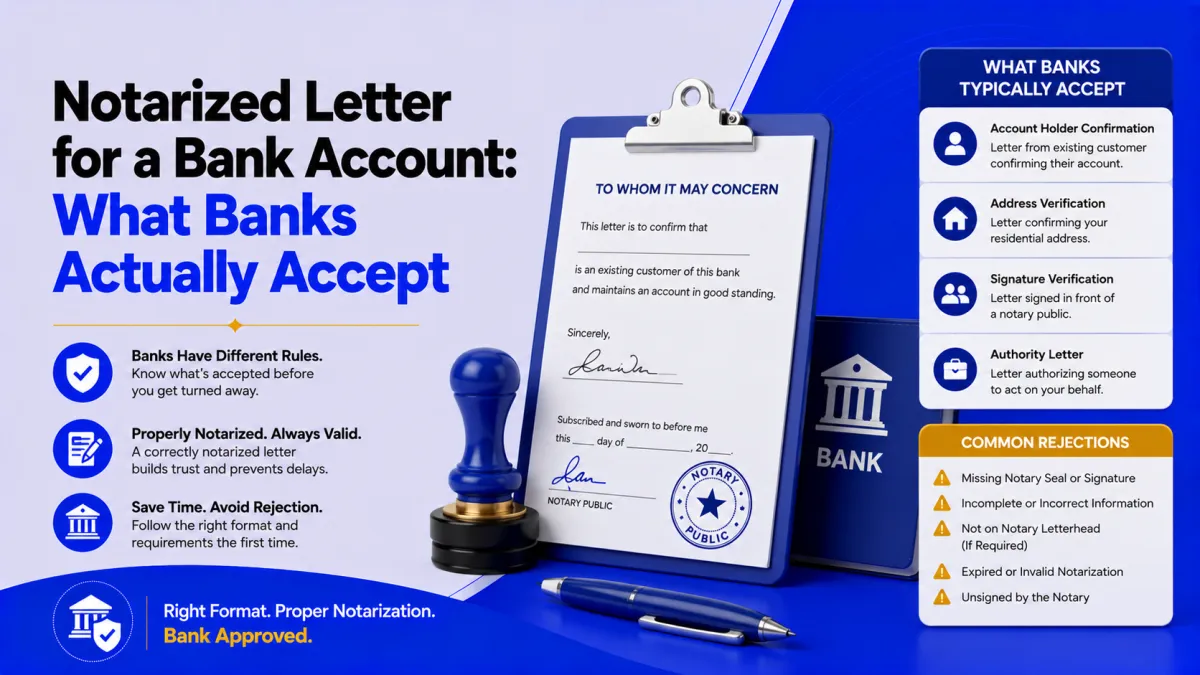

Quick answer: A notarized letter for a bank account is most useful for a one-time, specific authorization (letting someone make a single deposit or pickup) or as proof (proof of funds, address, or a fraud statement). For ongoing access to someone’s account, most banks won’t rely on a generic notarized letter they require their own authorization form or a power of attorney, often on the bank’s own form. Always call the bank first to confirm what they’ll accept.
You need someone to handle something at your bank, a deposit while you’re abroad, proof of funds for a visa, or help for an aging parent and you’ve been told to bring a “notarized letter.” Before you write one, it’s worth knowing the part most templates skip: a notarized letter for a bank account works well for narrow, one-time purposes, but banks frequently won’t accept it as a pass for ongoing account access.
This guide explains what banks actually take, what to put in the letter so it’s honored, and when you need a power of attorney instead.
What a notarized letter for a bank account actually is
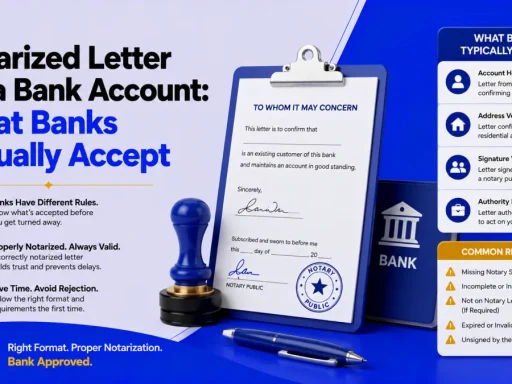
A notarized letter for a bank account is a signed statement, verified by a notary public that either authorizes another person to take a specific banking action on your behalf or attests to a fact about your account. The notary confirms your identity and witnesses your signature, then adds a seal; this doesn’t change the letter’s contents, it just proves you signed it willingly.
In practice these letters fall into two buckets: authorization letters (granting someone limited permission) and bank affidavits/statements (used as proof). For the underlying mechanics of a sworn statement, see BlueNotary’s guide to notarized affidavits, and for what a notarized act certifies in general, the complete guide to notary certification.
The honest part: what banks actually accept
Here’s the expectation-setting most articles avoid. A notarized letter is strong evidence that you made a request but a bank’s willingness to act on it depends entirely on what you’re asking for:
| What you need | Will a notarized letter usually work? | What banks typically accept |
|---|---|---|
| A one-time deposit, pickup, or errand | Often yes | A notarized authorization letter (or the bank’s form) |
| Proof of funds / address / ownership | Yes | A notarized statement or bank affidavit |
| Disputing a fraudulent transaction | Yes | A notarized fraud/identity statement |
| Visa or immigration financial support | Yes (often + apostille) | Notarized proof of funds, authenticated for use abroad |
| Ongoing access to your account | Usually no | The bank’s own authorization form or a power of attorney |
| Acting for an incapacitated person | No | A durable power of attorney (often the bank’s form) |
| A deceased person’s account | No | Death certificate + court letters (executor/administrator) |
The pattern: A notarized letter shines for specific, time-boxed, or evidentiary purposes. The moment you need lasting authority over an account, banks shift to their own process, for good reason, since they bear the fraud liability. As the Consumer Financial Protection Bureau explains, a bank may even require that a power of attorney be on its own form.
Notarized letter vs. bank form vs. power of attorney
Choosing the right instrument saves a wasted trip. Here’s how the three compare:
| Notarized authorization letter | Bank’s own form | Power of attorney (POA) | |
|---|---|---|---|
| Best for | A single, defined action | Adding an authorized user/signer | Broad or ongoing authority |
| Scope | Narrow, one-time | Set by the bank | Wide, durable (can survive incapacity) |
| Accepted for ongoing access? | Usually not | Yes | Yes (sometimes only on the bank’s form) |
| Notarization | Typically | Per bank | Yes, usually + sometimes a witness |
| Can the bank refuse? | Yes, at discretion | n/a | Only in limited cases |
A valid POA generally should be honored but, as Nolo notes, banks can refuse one if they suspect forgery, know it was revoked, or believe the principal is being exploited. If you’ll manage accounts long-term, a POA (ideally reviewed with the bank in advance) is the durable tool; a notarized letter is the quick, narrow one.
What to put in a notarized bank authorization letter
If a notarized letter is the right tool, a vague one gets rejected. Include every element below so the bank can act with confidence:
- Your full details as the account holder — name, address, and account number(s) the letter applies to.
- The authorized person’s identity — full legal name, your relationship to them, and their ID type and number.
- The exact scope of authority — precisely what they may do (e.g., “deposit only,” “pick up a cashier’s check,” “branch transactions only”).
- Limits — a dollar cap if appropriate, and any conditions or exclusions.
- A start and expiry date — e.g., “valid through March 31, 2026.” Open-ended letters are more likely to be refused.
- Your signature, notarized — sign in front of the notary, who verifies your ID and completes the certificate. Don’t sign in advance.
A real example: Aisha was studying overseas and needed her brother to deposit a check into her U.S. account. A notarized letter naming him, the account, “deposit only,” and a 60-day expiry was accepted at the branch because it was specific and time-boxed. Had she asked for open-ended withdrawal rights, the bank would have pointed her to a POA instead.
For a closely related situation, BlueNotary’s notarized letter for an apartment shows the same specificity principle for landlords, and common notarization mistakes covers errors that get any notarized document bounced.
Using a notarized bank letter as proof (funds, address, fraud)
Beyond authorization, banks and third parties often accept a notarized statement as proof:
- Proof of funds or financial support — common for visa and immigration applications. These frequently need to be authenticated for use abroad, so review apostille vs. notary public if the document is going to another country.
- Proof of address or account ownership — a notarized statement can support applications that require it.
- Fraud or identity disputes — a notarized statement that a transaction wasn’t authorized carries weight, similar to an identity affidavit. These also illustrate why notarized documents hold up, see can an affidavit be used as evidence in court.
How and where to get the letter notarized
Once your letter is written and unsigned, you have several options:
- Your own bank:- Many branches have a notary for customers, convenient, since the bank can also tell you on the spot whether the letter meets its requirements.
- A local notary:- Banks, shipping stores, libraries, and mobile notaries all offer the service, see places to find a notary near you.
- An online notary:- With remote online notarization, you can get the letter notarized from home in minutes, useful if you’re abroad or homebound. Bring valid photo ID either way, and don’t sign until the notary is watching.
Whichever you choose, call the bank first to confirm what it will accept. Requirements vary by institution and state, to check your state’s notary rules, see who regulates notaries by state.
The bottom line
A notarized letter for a bank account is the right tool for a narrow, specific job, a one-time errand or a piece of proof like funds, address, or a fraud statement and notarization gives it credibility. What it won’t do is hand someone lasting control of an account; for that, banks lean on their own forms or a power of attorney. Write the letter specifically, give it an expiry date, confirm acceptance with the bank before you sign, and you’ll avoid a wasted trip. When you’re ready to get a bank letter notarized from anywhere, BlueNotary can connect you with a commissioned online notary in minutes.
Need a bank authorization letter or proof statement notarized today? Start a session on BlueNotary to verify your ID, sign on camera, and download a notarized letter the same day, even from overseas. First time? Read how to use an online notary service, then confirm with your bank what it will accept.
Frequently Asked Questions
What is a notarized letter for a bank account?
It’s a signed statement, verified by a notary, that either authorizes someone to take a specific banking action for you or attests to a fact about your account like proof of funds. The notary confirms your identity and witnesses your signature, adding credibility.
Do banks accept a notarized authorization letter?
Often, for a specific one-time action like a single deposit or document pickup. For ongoing account access, most banks won’t rely on a generic notarized letter and instead require their own authorization form or a power of attorney.
Can I authorize someone to access my bank account with a letter?
For a limited, defined task, yes. A notarized authorization letter naming the person, the account, the exact scope, and an expiry date is often accepted. For broad or ongoing access, the bank will usually require its own form or a power of attorney.
Does a bank authorization letter need to be notarized?
Frequently. Notarization verifies your identity and signature, which makes banks more comfortable acting on the letter. Some states may require a witness as well. Confirm your bank’s specific requirement before signing.
Will a bank accept a notarized letter instead of a power of attorney?
Usually not for meaningful or ongoing authority. Banks rely on a power of attorney for that, and may even require it on their own form. A notarized letter is best for narrow, one-time purposes or as proof.
What should a notarized bank authorization letter include?
Your name and account number, the authorized person’s name, relationship, and ID, the exact scope of authority, any dollar limits, a start and expiry date, and your notarized signature. Specific, time-limited letters are far more likely to be accepted.
Can you notarize a bank letter online?
Yes. Remote online notarization lets you verify your identity and sign before a commissioned notary over secure video, which is convenient if you’re abroad or unable to visit a branch. Bring valid photo ID and don’t sign in advance.
Can a bank’s notary notarize my letter?
Yes, many branches offer notary service to customers. It’s convenient because the bank can also confirm whether your letter meets its requirements before you rely on it.